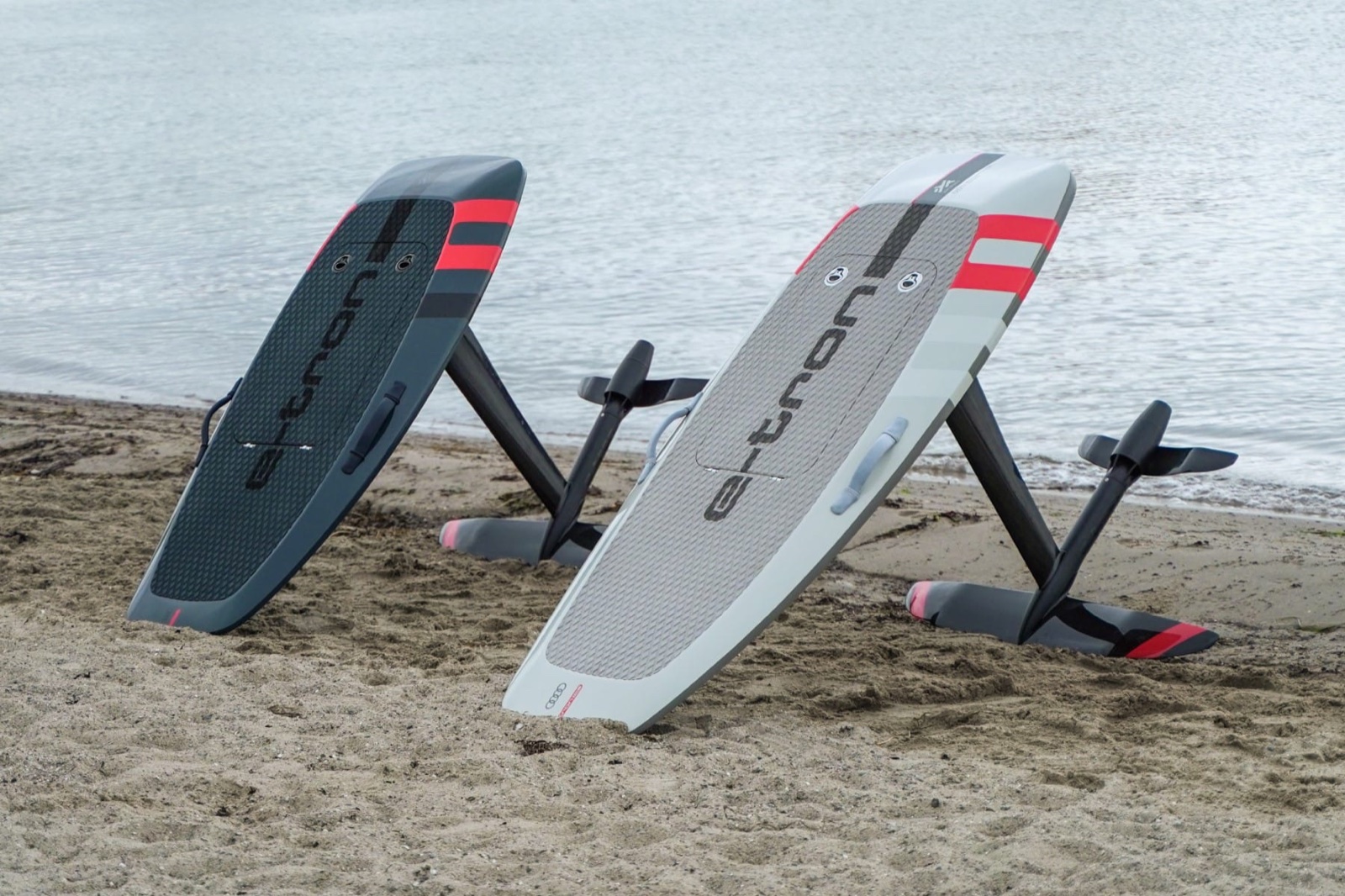
The Aerofoils Audi e-tron eFoil is a German jet-drive electric hydrofoil built by an Audi spin-off in Bavaria. The board is in the same shelf as the Lift5 and the Fliteboard 4, with one clear difference: the propeller is fully shielded inside a jet housing, not open under the foil. That single design choice changes how the board feels to ride and how confident you are in crowded water.
What is the Aerofoils Audi e-tron eFoil?
The Audi e-tron eFoil is a stand-up electric foilboard. The board is carbon-laminated composite with a foam core, the mast is carbon, and the propulsion is a jet drive at the back of the fuselage rather than an exposed propeller. Aerofoils sells it in two sizes: the Adventure at 5 feet 9 inches and 103 liters, and the Performance at 5 feet and 83 liters. The mast is 31.5 inches, which is one of the longest masts in the category and gives you more clearance over chop.
The battery is a 2.23 kWh lithium-ion pack rated by Aerofoils for up to 2 hours of ride time. In practice, most riders see 75 to 95 minutes depending on weight, ride mode, and how much time you spend climbing back up to foil after a fall. The motor pushes the board to 31 mph (50 km/h) top speed, and the board itself weighs about 70 pounds (32 kg) ready to ride.
Control is a wireless thumb-throttle remote with an LED display, paired by Bluetooth to a companion app that handles firmware updates and ride-mode setup. Aerofoils is an Audi AG spin-off, so the design language matches the EV-era Audi look: clean lines, a single hero color stripe, and the four-ring badge on the deck.
What's it like on the water?
The first thing you notice is the absence of a propeller you can kick. If you have ridden an open-prop board, you know the small dance you do in the water when the board is upside down and the remote is somewhere under the surface. On the e-tron foil that worry is gone. The jet shroud means you can grab the rear of the board with your hand and the worst thing that happens is the jet pushes water at you.
We took an Adventure board out of Lake Garda last summer on a glassy morning. Takeoff is a moment slower than on a Lift5 because the jet does not bite as instantly as an open propeller does, but once you are up and trimming, the ride is steady. The board tracks straight. There is no torque pulling the deck one way under acceleration, which is something you feel on every open-prop board even if you have ridden enough to compensate for it. On the e-tron foil you just point and go.
Top speed in our session was 28 mph in Cruise mode. We did not run it flat out, but the published 31 mph is in line with what riders report on the longer Adventure board. Acoustic noise at cruise is low, lower than the Lift5 we rode the week before. That matters when you are passing a quiet anchorage at 6 in the morning. Battery in our session dropped from 100 percent to 18 percent over 78 minutes of mixed riding for a 180-pound rider, which is in the published window.
Falls are uneventful. The remote floats, the jet stops when the magnetic key separates from the remote, and you can swim back to the board without thinking about where the prop is.
Who is the Aerofoils Audi e-tron eFoil for?
The e-tron foil is for the rider who has decided that a shielded jet drive is worth a slight performance trade. Families riding together, instructors running schools, and owners who hand the board to friends will all get more out of the jet than they would out of an open prop. If you have ever had a near-miss with a propeller, or watched a guest panic when they fell off, you understand why the jet exists.
It is also for buyers who care about how the board looks. The Audi design language is not a sticker job. The board, the carry case, the remote, and the app all read as a single product. On a dock full of Lifts and Flites, it is the board people walk over to look at.
It is not the right board if you live a long way from a service partner. Aerofoils has strong coverage in Germany, Austria, Switzerland, and a growing footprint in France, Italy, and Spain. In the US, dealer presence is thin and concentrated in Miami, Newport, and a few California spots. If your nearest authorized service is a flight away, a Fliteboard 4 or a Lift5 will be easier to live with. It is also not the right board if you are chasing the longest range in the segment. The Lift5 with the extended-range battery has a longer ceiling, and Fliteboard's Explore battery does too.
Pricing
A new Adventure or Performance Audi e-tron eFoil set lists at EUR 15,769 including VAT, which is roughly $17,000 to $17,500 depending on the exchange rate and the import path. The Adventure base set starts at EUR 14,269. US pricing through dealers like Voltwatersports lands in the $16,000 to $18,500 window depending on accessories and spare battery options.
The board has been in the market since 2022, so the used pool is still small. Most listings are 2022 and 2023 boards from European sellers, asking EUR 9,500 to EUR 12,000 with low hours. US used boards are rare and tend to ask close to new pricing because of import costs and the limited dealer network. If you are buying used, the bigger questions are battery state of health and whether the seller can transfer the warranty. A 2022 board with an original battery and 40 hours on it is a different proposition than the same board with a replaced battery and documented service.
Year-by-year notes
The board launched in 2022 as a single Audi-collaboration model. The original battery, original jet housing, and the first-generation app shipped together that year. There were small firmware updates through 2023.
2024 is the first inflection year. Aerofoils introduced an updated battery generation with better thermal management and a slightly longer real-world ride time, and the app firmware moved to a more stable build. If you are buying used, a 2024 board is meaningfully easier to live with than a 2022 or 2023.
2025 added the Performance board at 83 liters next to the original Adventure at 103 liters. The smaller board is for lighter or more skilled riders who want quicker turns and a livelier feel. Both sizes share the same battery, mast, and jet drive.
2026 is a refinement year. No major hardware changes, but the app added remote diagnostics and the firmware tuned the low-speed throttle response for new riders. The shipping color palette also expanded.
Cost of ownership
Operating costs on an eFoil are low compared to any combustion craft. There is no fuel, no oil, no winterization in the same sense. The costs to plan for are charging, battery replacement, and the occasional service item.
A full charge uses about 2.5 kWh including charger losses, which is under a dollar at most US electricity rates. The charger is single-phase 110-volt or 220-volt and takes 2.5 to 3.5 hours from empty.
The battery is the cost item that owners need to plan for. Aerofoils rates the pack for 500 to 800 charge cycles before noticeable capacity loss. A replacement pack from Aerofoils is in the EUR 3,500 to EUR 4,500 range depending on the year and the dealer. If you ride 60 to 80 hours a year, you will probably want a new pack somewhere between year 4 and year 6.
Service items are small: jet housing inspection, mast bolt torque check, and remote battery replacement. Aerofoils suggests a yearly checkup at a dealer if you ride often, and dealers charge EUR 200 to EUR 400 for it. Insurance is optional and costs $200 to $500 a year for a $17,000 board through marine insurers like Velos or West Marine.
If you buy a 2024 board for $15,000 and ride 60 hours a year, your five-year total cost of ownership lands in the $7,000 to $10,000 range, mostly the battery replacement.
Best year and spec to buy
The pick is a 2024 or newer Audi e-tron eFoil. The second-generation battery, the matured app firmware, and the cleaner build documentation make it the easier board to live with. The Adventure at 103 liters is the right choice for the majority of riders, including new riders learning takeoffs. The Performance at 83 liters is the choice if you are a confident foiler under 170 pounds who wants a livelier feel.
Buy from a dealer who can hold spare parts and a backup battery. Verify the mast-to-board interface for impact damage and check the jet shroud for nicks. Ask for the app pairing to be reset, and ride the board before you sign anything. A board that has been stored without charging for a long stretch will tell you in the first ride.
We rode a 2024 Adventure with 110 hours on it that the owner had bought new and serviced once. The board felt the same as a new one out of the box. Build quality on these is durable if the owner has rinsed the mast and stored the battery at 50 percent between sessions.
Alternatives
The Lift5 is the closest US-market cross-shop. Lift Foils has the longest dealer footprint in the US, the broadest spare-parts coverage, and a similar carbon build. The propeller is open by default with a Lift Guard shroud as an option. Pricing is in the same window as the e-tron foil.
The Fliteboard 4 is the Australian alternative with a global dealer network and the most-developed app in the category. The open propeller is standard, with a jet drive option that is closer to the Aerofoils approach. Fliteboard has stronger US support than Aerofoils but a slightly different ride feel.
The Waydoo Evo Pro Plus is the value option. It costs roughly half what the e-tron foil costs and gives up build quality, ride feel, and dealer support. For a buyer testing the category before committing to a top-tier board, it is the sensible first step.