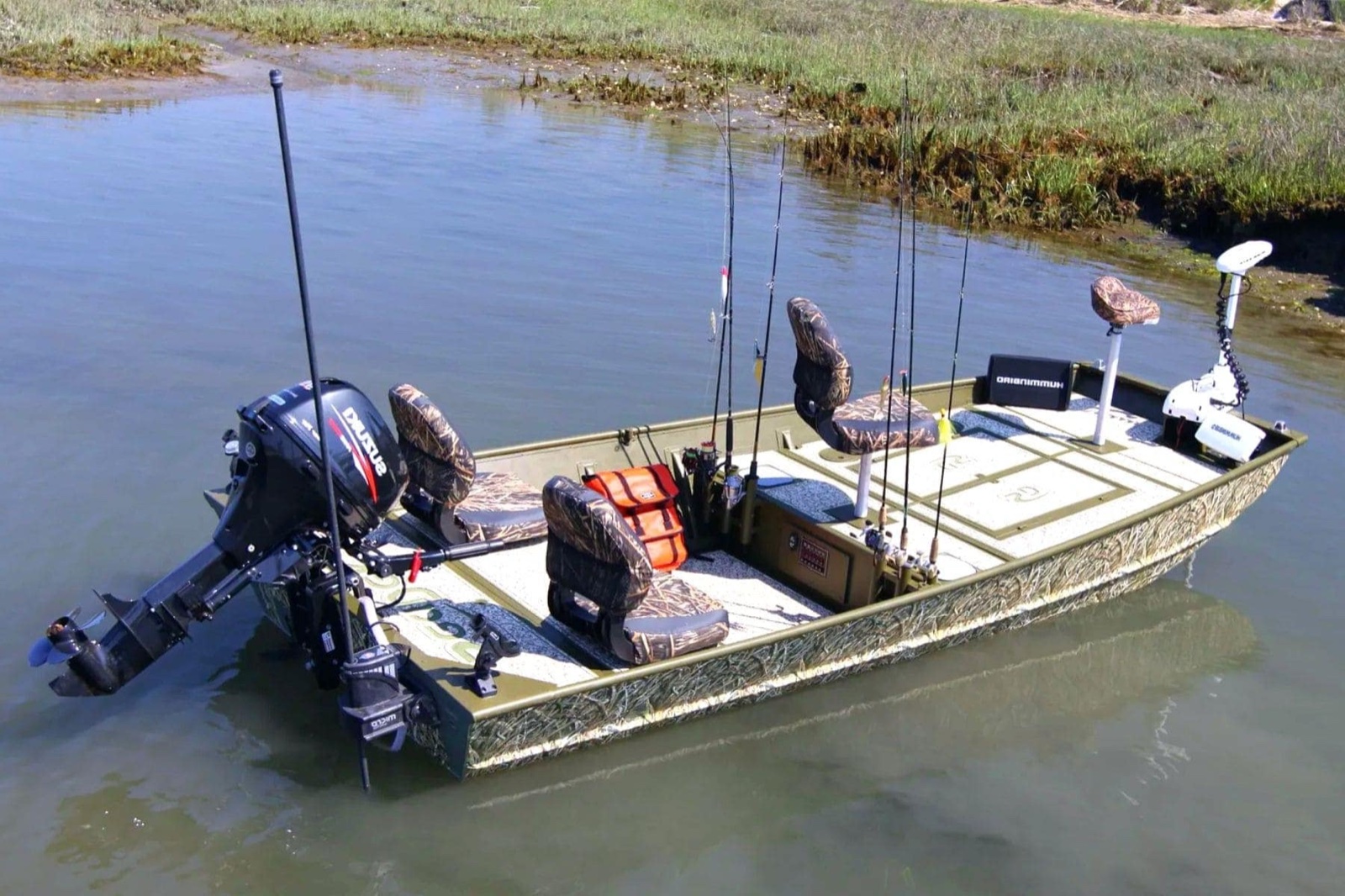
What is the Alumacraft 1448 Jon?
The Alumacraft 1448 Jon is a 14-foot welded-aluminum jon boat with a flat bottom, a 70-inch overall beam (the 48-inch bottom width is what the model name references), a 285-pound hull weight, a 4-person rated capacity, an 885-pound carrying capacity, and a 25 hp maximum outboard rating. The hull aluminum is 0.070 inches thick at the bottom and at the freeboard, which is honest entry-tier gauge for a 14-foot platform. Production ran from 2017 to 2019. Alumacraft discontinued the 1448 line in favor of the MV 1448 (modified-V) and longer Jon variants from 2020 forward. The boat is therefore a used-market-only buy in 2026.
Standard equipment from the factory was minimal: three bench seats (two cross-bench seats forward and a single transom-edge bench), a transom plate sized for a 25 hp outboard, lifting handles, and the painted hull finish. Casting deck, livewell, bilge pump, navigation lights, and trolling-motor mount are aftermarket additions or owner-built work.
Who is it good for?
The right buyer is the cartop or pickup-bed jon-boat household running small water. Pond, slough, slow-river, and creek anglers in the Midwest and the Southeast are the core market. The boat fits in the bed of a full-size pickup with the tailgate down or strapped to a roof rack on a midsize SUV. No trailer is required, no trailer storage is required, and the launch is a two-person carry from the truck to the water. We watched a father and son lift a 1448 off a Ford F-150 at a Tennessee River backwater launch one Saturday morning, slide it down a clay bank, and have lines in the water inside 12 minutes. That is the use case.
Backup-boat households are the second profile. Owners who already have a primary fishing boat and want a small-water craft for the family pond, the duck-hunting slough, or the ranch creek find the 1448 Jon at the right size and the right price. A used 1448 Jon with a small Mercury or Yamaha 9.9 hp outboard and a $400 used trailer puts a complete shallow-water rig under $4,500 today.
Solo and two-angler fishermen running small water are the third profile. The 70-inch overall beam keeps the boat stable for two anglers seated on the cross-benches, and the flat-bottom geometry gives a wider usable deck than a modified-V at the same length.
Who is it not good for?
Buyers who want a complete factory package with the outboard, the trailer, and the standard accessories should look at the Tracker Grizzly 1648 SC or the Lowe Jon 1652 MT. Both ship as turnkey packages. The 1448 Jon was always a hull-only buy, and adding the outboard, the trailer, and the basic accessories takes the buyer's time and effort.
Big-water and large-river owners are wrong-targeted. The 1448 Jon is happy on water under 200 acres or in slow current under 4 knots. Anything larger or faster will overwhelm the 0.070-inch bottom and the 25 hp max rating. A 16 or 17 foot platform with a 30 to 40 hp outboard is the right tool for big-water use.
Households who turn boats over every two to three years will not find strong used-market depreciation. The 1448 Jon's resale price stays firm but the upside is also limited. Entry-tier jons hold value but do not appreciate.
Pricing
Production ran from 2017 to 2019 at an original $1,900 retail price for the hull only. The 1448 Jon is therefore a used-market-only purchase in 2026, with no factory-new units available.
Used pricing on the secondary market is wide. A 2017 to 2019 hull with no documented soft spots, no leaks, and the original transom plate runs $1,400 to $2,200 hull-only on the lower end, and $2,400 to $3,200 hull-only for boats with low hours and clean cosmetics. Used packages with a Mercury or Yamaha 9.9 hp outboard and a single-axle trailer run $2,800 to $5,500 depending on age, condition, and outboard hours.
The value buy is a 2017 to 2019 hull at $1,800 to $2,400 hull-only paired with a used Mercury 9.9 hp outboard for $1,200 to $1,800 and a used utility trailer for $400 to $700. Total package math under $4,500 for a complete shallow-water fishing rig.
Higher used asking prices in the $5,000 to $7,000 band show up occasionally and reflect either heavy aftermarket modification (custom casting decks, trolling-motor installations, electronics packages) or the ambition of the seller. Most are negotiable.
What works
- 14-foot welded-aluminum hull at 285 pounds is portable. The boat fits in a full-size pickup bed or on a roof rack, and a two-person carry from the truck to the water is realistic.
- Flat-bottom hull provides roughly twice the usable deck space of an equivalent modified-V design at the same length, which is a real fishing benefit.
- 70-inch overall beam keeps the boat stable for two anglers seated on the cross-benches. Standing-up casting is workable for a single angler, less stable with two.
- 25 hp maximum outboard rating leaves room to step up from a 9.9 hp tiller to a 15 or 20 hp later in the ownership window.
- Welded-seam construction is genuinely a step up from riveted alternatives at the same price band. No rivet leaks to chase.
What doesn't
- Production discontinued in 2019. Factory-new 2026 units are not available, the buyer is shopping the secondary market.
- 0.070-inch bottom is honest entry-tier and lighter than the 0.080 to 0.100 inch bottoms on the premium jon-boat lines. Rock contact and stump bumps will leave marks faster.
- Hull-only at the entry tier. Outboard, trailer, oars, lifejackets, navigation lights, and basic accessories are all separate buys, which can stretch the package math beyond the initial hull price.
- No casting deck, no livewell, no bilge pump, no rod-holder layout from factory. Owners who want these features build them or pay aftermarket money to add them.
- Flat-bottom hull is calm-water-first by design. Honest 1-foot chop will slap the bottom hard, and the boat is not happy in any cross-wind running over 15 knots. We launched one on a Mississippi Delta backwater into a 12-knot south wind and the bow slap was sharp enough that we cut the morning short and tucked back into the lee of a cypress stand.
Year-by-year notes
2017 hulls are the original 1448 Jon production with the painted hull finish, the three-bench-seat layout, and the 25 hp transom rating. Some early hulls had welds that owner accounts flagged for inspection.
2018 to 2019 hulls carried over the 2017 layout with minor cosmetic refinement. The painted finish and the bench-seat geometry were unchanged.
2020 forward the 1448 Jon was discontinued. Alumacraft transitioned the entry-tier line toward the MV 1448 (modified-V) and the 1232 (12-foot) at the lower end and the 1648 (16-foot) at the upper end. Buyers who want a current-production Alumacraft jon boat in this size band should look at the MV 1448.
Cost of ownership
Operating cost on a 1448 Jon is the lowest in the segment. A 9.9 hp outboard burns 1 to 2 gallons of fuel per typical pond or creek outing, and the annual outboard 100-hour service runs $150 to $300.
Insurance on a $3,000 to $4,500 package runs $80 to $200 a year for liability-and-hull coverage. Storage is usually backyard or a covered shed since the hull and trailer (or just the hull) fit in a standard garage.
Plan a $100 to $250 a year reserve for hull maintenance and small repairs. Painted-finish touch-ups, transom-plate hardware, and seat-bracket inspection are the recurring lines. The welded seams generally do not need any service.
Resale runs roughly 30 to 36 percent over a five-year used-on-used hold. The entry-tier jon-boat market always has demand, which keeps the resale price firm.
Best year and trim to buy
A 2017 to 2019 hull with no documented soft spots in the bottom or the transom corners, the original transom plate in good condition, no obvious weld repair, and a clean painted finish is the value buy. Asking prices in the $1,800 to $2,400 hull-only band are the right zone.
Verify three things before close. First, walk the bottom looking for any visible soft spots, weld discoloration, or repaired punctures. Second, pull the transom plate hardware and check for cracking or hidden corrosion at the upper bolt holes. Third, inspect the welded seams along the keel and the chines for any visible cracking or weld repair work.
For a complete-package buy, target a used 1448 Jon paired with a low-hours Mercury or Yamaha 9.9 hp outboard, a single-axle trailer, oars, lifejackets, and a basic anchor. Total package math under $4,500 puts a complete shallow-water fishing rig on the water.
Alternatives
The Lowe Jon 1652 MT is the 16-foot riveted competitor for buyers who want more length, more capacity, and a current-production package with a turnkey trailer-and-outboard configuration. The Tracker Grizzly 1648 SC is the welded 16-foot competitor at slightly higher money, with a more refined hull layout and a Mercury package that ships from the factory. The Veer V13 by Lund is the 13-foot utility alternative for buyers who want even shorter and lighter for solo cartop carry, with the trade of less length and a different bow geometry.