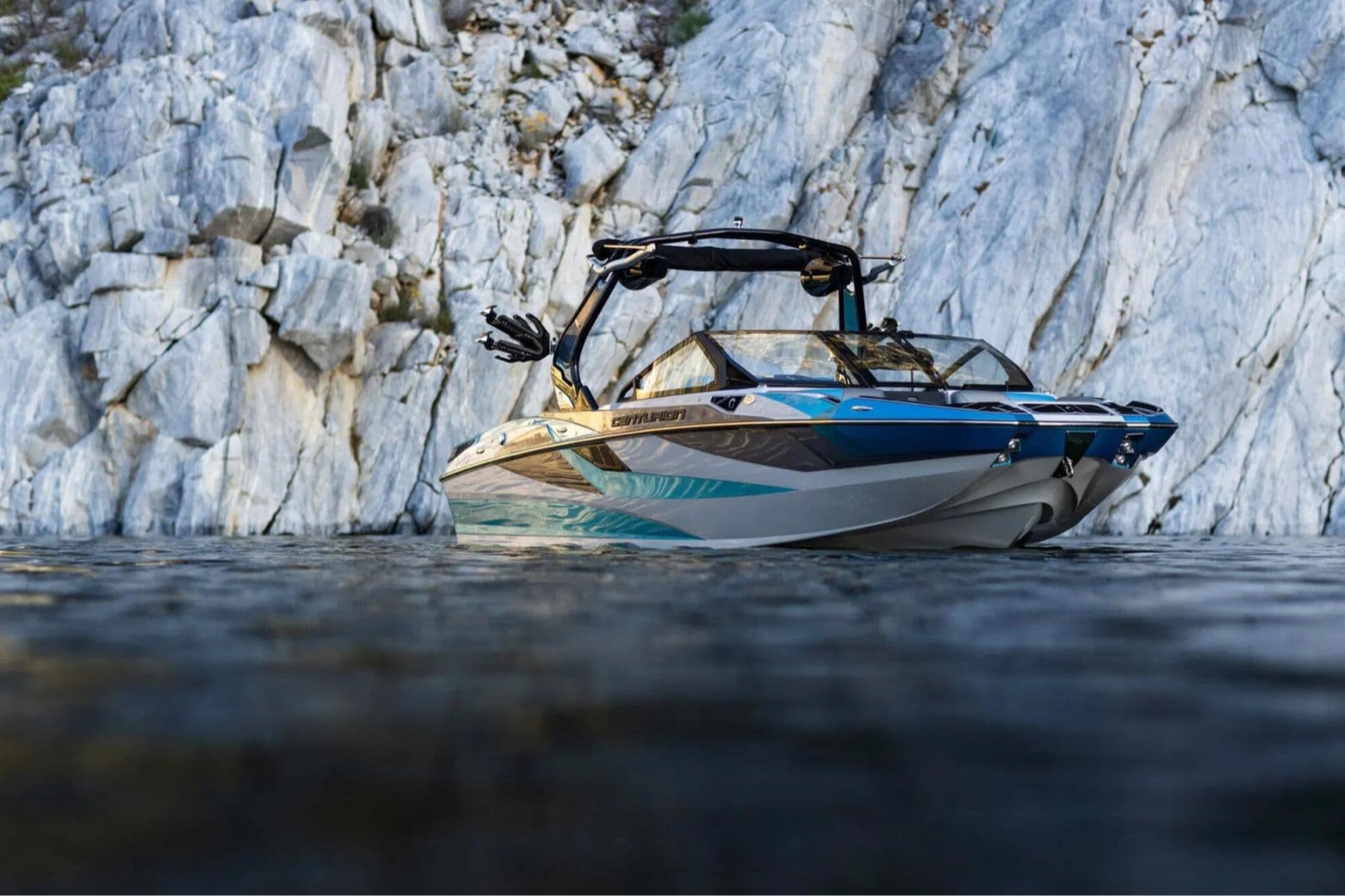
What is the Axis A22?
The Axis A22 is a 21-foot 11-inch V-drive wake boat built by Malibu Boats as the mid-tier brand in the same factory and on the same supply chain as the Malibu Wakesetter line. The hull shares the Wake Plus geometry and the integrated Surf Gate hull-shaping system with the Malibu 22 LSV, the engine ladder spans from the Monsoon M3 (340 hp) up to the Monsoon M5 (410 hp), and the cockpit is rated for 13 occupants. Stock ballast capacity sits at roughly 3,200 to 3,500 pounds depending on year and option load, with a smaller upgrade window than the Malibu sister boat.
The helm display from 2021 forward is the 7-inch Axis touch screen with the Surf Gate, Power Wedge, and ballast controls. The Garmin chartplotter is standard, JL Audio is the volume audio choice, and the powder-coated tower with bimini is the standard tower spec. The boat is freshwater-only by design and engineering, with no SaltShield equivalent in the Axis catalog.
Who is it good for?
The right buyer is the first-time wake-boat household running freshwater lakes for 50 to 150 hours a season. Texas reservoirs, the upper Midwest lakes, the Pacific Northwest sounds (freshwater stretches), and the Tennessee Valley reservoirs are the natural homes. The boat is happy with two riders, a coach, two more in the bow, and the helmsman across a typical Saturday loop. We spent a July afternoon on a 2022 hull on Lake Travis, surf side switching every 20 minutes for a group of six, and the wave shape stayed clean through every shift. The Surf Gate is doing the work.
Cross-shoppers from Malibu who want the Surf Gate experience without the 22 LSV price ceiling are the second core profile. The gap is real but limited: the helm display is smaller, the upholstery grade is a tier below, and the audio is mid-tier rather than premium. The wake and the surf system itself are the same.
Owners stepping up from a bowrider with a surf package are the third profile. The A22 is genuinely a watersports-first boat, with the cockpit layout, the ballast geometry, and the wake control that a wake-equipped bowrider cannot match. Households who have done the bowrider phase and want a serious wake boat without the premium-segment price land here.
Who is it not good for?
Premium-tier buyers cross-shopping the MasterCraft X24, the Nautique G23, or the Malibu 22 LSV should weigh the trade carefully. The Axis hull and surf system are excellent, but the helm experience, the upholstery, and the audio are a step below. Buyers who notice that gap should pay the premium-segment money.
Saltwater coastal owners are wrong-targeted. The V-drive layout, the Surf Gate actuators, and the surf-tab hardware are not engineered for routine salt-water service. Florida intracoastal owners, Pacific Coast saltwater users, and Caribbean households should pick a different platform.
Tournament-level surf households who need 5,500-plus pound ballast and the deepest wake the segment can produce will hit the A22's ballast ceiling fast. The boat tops out at roughly 3,500 to 4,200 pounds of ballast depending on configuration, where the Malibu 23 LSV and the larger Nautique platforms reach 5,500 plus.
Pricing
A 2026 A22 with the Monsoon M3 and a base option list is roughly $120,000 to $135,000 dealer-discounted. The Monsoon M5 upgrade plus a loaded option list (additional ballast, premium audio, surf-platform lighting, the trailer) pushes the build to $145,000 to $155,000. The Axis pricing structure is roughly 60 to 70 percent of the equivalent Malibu 22 LSV configuration.
Used pricing has settled into a wide band that reflects the 2010 to 2022 production window. A 2010 to 2014 hull with 400 to 800 hours is $45,000 to $60,000 depending on engine spec and condition. A 2015 to 2018 hull with the Surf Gate (added across the line in 2014) and lower hours sits in the $60,000 to $78,000 band. A 2019 to 2022 hull with the refined helm electronics and the Monsoon M5 upgrade clears $78,000 and sometimes $92,500 for the loaded configurations. Across the recent listing average the used market sat near $74,750.
The value buy is a 2019 to 2022 hull with the Surf Gate, the Monsoon M5, the Garmin chartplotter, and a documented Malibu-network service history. Asking prices in the $72,000 to $88,000 band match the use case for most first-wake-boat households.
What works
- Surf Gate hull-shaping system is genuinely the same as on the Malibu 22 LSV. The wave shape, the height, and the surf zone all match the Malibu equivalent.
- 21-foot 11-inch length plus a 100-inch beam gives a usable cockpit volume that fits 13 occupants without the layout crowding common at this length.
- Pop-up rear-facing seats are a thoughtful design feature for spotters and coaches running drills with the riders.
- Storage under all seats is more usable than the segment median, with deep lockers under the bow lounge and the rear-facing seats.
- Resale tracks the Malibu sister boat within 5 percent, which is firm for a mid-tier brand.
What doesn't
- Helm display is the 7-inch Axis screen where the Malibu 22 LSV uses the 12-inch Command Center. The buyer notices the difference at the dock and at the helm.
- Upholstery grade, vinyl thickness, and stitching detail sit a tier below the Malibu sister boat. What owners report is faster wear at the high-touch areas (helm seats, rear-facing pop-ups, swim-platform pads). We pulled a 2019 hull onto the trailer at a Lake Powell launch ramp last spring and the helm-seat bolster vinyl already showed clear scuffing at the corner where the driver's left hip rides.
- Surf Gate actuator and reed-switch faults are reported across multiple model years. What comes up across owner accounts includes "surf gate fault retracting right" alerts and reed-switch failures inside the actuator cylinder that are not field-serviceable.
- Tower folding is a 4-screw job and the tower is heavy with the speakers loaded. Owners who trailer often will notice.
- Factory QC has been inconsistent, with surf-system, electrical, ballast, stereo head-unit, and floor-drain issues that dealers have to chase down across the warranty window.
Year-by-year notes
2014 introduced the Surf Gate system on the Axis A22, which is the cutover line every used buyer should know. Pre-2014 hulls have a different surf experience that does not match the post-2014 wave quality.
2018 to 2019 hulls refined the helm electronics, added the Monsoon M5 as a more-common factory upgrade, and updated the cockpit upholstery palette.
2020 to 2022 hulls have the refined Garmin chartplotter, the standard 7-inch Axis helm display, and the more-consistent build profile. Some 2020 to 2022 hulls have Surf Gate, ballast, and stereo issues that owners flagged across the model years.
2023 to 2026 hulls add minor cosmetic refinement, an updated tower-mount design that improves folding ease, and incremental Axis touch-screen firmware updates that address some of the surf-system fault codes from earlier hulls.
Cost of ownership
V-drive operation costs more than an outboard wake-capable boat. Annual oil change, transmission service, shaft-seal inspection, and prop-pocket check at a Malibu-network dealer is $600 to $1,000. The Surf Gate hardware adds an annual inspection line of $200 to $400.
Fuel burn at typical surf speed (10 to 11 mph with full ballast) is roughly 4 to 6 gph. A typical Saturday running 4 hours of surf and 1 hour of cruising uses 25 to 35 gallons of premium fuel.
Insurance on a $80,000 hull is $1,500 to $2,800 a year depending on storage. Dry-stack or covered-slip storage in the wake-belt states (Texas, Arizona, the upper Midwest, the Pacific Northwest) costs $2,500 to $5,500 annually.
Plan a $1,800 to $3,200 a year reserve for routine maintenance plus a Surf Gate actuator inspection at the 500-hour mark and a transmission service at the 1,000-hour mark. Tower hardware, surf-tab hinges, and stereo head-unit firmware updates are the recurring small lines.
Resale tracks the Malibu sister boat within roughly 5 percent over five years. Five-year depreciation on a clean A22 is roughly 28 to 32 percent against a segment median closer to 35 percent for entry-tier wake boats.
Best year and trim to buy
A 2019 to 2022 hull with the Surf Gate, the Monsoon M5, the Garmin chartplotter, the JL Audio mid-tier upgrade, and a documented Malibu-network service history is the value buy. Asking prices in the $72,000 to $88,000 band are the right zone for most first-wake-boat households.
Verify three things before close. First, run the Surf Gate through both wave sides at full ballast and confirm no fault codes, no reed-switch issues, and clean actuator deployment. Second, pull the latest dealer service report and check the transmission and Power Wedge service. Third, walk the upholstery, the helm seat bolster, and the storage compartments for the fit-and-finish lapses noted on a slice of model years.
For 2026-new buyers, the Monsoon M5 with the Garmin chartplotter, the JL Audio mid-tier upgrade, the additional ballast option, and the trailer is the spec that resells best at year 5.
Alternatives
The Malibu 22 LSV is the step up to the same Surf Gate experience with the 12-inch Command Center, premium upholstery, a deeper ballast capacity, and a firmer resale price. The MasterCraft X24 is the premium cross-shop with a different surf-system implementation and a higher build profile for buyers who want a tier above the Malibu-Axis lineage. The Regal LS6 Surf is the bowrider-with-surf-package alternative for households that want a single boat for wake and family duty, with the trade of a less-shaped surf wave and a different cockpit geometry.