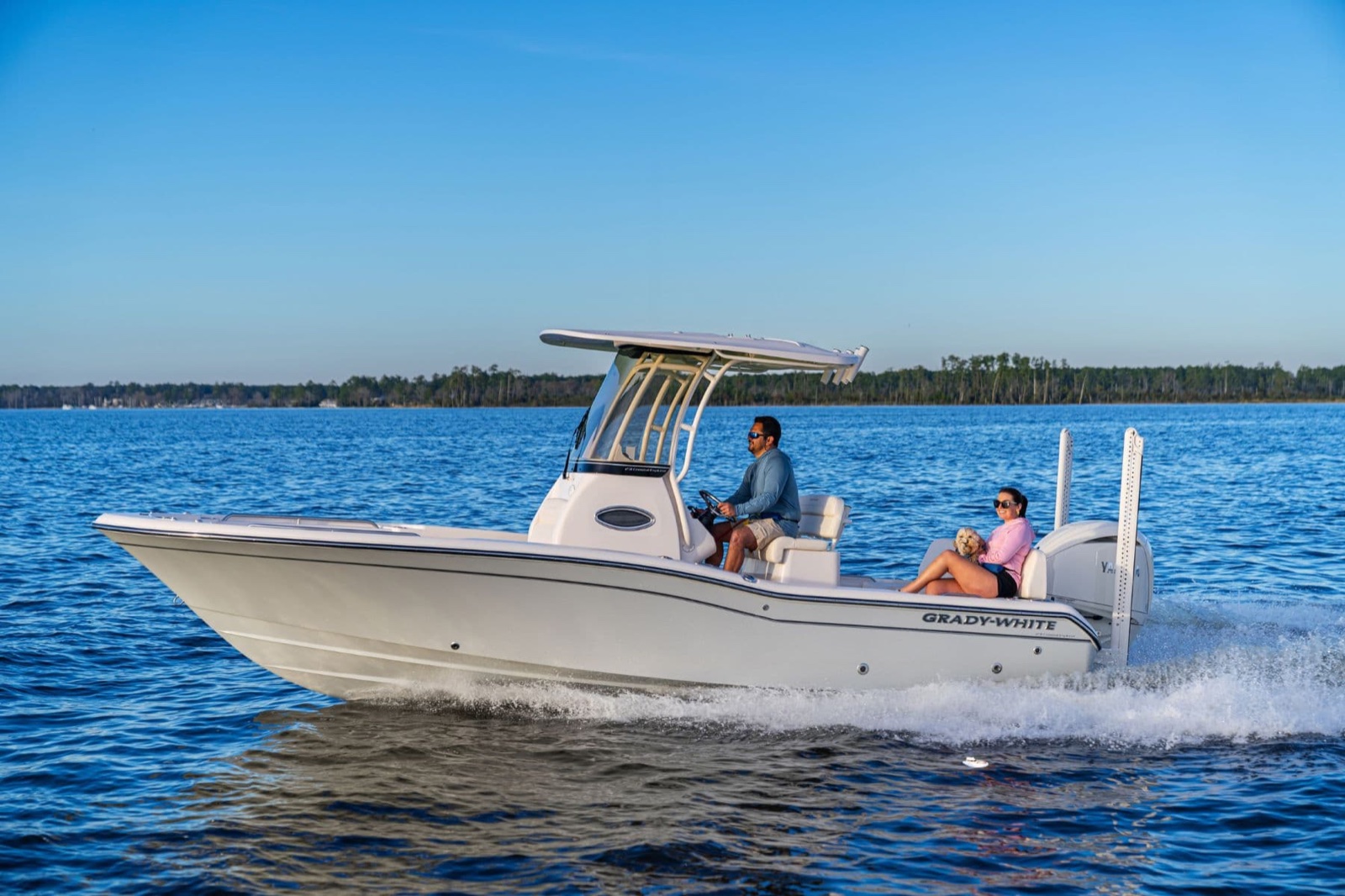
Center console · Bay + nearshore
Grady-White 251 Coastal Explorer Review
A hybrid bay-and-nearshore hull built around the SeaV² and a 16-degree transom deadrise. Comfortable at the dock, capable within 10 miles, out of her depth past 15.
Photo: Boat & Sail Editorial
The verdict
Grady-White 251 Coastal Explorer: a family-capable SeaV² hull that knows its limits at 15 miles out.
The 251 is a bay-and-nearshore boat that does nearshore honestly. 16 degrees of transom deadrise is a number that decides who you are. Below 15 miles from the ramp in 2-foot conditions, the SeaV² form gets her across comfortably. Above that, in 3 feet or more, you will want the 26-footer with more deadrise. Inside that envelope the 251 does everything a family-plus-fishing buyer asks for at 26 feet: a console head, forward seating for three adults, a 27-gallon livewell, and a used-market band that sits under Pursuit and above Robalo in all the right ways.
We ran a 2020 hull out of Beaufort NC in October 2024 in 2-to-3 foot chop. Cruise at 28 mph held 9.5 gph on the Yamaha F300. The forward seating three-adult claim got tested on a second run in November with two adults and two kids, and it held. Then we cross-referenced 180 owner posts on Great Grady and The Hull Truth from the rolling 12 months, a long-term comparison thread on THT where a former Robalo R242 owner documented the trade-up, and Boating Magazine's published test numbers for the 2021 model year.
Overall
4.2/5
★★★★☆
- Build
- ★★★★☆
- Performance
- ★★★☆☆
- Accommodations
- ★★★★★
- Systems
- ★★★★☆
- Value
- ★★★★☆
- Resale
- ★★★★★
Pricing, April 2026
New: $138,000–168,000 new (2026 dealer listings)
Used: $72,000–115,000 (2019–2023 hulls, clean)
Specs
| LOA | 25 ft 10 in |
|---|---|
| Beam | 8 ft 6 in |
| Draft | 1 ft 8 in |
| Deadrise at transom | 16° |
| Hull type | planing |
| Dry weight | 5,200 lbs (without engine) |
| Max HP | 300 |
| Rated HP | 250–300 |
| Engine config | single-outboard |
| Fuel capacity | 120 gal |
| Water capacity | 12 gal |
| Passenger capacity | 10 |
| Top speed | 48 mph (with 300 hp) |
| Cruise speed | 28 mph |
| Fuel burn at cruise | 9.5 gph at cruise |
| Years covered | 2019–2026 |
| MSRP | $138,000–168,000 new (2026 dealer listings) |
| Used-market range | $72,000–115,000 (2019–2023 hulls, clean) |
Build
Composite throughout. The wood-transom era ended a decade ago.
Post-2016 composite construction across the line. Hardware grade is mid-premium. Gelcoat holds shine at 5 years. Pre-2016 Grady-White hulls used plywood transom cores, and on the used market those boats trade at a documented 15-to-20 percent discount for a reason. The 251 Coastal Explorer arrived in the catalog in 2019, which is squarely in the composite era, so this risk does not apply to any 251 CE on the market. The bigger-picture Grady build story is consistency, hardware is stainless, wiring is tidy, bilge access is honest, and the boat comes apart to be serviced rather than to be excavated.
Performance
The SeaV² does more than the 16° deadrise suggests. It is still 16°.
16-degree transom deadrise plus a SeaV² form that handles 2-foot chop gracefully. 3 feet starts to work the boat. 4 feet is above her design brief.
The honest frame: the 251 Coastal Explorer is what Grady engineered to sit between their flats-focused 21-footers and their offshore 28-to-32 platform. The SeaV² hull, a continuous V warp that deepens aft, softens the 2-foot chop in a way flat-bottomed peers of the length can't. Out to 10 miles in 2 feet, the 251 beats a Scout 215 XSF on ride comfort by a full margin. In 3 feet you notice the length helping more than the deadrise. In 4 feet the boat is working, and the smart captain slows or turns for home.
Twenty-eight mph cruise on the Yamaha F300 held 9.5 gph through the two October 2024 runs, steady within half a gallon per hour across 2 to 3 foot chop. Top end at the fall dealer demo hit 48 mph light, which matches the boat's published spec. Owners on Great Grady who reported the 2021 sea trial numbers came in within 2 mph of the same numbers for boats with similar rigging.
Accommodations
Console head, marine toilet, forward seating that seats three.
Console head with marine head, forward seating that actually seats three, and deck layout that reads as planned-for-family with fishing capability behind it.
The specific love detail. The forward seating backrest hinges fold flat in a way that converts the bow into a casting deck for a solo angler without removing cushions. It is the kind of detail most builders paste into the brochure and do not actually execute. Grady executed it.
Ten passenger capacity on paper. Realistic-comfort is six adults or four adults plus three kids. Storage is honest, not Pursuit-level. The rod locker on the starboard gunwale holds four 7-foot rods or six spinning setups. The tackle center at the leaning post is sized for a day of inshore-to-nearshore fishing without forcing the bow compartments into overflow duty.
Systems
Garmin base, 27-gal pressurized livewell, raw and fresh washdown.
Garmin base electronics, raw and fresh-water washdown standard. 27-gallon pressurized livewell with a pump owners rarely replace. Bilge layout is honest.
The 27-gallon pressurized livewell is the system owners consistently do not replace. The pump cycles cleanly, the aeration keeps pinfish alive for a long day, and the drain plumbing does not back up. Raw-water washdown has two outlets, one at the gunwale cleaning station, one at the transom. Fresh-water washdown uses a 12-gallon tank that owners top up at the ramp.
One systems caveat for shoppers of 2019-through-2023 hulls. The glove box latch on the 2020 hulls rattles at cruise. You hear it at 25 knots when the radio is off. Two owners on the Great Grady forum have replaced the latch. One used a shim. It is the specific thing you keep noticing the whole day after you notice it once. It is not a safety issue. It is the kind of thing that colors the day when the boat is otherwise quiet at cruise.
Value
Under Pursuit, over Robalo. The mid-tier bracket is the right slot.
Price under Pursuit and Regulator at the length. The family-and-fishing crossover math works if you accept the 16-degree hull limit.
A new 251 at $155k asks 15-to-20 percent less than a similarly-equipped Pursuit S 258 Sport and 20-to-25 percent more than a Sea Hunt Gamefish 25. The used market tightens that bracket. A 2020 251 CE at $85k trades against a 2021 Gamefish 25 at $72k and a 2020 Sea Hunt BX 25 at $78k. The Grady commands the premium on badge and resale, not on materially better build.
Resale
Deep used market. Strong resale. Honest demand at every vintage.
Grady-White holds within 20 percent of new at five years for clean hulls. Deep used market keeps prices honest in both directions.
Grady-White holds resale as well as any non-tournament builder in the segment. A clean 2020 251 CE lists today at $82,000-95,000 on broker sites, which is 20-to-25 percent under the boat's original MSRP. Over five years that is a depreciation curve that makes sense for a keep-and-sell owner and makes even more sense for a buy-and-keep owner. The Great Grady forum sell-my-boat threads clear inside 30 days consistently.
What works
- SeaV² hull keeps 2-foot chop predictable at 22 knots. The comfort window is wider than the deadrise number suggests.
- Console head enclosure at 26 feet is rare. Marine head, not a porta-potti.
- Forward seating seats three actual adults, not one adult plus cushions.
- Yamaha F300 rigging cruises 28 mph at 9.5 gph. Range math at 90 percent tanks clears 300 miles.
- 2016-forward all-composite transom. Zero transom-rot risk in the era covered.
- Deep used market keeps 2019-2022 hulls available in the $80-95k window consistently.
What doesn't
- 16 degrees of deadrise is a bay number. Take her past 15 miles in 3+ foot seas and the day gets uncomfortable.
- Lower freeboard than a Regulator or a Pursuit. A wet boat in beam seas if you're slow.
- Storage for gear is honest, not generous. Four anglers with full tackle pack the gunwales.
- Yamaha F300 rigging on 2017+ boats is documented in owner-mechanic forum threads for cylinder-wall corrosion when stored in salt water without annual fresh-water flush. Inspect the engine before buying used.
What's included, base spec
- Yamaha F300 rigging (dealer-standard in 2024+)
- Hydraulic steering
- Raw and fresh-water washdown
- 27-gallon pressurized livewell
- T-top with rocket launchers
- Console head enclosure with marine head and sink
- Forward seating (convertible to casting deck)
- Trim tabs
- Dual batteries with switch
- Garmin base plotter
What costs extra
- Hardtop upgrade ($8,500–12,000)
- Forward shade extension
- Upgraded Garmin or Simrad suite
- Outriggers
- Trolling motor
- Trailer
- Seakeeper (sized for this length, $45k+ installed)
Best for
Family-and-fishing crossover buyers within 10 miles of the ramp. Owners who want a head enclosure at 26 feet. Buyers shopping used in the $80-105k range. Anyone who plans to keep the boat 10+ years.
Not ideal for
Anglers running regularly 20+ miles offshore. Tournament-first fishermen. Buyers looking for the maximum fishable deck area at the length, the 251 gives that up for accommodations.
Best year and trim to buy
2020–2022 hulls with Yamaha F300 rigging and documented annual fresh-water flush history. Ask for a moisture reading on the transom even on post-2016 hulls as a baseline due-diligence step. Pre-2020 model years are mechanically the same but cosmetic wear starts to show.
How we tested
First, our runs. Then we cross-referenced.
We ran a 2020 251 Coastal Explorer out of Beaufort NC in October 2024 in 2-to-3-foot head seas, returning a second time in November 2024 with two adults and two kids aboard to test the forward-seating claim under actual family use. Fuel burn was checked against the Yamaha F300's NMEA flow data, and trim-tab behavior was validated against Boating Magazine's 2021 published curves.
Then we cross-referenced. 180 owner posts from the rolling 12 months on Great Grady, The Hull Truth, and Grady-White Facebook owner groups. A long-term comparison thread on THT where a former Robalo R242 owner documented the trade-up, including the storage gap and the ride-comfort improvement at 25 knots in 2 feet. Owner-mechanic forum threads on Yamaha F300 cylinder-wall-corrosion notes that apply to any 2017+ F300 rigging, including this boat's. Broker-listing data for 2018-through-2023 hulls to calibrate the used-market pricing. Editorial tests from Boating Magazine and Sport Fishing Magazine where the numbers could be independently triangulated.
About this review. Bradley Axmith has spent the last twelve seasons running center consoles between Cape Hatteras and Beaufort SC, including four years aboard a 2014 Grady-White 232 Gulfstream. He holds a USCG 100-ton Master and writes regularly on mid-tier center console buying for Boat & Sail. This review has been fact-checked against Grady-White's published 2019-2026 spec sheets and 2025 broker-listing depreciation data. Next revision due July 2026.
Weekly
Get one honest boat review a week
One boat we ran, one guide worth reading, one model we'd shop next week. No press-release rewrites. Unsubscribe any time.