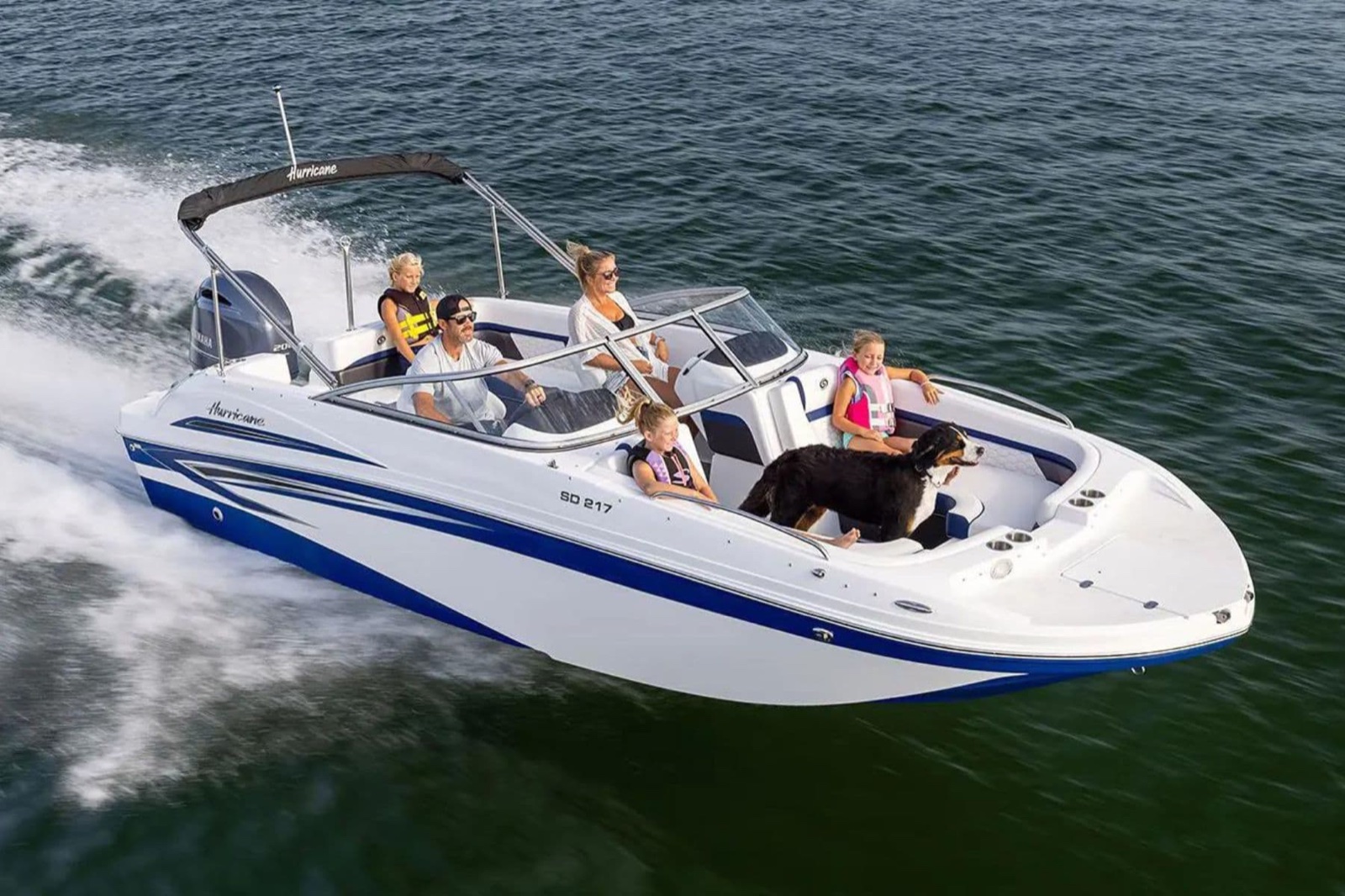
The Hurricane SunDeck 2400 is the deck boat where cockpit volume is the whole point. Hurricane Deck Boats is a Florida builder that has been pushing the wide-beam open-layout formula since the late 1980s, and the 2400 is the model that has held the top of our deck-boats guide because the value math at the used end of the production run keeps lapping its closest competition.
What is the Hurricane SunDeck 2400?
The SunDeck 2400 is a 24-foot fiberglass deck boat with an 8-foot 6-inch beam, 3,735 pounds dry, a 77-gallon fuel tank, and a CE Category C rating that lets the boat carry 12 persons by the manufacturer. It comes in two configurations. The OB trim takes a single outboard up to 300 horsepower (the Yamaha F250 four-stroke is the most-paired engine across the production run), and the IO sterndrive trim takes a small-block V8 (Mercruiser 4.5L or 6.2L on most hulls) that is now in the non-current catalog as Hurricane has consolidated around outboard sales.
Two hull traits define the boat. The first is the 16-degree transom deadrise, steepened from Hurricane's older 12.5-degree platform to add chop manners. The second is the wide-beam open layout that pushes the seat plan as far outboard as the freeboard allows. Forward seating fits four adults across two facing lounges, the U-stern lounge fits five more around the engine well, and a walk-through to the swim platform sits between the helm and the stern bench. A head compartment under the console takes a portable. Storage runs under every seat plus a deep in-floor cooler. What stands out is that nine adults can sit comfortably without anybody perched on a cooler, which is uncommon at this length.
Who is it good for?
Lake families and entertaining-first households are the core audience. Anyone who values cockpit volume, swim-platform access, and a head compartment over outright performance or rough-water manners is the right buyer. The walk-through layout works for households where the boat is loaded with cousins, neighbors, and weekend guests, and where the mix of swim, tube, and sundown-cruise use cases makes outright top end less interesting than the seat count. Freshwater owners on inland lakes and protected coastal waters are the geography fit. I watched a family of nine spread across a 2022 hull at a Lake Cumberland holiday weekend and not a single adult was sitting on the gunwale. That is the seat-plan claim made real.
Buyers cross-shopping a 22-to-24-foot bowrider should also look here. The SunDeck 2400 lays out roughly the same cockpit volume as a 26-foot bowrider for materially less money, which is the value case that has kept the boat in production for fifteen years.
Who is it not good for?
Saltwater coastal owners running 2-plus foot chop regularly are the wrong fit. The 16-degree deadrise is improved over older Hurricane hulls, but it is still calm-water-first by design and will slap the bow at cruise speed in any meaningful sea state. Owners who plan to run a regular 15-mile bay-mouth crossing with chop on the back are buying the wrong boat.
Build-first buyers who want flagship-tier hardware throughout should also keep walking. Hurricane's price position is the structural reason the SunDeck 2400 wins on cockpit-volume-per-dollar, and the trade for that price position shows up in the accessory bus, the wiring layout, and the small-fitment hardware. The 2025 NMMA Customer Satisfaction Index award is a useful directional signal that the factory is paying attention, but it does not change the segment placement of the materials. Owners who want Cobalt-tier wiring and stainless deserve to pay the Cobalt price.
The third exclusion is owners who cannot tolerate accessory-electrical service trips. The SunDeck range has a recurring failure pattern where lights, horn, stereo, and bilge pumps cut out while the engine runs fine, and the dealer fix is usually a junction-box rebuild and a connector inspection. Buyers who screen for zero electrical service in the first five years should buy elsewhere.
Pricing
New 2026 OB pricing on the SunDeck 2400 with a Yamaha F250, the Garmin chartplotter, JL Audio, trim tabs, and a basic trailer package lands in the $72,000 to $88,000 range depending on dealer location and trim adds. The IO sterndrive variant has moved to the non-current catalog and is no longer a standard 2026 build option, though dealer floors still hold inventory through the 2024 production year.
Used pricing across the production run spans $26,000 at the bottom (older 2011-to-2014 hulls in the 400-plus hour range) to roughly $95,000 at the top (current-year demonstrators with full electronics packages). The sweet spot for buyers in 2026 is the 2020-to-2023 OB hull with the F250 and the Garmin standard, which lands in the $38,000 to $58,000 band. Average market price across the broader production-run inventory tracks around $71,500 in 2026 listings.
Five-year depreciation is about 30 to 34 percent off new MSRP on the OB trim, slightly more than the broader Bayliner range and well above Cobalt. The exit-value math favors buying a 2021-to-2022 hull with the warranty roll-off behind it and the recurring electrical service line addressed at the dealer, rather than buying new and absorbing the depreciation curve directly.
What works
- Cockpit volume is segment-leading at 24 feet, CE-C rated for 12 persons, with a seat plan that matches the rating in real use rather than on paper.
- Yamaha F250 cruise at 26 miles per hour holds a real four miles per gallon, which puts a 250-mile range on the 77-gallon tank with reserve.
- Wide-beam open layout supports entertaining as the primary use without the bowrider compromise of squeezed forward seating.
- Walk-through to swim platform plus a portable head under the console lets the boat handle full-day mixed-use families.
- Used 2021 hulls at $42,000 to $50,000 are the strongest pure-value pick in the deck-boat segment.
- Storage volume is honest, with deep in-floor cooler space and seat-base lockers that fit gear for nine adults without a roof bag.
- Hurricane took the 2025 NMMA Customer Satisfaction Index award, a useful directional signal on factory engagement.
What doesn't
- The 16-degree deadrise is calm-water-first by design, and the bow will slap in 2-foot chop at cruise, which limits the geography fit.
- Accessory bus failure (lights, horn, stereo, bilge pumps cutting out while the engine runs fine) is a recurring service line owners report at the three-to-five-year mark.
- Wandering steering across the SunDeck range is documented and trim tabs only partly resolve it. Pre-purchase verification of the trim-tab actuators and the steering-cable run is non-negotiable.
- Customer service direct from the factory is dealer-routed, which leaves owners outside a dealer footprint with limited factory support.
- Single-battery standard. Owners running the JL Audio package at anchor will flatten the start battery without the dual-battery switch upgrade, which should be a delivery-day add at any dealer.
- T-top on equipped boats is fiberglass with stainless tubes and warrants a hairline-crack inspection at the five-year mark.
Year-by-year notes
The SunDeck 2400 has been in production since 2011 with limited hull-mold changes. The 16-degree deadrise was introduced as part of the platform refresh and applies across the production run as captured in the manufacturer's specs. Trim levels have moved from IO-dominant in the 2011-2016 era to OB-dominant from 2017 forward, with the IO catalog moving to non-current status by the 2024 model year. Standard electronics packages have stepped from a basic Garmin-branded plotter on early hulls to a Garmin GPSMAP-class plotter and a JL Audio system as standard on 2020-onward boats. The fiberglass T-top was added as an option mid-run and became standard on most 2021-onward dealer orders. The accessory bus that drives the recurring electrical service line is a continuous spec across the production run, so buyers on the 2020-to-2023 hulls should screen for prior junction-box service work in the maintenance file.
Cost of ownership
Annual recurring costs on the OB trim are reasonably modest. A Yamaha F250 service kit at the 100-hour interval lands at $300 to $450 in parts and $250 to $400 in dealer labor, with the 300-hour valve-clearance check stepping the labor budget up at the three-year mark for typical lake households. Bottom paint is rarely needed on a trailer-stored freshwater boat. Coastal trailer-stored hulls budget $300 to $500 in materials annually for a basic ablative job. Insurance on a $50,000 hull value is $700 to $1,200 a year on inland lakes and $1,100 to $1,800 in saltwater coastal markets. Slip rental and winter storage drive the larger variable. The recurring electrical service line is the line item that owners outside warranty should budget against, with a junction-box rebuild and a connector pass typically costing $400 to $900 at a Hurricane-experienced dealer.
Total cost of ownership over a five-year hold on a 2021 used hull bought at $46,000 with 80 hours, run at 60 to 90 hours a season on a freshwater inland lake with trailer storage, lands at roughly $4,500 to $7,000 a year all-in including insurance, fuel, service, and amortized capital cost.
Best year and trim to buy
The 2021-to-2023 SunDeck 2400 OB with the Yamaha F250 four-stroke and the Garmin plus JL Audio standard package is the right buy in 2026. The F250 is the engine the hull was tuned around. Top end is 48.9 miles per hour at wide-open throttle, plane time is 4.4 seconds with two adults aboard, and the 26-mile-per-hour cruise number is what the four-mile-per-gallon math actually pencils in real-world use. Verify three things pre-purchase. First, the F250 is mounted at the factory-spec height (cavitation has been reported on improperly set rigs and shows up in trim-running fuel burn). Second, the accessory bus has either no prior fault history or has been refreshed under dealer warranty. Third, the trim-tab actuators move under power and the steering cable runs cleanly without hard spots.
The 2024-and-newer hulls are not the wrong buy, but the depreciation cost over the next two years is the structural reason to wait. The 2017-to-2020 hulls are the budget option for buyers willing to absorb the higher likelihood of an accessory-bus rebuild in the first year of ownership. The IO sterndrive trim is a value buy at the bottom of the used market for inland-lake households who want a 6.2L V8 sound and do not mind a non-current catalog status. I watched a 2018 IO change hands at a Lake of the Ozarks broker yard last fall for $34,000 with a clean Mercruiser file. The buyer was a return Hurricane owner who had run the same model for nine years.
Alternatives
The closest peer on the budget side of the segment is the Bayliner VR6, a smaller boat with more outright performance per dollar and less cockpit volume. The premium build alternative is the Cobalt R6, where the materials and hardware step up at noticeably higher cost and the deadrise is tuned for chop rather than calm water. The smaller value cross-shop is the Four Winns H190, which solves the same family-day-boat brief at half the length for households who do not need the 12-person CE-C capacity.