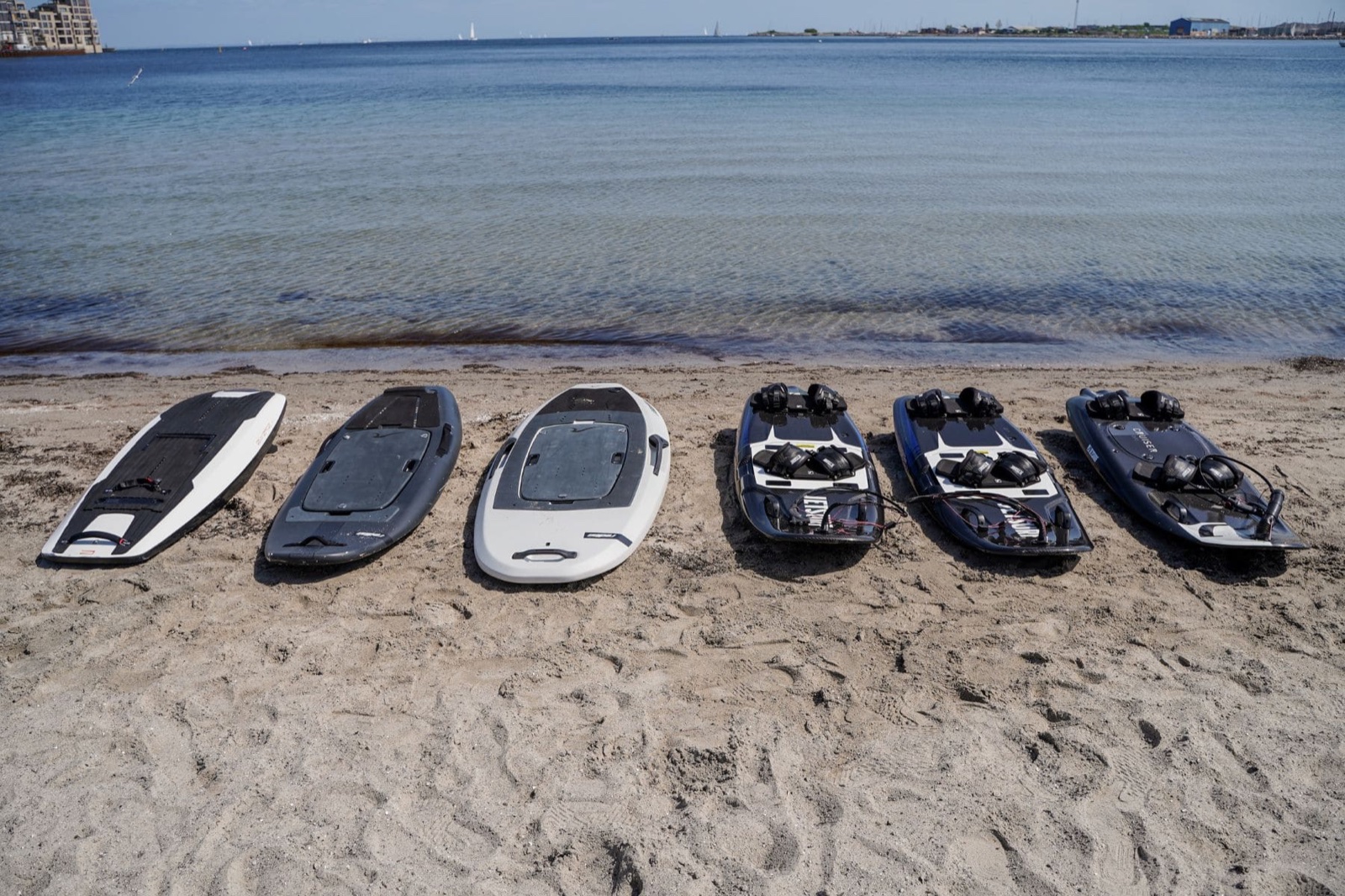
The Lampuga Air is the only credible inflatable electric jetboard on the market in 2026. Lampuga, a German builder based in the Stuttgart area, has been making electric water toys since the early 2010s and built the Air as the answer to the question every traveling rider eventually asks. Where do you put a rigid carbon jetboard when you do not have a garage. The Air packs into a roller bag the size of a large suitcase with the battery out, and that single design decision opens the segment to a buyer who cannot make a 5-foot-9 carbon board work in their life.
What is the Lampuga Air?
The Air is an 8-foot 2-inch drop-stitch inflatable jetboard. Width is 2 feet 4 inches. Inflated thickness is 6 inches. Volume is roughly 110 liters, which is the segment-leading stability number for the inflatable category. The hull is drop-stitch construction (the same fabric-and-internal-thread technique used in high-pressure SUP boards), reinforced with PVC rails and a sealed insert on the underside that takes the impeller drive.
The drivetrain is a jet-impeller setup, not a foil. Water comes in through the intake under the rear of the board, runs through the impeller, and exits at the tail. A 1.2 kWh lithium battery sits in a sealed compartment forward of the rider position. Top speed is 38 to 42 km/h. Ride time on a single battery is about 30 minutes at cruise, less at full throttle. The controller is a Bluetooth-paired waterproof handheld trigger that talks to the board through a sealed receiver in the deck.
The pack-down is the headline feature. Deflated, the board rolls up to roughly 32 by 18 by 14 inches. Add the battery in its own carry case (the battery cannot go in checked baggage on a commercial flight because of lithium restrictions, so the battery ships separately or travels with you on private aircraft) and a hand pump or 12-volt pump, and the whole kit fits in the trunk of a normal sedan or in checked baggage on a commercial flight if the battery is shipped ahead. That is the trade the buyer is making, and for the right buyer, it is the only viable option.
Who is it good for?
Travelers who fly with the board are the core buyer. I packed and unpacked the Air at a beachfront rental on Lake Pleasant outside Phoenix in early spring, and the cycle from car-trunk to inflated-and-ready-to-launch was under 15 minutes with an electric pump. That is the experience that sells the Air. The board lives in the trunk between sessions, the battery lives in the room, and the setup involves no roof rack, no truck, and no garage.
Apartment dwellers and city renters who cannot store a rigid carbon board are the second profile. Awake Ravik 3 and Jetsurf carbon boards are 5-foot-9 to 6-foot rigid hulls that need wall hooks, a closet corner, or a storage unit. The Air folds onto a shelf. For a buyer in a 600-square-foot apartment who wants to ride twice a week in summer, the storage math is the whole decision.
Yacht owners and motoryacht crews wanting a deflatable tender toy are the third buyer. A 60-foot motoryacht with limited foredeck stowage cannot carry a quiver of rigid jetboards, but it can carry three Air kits in a single lazarette locker. The boards inflate dockside or off the swim platform, the batteries charge off the boat's house system overnight, and the whole kit stows back down before the next leg.
Who is it not good for?
Sport riders chasing 50-plus km/h should walk past the Air to the Awake Ravik 3 or the Jetsurf carbon boards. The Air's 42 km/h top end is the inflatable's structural ceiling, not a tuning choice. The drop-stitch hull cannot transmit the kind of edge pressure that a carbon board takes at 55 km/h, and the ride flexes at the limit.
Daily riders running multiple sessions a day are the second exclusion. There is no swap-battery workflow that Lampuga supports as a first-party accessory. Owners who want back-to-back sessions either buy a second board or wait through a 90-minute charge cycle between rides. The rigid premium boards in the segment all support fast-swap battery packs as a workflow.
Buyers who expect their water-toy purchases to hold strong resale should also walk past. The inflatable jetboard segment is new, the used market is thin, and resale on a 2024 Air after three seasons lands roughly 35 to 45 percent under MSRP. A used Awake or Jetsurf at the same age holds 20 to 30 percent under MSRP. The travel-and-storage trade is real money on the exit too.
Pricing
The 2026 Lampuga Air starts at roughly $11,990 for the base kit (board, battery, controller, charger, hand pump, carry bag) and climbs to $14,490 for the package that adds the spare fin set, the electric pump, and the premium roller bag. European pricing trends slightly higher at full euro retail. North American dealer pricing is concentrated in coastal markets and Lake Tahoe-area dealers; landlocked buyers usually order direct.
The used market spans roughly $7,500 to $10,800 for 2022 to 2024 boards in good cosmetic condition with the original battery showing 70-plus percent capacity. The battery is the variable. A used Air with a degraded battery is worth $2,500 to $4,000 less than the same board with a healthy one, and the OEM battery replacement runs about $2,800 to $3,400 at current pricing.
Depreciation in the first three years runs roughly 30 to 45 percent of MSRP. That is steeper than the carbon-board competition and reflects the newer market, thinner buyer pool, and battery-cycle uncertainty. Buyers planning a 5-plus-year hold absorb that curve. Buyers planning to flip in two to three years should consider the difference part of the cost of the storage and travel features.
What works
- The only credible inflatable electric jetboard in the segment. Packs to checked-bag size with the battery out.
- 110-liter volume is the segment-leading stability number for an inflatable. Learners stand up faster.
- Sealed impeller-plate insert and reinforced rails are the inflatable construction leaders.
- 30 minutes of cruise on the 1.2 kWh battery is honest for the form factor.
- Entry pricing around $12,000 brings electric jetboarding to apartment dwellers and travelers.
- Soft drop-stitch deck is forgiving on shins and knees compared to a rigid carbon hull.
- Setup and pack-down cycle under 15 minutes with an electric pump.
What does not
- 42 km/h top end is roughly 14 km/h below the Awake Ravik 3.
- No first-party swap-battery workflow. Sessions are limited to single-charge runs.
- Resale lags rigid carbon boards by 15 to 25 percent over a three-year hold.
- Inflation and deflation cycle adds 8 to 12 minutes to every session.
- Service network outside Europe is thinner than Awake or Jetsurf, with most US repairs going back to the German factory.
- Battery air-travel restrictions mean the battery ships separately or travels only on private aircraft.
Year-by-year notes
The Air launched in 2021 and saw refinements in 2022 (reinforced rail), 2023 (updated battery management for cycle life), and 2024 (improved sealing on the impeller-plate insert). The 2025 and 2026 boards are essentially the 2024 platform with cosmetic updates and a slightly larger controller. There are no defect-screen years to avoid, but the pre-2023 battery management is the meaningful version difference. Buyers shopping used should prefer a 2024 or 2025 board over a 2022 board even if the 2022 looks cosmetically newer, because the battery-management improvements compound over the pack's life.
Cost of ownership
Operating costs are modest. Annual recurring lines include occasional pump-seal kits, a fin set every two to three years, and the battery cycle math. A healthy battery is rated for roughly 500 full cycles before falling below 80 percent capacity. A rider doing two sessions a week through a six-month season uses roughly 100 cycles a year, putting battery replacement in the year-five window.
Charging at home is about $0.30 per session at typical US residential rates. Apartment chargers and yacht house systems handle the charger draw without issue. The board itself has no maintenance schedule beyond rinsing after saltwater use and storing the deflated bag in a dry indoor space. Insurance is not standard for water toys at this price; some homeowners' policies will rider it for $80 to $150 a year.
Best year and trim to buy
The 2024 or 2025 Lampuga Air with the current battery management, the reinforced rail, the sealed impeller-plate insert, and the electric pump in the package is the right buy in 2026. New, that is a $13,000 to $14,500 purchase. Used in good condition with 70-plus percent battery health is $9,000 to $10,800. Verify the battery on a recent full-charge cycle, confirm the impeller plate has no seam separation, and check the controller pairs cleanly with the board on the first attempt.
Alternatives
The rigid performance benchmark is the Awake Ravik 3, which hits 56 km/h on a carbon hull and supports swap-battery sessions for sport riders. The other inflatable in the broader electric-watersport segment is the Fliteboard Air inflatable efoil, which trades the jet drive for a foil setup that rides above the water rather than across it. The rigid mid-tier cross-shop is the Radinn Carve, which sits between Lampuga and Awake on both price and performance, in a rigid composite hull.