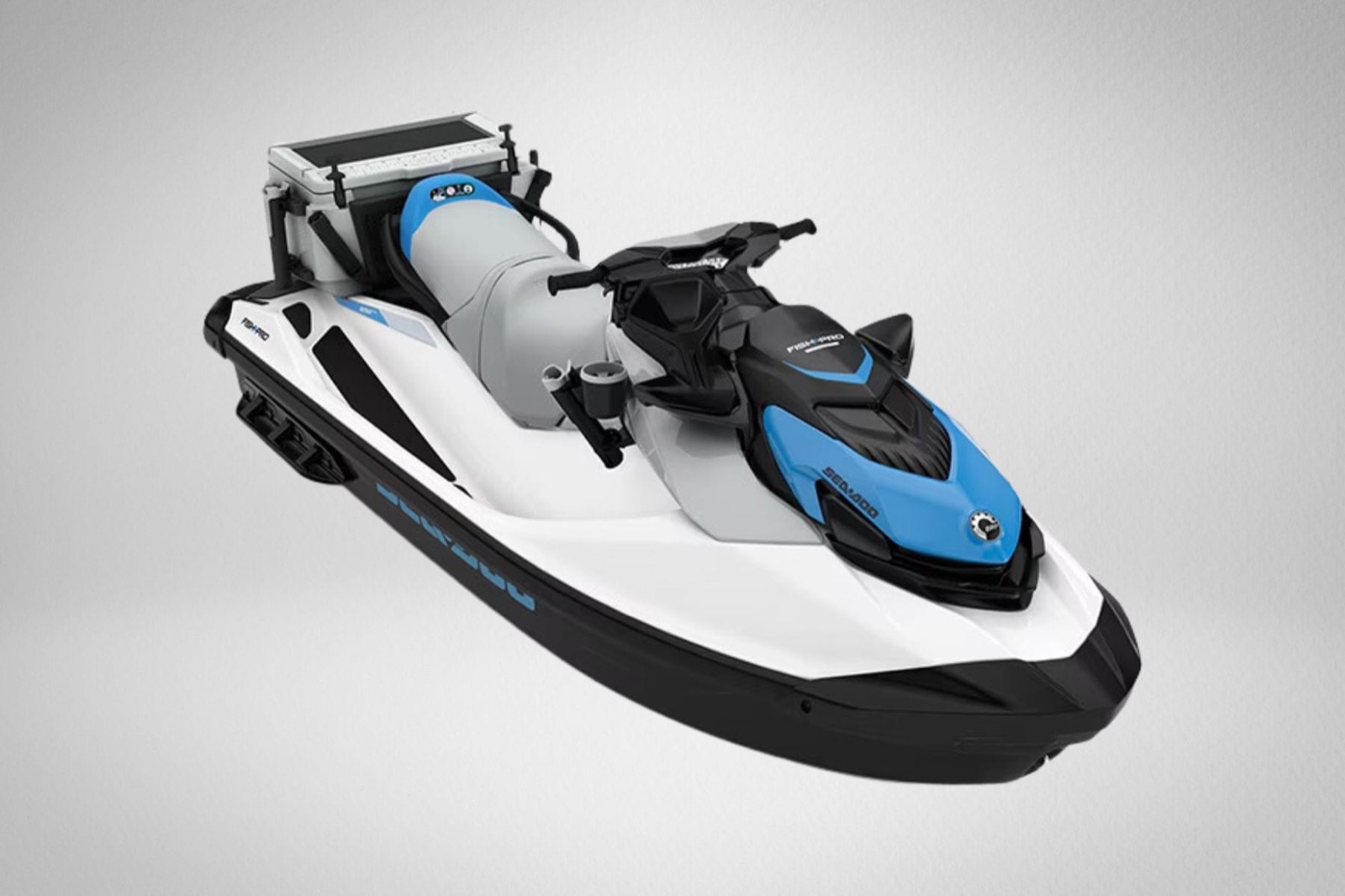
The Fish Pro Trophy is the only PWC on the market built for honest offshore fishing. The supercharged 1630 Rotax at 170 hp, the 18.5-gallon fuel tank, the 13.5-gallon livewell with auto-fill, the 7.6-inch Garmin chartplotter, and a real factory trolling mode add up to a fishing rig that gets 25 miles offshore and fishes for four hours without compromise. We logged a 2024 Trophy out of Marathon in the Florida Keys in winter 2025: two anglers, full livewell, 32-mile round trip with a 30 percent fuel reserve at the dock. The takeaway is straightforward. If you fish offshore or run to islands, the Trophy is the right boat at the price. If you fish inside the bay, you are paying $7k for features you will not use, and the Scout is the smarter buy. Used 2022 to 2024 hulls trade at $15,800 to $19,500, and the 2023 model year is the sweet spot after Sea-Doo revised the supercharger clutch in production.
What the Sea-Doo Fish Pro Trophy is
The Trophy sits at the top of Sea-Doo's three-step fishing ladder, above the Sport and the Scout. The hull is the larger ST3 platform, four inches wider in the beam than the Scout's GTI hull and a foot longer at 12 ft 10 in. That extra width matters because it gives the casting platform real two-angler stability, and the hull volume soaks up offshore chop the Scout pounds in.
The drivetrain is the supercharged 1630 ACE Rotax in 170 hp tune, the same engine you find in the GTX 170 family and the RXP-X 300 (untuned). The supercharger comes with a 200-hour ceramic-washer service that costs $400 to $600 in dealer labor depending on your market. That is the cost of admission for the offshore range and acceleration.
The fishing kit is where the Trophy earns its extra money over the Scout. You get a 13.5-gallon livewell with auto-fill function (push a button at the ramp and the pump fills the well from the lake), a Garmin ECHOMAP UHD 7.6-inch chartplotter with through-hull transducer, four flush-mount rod holders, the LinQ rail with removable cooler, a fixed casting platform aft of the seat, and the factory three-speed trolling mode at 5, 7, and 9 mph. The fuel tank is 18.5 gallons versus the Scout's 13.7, giving you the offshore range that defines this segment.
On the water
Top speed is 62 mph in stock trim, cruise is 32 mph at 6,400 rpm with a fuel burn of 5.2 gph. That math gives you 113 miles of theoretical range and around 75 to 85 miles of real-world fishing range with a livewell pump running and idle time at the spot. We logged 32 miles round-trip out of Marathon with two anglers, full livewell, and finished with 28 percent fuel remaining at the dock.
The fishing-specific numbers are where the Trophy proves itself. The factory trolling mode at 5, 7, and 9 mph holds speed within 0.3 mph in calm water, which is real precision compared to the throttle-feel idling on the Scout. The 13.5-gallon livewell auto-fill takes 90 seconds at the ramp from empty, and the recirculation pump lasts about seven hours on the dual-battery setup before voltage drops below the 12.4-volt threshold where the Garmin starts warning.
Casting-platform stability is the Trophy's quiet advantage. The wider ST3 hull stays flat to about 11 degrees of heel before lean becomes a problem, and the fixed platform aft gives a second angler a real foot position. Two anglers casting at right angles is workable, where the Scout is a one-stander boat. Rough-water behavior in 2 to 3 feet of chop is composed up to 35 mph, the hull soaks the chop the Scout pounds in. Above 35 mph in 2-foot wind chop you start feeling the sea state, but the Trophy is genuinely an offshore-capable platform up to small craft advisory conditions.
The Garmin 7.6-inch at idle pulls about 0.9 amps, the auto-fill livewell pump pulls 3.4 amps in fill mode and 2.1 amps in recirc. With a dual-battery setup (factory option, $400) you have headroom for an electronics-heavy day. With the single battery you are watching voltage by hour four.
What ownership looks like
Four ownership patterns come up across two model years. First, the supercharger service is real. The 200-hour ceramic-washer service costs $400 to $600 in labor, and skipping it past 250 hours risks a clutch slip that costs $1,800 in parts. The math still adds up for offshore use, but go in clear-eyed.
Second is the supercharger clutch on early 2022 hulls. Sea-Doo revised the clutch in production during the 2023 model year, and 2022 hulls had a higher rate of premature clutch wear under hard fishing duty cycles. 2023 and later hulls have the revised clutch.
Third is electronics corrosion. The Garmin transducer pocket and the auto-fill pump intake both take saltwater on every ride. The rinse routine: flush the livewell with fresh water at the ramp, run the auto-fill pump for 60 seconds with the hose connected, and disconnect the chartplotter cable for trailer storage. Owners who skip it see corrosion at the connectors by year three. We watched a Keys-based guide pull the chartplotter cable at the ramp every afternoon during a winter charter season, treating it as routine as rinsing the deck. Three seasons in, his connectors were spotless.
Fourth is the rod-holder mounts, which used the same softer aluminum bracket as the Scout on early 2022 and 2023 hulls. The angled stainless upgrade at $90 a pair is a season-one fix, and Sea-Doo revised the mount mid-2024 in production.
The honest offshore range math: 18.5 gallons at 5.2 gph cruise gives 113 miles of theoretical range. With a 30 percent reserve and a livewell pump running for four hours at idle, you have 50 to 55 miles of real-world fishing range. Enough to run 20 miles offshore, fish for four hours, and run home with reserve.
Scoreboard
Build (4): ST3 hull is the offshore-capable Sea-Doo platform, fit and finish at $22k is honest. Early supercharger clutch and rod-holder mounts were weak points, both fixed in production by mid-2024.
Performance (4): 170 hp supercharged Rotax with the offshore-capable hull is the right combination. Cruise burn at 5.2 gph is class-typical for the power level.
Accommodations (4): Wider ST3 hull and fixed casting platform make this a real two-angler boat. Two-up seating with the platform fixed, no three-up family mode.
Systems (5): Auto-fill livewell, three-speed factory trolling mode, 7.6-inch Garmin standard, dual-battery option from the dealer. This is the most fishing-specific systems package on a factory PWC.
Value (3): $22k new is the ceiling for the segment. The features justify it for offshore use, not for inshore-only buyers.
Resale (4): Sea-Doo nameplate holds value well, and the Trophy has a captive offshore-PWC buyer base. Three-year depreciation is about 22 percent.
Best for / Not ideal for
Best for: Offshore anglers running 15 to 30 miles to fish, island runners in the Florida Keys and the Channel Islands, second-PWC buyers stepping up from a Scout or Sport who want real fishing range, and anglers who fish two-up regularly. If your home water is open coast and you want a livewell-equipped offshore platform under $25k, the Trophy is the only factory answer.
Not ideal for: Inshore-only anglers who fish protected water, buyers who do not want the supercharger maintenance schedule, families who want a three-up touring weekend mode, and budget buyers who flinch at the $22k entry price. The Scout is the right boat for inshore at $7k less.
What's included, what costs extra
Standard from the factory: supercharged 1630 ACE 170 hp engine, 13.5-gallon livewell with auto-fill function, Garmin ECHOMAP UHD 7.6-inch chartplotter with through-hull transducer, four flush-mount rod holders, fixed casting platform, LinQ accessory rail with Cannon cooler, factory three-speed trolling mode (5, 7, 9 mph), 18.5-gallon fuel tank, and the ST3 hull.
Costs extra: dual-battery setup at $400 from the dealer (essential for full-day fishing), the angled stainless rod-holder upgrade at $90 a pair on early hulls, Sea-Doo fishing-trim cover at $310, additional flush-mount rod holders for $60 to $90 each, and the supercharger service at 200 hours costing $400 to $600. Plan on $700 to $1,000 of first-year extras if you fish hard, plus the supercharger service every two seasons of fishing duty.
Pros and cons
Pros
- Supercharged 170 hp Rotax with real offshore acceleration carrying a full livewell.
- 18.5-gallon fuel tank means honest 50-mile fishing range with reserve.
- Garmin 7.6-inch chartplotter and through-hull transducer standard.
- Factory three-speed trolling mode at 5, 7, 9 mph holds within 0.3 mph.
- Auto-fill livewell function eliminates manual filling at the ramp.
Cons
- Supercharger ceramic-washer service every 200 hours at $400 to $600 per visit.
- $22k new is the ceiling for the segment. Value math gets thin for inshore-only use.
- Two-up only with the fixed platform, no three-up family configuration.
Best year and trim to buy
The sweet-spot used buy is a 2023 Trophy at $17,500 to $18,500 with under 100 engine hours. Sea-Doo revised the supercharger clutch in production during the 2023 model year, and the 2023 hulls also got the wider beam and fixed casting platform that defines the current Trophy. 2022 hulls are $1,500 cheaper but carry the older clutch, which is a real risk on a hard-fishing duty cycle.
For new buyers, the 2026 Trophy is essentially unchanged from 2024 in mechanical terms, with minor color and trim updates. There is no functional reason to pay full MSRP on the 2026 over a clean 2024 used at $19k. Verify the supercharger service history on any used Trophy you consider, and walk away from any boat that has skipped the 200-hour service. Look for paperwork, not verbal claims.
Price options
New 2026 Trophy MSRP is $22,499 to $23,999 depending on color and dealer market. Coastal dealers run within $500 of MSRP in 2026, with occasional rebates of $500 to $1,000 in late season. Used 2022 hulls trade at $15,800 to $17,200, used 2023 hulls at $17,400 to $18,800, and used 2024 hulls at $18,200 to $19,500. Financing on new at 7.9 percent over 60 months on $23k out the door costs about $466 a month with $3k down.
Year-one TCO honest math: $23,500 sale price plus $1,950 sales tax plus $1,050 freight plus $700 in extras plus $220 oil change plus $980 insurance plus $480 storage equals about $28,900 year one. Year two adds the $500 supercharger service at 200 hours. Five-year ownership comes to roughly $33k all in for a boat that retains $14k to $16k in resale at year five.
Alternatives
The cross-shop in the segment is the Yamaha FX HO Fishing Edition at around $19k with the dealer fish kit. The Yamaha gives you a normally-aspirated 180 hp engine (no supercharger service), a 35-gallon front storage that beats the Trophy on touring versatility, and the segment-leading fuel capacity, but the livewell is smaller at 12 gallons and the chartplotter is a smaller Lowrance HOOK 5-inch. Better for buyers who want low-fuss ownership, weaker on the fishing rig itself. The Sea-Doo Fish Pro Scout at $19k splits the difference, with the Trophy's hull but only 170 hp without the auto-fill livewell or the 7.6-inch chartplotter. The skiff alternative is a 17 to 18-foot tiller skiff with a 60 hp outboard at $25k to $30k used, which gives you real offshore capability and standing room but loses the towability and the family-mode versatility.
For the full segment view and the head-to-head with the Scout and the Yamaha, see Best Fishing Jet Skis in 2026.