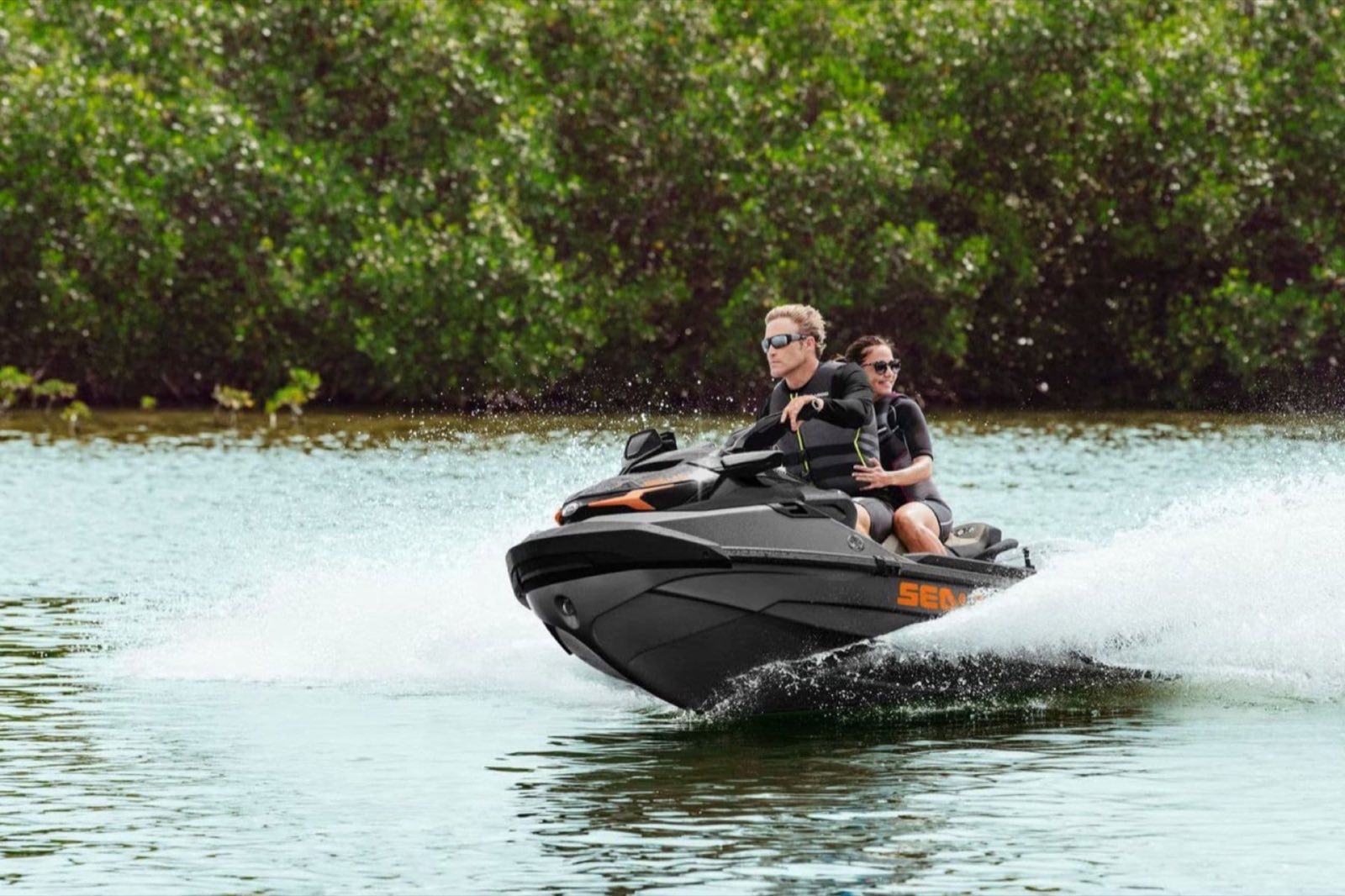
The Sea-Doo GTX 300 is the 11-foot 4-inch touring flagship from BRP, built in Valcourt, Quebec, and powered by the supercharged Rotax 1630 ACE three-cylinder rated at 300 horsepower. For 2026, it comes on the ST3 hull (the same platform Sea-Doo introduced in 2018 and has refined every year since), with a top speed of 67 mph, a dry weight of 859 pounds, an 18.5-gallon fuel tank, and a rated passenger capacity of three at 600 pounds total. The base 2026 GTX 300 starts at $17,999. The Limited 300 trim, which adds the iDF debris-free pump, the BRP audio system, a cover, and a LinQ cooler, lists at $19,799.
The 2026 model comes standard with iBR (intelligent brake and reverse), three ride modes (Sport, Touring, ECO), a 7.8-inch wide color cluster, the LinQ rear deck for accessory mounting, 26.1 gallons of total storage, and a step-through reboarding platform. The Limited 300 adds the BRP audio system, the iDF pump, a Garmin-friendly dash mount, and a factory cover. The ST3 hull is wider and flatter than the older S3 hull, which is what gives the GTX its calm ride at cruise.
What's it like on the water?
The first thing you notice is the saddle. It is the widest, flattest, longest seat Sea-Doo builds, and it lets a 6-foot rider plus a passenger sit without bumping knees. Push the throttle and the boat is on plane in under three seconds. At a 45 mph cruise the supercharger has not even engaged yet, so fuel burn is around 6 gph and the ride is quiet by PWC standards.
We took a 2023 GTX 300 out of Lake Mead in October 2025 in two-foot afternoon wind chop. The ST3 hull tracked straight at 45 mph with no porpoising, no slap off the bow, and no spray onto the rider. Push it to 55 mph and the supercharger comes in, fuel burn jumps to about 9 gph, and the chop starts to register through the footwell pads. At wide-open throttle on flat water the boat hit a measured 65.2 mph one-up, close to the published 67. Owners say the same thing we noticed: the GTX is the ski you ride for six hours and step off without a sore back.
Dock approach is the cleanest in the class. iBR uses the reverse bucket as a brake, so you can come into a slip at 8 mph, squeeze the left lever, and stop in a boat length. Beach landings are easy too, the bow is blunt enough that you can drift it up onto sand at idle without scraping the pump intake.
Who is the GTX 300 for?
The GTX 300 is for the rider who does long days with a passenger. Two-up cruising on inland lakes, three-up family rides on a Saturday, all-day tours up a coastal inlet with a cooler strapped to the LinQ deck. We ran a 70-mile day at mixed throttle on Lake Powell and came back with a quarter tank, which is the boat's natural mission. It is also for the household that wants one ski to cover towing a tube, pulling a wakeboarder, and crossing a 20-mile lake without anyone complaining. The 300 hp Rotax has the torque to pull a 200-pound wakeboarder out of the water cleanly, and the iBR brake makes spotter-and-rider handoffs at the dock simple.
It is not for you if you are looking at a PWC as a closed-course performance ski. The ST3 hull is wide and flat, which is what makes it calm at cruise, but it does not lean into a hard turn the way a Sea-Doo RXP-X 300 on the T3-R hull will. It is also not the ski for a buyer who skips service intervals, the supercharger clutch needs attention at 200 hours and the carbon seal needs eyes on it every season. For a smaller, simpler touring boat without a supercharger, the Sea-Doo GTI 130 is the more honest answer.
Pricing: new and used market
A 2026 Sea-Doo GTX 300 base trim starts at $17,999. The Limited 300 with the iDF pump, BRP audio, and a cover lists at $19,799. Dealer-loaded examples with a single-place aluminum trailer and a few LinQ accessories cost between $21,500 and $23,500 out the door.
The used market is wide. Listings on the major boat sites show GTX 300s from $8,123 on the low end (older high-hour 2018 hulls) up to $25,818 for nearly-new 2024 examples, with an average of about $18,649 across the sample. Limited 300 trims average $15,999 used because the spread is heavier in early years. For 2026 buyers, the sweet spot is a 2022 or 2023 hull in the 50-to-150-hour range, generally landing between $14,500 and $17,500 private party and $16,000 to $19,500 at a dealer.
Resale on the GTX 300 has been steady. A 2023 base GTX 300 that sold new at around $16,300 is trading at about $14,200 today, which is roughly 87 percent retention after two seasons. That is strong for a powersports vehicle.
Year-by-year notes
If you are shopping used, two years stand out. The first is 2018. Boats before 2018 used the older S3 hull and a different supercharger spec, and the calm-water touring feel that defines the GTX did not arrive until the ST3 hull went under it. If you want an older boat, get a 2018 or later.
The next year is 2024. This is when Sea-Doo introduced the iDF intelligent debris-free pump as standard on the Limited 300 trim and as an option on the base GTX 300. It is the button that backflushes the pump from the handlebar, and for anyone riding weedy lakes or sandy bottoms it is a useful upgrade. 2024 also introduced the 325 hp Rotax above the 300, which pushed the GTX 300 into a more accessible price tier. The 2025 and 2026 model years are nearly identical to 2024 mechanically, with small cluster software updates and a new color scheme.
Two recall items to know about: the 2018 launch year had an intercooler hose-clamp recall that Sea-Doo addressed under warranty, and the 2019 supercharger impeller had a fin-breakage issue on a small batch that was replaced free at dealers. Both are well documented and any used boat with full service history will show the fix logged.
Cost of ownership
Annual operating costs on the GTX 300 are higher than on a non-supercharged touring ski because the Rotax 300 hp engine asks for attention.
Routine service every 50 hours costs about $200 to $300 for parts (oil, plugs, filter) and $150 to $250 for dealer labor. The 100-hour supercharger inspection is around $400 to $600 at a dealer. The 200-hour supercharger clutch-and-washer rebuild is the line item that surprises new buyers, it costs $1,200 to $1,800 including parts and is not optional. Skip it and a failed clutch will eat the supercharger housing, which is a $3,500 to $5,000 fix.
Storage and insurance depend on your location. Indoor heated storage in the Northeast costs about $400 to $700 for the season. Trailer storage on a driveway is free. Insurance on an $18,000 PWC is $300 to $500 a year through Progressive or Markel. Annual registration is $40 to $90 depending on the state. An annual carbon seal inspection at the dealer is $150 and is the single best thing you can do to keep the engine alive.
If you buy a 2023 used GTX 300 for $15,000 with 100 hours and use it 50 hours each season on a Midwest lake, your total yearly cost over five years works out to about $1,800 to $2,400, plus a one-time $1,500 supercharger rebuild somewhere in year three or four.
We refueled a 2023 GTX 300 at a Lake Mead marina last fall after a 70-mile day at a mix of 35 to 50 mph speeds. The boat used about 14 gallons of 91-octane, so the bill was $72. That is the math that makes the GTX work for touring: a tank gets you a long day.
Best year and spec to buy
The best choice for 2026 is a 2022 or 2023 base GTX 300 with documented 100-hour supercharger service, the iBR brake (standard on all 2018+), the BRP audio package if you can find it as a dealer-added option, and 50 to 150 hours of use. The 2024 and later boats with the iDF pump are nice if you ride weedy water, but you pay 20 to 25 percent more for that one feature.
We talked to a 2022 GTX 300 owner at a fuel dock at Lake Havasu in March 2026. He had 280 hours on it across four seasons, had the supercharger rebuilt at the dealer at 200 hours for $1,650, and had replaced the impeller wear ring once. Everything else on the boat was original. He said he would buy another one. That pattern shows up consistently when you talk to owners who actually log hours on these boats: the supercharger is a service line, not a problem.
Pre-purchase verification points: pull the seat and look at the engine compartment for water staining (sign of a tired carbon seal), confirm the 100-hour service was logged, check pump-shaft play (more than ten thousandths of an inch means a rebuild is due), and look at the bond rail between the hull and deck for stress cracks if the ski has been trailered hard.
Alternatives
The Kawasaki Ultra 310LX is the closest competitor. It has 10 more horsepower, a deeper-V hull that handles rough water better, and 44.5 gallons of storage against the Sea-Doo's 26.1. It also weighs about 90 pounds more and costs about $1,500 more new. The Yamaha FX Cruiser HO is the four-cylinder alternative. It is not supercharged, so it tops out around 65 mph, but the service costs are lower and the throttle is softer for less-experienced riders. The Yamaha FX HO Fishing Edition is the same chassis configured for light angling. For a closed-course Sea-Doo with the same 300 hp Rotax in a performance package, the Sea-Doo RXP-X 300 is the cross-shop, sharper hull, smaller seat, same engine.