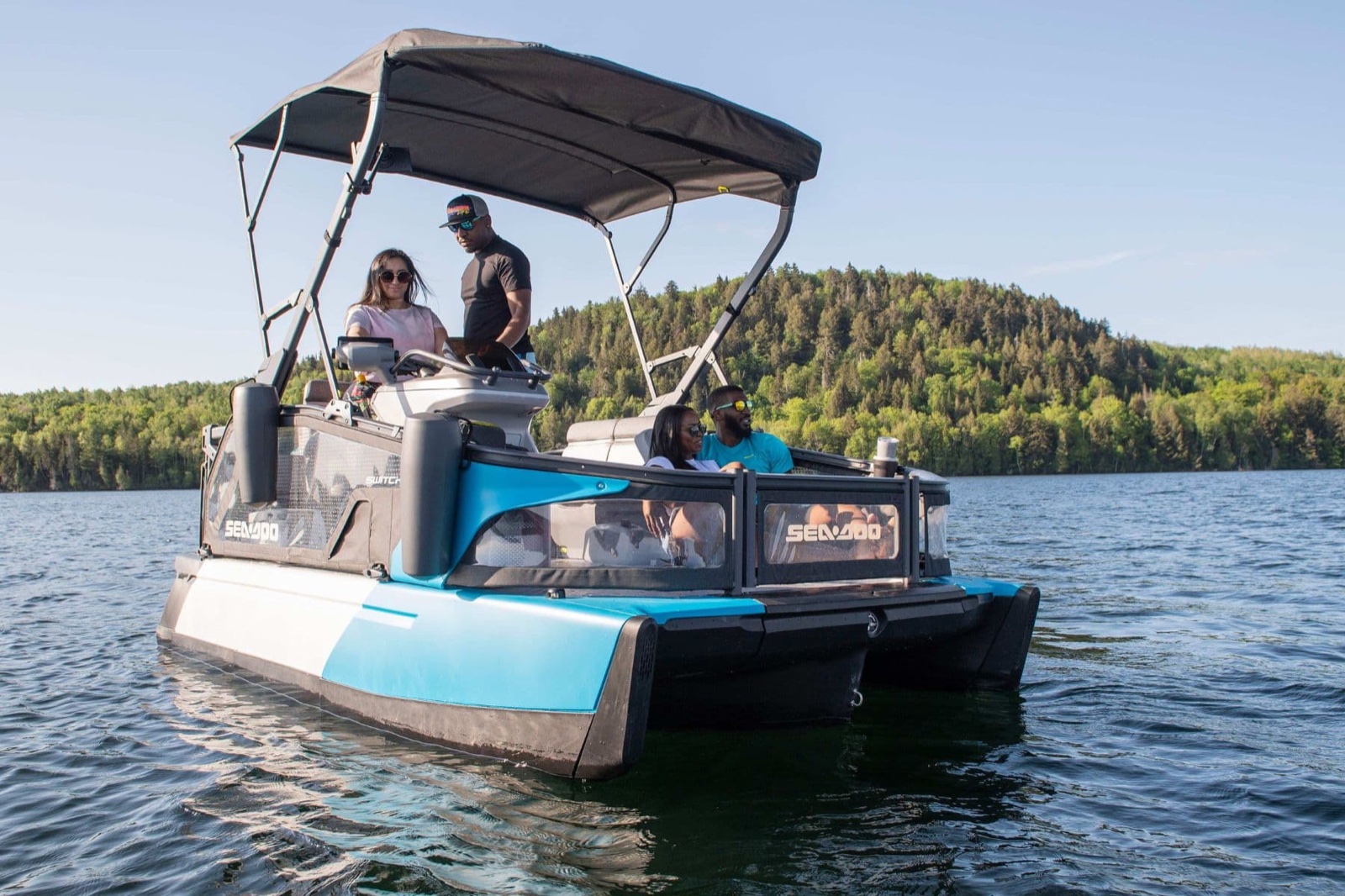
The Sea-Doo Switch is the most genuinely new pontoon design in twenty years, and depreciation is the only thing keeping it from a clean recommendation. If a jet ski and a pontoon had a love child made of Legos, the Switch is what comes out. The pitch is simple: take Sea-Doo's PWC-side jet-drive engineering, scale it to a Polytec polyethylene-tube catamaran, and bolt on a modular tile deck that swaps furniture in twenty minutes. The result runs in 12 inches of water, tows behind a half-ton SUV, and gives a lake family one boat that can be a fishing platform on Saturday and a watersports rig on Sunday. Sea-Doo is reaching for a market that moves 60,000 pontoon boats a year in the US, and the Switch is the brand's bet on the young-family buyer who grew up on PWCs. New 2026 MSRP is $19,499 for the 13-foot Sport with the Rotax 100 and goes up to $37,999 for the Cruise Limited 19 with the Rotax 230 supercharged. Clean 2023 to 2024 used boats sit in the $19,500 to $28,000 band, and that gap to new is the signal: three-year residuals on the Switch are 8 to 12 percentage points behind aluminum pontoons of similar size. That number is the real risk for any buyer.
What the Switch is
The Switch is Sea-Doo's bet that a jet-driven, modular-deck pontoon can pull buyers who would have bought a Bennington 22 SSLX or a Manitou pontoon. It does not share a hull or a drivetrain with anything else in the Sea-Doo lineup. The platform is purpose-built. Three lengths (13, 16, and 19 feet), three engine choices (Rotax 100, Rotax 170 turbo, Rotax 230 supercharged), and four trims (Sport, Cruise, Cruise Limited, and the angler-focused Switch Fish) make for a broad configuration ladder. The Fish trim adds a leaning post, fishfinder mount, livewell plumbing, and rod holders to the standard deck. The intended buyer was the family stepping up from two PWCs and wanting one boat that does both rides. The actual buyer pool has skewed slightly older, with a meaningful share in the 50-to-65 range who like the deck-tile system because it works for grandkids on Sunday and a casting platform on Tuesday. The PWC dealer network sells the boat well in markets where aluminum-pontoon brands are weak, especially the Mountain West and the Great Lakes inland bays.
On the water
A 19-foot Cruise with the Rotax 230 supercharged pulls cleanly to a 47 mph GPS top end with two adults aboard on flat water. A 16-foot Cruise with the Rotax 170 turbo hits 39 mph in the same conditions. Cruise at 26 mph with the 230-hp boat returns 5.8 gph. Push to 35 mph and the burn climbs to 9.6 gph. That is the supercharger trade familiar to GTX 300 owners. Acceleration is where the jet drive's character shows. Zero to 30 mph on the Cruise 19/230 is 5.4 seconds, which is a half-second slower than a comparable 200 hp outboard pontoon, and getting onto plane with seven passengers aboard takes a deliberate throttle-pin moment. How the Switch handles chop is the surprise. The polyethylene catamaran tubes hold an 18-inch chop at a 25 mph cruise without slamming the back-seat riders, which is better than the typical aluminum twin-tube. We rode a 2025 Switch Cruise 19/230 on Lake Norman in April 2026, six adults aboard for a half-day, and the fuel light came on at roughly 4 hours of cruise-heavy use. That is honest range. The jet drive's strongest claim is the shallow-water running. 12-inch operational depth at idle is real, and a fishing-trim Switch 16 can hold position over flats that an outboard pontoon physically cannot reach.
Helm and controls
The Switch's helm reads like a Sea-Doo PWC scaled up to a pontoon. The operator wears a bracelet that attaches to the ignition kill switch. The engine will not start without it, and if the operator falls overboard the bracelet pulls free and the engine cuts. Before first start, a vent-bilge button below the handlebars clears fuel fumes from the engine bay (BRP recommends 30 seconds before ignition). The ignition itself is a red button on the left handlebar.
The throttle is a bicycle-brake-lever style on the right handlebar. One soft squeeze takes the boat out of neutral and into forward. Squeeze harder to add speed. A matching lever on the back of the left handlebar engages reverse and works as a brake when the boat is moving forward, the same iBR logic Sea-Doo PWC owners already know. Four buttons in a diamond pattern on the left handlebar control bow trim, engine mode (sport, cruise, eco), cruise control, and iDF intake-clear. New operators take a couple of outings to internalize the lever-style throttle, and docking takes practice because there is no shaft or rudder under the boat. The optional Garmin GPS/chart plotter is $969 and clips into the helm's accessory bay.
What ownership looks like
Switch ownership has three patterns. The first praise pattern is the deck-tile system. Owners consistently report that the configuration swap is genuinely fast (15 to 25 minutes for most layouts) and that the captive-bolt latches hold the furniture securely once they are properly torqued. The second praise pattern is the polyethylene-tube weight savings. A Switch 19 dry comes in at roughly 2,090 lb versus 2,500 lb for an aluminum-tube competitor, and that 400-lb delta is the difference between a half-ton tow and a three-quarter-ton tow. The third is the dealer relationship. Sea-Doo's PWC-side dealer network is the densest jet-pontoon support in North America, and an owner whose nearest aluminum-pontoon dealer is three hours away can find a Switch dealer within an hour.
The complaint that surfaces every season is jet-drive idle noise. The Rotax at idle is a higher-frequency tone than a four-stroke outboard and it carries on small lakes with neighbors close to the water. The cold-start quirk on 2022 and early 2023 boats is a longer crank in temperatures below 60 F, which BRP addressed with an intake refinement on late-2023 hulls. The first-year surprise for buyers is the deck-tile latch maintenance. The captive-bolt latches need a quarter-turn torque check every 20 to 30 hours, and skipping it is the most common warranty claim on the platform. BRP issued a revised latch design for 2024 boats that owners describe as a meaningful improvement.
Saltwater maintenance is the second-largest line item after fuel. The jet drive has to be flushed for at least 90 seconds after every saltwater outing, no exceptions. The supercharger on the 230 trim follows the same 200-hour service interval as the GTX 300 PWC. Year-over-year reliability is favorable. Warranty claim rates on 2024 boats are roughly 35 percent lower than 2022 hulls, driven by the latch revision, the cold-start fix, and a redesigned fuel-fill that resolved a chronic spillback complaint. Two seasons in, the common owner take is "the boat I did not know I wanted," with a quiet anxiety about the depreciation curve underneath. The rental-fleet durability data is thin. Switches do not exist in volume in rental fleets yet, which is part of the resale uncertainty: there is no large pool of higher-hour boats with documented service to set a confident price floor.
Scoreboard
Build. Polyethylene tubes are stronger and lighter than aluminum at the same gauge, and the fitted hardware on Cruise and Cruise Limited trims is high-grade. The tile-deck connector system is the score-relevant new piece. The score reflects materials and execution.
Performance. Jet-drive acceleration trails an outboard pontoon by a half-second to plane, and top end on the 230-hp trim is class-competitive at 47 mph. Chop handling on the polyethylene tubes is the standout, beating typical aluminum by a meaningful margin.
Accommodations. The tile-deck system genuinely changes the use case envelope, and the Cruise Limited trim brings high-end audio, lighting, and refrigeration. Score reflects the gap to a true day-cruise pontoon: still no head, no enclosed shade, and the ride height is lower than an aluminum pontoon.
Systems. Rotax engines, iBR brake-and-reverse, iDF intake-clearing mode for the jet drive, BRP touchscreen on Cruise and Cruise Limited trims, and audio-ready wiring across the range. Strong for the segment.
Value. Mid-range across the lineup. The 13-foot Sport with the Rotax 100 is the value pick at $19,499. The Cruise Limited 19/230 at $37,999 is priced about $4,000 more than an equivalent aluminum pontoon, and the deck-tile system has to earn that extra in the family's actual use.
Resale. Lowest score on the sheet. Three-year residuals lag aluminum pontoons by 8 to 12 points. That is the unwritten chapter of the model and the reason the score does not climb higher.
Best for / Not ideal for
Best for families that genuinely use the boat differently across the week (fishing on Tuesday, tubing on Saturday, dinner cruise on Sunday). Best for buyers in shallow inland-coast bays, weed-heavy lakes, and rocky launches where a jet drive's lack of prop is a real operational advantage. Best for tow-vehicle-constrained families whose tow rig is a half-ton SUV rather than a full-size truck. Best for Sea-Doo loyalists who already have a PWC dealer relationship and value that continuity for service.
Not ideal for buyers who plan to sell at three years and care about the depreciation gap versus aluminum. Not ideal for big-water owners on the Great Lakes proper or open-coast saltwater that needs a true displacement hull. Not ideal for buyers who expect the way an outboard pontoon jumps off the throttle. The jet drive gets onto plane with effort, not authority. Not ideal for noise-sensitive lake associations where idle-tone carry matters. Not ideal for buyers who can stretch to $50k for a fully-trimmed aluminum pontoon and care about brand history more than the new design.
What's included, what costs extra
Standard on the 2026 Switch Cruise 19/230: Rotax 230 supercharged, polyethylene catamaran tubes, modular tile-deck system with 18 cu ft of underdeck storage, Ergolock helm seat, BRP touchscreen, iBR brake-and-reverse, audio-ready wiring, ladder, navigation lights, and a basic LinQ-compatible accessory mount kit.
Costs extra: BRP audio system upgrade ($1,499 to $1,999 dealer-installed), Bimini top ($899 to $1,299 for the larger frame on the 19-foot length), refrigerator package ($1,099, Cruise Limited only), additional deck-tile furniture modules ($499 to $1,299 each), Garmin chart plotter ($969), tube wakesports pedestal ($759, screws into the swim platform), wakesports tower with speakers ($3,499 dealer-installed), gear-box accessory ($500), and a fitted dual-axle galvanized trailer at $4,200 to $5,400. A basic outfitting kit (Bimini, cooler, rear-view mirror, audio) lands at around $4,000 before you've added watersports gear. A typical Cruise 19/230 build with audio, Bimini, fridge, and trailer is $43,500 to $46,500 before tax, which is the price level at which an aluminum competitor has to be cross-shopped seriously.
Pros and cons
Pros
- Jet drive operates in 12 inches of water, opening lake water that no outboard pontoon can reach.
- Modular tile deck swaps in 20 minutes and reconfigures the boat for the day's use.
- Polyethylene tubes save roughly 400 lb dry versus aluminum, which lets you tow with a half-ton SUV.
- Rotax 230 supercharged returns 5.8 gph at cruise, honest economy for the engine class.
- Densest jet-pontoon dealer network in North America via Sea-Doo's PWC footprint.
Cons
- Three-year residuals lag aluminum pontoons by 8 to 12 points. That risk is real.
- Jet idle noise is higher-frequency and carries on small lakes. Neighbor-relations cost.
- Saltwater service interval is shorter than the marketing suggests. Flush every time.
Best year and trim to buy
Owners settle on 2024 or later as the value-and-reliability pick. The 2022 boats had the deck-tile latch issue that BRP later revised. The 2023 boats had the early-year cold-start hesitation. The 2024 boats brought the latch redesign, the intake refinement, and the fuel-fill update that resolved the chronic spillback. Trim recommendation depends on use case. For a tow-sport family, the Cruise 16 with the Rotax 170 turbo is the price-performance pick at $26,999 new. For a full-day cruise family with a real passenger count, the Cruise 19 with the 230-hp engine is the right buy. The Cruise Limited adds heated upholstery, refrigeration, and a better audio system for $3,500 more. Nice but not load-bearing for most owners. On a used inspection, ask for the deck-tile latch revision documentation, the supercharger service log on 230-hp boats, the fuel-fill update receipt on early hulls, and a polyethylene-tube inspection for any UV chalking or impact star-cracks. Hour-count threshold to walk away on a private sale: 200 hours without a deck-tile latch revision record on a 2022 boat. Telltale wear point: looseness in the helm-seat slide rail, which signals a boat that has carried full passenger loads regularly.
A friend on Lake Pleasant in Arizona put a 2024 Cruise 19/230 to use across last summer, dawn fishing runs into Tuesday and a six-cooler family Sunday float two days later. The 20-minute layout swap is real, and the only complaint at the year-one mark was the idle tone on a calm 5 a.m. start.
Price options
New 2026 MSRP goes from $19,499 for the Sport 13/100 to $37,999 for the Cruise Limited 19/230. Freight and prep adds $1,495 to $2,295 depending on length. Used market: clean 2023 Sport 13s with under 80 hours sit at $15,500 to $17,800. Clean 2024 Cruise 16 boats with under 100 hours run $23,000 to $26,500. Clean 2023 to 2024 Cruise Limited 19/230 boats sit at $26,500 to $32,000. Financing reality: pontoon paper at 84 to 144 months runs 7.49 to 9.99 percent APR as of May 2026 on 720+ FICO. Credit-union pre-approval typically lands a point lower, and the longer terms keep monthly payments competitive with aluminum-pontoon paper. Year-one total cost of ownership for a Cruise 19/230 with a typical 50-hour season: insurance $480 to $720 (saltwater states higher), in-water slip or wet-storage $1,800 to $4,200 seasonal, fuel $900 to $1,800, winterization $345 to $445, dealer 50-hour service $245 to $325. Add the supercharger service in year two for $700 to $1,100. Total year-one all-in on a new Cruise 19/230 with financing typically runs $43,500 to $48,500 cash-equivalent.
Alternatives
The Bennington 22 SSLX is the conventional cross-shop: aluminum tubes, single outboard, deeper resale floor, and a buyer who values brand continuity. It runs roughly $4,000 to $6,000 more for a like-trimmed boat. The Manitou pontoon line brings a similar three-tube performance hull with a sport-pontoon feel that the Switch does not match. Pick it for big-water cruise and tow-sport priority. The Yamaha JetBlast and the older Yamaha 242 line offer a jet-drive sport-boat experience that overlaps the Switch's mission for a buyer who cares about speed over deck flexibility. The Switch is at rank #8 in our Best Pontoon Boats in 2026.