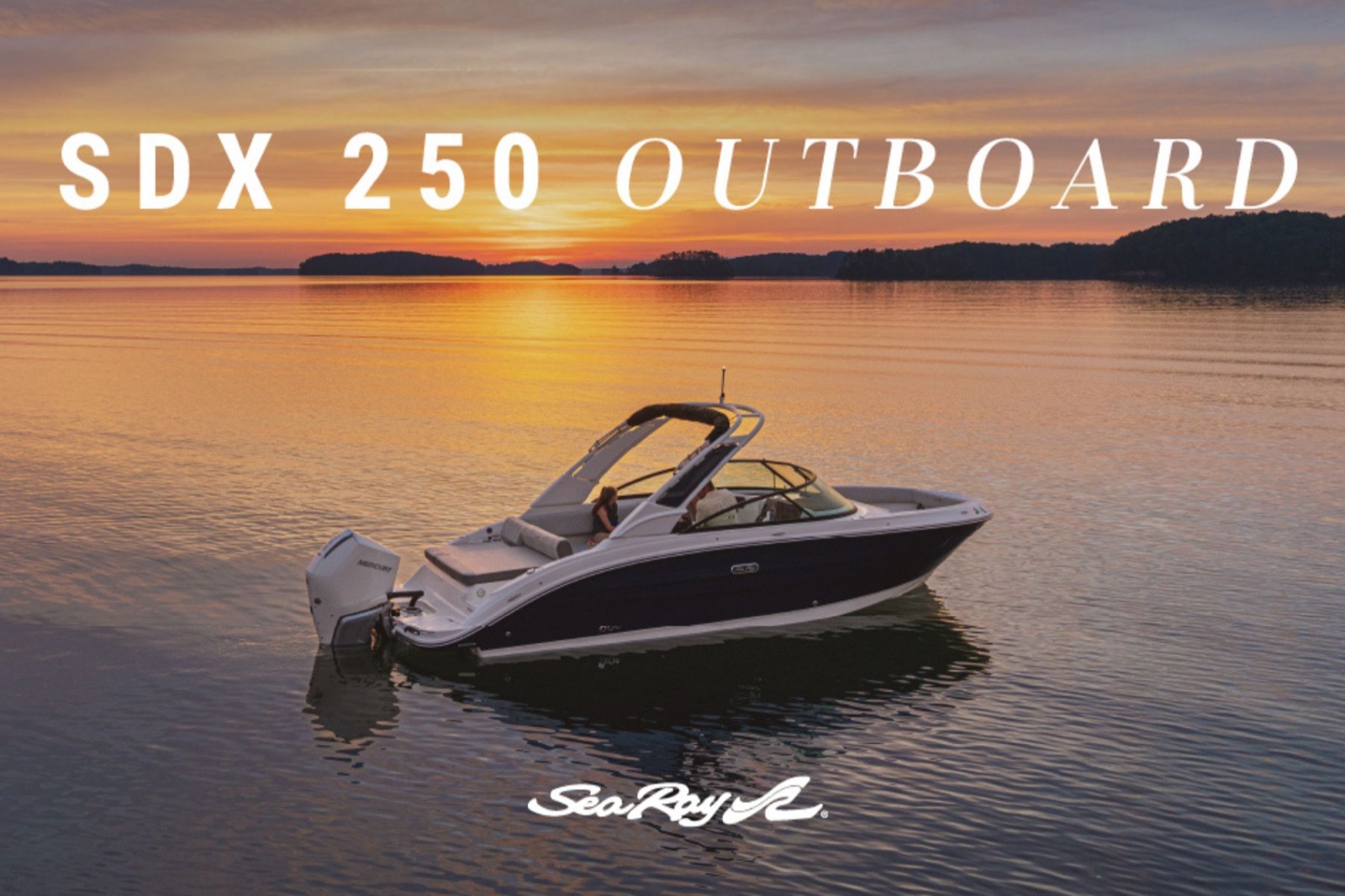
Sea Ray under $40k means a 2017-to-2019 SDX 220, and that is real boat for the money. The SDX line was Sea Ray's volume 22-foot bowrider through the late 2010s, the boat that filled dealer lots and showed up at lake marinas across the Midwest and the Southeast every summer. The reason it shows up on our under-$40k guide in 2026 is the same reason it sold so well new. The cockpit is roomy, the layout works for entertaining, the brand resale holds the boat together as an asset, and the price has finally come down to the budget tier.
What is the Sea Ray SDX 220?
The SDX 220 is a 22-foot fiberglass bowrider with a 6.2L MerCruiser sterndrive on a Mercury Bravo III duoprop drive. Beam is 8 feet 6 inches. Dry weight is roughly 4,200 pounds depending on options. The hull is a 21-degree deadrise at the transom, which is the standard for the bowrider segment at this length and keeps the ride manageable in 2-foot chop without the bow-slap that 17- and 19-foot boats deliver.
The cockpit is the part that sold the boat. Forward seating with a built-in cooler and a table mount on most trim packages. A U-shaped stern lounge with cup holders. Walk-through windshield connecting the bow and the helm. Head compartment under the console that takes a portable. The vinyl is mid-premium and holds up well in storage if the boat is covered. The hardware is stainless on the visible mounting points.
From 2018 onward, Sea Ray made the Garmin chartplotter and the JL Audio stereo with transom remote standard, along with trim tabs and a dual battery switch with a bilge-pump manual override. That kit is part of why the 2018 and 2019 hulls are the sweet spot for buyers shopping under $40k in 2026. The earlier 2017 hulls had most of the same layout but a less complete electronics package, so a 2017 listing at $32,000 to $35,000 leaves the buyer rebuilding the helm with aftermarket parts to match the 2018 spec.
The engine is the part that defines ownership cost. The 6.2L MerCruiser is a 350-horsepower V8, the volume Mercury powerplant for sterndrives at this length through the decade. The Bravo III drive is a duoprop that gives the boat strong holeshot, an honest 50 mph top end, and 3.4 mpg at 28 mph cruise. The drive also gives the boat the bellows-replacement schedule that catches first-time sterndrive owners, which we cover in the cost section.
Who is it good for?
Entertaining-first families on Midwest and Southern lakes are the core buyer. The SDX 220's cockpit fits seven adults, eight if everyone is friendly, and that is the largest seating footprint on the under-$40k bowrider guide. We watched a family of four plus two friends pull a SDX 220 off the trailer at Lake of the Ozarks last summer, run a wakeboard pull for the kids in the morning, anchor in a cove for lunch with the bow cushions out, and drive home at sunset. The boat did the day exactly the way the layout reads, and the engine never gave them anything to think about.
Buyers cross-shopping Cobalt at the same length are the second profile. Cobalt builds a more finished interior at materially more money, even on the used market. The SDX 220 is the boat for buyers who want the bowrider brief and the brand name but do not want to stretch to a Cobalt R6 at $50,000-plus used. Sea Ray's gelcoat is a step under Cobalt's, the hardware is a step under, but the cockpit volume and the brand-resale floor are very close on a five-year hold.
Owners willing to stretch the budget for a 2018 or 2019 hull are the third group. The extra $3,000 to $5,000 versus a 2017 listing buys the Garmin and JL standard kit, the slightly refreshed cockpit upholstery on 2019 hulls, and the cleanest service record on the used market.
Who is it not good for?
Buyers who want a current-year or near-current-year boat should not shop this guide. The under-$40k budget does not reach anything newer than 2019 on the SDX 220. If having a 2022 or 2023 hull matters, the buyer is shopping a different price tier, and the right boat at $55,000-plus is a different conversation.
Anyone uncomfortable with the Bravo III bellows maintenance schedule should also walk past. Bellows replacement every two to three years is a $1,200 to $1,800 line that surprises first-time sterndrive owners who came from outboard boats. Outboard buyers see fuel and impellers, not bellows and gimbals. The SDX 220 OB exists for that buyer, but the under-$40k budget does not stretch to the outboard version of this hull.
Buyers who fish more than they entertain are the third exclusion. The SDX 220 is a bowrider, not a fish-and-cruise. There are no rod holders standard, the livewell is an upgrade, and the layout is built around bow lounging and a stern swim platform. The Bayliner VR6 or a Four Winns equivalent covers a similar bowrider brief at less money for a buyer who does not need the Sea Ray name.
Pricing
New 2026 SDX 220 pricing at the dealer runs $72,000 to $88,000 depending on trim package, tower option, and audio upgrade. That is the price tier the used buyer is looking back from.
The used market on 2017-to-2019 SDX 220 hulls in 2026 sits at $32,000 to $39,000 for clean boats with under 350 hours and documented service. Below $32,000 the listings tend to be pre-2017 hulls, deferred-service boats, or units with cosmetic issues that show up on inspection. Above $39,000 the listings tip into 2020-and-newer territory, which is a different price conversation. The depreciation curve on the SDX 220 is steep through year four and flattens through years five to seven, which is why the 2018 and 2019 vintage is where the value lives in 2026.
A 2018 SDX 220 with 200 hours, the Garmin and JL kit, the trim tabs, and a service file showing current bellows and impeller work should land at $36,000 to $39,000 at a Sea Ray-experienced dealer. That is the buy.
What works
- Cockpit fits seven adults. The largest social-bow layout on the under-$40k guide
- 6.2L MerCruiser is a 50 mph top-end V8 with honest 3.4 mpg cruise at 28 mph
- 21-degree deadrise holds 2-foot chop at 25 knots without bow-slap
- Garmin chartplotter and JL Audio stereo standard from 2018 onward
- Trim tabs standard. Real boat-thinking at the price tier
- Sea Ray brand resale supports a clean exit at trade-in time
- Walk-through windshield and U-stern lounge make the entertaining brief work for a household plus guests
What does not
- Bravo III bellows replacement every two to three years runs $1,200 to $1,800 and catches first-time sterndrive owners
- Budget caps the buyer at 2017-to-2019 vintage. No newer-than-five-years hull fits under $40k
- 6.2L MerCruiser burns about 5 gallons per hour at cruise. Real money over a season
- Head compartment under the console takes a portable only. Not a stand-up head
- Sterndrive impeller and gimbal service is an annual line that an outboard equivalent does not need
- Older 2017 hulls without the standard Garmin and JL kit need an aftermarket helm rebuild to match the 2018 spec
Year-by-year notes
The current SDX 220 layout launched for the 2017 model year as the bowrider replacement at the 22-foot length. The 2018 model added the Garmin chartplotter and the JL Audio stereo as standard kit and bumped the helm electronics package. The 2019 model carried minor cockpit upholstery refinements without a meaningful change to the layout or the drivetrain. From 2020 onward, the SDX 220 continued with iterative upgrades to the audio and chartplotter packages, and an outboard version (SDX 220 OB) appeared alongside the sterndrive on the dealer order sheet, though the outboard version sits above the under-$40k budget cap in 2026.
There is no defect cutover year worth screening against. The known wear points (bellows, impellers, gimbal bearings) are part of the Bravo III maintenance pattern across every year of the production run.
Cost of ownership
Annual costs are higher than an outboard equivalent because of the Bravo III maintenance schedule. Mercury 6.2L service every 100 hours runs $400 to $600 in parts and $300 to $500 in dealer labor. Bravo III drive service (impeller, gimbal bearing, gear oil) is $400 to $700 a year. Bellows replacement every two to three years is $1,200 to $1,800 for the single drive. We watched a first-time Sea Ray owner at a Lake Travis service yard last fall open the first bellows invoice and visibly do the math in his head. The boat was faultless. The math just had not been part of the picture when he bought it.
Insurance on a $36,000 hull is $800 to $1,400 a year. Trailer storage costs the most variable. A slip on a Midwest lake runs $1,500 to $4,000 a season depending on the marina. Trailer-and-store at home is the cheapest setup if the household has the driveway space.
A five-year hold on a 2018 used SDX 220 bought at $38,000 with 200 hours, used 60 hours a season on a Midwest lake with trailer storage, lands at roughly $4,500 to $7,000 a year all-in including insurance, fuel, service, slip or launch fees, and the amortized capital cost.
Best year and trim to buy
A 2018 or 2019 SDX 220 with the 6.2L MerCruiser on a Bravo III drive, the Garmin chartplotter, the JL Audio stereo, the trim tabs, and under 250 hours with a documented service record is the right buy in 2026. The 2019 model carries a slightly more refined cockpit upholstery package than the 2018, but the ride is functionally identical.
Verify four things pre-purchase. First, the bellows service is in the file with the most recent replacement dated within two years. Second, the impeller and gimbal service is at the right hour mark. Third, the engine compression is within Mercury's spec on a service-yard check. Fourth, the gelcoat at the chines and the swim platform shows no impact-driven cracks or repaired blisters. A clean 2018 hull with this checklist clear should land at $36,000 to $39,000.
Alternatives
The premium cross-shop at the same length is the Cobalt R6, which trades the Sea Ray brand network for a tier-up build and hardware at materially more money even on the used market. The budget alternative is the Bayliner VR6, which covers the same 22-foot bowrider brief at lower new and used prices, with a build tier below Sea Ray. Buyers who do not need the seven-adult cockpit can step down to the Four Winns H190 at a smaller length and a lower price point.