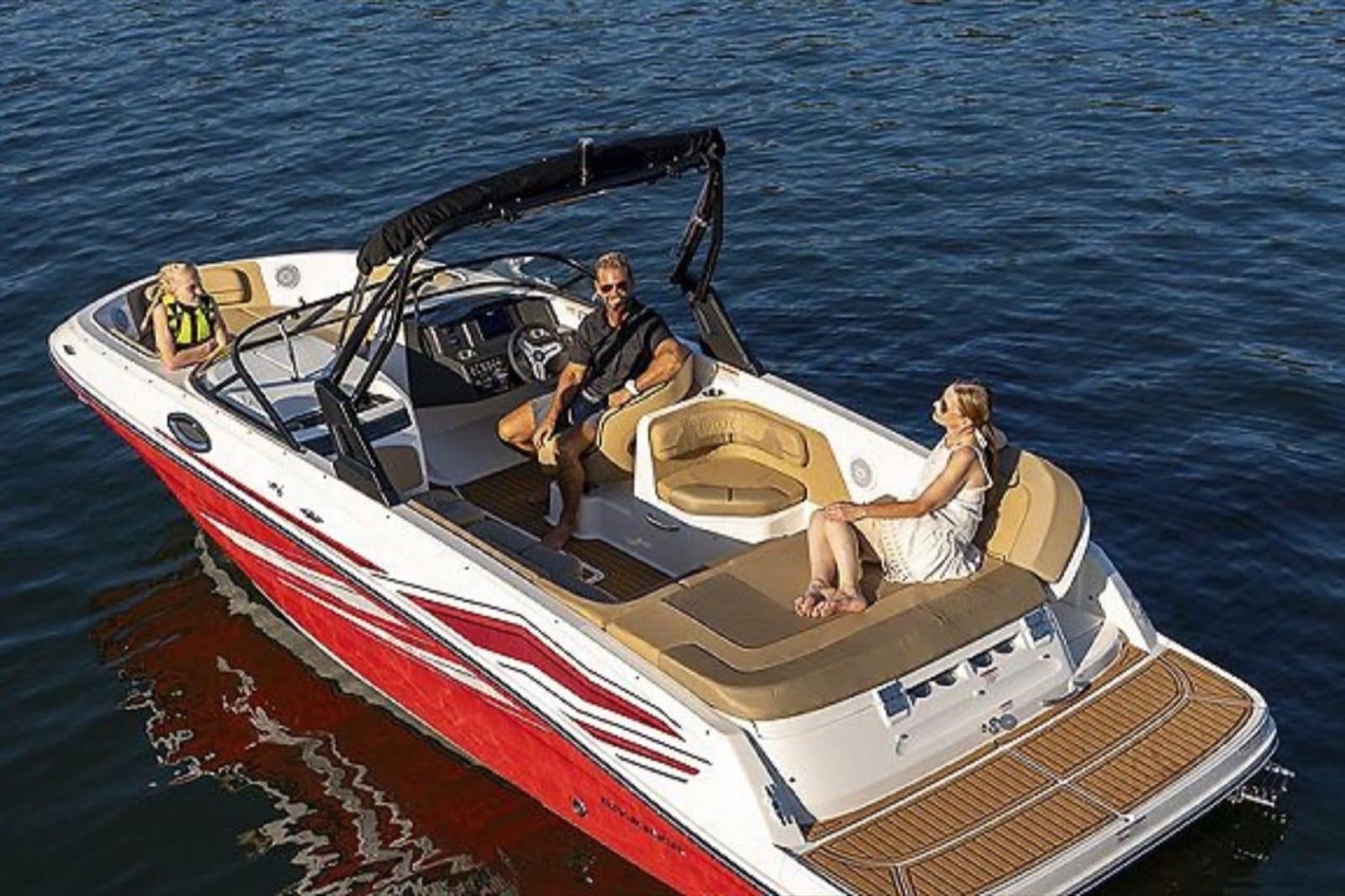
The Stingray 212SC is a 21-foot sterndrive bowrider built in Hartsville, South Carolina, and the model the company sells most of in the bowrider range. Stingray has been building boats since 1979 and the family-owned factory has been making the same kind of value-tier sport boats for the inland-lake market for most of that time. The 212SC has been in production in its current form since 2015, and the 2026 catalog keeps the same hull with refreshed graphics and minor trim updates.
What is the Stingray 212SC?
The 212SC is a 21-foot 5-inch fiberglass sterndrive bowrider on Stingray's Z-plane hull. Beam is 8 feet 2 inches, dry weight is about 3,400 pounds, and the boat trailers comfortably behind a half-ton truck with the right hitch setup. The Z-plane is the design feature Stingray markets and the one buyers notice on a sea trial. The hull has a stepped pad that reduces wetted surface at speed, so the boat tops out faster than the beam and weight would predict.
Power options across the production run have included MerCruiser 4.3L V6 and 4.5L V6 sterndrives at 220 to 270 horsepower, plus a Volvo Penta 5.0 option on some model years. The 4.5L at 250 horsepower is the most common used build and the engine most buyers default to. Fuel is 41 gallons. The drive is an Alpha One or a Bravo Three depending on the engine choice, with the Bravo handling the higher-horsepower builds.
The cockpit follows a familiar bowrider layout. Two captain chairs at the helm, a U-shaped seating area aft, a swim platform with a telescoping ladder, and the bow seating forward of a walkthrough. Storage is in-floor under a center hatch plus under most of the bench cushions. A head compartment in the port console is a popular dealer-add option but not standard.
I ran a 2020 212SC on Lake Murray in South Carolina on a humid August afternoon, three adults and two kids aboard. The boat hit a comfortable 48 mile per hour top end without feeling overpowered and held a 32 mile per hour cruise burning the kind of fuel you would expect from a low-strung gas sterndrive. The wake behind the boat was clean enough for tubing and the kids did not complain about the ride home. The vinyl on the rear bench had faded a half-shade darker than the rest of the boat, which is the finish issue Stingray owners flag most often after a couple of seasons in the sun.
Who is it good for?
First-time bowrider buyers on inland lakes. The 212SC is the boat most lake-day families end up at when they want a new boat for what a used Sea Ray or Chaparral costs. The Stingray badge does not carry the same broker premium, and the dollars saved at purchase go toward the trailer, the slip, and the first season of fuel.
Families running 30 to 50 hours a season. Stingray boats are sized for protected freshwater and short outings. They are not coastal cruisers, they are not weekend cabin boats, and they are not surf platforms. They are Saturday-on-the-water boats and they do that job well.
Buyers who want a tower option. Most 212SC builds at the dealer add a folding aluminum tower, which turns the boat into a workable tow platform for tubes and an entry-level wakeboard pull. The tower also adds a place to mount speakers and a Bimini, which is the setup most lake families want.
Who is it not good for?
Buyers who want segment-leading finish should walk past. The gelcoat, the upholstery, and the hardware on a Stingray sit a tier below a Sea Ray, a Chaparral, or a Cobalt at the same length. The shine fades quicker on south-exposed surfaces and the upholstery shows wear earlier than the bigger-brand competition.
Resale-first buyers should think hard about it. A five-year-old Stingray 212SC sells for less than the equivalent Sea Ray SPX 230 or Chaparral 19 H2O Sport, even when the boats are in similar condition. The depreciation curve is steeper, and the math only works if you plan to keep the boat ten years or more.
Crews that fill an 8-foot beam should look longer. The 212SC is 8 feet 2 inches wide and the cockpit is tight at six adults aboard. Families with two kids in tubes worth of friends should step up to a 23-foot SPX or a similar wider-beam build.
Pricing
New 2026 212SC pricing lands between roughly $58,000 and $72,000 depending on engine choice, dealer, and option package. The most common dealer build includes the 4.5L at 250 horsepower, the cockpit sound upgrade, a folding tower, and the bow filler cushion, which puts the typical out-the-door price near the middle of that range.
The used market for 2017-to-2023 hulls in clean shape with 100 to 300 hours falls between $22,000 and $42,000. The bottom of that band is a high-hour boat in a slow regional market with a 4.3L V6. The top is a low-hour 2022 with the 4.5L, a tower, and a current service file at a dealer that knows Stingray.
Five-year depreciation on a clean 212SC sits around 40 to 45 percent off new. That is steeper than the segment average and is the cost of the value-tier badge. Buyers who plan to flip in three to five years see most of that drop come out of their resale price.
What works
- Z-plane hull gives a faster top end than the beam and weight predict. Owners notice the speed first on a sea trial.
- Entry price is the best in the segment for a brand-new sterndrive bowrider from a dealer with a real warranty.
- MerCruiser 4.5L at 250 horsepower is a low-strung gas engine with predictable maintenance and parts everywhere.
- Tower option turns the boat into a workable tube and entry-level wakeboard platform.
- Trailerable footprint at 8 feet 2 inches beam keeps the boat inside normal towing rules in every state.
- Hartsville factory has been building Stingrays since 1979. The build records are consistent across the production.
- Bow seating is comfortable for two adults and the walkthrough does not feel narrow.
What doesn't
- Cockpit is tighter than a Sea Ray or a Chaparral at the same length. Six adults aboard feels full.
- Gelcoat finish is a tier below the bigger brands. The shine fades quicker on south-exposed surfaces and the upholstery shows wear earlier.
- Resale curve drops harder than Sea Ray, Chaparral, or Four Winns. The math only works on a long hold.
- Storage volume under the seats is modest. A long family weekend means gear ends up in the bow.
- Dealer network is regional. Buyers outside the Southeast and Midwest pay more for parts and warranty.
- Helm electronics package is basic on the standard build. Most buyers add the upgraded display.
Year-by-year notes
The 212SC launched in 2015 on the current Z-plane hull. The 2018 model added the option of the MerCruiser 4.5L V6 alongside the 4.3L. The 2020 model refreshed the graphics and trim panels and made the cockpit sound upgrade more common in dealer builds. The 2022 model added a cleaner helm electronics package and updated the upholstery patterns. The 2024 model refreshed minor trim and added a couple of color options. There is no defect cutover year to screen for, but the older 4.3L V6 boats are worth less on the used market than the equivalent 4.5L builds and that is the bigger pricing factor on the resale lot.
Cost of ownership
Annual recurring costs are average for the segment. MerCruiser 100-hour service costs $400 to $600 in parts and $400 to $500 in labor. Alpha One or Bravo Three impeller and gimbal-bearing service adds $400 to $600 per year. Bellows replacement at the two-to-three-year mark adds $1,200 to $1,700. Bottom paint on a freshwater slip-stored boat costs $250 to $400 in materials annually. Insurance on a $35,000 hull is $500 to $900 a year in most freshwater markets.
A five-year hold on a 2021 212SC bought at $34,000 with 130 hours, used 50 hours a season on Lake Lanier with trailer storage and an annual dealer service, lands at roughly $3,200 to $4,800 a year all-in. The capital cost is lower than a Sea Ray equivalent because the entry price was lower, which partly offsets the steeper depreciation curve.
Best year and trim to buy
The 2020-to-2023 212SC with the MerCruiser 4.5L at 250 horsepower, the folding tower, the cockpit sound upgrade, and a current bellows service in the file is the right buy in 2026. Five things to verify pre-purchase. First, the bellows service is current and dated. Second, the impeller and gimbal-bearing work are at the right hour mark. Third, the engine alarm history is clean on a tester pull. Fourth, the upholstery has not cracked at the seat-bottom seam where most failures show up first. Fifth, the trailer is sized for the boat and the bunks and rollers have been replaced if the boat is more than five years old. A clean 2022 with 150 hours and the right options should land between $34,000 and $40,000 with a Stingray-experienced dealer.
Alternatives
The other value cross-shop in the same segment is the Bayliner VR6, which sits at a similar price tier with a wider dealer network and a slightly lower resale curve. The step-up alternative at one length down is the Four Winns H190, where the finish and the resale strength are stronger at a modest price step. The premium-finish cross-shop at smaller length is the Chaparral 19 H2O Sport, which costs more new but holds its price better through year five. For families who want a Sea Ray badge at the same length, the SPX 230 is the bigger-brand alternative at a meaningful price step over the Stingray.