Origin and ownership
Pursuit was founded in 1977 in Belmont, Michigan. The brand built premium offshore center consoles and walkarounds and grew steadily through the 1980s and early 1990s. In 1995, S2 Yachts (the Slikkers family company that owns Tiara) acquired Pursuit and consolidated production at the Fort Pierce, Florida facility.
The Slikkers family has owned Pursuit since 1995 and the build philosophy has stayed consistent through the decades. Production is single-site at Fort Pierce, and the parts-and-service network shares infrastructure with Tiara, which is the practical advantage of the dual-brand structure.
Ownership has stayed family-held throughout. The Slikkers operate Tiara, Pursuit, and S2 Yachts under one parent and have not pursued external ownership or public markets. The structural stability is part of the brand argument.
Design philosophy
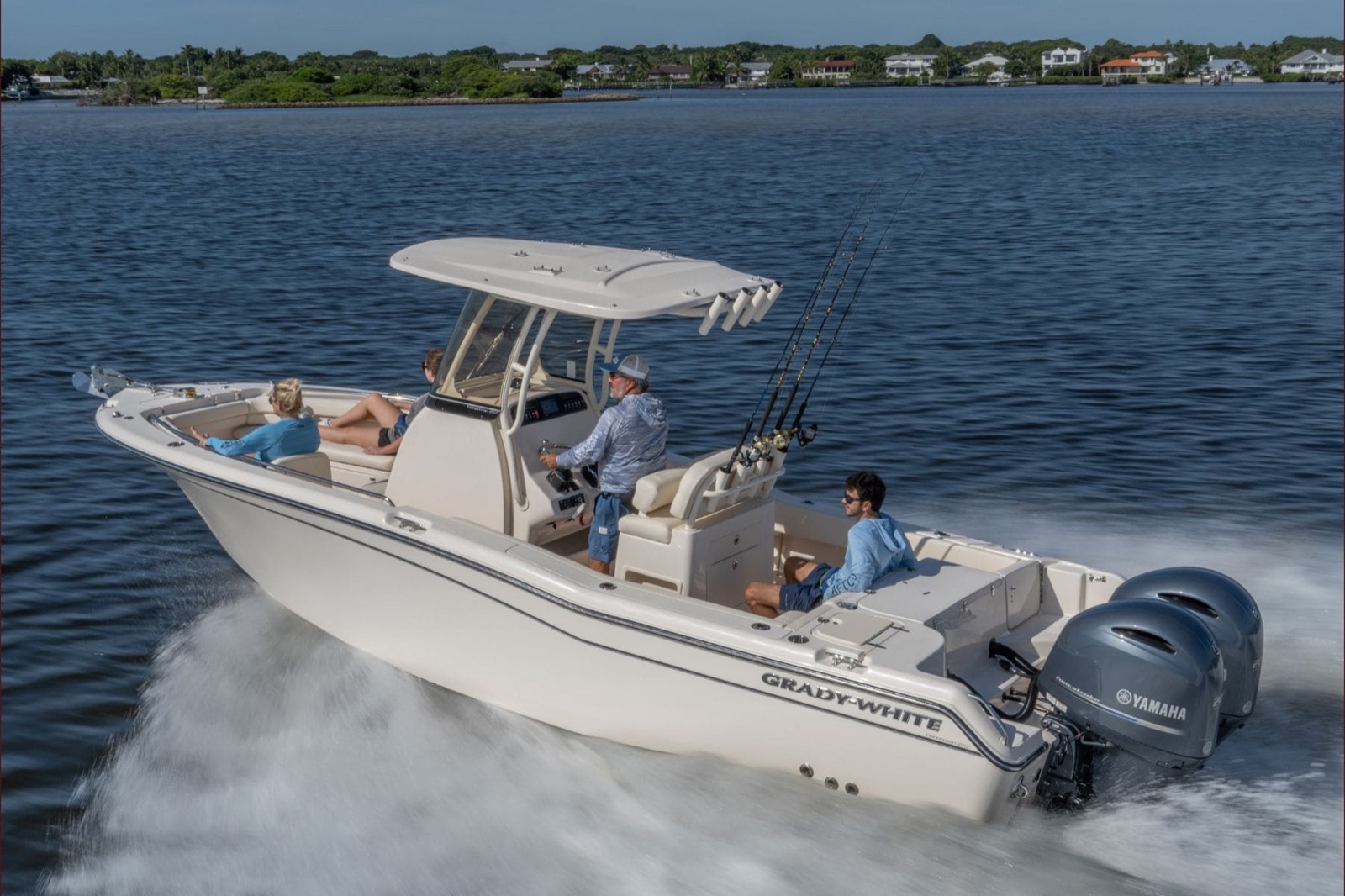
The Pursuit hull form sits between Grady-White's SeaV² and a sharper full-V. Transom deadrise typically runs 22 to 24 degrees on the OS line and 24 to 26 degrees on the Sport flagships. The hull rides slightly deeper in the water than a same-LOA Grady or Whaler at slow troll, which the brand argues gives better tracking in trolling-speed offshore work.
Yamaha is the dominant outboard rigging across the lineup. The factory tunes around the Yamaha torque curve and the parts-and-service is set up around Yamaha. Mercury is occasionally available as a dealer-special order on the OS line.
Construction uses hand-laid fiberglass with composite stringers across all current production. The transom cutover to all-composite happened in 2018, slightly later than Grady-White's 2016 cutover. Pre-2018 transoms in saltwater service warrant a moisture-meter check at survey.
Terminology you should know
- OS
- Open Sport. The volume center-console line, 22 to 36 feet, single to triple outboard rigging.
- DC
- Dual Console. Family-layout line with forward seating and port-side head, 23 to 32 feet.
- Sport / S series
- Sport flagship line. Center consoles 26 to 40 feet with triple or quad outboards, forward cabin on the 328 and up.
Used-market notes and known issues
The 2018 transom cutover is the screen for any used Pursuit shopping decision. Pre-2018 hulls used a plywood-cored transom; post-2018 hulls are all composite. Pre-2018 saltwater hulls warrant a moisture-meter check at survey.
Yamaha F300 V6 cylinder-wall corrosion pattern surfaces on 2017 to 2020 rigs without documented annual fresh-water flush history. Inspect on any used hull. The XTO 425 V8 does not show the same pattern.
Hardtop hardware on 2018 to 2020 hulls in salt-heavy markets shows pitting at the rear stanchion mounts. Cosmetic, refinish runs $1,500 to $2,500 at a marine fabrication shop.
Forward cabin condensation on Sport-class hulls in cold-climate use shows on the hull liner above the V-berth. Owner mod (closed-cell foam backing) is documented across owner-mechanic forum threads.
Dealer network shared with Tiara is concentrated in Florida, the Gulf, and the Northeast. West Coast and Pacific Northwest coverage is mid-density.
Resale
Pursuit holds resale tightly in the premium offshore segment. Three-year depreciation runs 12 to 18 percent on clean OS and Sport hulls. Five-year depreciation runs 25 to 32 percent. The family-held structure and the Tiara sister-brand parts pipeline both support the floor. The 408 Sport specifically trades within 14 to 18 percent below new at three years.
Where Pursuit fits
Buyers cross-shop Pursuit against Grady-White and Boston Whaler on the premium offshore center-console segment. The argument for Pursuit is the slightly deeper-V hull (better tracking at slow troll), the Tiara parts-and-service network, and the family-held production discipline. The argument against is the slight pricing premium over Grady or Whaler equivalents. Buyers who prioritize the SeaV² ride should stay with Grady. Buyers who prioritize the unsinkable construction should buy Whaler. Buyers who like the deeper-V tracking and the S2 family-held story buy Pursuit.