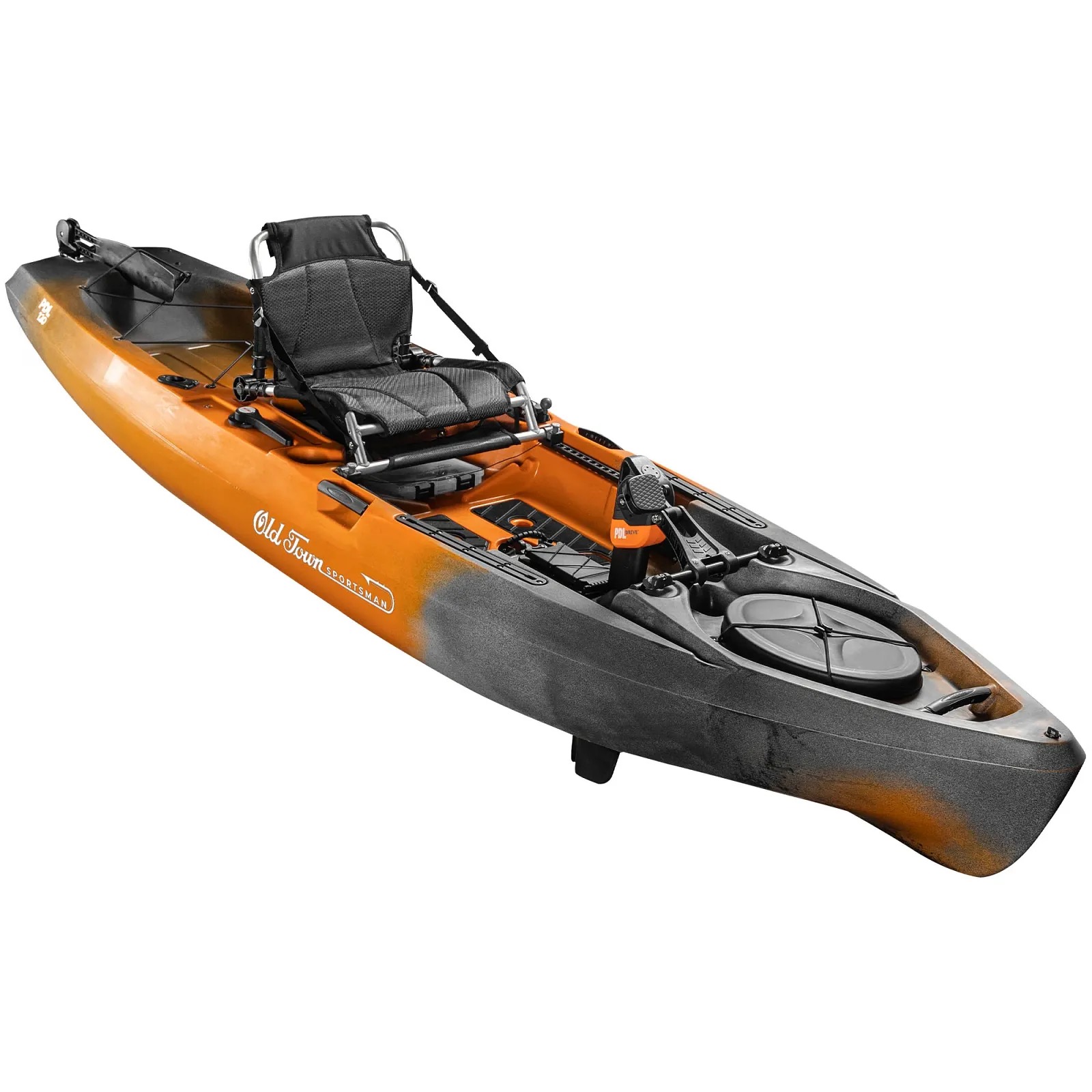
The Sportsman PDL 120 is Old Town's answer to a question Hobie wrote and priced at $5,800. The answer takes the platform back to roughly $3,000 and rebuilds it on a simpler prop drive, a 36-inch beam (two inches narrower than the Hobie), and a hull a meaningful 30-plus pounds lighter at the truck. For 80 percent of fishing situations, the trade is invisible. For the other 20, the Hobie pivot-in-place is real.
What the spec sheet says
Old Town publishes the Sportsman PDL 120's assembled weight at 116 lbs, of which the pedal console accounts for 19 lbs. Length 12 feet, beam 36 inches, total capacity 500 lbs with 384 lbs usable. Propulsion is the Old Town PDL Drive, fully sealed and saltwater-safe with a 5-year limited warranty. The hull is the Double-U design, optimized for primary lateral stability. Standard rigging includes a transducer scupper for fish-finder install, accessory tracks port and starboard, and the upgraded Element seat trim on the higher-spec model.
Source: Old Town Watercraft Sportsman PDL 120 product page and the Wired2Fish PDL Pro long-term review.
How owners describe it on the water
Wired2Fish's long-term review of the PDL platform reports cruise speeds around 3 mph at sustainable cadence, with sprint capability near 5 mph "with effort," and characterizes the hull as "a big, comfortable hull, which cuts down on its top speed." On standing stability, the same review concludes: "Standing is comfortable; I felt confident when pitching, changing lures, or fighting fish." The reviewer's takeaway on value at the Pro variant's $3,500 price point: a potential "buy once, cry once" investment.
Owner-forum cross-reference on kayak-fishing community sites turns up consistent reports of the PDL drive's reliability across multi-year ownership, with the saltwater-safe seal and 5-year warranty featuring prominently as ownership-cost reducers compared to alternatives that require regular service.
Build
Rotomolded polyethylene hull with the Double-U design that produces the strong primary stability the platform is known for. Hardware is mid-tier and rigging quality on the Element trim is honest at the price point, one notch under Hobie's anodized aluminum and stainless throughout but more than serviceable for the segment.
Assembled at 116 lbs, the PDL 120 is roughly 32 lbs lighter than the Hobie Pro Angler 14's fully rigged 148.5 lbs. Solo anglers loading onto a truck rack feel the difference weekly, and Wired2Fish was direct about it: "not a kayak you'll want to throw on a roof rack solo," but more workable than the Hobie at the same task.
Performance
The PDL prop drive is mechanically simpler than the MirageDrive. A single propeller turns under the hull, forward-only at the pedals, with a clutch lever at the gunwale that disengages drive for paddling backward or for casting drift. Wired2Fish describes the system as offering "instant forward and reverse for rapid positioning." It is fully sealed and saltwater-safe with a 5-year warranty.
The trade vs the Hobie is the lack of true 360-degree pivot. To turn the bow in place without paddling, the PDL 120 requires rudder input combined with pedal cadence. For lake bass, panfish, and slow-river work, that limitation is invisible. For sight-casting moving redfish or for fishing structure where pivot-in-place matters, the Hobie pulls clearly ahead.
Cruise sits around 3 mph sustainable, with 5 mph available at sprint per Wired2Fish testing. On a 12-foot hull this is appropriate; the longer 13'8" Hobie carries more waterline and pulls ahead on transit and current-fighting.
Accommodations
The 36-inch beam is the segment second-tier. Standing platforms work for anglers under 220 lbs without complaint per owner reports and remain workable up to 240 lbs with practiced foot placement. The Pro variant introduces an adjustable sliding seat on a shuttle track that, per Wired2Fish, positions users in a "more natural position, especially when pedaling or transitioning to standing." A fit caveat from the same review: anglers with inseams shorter than approximately 29 inches "may struggle reaching the pedals."
Storage is honest for the price tier. Two bow hatches, a tank well sized for a Yeti Tundra 35 plus a tackle crate, and accessory tracks port and starboard accept most aftermarket mounts. Less than the Hobie's segment-leading storage, but enough for a long day of fishing.
Systems
Transducer scupper for fish-finder install, factory-positioned for popular sonar units. The PDL drive lifts out with a carry handle for car-topping or service access, matching the Hobie on convenience. The 5-year warranty on the drive itself is meaningfully longer than what most pedal-kayak builders offer.
Value and resale
The strongest pure-value pick in the standing-angler segment. Roughly $3,000 new for a real pedal-drive kayak with a stable standing platform and a premium-spec seat is the math that brings first-time buyers into the segment without a $5,800 commitment. Used at $2,200 for a 2023 hull is the entry that ends the question for an angler who fishes 10 to 30 days a year.
Resale runs in the range of 30 percent depreciation at three years for clean hulls, slightly behind the Hobie's segment-leading 25 percent but ahead of the segment average. Old Town brand recognition supports steady used demand.
Ownership cost (2026 estimate)
| Line item | Annual |
|---|---|
| PDL drive service (prop, clutch lever, gear bushing) | $50 |
| Storage (indoor rack, regional avg) | $300 to 600 |
| Insurance ($3,000 hull) | $50 |
| Transducer, battery, accessories amortized | $150 |
| Total | $550 to 850 / yr |
The PDL drive's 5-year manufacturer warranty plus the saltwater-safe seal mean replacement budget tracks lower than for competitive pedal drives. Outside warranty, expect $400 to 600 for a full drive replacement.
Best year to buy
2022 to 2024 hulls with the PDL drive and the Element seat trim. The 2021 model has the older universal seat (one notch below Element), worth a $300 discount on a used buy. The Pro variant introduced in recent model years adds the sliding-track seat and a more refined deck layout : worth the upcharge if available in budget. A 2023 hull at $2,200 to 2,400 with low hours and a verified PDL drive is the sweet spot of the used market in 2026.