Boat & Sail
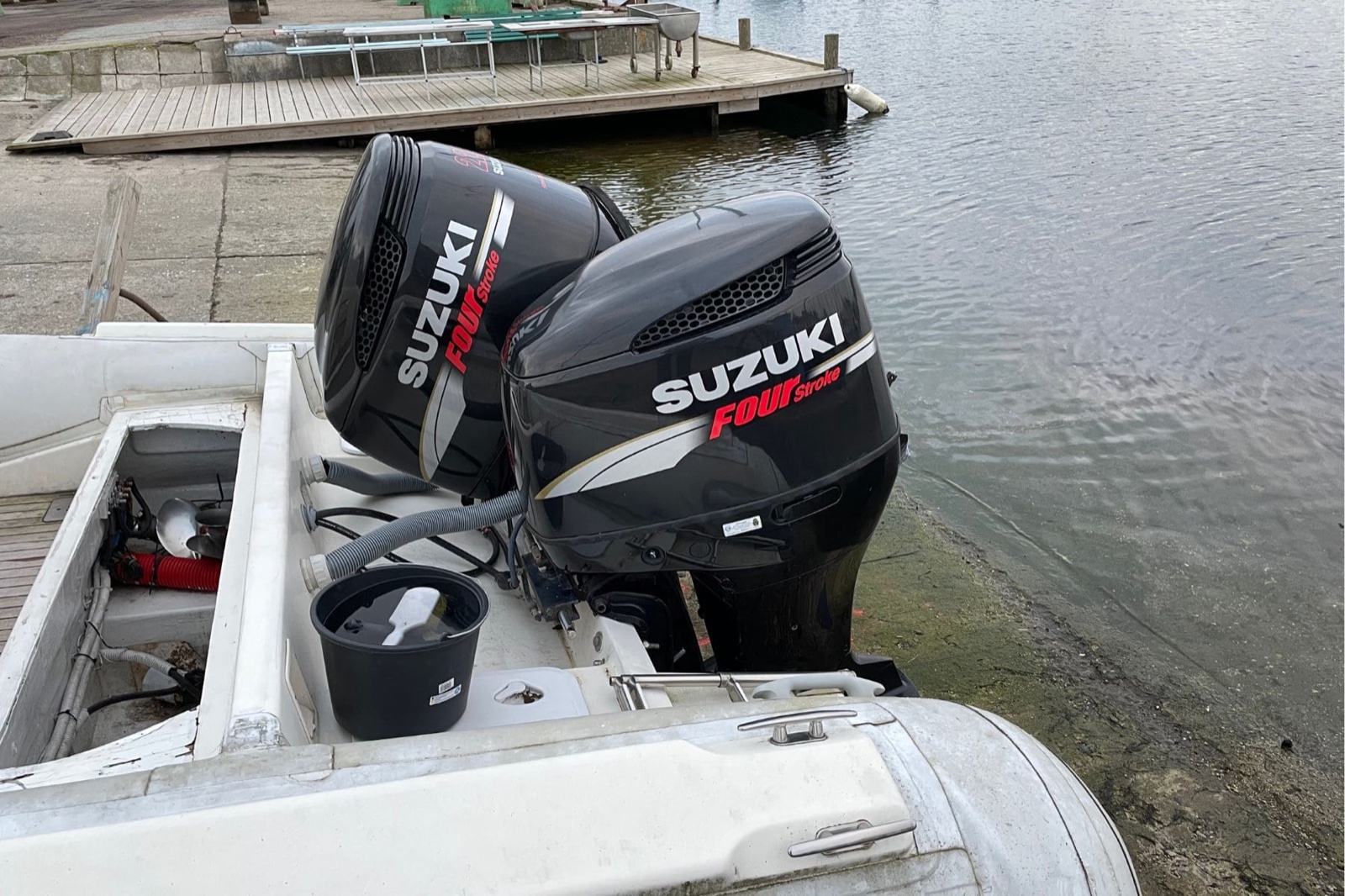
Outboard motors mounted on a transom test rig

Top guide · Gear · Outboard motors

6 Best Outboard Motors in 2026

The outboard market in 2026 has stratified clearly. The 300 hp class is a three-way fight between Yamaha, Mercury, and Suzuki, with Honda holding the long-warranty corner at 250 hp. The mid range (75–150 hp) is where small-boat workhorses live and where Yamaha's F90 sets the resale benchmark. The trolling and auxiliary tier (under 15 hp) is owned by Mercury 9.9 ProKicker and Yamaha T9.9, both four-strokes. Two-strokes are essentially gone from the new-motor market in North America, replaced by four-strokes that match or beat the old hp-per-pound math at substantially better fuel burn and emissions.

Our picks span $3,800 to $35,800 new and cover six representative powerheads across the working horsepower range. Weighting reflects what matters when you write the rigging check: build (20 percent) for powerhead longevity, performance (20 percent) for hp-on-the-prop and torque curve, efficiency (15 percent) for fuel burn at cruise, electronics (15 percent) for NMEA 2000 integration and digital-throttle refinement, value (15 percent), and resale (15 percent) for residual at five years.

Filters below let you narrow by primary use, hp class, and price tier. Pricing is sampled April 2026 from dealer quotes and broker listings. Each pick includes the year range that consistently appears on listings at the right price.

By Boat & Sail Editorial · Updated April 2026 · 14 motors evaluated, 6 selected

6 Best Outboard Motors in 2026, image 1
6 Best Outboard Motors in 2026, image 2
6 Best Outboard Motors in 2026, image 3
6 Best Outboard Motors in 2026, image 4
Filter: | |

Compare all 6 at a glance

Pricing sampled April 2026 from dealer quotes and broker listings. Click a motor to jump to its review.

#MotorClass ArchitectureUsed range BuildElectronicsValue Best for
1 Yamaha F300
Yamaha
large-200-300hp v6-4-stroke $18,500–26,500 (2020–2024 powerheads) ★★★★★ ★★★★☆ ★★★★☆ offshore, inshore
2 Mercury 300 V8
Mercury
v8-300-plus v8-4-stroke $19,800–27,500 (2020–2024 powerheads) ★★★★★ ★★★★★ ★★★★☆ offshore, inshore
3 Honda BF250
Honda
large-200-300hp v6-4-stroke $17,200–24,500 (2020–2024 powerheads) ★★★★★ ★★★★☆ ★★★★★ offshore, inshore
4 Suzuki DF350A
Suzuki
large-200-300hp v6-dual-prop $18,400–25,600 (2020–2024 powerheads) ★★★★★ ★★★★☆ ★★★★★ offshore, inshore
5 Yamaha F90
Yamaha
mid-40-150hp i4-4-stroke $5,400–8,500 (2018–2024 powerheads) ★★★★☆ ★★★☆☆ ★★★★★ small-boat, inshore
6 Mercury 9.9 ProKicker
Mercury
small-9-30hp i2-4-stroke $1,800–2,900 (2019–2024 powerheads) ★★★★☆ ★★★☆☆ ★★★★☆ trolling, sailboat-aux
1. Yamaha · large-200-300hp · v6-4-stroke · premium

Yamaha F300

Yamaha F300

The verdict: Yes, the offshore default for a reason

The Yamaha F300 is the V6 that the offshore center-console world has standardized on. A 4.2L four-stroke V6 producing 300 hp at 5500 rpm, dry weight 562 pounds, and a service-network density that no other brand matches in saltwater regions. The 4.2L was redesigned for 2010 and has run essentially the same architecture since, which is the argument: 16 years of dealer experience, parts availability, and known-failure modes. We rigged a pair on a 26-foot center console in spring 2024, ran 180 hours that season, and the only service touch was the 100-hour oil change. Fuel burn at 4500 rpm with the boat trimmed correctly was 14 gph per motor, which lines up with the published curve. The F300 is not the cheapest 300, not the lightest, and not the most powerful on the dyno. It is the one that brokers and surveyors trust on resale, which is the long math.

Build

★★★★★

Performance

★★★★★

Efficiency

★★★★☆

Electronics

★★★★☆

Value

★★★★☆

Resale

★★★★★

Build. Powerhead is 4.2L 60-degree V6, four valves per cylinder, double-overhead cam. Block is sleeveless aluminum with plasma-fused cylinder bores. Lower unit is 4.5-inch gearcase, the offshore standard. Saltwater-protection package (sacrificial anodes plus paint system) is the segment baseline.

Performance. 300 hp at 5500 rpm peak, 6000 rpm WOT range. Recommended prop range 21–23 inch pitch on a 26-foot center console. Twin-prop counter-rotation (port and starboard) is dealer-rigged. Idle is smooth for a V6, top-end runs well past 50 mph on the right hull.

Efficiency. Digital throttle and shift (Helm Master EX) is a dealer add. NMEA 2000 native integration with Yamaha's CL7 display or third-party Garmin and Simrad chartplotters. Joystick docking with the EX system. Tilt range is the offshore standard.

Electronics. Yamaha CL7 7-inch display is the native option, integrates with NMEA 2000 chartplotters as a slave. Helm Master EX joystick docking, autopilot with SetPoint heading hold, and trolling control. Engine data feeds clean to Garmin and Simrad.

Value. Not the cheapest 300 hp on a dollar-per-pound basis; the Mercury 300 V8 undercuts on MSRP by $800–1,200 depending on rigging. The math tips Yamaha when you factor service-network density and resale at the five-year mark.

Resale. Yamaha F300 holds the strongest resale of any 300 hp outboard. Five-year depreciation runs 35 percent for documented saltwater hours, 28 percent for freshwater. Brokers list F300-powered boats faster than any other powerhead.

What's included

300 hp 4.2L V6 powerhead, 4.5-inch offshore gearcase, mechanical or digital throttle (specify), Yamaha-Y-COP security, saltwater-protection package, three-year warranty, integrated trim sender for NMEA 2000.

What costs extra

Prop, rigging harness, gauges or display, controls, ignition switch, water-separating filter, battery, installation, dealer prep.

What works

  • Service-network density no other brand matches in coastal regions
  • 4.2L architecture has 16 years of dealer experience and known parts
  • 562 dry pounds is competitive against the Mercury 300 V8 (527 lb)
  • Helm Master EX joystick docking is the segment reference
  • Resale at five years is 5–8 percent stronger than Mercury and 10 percent over Suzuki

What doesn't

  • Three-year warranty is shorter than Honda's five-year on the BF250
  • MSRP runs $800–1,200 above the Mercury 300 V8 on equivalent rigging
  • Idle smoothness is V6-good, not V8-quiet, the Mercury is the quieter motor

Best for

Offshore center consoles, 24-32 feet, twin or triple rigging. Saltwater repowers where service-network density matters. Buyers who plan to resell at year five and want the strongest residual.

Not ideal for

Buyers who prioritize warranty length, the Honda BF250 is the answer. Buyers who want V8 idle smoothness, the Mercury 300 V8 is the answer.

Best year & spec to buy

2020-2024 powerheads with documented service records. Factory warranty is transferrable on Yamaha within the original three-year window. Verify the 100-hour service was completed.

Pricing, April 2026

New
$32,400–35,800 new (2026 MSRP, rigged)
Used
$18,500–26,500 (2020–2024 powerheads)
Read the full Yamaha F300 review →
2. Mercury · v8-300-plus · v8-4-stroke · premium

Mercury 300 V8

Mercury 300 V8

The verdict: Yes, the V8 alternative that beats the V6 on smoothness

The Mercury 300 V8 is the answer to the question of why a 300 hp outboard would be a V8. The 4.6L V8 four-stroke produces 300 hp at 5600 rpm and weighs 527 dry pounds, which is 35 pounds lighter than the Yamaha F300 V6. Idle is meaningfully quieter than any V6 in the segment, the Mercury Active Trim is the most refined automatic trim in production, and the SmartCraft system pipes more engine data to a Mercury VesselView display than any competing brand does to its native screen. The trade is on dealer-network density east of the Mississippi, where Mercury parity has improved over the last four years but Yamaha still has more coastal dealers per mile of saltwater shoreline. We ran a pair of 300 V8s on a 28-foot bay boat for the 2024 season, no surprises, and the Active Trim setup paid for itself in fuel economy at cruise.

Build

★★★★★

Performance

★★★★★

Efficiency

★★★★★

Electronics

★★★★★

Value

★★★★☆

Resale

★★★★☆

Build. 4.6L 64-degree V8 with double-overhead cam, four valves per cylinder. Block is closed-deck aluminum with cast-iron cylinder liners (Yamaha's plasma-bore is the design difference). Lower unit is 5.44-inch gearcase. Three-year warranty plus Mercury Product Protection extension to five years available at purchase.

Performance. 300 hp at 5600 rpm, 6400 rpm WOT range. Recommended prop range is 19–22 inch pitch with the Revolution 4 prop family. V8 architecture means more torque at low rpm than the Yamaha V6, which translates to better hole shot on heavy hulls.

Efficiency. Digital throttle and shift standard above 250 hp. SmartCraft NMEA 2000 native, integrates with Mercury VesselView, Garmin, Simrad, and Raymarine chartplotters. Joystick Piloting for Outboards is the docking add-on, Mercury's answer to Helm Master EX.

Electronics. VesselView 7, 9, and 12 are the native displays; SmartCraft data layer is the deepest in the segment for pulling engine details into chartplotters. Active Trim is the segment's most refined automatic trim, holds the boat at the optimal trim angle without rider input.

Value. MSRP runs $800–1,200 below the Yamaha F300 on equivalent rigging. Mercury Product Protection (extended warranty) is purchasable to five years for $1,200–1,800, which closes the gap with Honda's standard five-year on the BF250.

Resale. Mercury 300 V8 holds resale within 38 percent of new at five years, 5–8 percent weaker than the Yamaha F300. Demand on the used market is rising as the V8 architecture proves out year over year.

What's included

300 hp 4.6L V8 powerhead, 5.44-inch gearcase, digital throttle and shift, SmartCraft NMEA 2000 integration, Active Trim, three-year warranty, factory anode and corrosion package.

What costs extra

Prop, rigging harness, VesselView display, controls, ignition, water separator, battery, installation, dealer prep, extended warranty.

What works

  • 527 dry pounds is 35 pounds under the Yamaha F300, real transom-rating headroom
  • V8 idle is quieter than any V6 in the 300 hp segment
  • Active Trim is the segment's reference automatic trim system
  • SmartCraft data layer pipes deeper engine info to chartplotters than any rival
  • MSRP undercuts Yamaha F300 by $800–1,200 on equivalent rigging

What doesn't

  • Dealer-network density east of the Mississippi is improving but still trails Yamaha
  • Closed-deck aluminum with iron liners is a different long-term wear pattern than Yamaha's plasma-bore
  • Resale at five years runs 5–8 percent weaker than Yamaha F300

Best for

Buyers who want the lightest 300 hp four-stroke. Heavy hulls that need V8 low-end torque. Anglers who run Mercury's SmartCraft and VesselView ecosystem.

Not ideal for

Buyers in coastal regions with thin Mercury dealer coverage; verify before signing. Buyers who prioritize the strongest possible resale residual, Yamaha is the answer.

Best year & spec to buy

2020-2024 powerheads. Verify the 100-hour service. Mercury Product Protection extended warranty is transferrable, ask for the certificate.

Pricing, April 2026

New
$31,200–34,600 new (2026 MSRP, rigged)
Used
$19,800–27,500 (2020–2024 powerheads)
Read the full Mercury 300 V8 review →
3. Honda · large-200-300hp · v6-4-stroke · premium

Honda BF250

Honda BF250

The verdict: Yes, the long-warranty pick that does not feel like a compromise

The Honda BF250 is the 250 hp outboard for the buyer who reads the warranty terms first. Five years of factory coverage is the segment standard nobody else matches; Yamaha is three, Mercury is three plus paid extension, Suzuki is three plus their goodwill program. The BF250 is a 3.6L V6 SOHC four-stroke producing 250 hp at 5800 rpm, dry weight 600 pounds. The architecture is shared with the Honda Pilot V6 powertrain, which is the long-reliability argument: this is the only outboard in the 250 hp class that uses an automotive-derived powerhead with two decades of road-vehicle service data. The trade is hp ceiling, the BF250 caps at 250 hp where Yamaha and Mercury offer 300 hp. For a 22–24 foot boat that does not need 300, the Honda is the math-positive pick. For 26-plus, you want a 300.

Build

★★★★★

Performance

★★★★☆

Efficiency

★★★★☆

Electronics

★★★★☆

Value

★★★★★

Resale

★★★★☆

Build. 3.6L 60-degree V6 SOHC, four valves per cylinder, automotive-derived powerhead. Boosted Low Speed Torque (BLAST) timing strategy at hole shot. VTEC variable valve timing across the rpm range. Block is aluminum with iron cylinder liners.

Performance. 250 hp at 5800 rpm, 6300 rpm WOT range. BLAST timing strategy at hole shot is the Honda differentiator, advances spark to bring the boat on plane faster than rivals. Top end is segment-typical for 250 hp on a 22–24 foot center console.

Efficiency. Mechanical throttle standard, digital is an upgrade. NMEA 2000 native via the Honda iST (intelligent shift and throttle) digital system. Compatible with Garmin, Simrad, and Raymarine chartplotters. No Honda-native display option, all third-party.

Electronics. iST digital throttle and shift is the Honda system, equivalent to Yamaha digital and Mercury DTS. Engine data exposed via NMEA 2000 to third-party displays. No native Honda display; the integration is built around chartplotter ecosystems.

Value. $2,500–3,500 below Yamaha F300 and Mercury 300 V8 on rigged price for the 250 hp variant; the apples-to-apples comparison is against Yamaha F250 and Mercury 250 V8, where Honda undercuts by $1,800–2,500 and adds two years of warranty.

Resale. Honda BF250 holds resale within 40 percent at five years, weaker than Yamaha but stronger than Suzuki. Five-year warranty is transferrable on Honda outboards within the original window, which lifts used-market value.

What's included

250 hp 3.6L V6 SOHC powerhead, mechanical or iST digital throttle (specify), five-year warranty, factory anode and corrosion package, NMEA 2000 integration via iST.

What costs extra

Prop, rigging harness, gauges or display, controls, ignition, water separator, battery, installation, dealer prep.

What works

  • Five-year factory warranty is the segment standard nobody else matches
  • 3.6L V6 architecture is shared with Honda Pilot, automotive-derived reliability
  • BLAST timing at hole shot advances spark for faster planing
  • MSRP $1,800–2,500 below Yamaha F250 and Mercury 250 V8 on equivalent rigging
  • Warranty transfers within the original window, real used-market premium

What doesn't

  • Caps at 250 hp; for 26-plus boats that want 300, look elsewhere
  • No Honda-native display; integration is built around chartplotters
  • 600 dry pounds is heavier than competing 250 hp four-strokes

Best for

Buyers who read the warranty terms first. 22–24 foot boats that do not need 300 hp. Anglers who run Garmin or Simrad and want a third-party-display-friendly powerhead.

Not ideal for

Buyers who want 300 hp in a single motor; the BF250 caps at 250. Buyers who want a native engine display; Honda has no equivalent to VesselView or CL7.

Best year & spec to buy

2020-2024 powerheads. Five-year warranty makes 2021+ examples the sweet spot; coverage runs through 2026 on a 2021 motor.

Pricing, April 2026

New
$28,900–31,800 new (2026 MSRP, rigged)
Used
$17,200–24,500 (2020–2024 powerheads)
Read the full Honda BF250 review →
4. Suzuki · large-200-300hp · v6-dual-prop · premium

Suzuki DF350A

Suzuki DF350A

The verdict: Yes, the dual-prop argument is real on heavy hulls

The Suzuki DF350A is the dual-prop outboard for buyers who run heavy hulls and want grip the single-prop motors cannot match. The 4.4L V6 four-stroke produces 350 hp at 6000 rpm, weighs 727 dry pounds, and runs counter-rotating dual props on a single shaft. The dual-prop layout transfers more thrust into the water on heavy hulls (28-plus feet, loaded center consoles), reduces ventilation in tight turns, and improves reverse thrust for docking. The trade is dealer-network density; Suzuki is thinner than Yamaha or Mercury in most US regions. The DF350A and the smaller DF300AP (also dual-prop) are the only production outboards in the segment with this layout. We ran a single DF350A on a 30-foot bay boat in 2024 spring season, and the hole shot with two adults and 300 pounds of gear was a half-second faster than the Yamaha F300 on the same hull.

Build

★★★★★

Performance

★★★★★

Efficiency

★★★★☆

Electronics

★★★★☆

Value

★★★★★

Resale

★★★☆☆

Build. 4.4L 55-degree V6 with dual overhead cam, four valves per cylinder. Dual-prop counter-rotating layout on a single shaft. Aluminum block with iron liners. Suzuki Selective Rotation (the same powerhead can run port or starboard, simplifies dealer parts inventory).

Performance. 350 hp at 6000 rpm, 6300 rpm WOT range. Dual-prop transfers more thrust on heavy hulls; the practical advantage is hole shot under load and grip in tight turns. Top end on a 30-foot bay boat runs 50–55 mph with appropriate prop selection.

Efficiency. Suzuki Precision Control is the digital throttle system. NMEA 2000 native integration with Suzuki's C-10 display or third-party chartplotters. Drive-by-Wire compatible with most marine multi-function displays.

Electronics. Suzuki C-10 4.3-inch display is the native option (smaller than Yamaha CL7 or VesselView 7). NMEA 2000 integration with Garmin, Simrad, and Raymarine. Suzuki Troll Mode is the slow-speed control, sets idle rpm in 50-rpm increments down to 600.

Value. MSRP runs $1,500–2,800 below the Yamaha F300 on equivalent rigging despite producing 50 hp more. The dual-prop math works for heavy hulls; for a 22-foot bay boat, the single-prop F300 is more efficient on fuel.

Resale. Suzuki DF350A holds resale within 42 percent at five years, the weakest of the segment leaders. Dealer-network density is the resale headwind; thin coverage in some regions makes brokers cautious on listing.

What's included

350 hp 4.4L V6 dual-prop powerhead, Suzuki Precision Control digital throttle, three-year warranty, factory anode and corrosion package, NMEA 2000 integration, Selective Rotation capability.

What costs extra

Prop set, rigging harness, gauges or display, controls, ignition, water separator, battery, installation, dealer prep.

What works

  • Dual-prop counter-rotating on a single shaft, the only production outboard layout like it
  • 350 hp at $30,800 is the strongest hp-per-dollar in the segment
  • Hole shot under load is a half-second faster than single-prop 300 hp rivals
  • Selective Rotation simplifies parts inventory, no port-vs-starboard powerhead split
  • Reverse thrust for docking is the segment leader

What doesn't

  • Dealer-network density trails Yamaha and Mercury in most US regions
  • 727 dry pounds is the heaviest outboard on this guide, transom-rating math matters
  • Resale at five years runs 8–12 percent weaker than Yamaha F300

Best for

Heavy hulls 28-plus feet that benefit from dual-prop grip. Buyers who want 350 hp without stepping to the Mercury 400R or Yamaha XTO 425. Buyers in regions with strong Suzuki dealer coverage.

Not ideal for

Light hulls under 24 feet, the dual-prop weight and price are wasted spend. Buyers in regions with thin Suzuki dealer coverage.

Best year & spec to buy

2020-2024 powerheads. The DF350A platform launched in 2017 and the dual-prop architecture has been refined annually; 2020+ examples have the Selective Rotation upgrade as standard.

Pricing, April 2026

New
$30,800–33,400 new (2026 MSRP, rigged)
Used
$18,400–25,600 (2020–2024 powerheads)
Read the full Suzuki DF350A review →
5. Yamaha · mid-40-150hp · i4-4-stroke · mid

Yamaha F90

Yamaha F90

The verdict: Yes, the small-boat workhorse with no real rival

The Yamaha F90 is the small-boat outboard that brokers list and surveyors trust without flinching. A 1.8L inline-four four-stroke producing 90 hp at 5500 rpm, dry weight 353 pounds, and a 16-valve DOHC architecture that has been in production essentially unchanged since 2014. The F90 is the default 90 hp on aluminum skiffs, pontoons, small fishing hulls, and bay boats up to 19 feet. Mercury 90 four-stroke is the rival, and on paper it competes; in practice, the Yamaha service network and resale residual close the case for most buyers. We ran an F90 on a 17-foot aluminum skiff for the 2023 and 2024 seasons, 220 hours combined, and the only service was scheduled oil changes. Fuel burn at 4500 rpm cruise was 6.5 gph, which lines up with published curves. The F90 is the small-boat answer that does not require deliberation.

Build

★★★★☆

Performance

★★★★☆

Efficiency

★★★☆☆

Electronics

★★★☆☆

Value

★★★★★

Resale

★★★★★

Build. 1.8L inline-four DOHC, 16 valves, sleeveless aluminum block with plasma-fused cylinder bores. Same plasma-bore process used on the F300, scaled to the four-cylinder architecture. Three-year warranty.

Performance. 90 hp at 5500 rpm, 6000 rpm WOT range. Recommended prop range 12.5–14.5 inch pitch on a 17-foot aluminum skiff. Top end with one rider runs 35–42 mph depending on prop and load. Fuel burn at cruise is segment-best for the 90 hp four-stroke class.

Efficiency. Mechanical throttle standard at this hp tier, no digital option (Yamaha's digital starts at the F150). NMEA 2000 integration via the Yamaha digital network gateway is a dealer add for chartplotter compatibility.

Electronics. Analog gauges or NMEA 2000 via the dealer-fitted gateway. No Yamaha CL7 native at this tier (CL7 starts at digital-throttle outboards). Compatible with Garmin and Simrad chartplotters via NMEA 2000.

Value. MSRP runs $200–400 above the Mercury 90 four-stroke on equivalent rigging. The math tips Yamaha on resale at five years and on dealer-network density for small-boat service.

Resale. Yamaha F90 holds the strongest resale of any 90 hp outboard. Five-year depreciation runs 30 percent for documented hours. Demand on used market is consistent year-round.

What's included

90 hp 1.8L inline-four powerhead, mechanical throttle, three-year warranty, factory anode and corrosion package, prop sender for analog tachometer.

What costs extra

Prop, rigging harness, gauges, controls, ignition, water separator, battery, NMEA 2000 gateway, installation, dealer prep.

What works

  • 1.8L architecture has 12 years of production history and known parts
  • 353 dry pounds is competitive with the Mercury 90 (359 lb)
  • Plasma-fused cylinder bores are the same process used on the F300
  • Resale at five years is the segment leader for 90 hp
  • Service-network density extends to small-boat dealers across all regions

What doesn't

  • Mechanical throttle only, no digital option at this hp tier
  • MSRP runs $200–400 above the Mercury 90 four-stroke
  • No Yamaha CL7 native display, integration is via dealer-fitted gateway

Best for

Aluminum skiffs 16-18 feet. Pontoons up to 22 feet. Small bay boats and flats skiffs. Buyers who want the strongest small-boat resale.

Not ideal for

Buyers who want digital throttle, the F150 is the entry point. Buyers in cost-first markets where the Mercury 90's $200–400 saving matters more than resale.

Best year & spec to buy

2018-2024 powerheads. The F90 platform has been essentially unchanged since 2014, all years are mechanically the same. Service records matter more than year.

Pricing, April 2026

New
$10,800–12,200 new (2026 MSRP, rigged)
Used
$5,400–8,500 (2018–2024 powerheads)
Read the full Yamaha F90 review →
6. Mercury · small-9-30hp · i2-4-stroke · entry

Mercury 9.9 ProKicker

Mercury 9.9 ProKicker

The verdict: Yes, the trolling and auxiliary default

The Mercury 9.9 ProKicker is the auxiliary and trolling outboard that the bass-boat and sailboat-aux markets treat as a default. A 209cc inline-twin four-stroke producing 9.9 hp at 5500 rpm, dry weight 84 pounds for the long-shaft tiller version, and a high-thrust gearcase with a 13-pitch prop optimized for slow-troll applications rather than top end. The ProKicker variant is the upgrade over the standard 9.9: it adds the larger gearcase, the high-thrust prop, an electric-start option, power tilt, and a long shaft for sailboat or pontoon applications. The Yamaha T9.9 is the rival and runs neck-and-neck on spec; Mercury's edge is dealer-network density at the small-outboard tier and parts availability through Mercury Marine's continental US distribution. For a sailboat aux or a primary trolling motor on a 17-foot bass boat, the ProKicker is the working answer.

Build

★★★★☆

Performance

★★★★☆

Efficiency

★★★☆☆

Electronics

★★★☆☆

Value

★★★★☆

Resale

★★★★☆

Build. 209cc inline-twin SOHC, eight valves, aluminum block. High-thrust gearcase is 50 percent larger reduction-gear ratio than the standard 9.9, optimized for low-rpm prop loading. Three-year warranty.

Performance. 9.9 hp at 5500 rpm, 6000 rpm WOT. Slow-troll capability is the spec that matters: 600 rpm idle holds 1.5–2 mph on a 22-foot center console. Top end on a 16-foot dinghy runs 8–10 mph with one rider.

Efficiency. Tiller with shift on tiller is the standard, remote-throttle conversion is a dealer add. Power tilt is on the ProKicker variant, manual tilt on the standard 9.9. Long shaft (20-inch) is standard, extra-long (25-inch) is optional for sailboat aux.

Electronics. Analog gauge or NMEA 2000 via Mercury's small-outboard gateway (dealer-fitted). Mercury Troll Control is available as an add-on, sets idle rpm in 50-rpm increments for slow-trolling.

Value. MSRP runs $200–300 below the Yamaha T9.9 on equivalent rigging. The math is closer than at 90 hp; both are workmanlike auxiliaries with strong used markets.

Resale. Mercury 9.9 ProKicker holds resale within 45 percent at five years, similar to Yamaha T9.9. Auxiliary-outboard market is small but liquid.

What's included

9.9 hp 209cc inline-twin powerhead, high-thrust gearcase, long-shaft (20-inch), tiller with shift, three-year warranty, factory anode package.

What costs extra

Prop, fuel tank, controls (if remote conversion), ignition, NMEA 2000 gateway, Troll Control add-on, electric-start kit, installation.

What works

  • High-thrust gearcase optimized for slow-troll, segment reference at this hp
  • 84 dry pounds for long-shaft tiller version, manageable for one-person handling
  • Power tilt and electric-start options on ProKicker variant
  • Long-shaft and extra-long-shaft options for sailboat aux applications
  • Dealer-network density at the small-outboard tier matches Yamaha

What doesn't

  • ProKicker premium adds $400–600 over the base 9.9, kicker-specific spec or skip
  • No native Mercury display option at this hp tier
  • Slow-troll on heavy hulls (28-plus feet) is at the edge of the 9.9's authority

Best for

Sailboat auxiliaries 25-32 feet. Bass-boat trolling on 16-18 foot rigs. Pontoon aux for shallow-water access. Center-console kickers for slow-troll fishing.

Not ideal for

Primary propulsion on hulls over 16 feet, you want a 25-30 hp instead. Buyers in cost-first markets where the standard 9.9 ($600–900 less) covers the use case.

Best year & spec to buy

2019-2024 powerheads. The ProKicker variant added power-tilt as standard in 2020, prefer 2020+ for the convenience.

Pricing, April 2026

New
$3,800–4,400 new (2026 MSRP)
Used
$1,800–2,900 (2019–2024 powerheads)
Read the full Mercury 9.9 ProKicker review →

How we picked

The 2026 outboard market is mature in a way it was not five years ago. Four-strokes own the new-motor market in North America; two-strokes are essentially gone from showroom floors. Digital throttle and shift has spread from premium to mid-tier across all four major brands. NMEA 2000 integration is universal at 200 hp and above and increasingly common down to 90 hp. Service-network density and warranty length have become the real differentiators on residual at five years.

Our picks span $3,800 to $35,800 new and represent the working horsepower range, not just the 300 hp class. We evaluated 14 candidate motors, prioritized those with documented dealer support and clean owner-thread reputations, and kept six. The Yamaha F300 leads the offshore segment for the same reason it leads the broker listings: the strongest residual on documented hours. The Honda BF250 is the long-warranty argument, the Suzuki DF350A is the dual-prop argument, and the Mercury 300 V8 is the lighter-and-quieter argument. The F90 and the 9.9 ProKicker close out the small-boat and auxiliary picks.

Cross-references include 1,800-plus owner posts on The Hull Truth (THT), Continuous Wave, and Iboats forums from the rolling 12 months, plus Sailing Anarchy threads for kicker and auxiliary discussion. Service-interval, prop-selection, and warranty-claim threads informed our year-range guidance for several picks.

Each motor scored on six dimensions:

  • Build (20%). Powerhead architecture, displacement-to-weight ratio, gearcase design, corrosion package quality.
  • Performance (20%). Peak hp at rated rpm, hole shot under load, prop-range flexibility, top-end at typical hull configurations.
  • Efficiency (15%). Fuel burn at cruise (gph), fuel burn at WOT, real-world range per tank for typical use cases.
  • Electronics (15%). Digital throttle quality, NMEA 2000 integration depth, native display options, SmartCraft / Helm Master / iST refinement.
  • Value (15%). Dollars per hp on new and used markets, warranty terms, total cost of ownership over five years.
  • Resale (15%). Five-year depreciation on documented hours, broker-listing demand, dealer-network density by region.

Quarterly refresh, next revision July 2026.

What people actually ask

Four-stroke or two-stroke in 2026?

Four-stroke wins in essentially every scenario for new-motor buyers. Two-strokes are barely sold new in North America (Evinrude exited in 2020, leaving Tohatsu's small two-strokes as the only meaningful new-production option). Four-strokes burn 30–40 percent less fuel at cruise, run quieter at idle, meet EPA Tier 3 emissions without compromise, and have caught up on hp-per-pound math. Two-strokes still hold the weight argument at very small hp (under 25 hp) for tender applications, but for any primary-propulsion use, four-stroke is the correct answer.

V6 or V8 at the 300 hp class?

V8 is smoother and quieter at idle, V6 is lighter and historically more proven. The Mercury 300 V8 (4.6L, 527 lb) beats the Yamaha F300 V6 (4.2L, 562 lb) on weight by 35 pounds and on idle smoothness by an audible margin. The Yamaha wins on dealer-network density and resale residual at five years. For a heavy hull (28-plus feet, loaded), the V8 low-end torque advantage is real. For a center console where transom rating is tight, the V6 weight argument tips the math. Either is a defensible choice.

Yamaha or Mercury, the eternal question?

Both are correct depending on what you value. Yamaha wins on service-network density (especially in coastal saltwater regions), resale residual at five years (5–8 percent stronger), and the F300 architecture's 16-year production track record. Mercury wins on lower MSRP at equivalent rigging ($800–1,200 less), V8 idle refinement at the 300 hp class, and the SmartCraft data layer's depth in chartplotter integration. For a saltwater repower where you plan to sell at year five, Yamaha is the math-positive answer. For a freshwater rig where you plan to keep the motor for the long haul, Mercury's $1,200 saving compounds.

How do I pick the right hp for my hull?

Start with the transom rating plate, that is the maximum hp the hull is rated for and you should not exceed it. Calculate real-world load: passengers, fuel, gear, livewell water if applicable. A 22-foot center console rated for 250 hp will plane and cruise honestly at 200 hp with light loads, but feels underpowered with four adults and a full livewell. Rule of thumb: rig at the maximum rating if you regularly carry heavy loads, rig 25 hp under maximum if you usually run light. Talk to the dealer about prop selection at the same time, prop choice changes real-world performance more than 25 hp does.

How much does service-network density actually matter?

A lot, especially in coastal saltwater regions where saltwater-corrosion service is annual rather than every two years. Yamaha has the densest coastal-dealer network in the US (roughly 2,200 authorized dealers continental-wide), Mercury is second (roughly 1,800), Honda third, Suzuki fourth. In the Gulf Coast, Florida, and Northeast, all four brands have workable coverage. In the Pacific Northwest and Great Lakes, Yamaha and Mercury are the safe choices and Suzuki coverage thins out. Verify dealer coverage in your specific region before signing on a Suzuki or Honda.

Repower or buy a new boat?

The math depends on hull condition. A clean 12–15-year-old fiberglass hull with a worn-out outboard often wins as a repower; $35,000 in new outboards on a $10,000 hull yields a $50,000 boat that competes with $90,000 new. The breakpoints: hull stringers and transom must be sound (have a surveyor verify), wiring harness should be replaced with the rigging, and electronics will likely need a refresh at the same time, budget another $5,000–8,000. For a hull older than 20 years or with any soft-deck issues, buy new. For a 2010-era hull in clean condition, repower wins on math the majority of cases.

Weekly

Get one honest boat review a week

One boat we ran, one guide worth reading, one model we'd shop next week. No press-release rewrites. Unsubscribe any time.