The Best Paddle Board Buyers Guide (2026)
Stand up Paddle Boarding is a relatively new sport in the watersports world and offers fun experiences for all levels. Paddle Boarding offers a diverse range of experiences from the more athletic, race and touring paddle boarding, to relaxing, fun, recreational paddle boards for the whole family. You can surf, practice yoga and fish all depending on the style of Stand-Up Paddle board (SUP) you have chosen.
If you are new to the sport and unsure what to look for, don’t worry, we have done the work for you. There are many factors to take into consideration when selecting the right paddle board, from volume and size; thickness, length and width, to accessories and extras. You will also have to consider the portability which might lead to you choosing between an inflatable stand-up paddle board (iSUP) or a solid SUP.
Type of Paddle Board
One of the first factors to consider when looking at purchasing a stand-up paddle board is whether you want a solid or inflatable board. Each board comes with its advantages and disadvantages and these factors will determine which is more suitable to your lifestyle and how you will use your paddle board.
Solid Paddle Board
Most solid paddle boards are made using fiberglass and/or epoxy around a foam core. This construction method allows boards to be lightweight whilst remaining stiff and durable. Some solid boards are made using carbon fibre this makes them a lot more lightweight, however, also means they are likely a lot more expensive (unless you can cop one on a huge sale like Black Friday). The most affordable SUPs are those made using plastic, these are a lot heavier which also affects the performance on the water. Often plastic SUPs are not as maneuverable or high performing as fiberglass and carbon fiber boards.
Inflatable Paddle Boards
The inflatable SUP board market has been increasingly growing in the last few years thanks to development in drop stitching technology. These boards use the high pressure of the air to fill their core and often have drop stitching construction and PVC exteriors as their main materials. Due to the high pressure air, these boards can feel very solid once inflated. The biggest advantage with inflatable SUPs is their portability. Folding into bags iSUPs are great for those who need to save on storage or are looking for a board they can take anywhere with them.
Paddle Board Hull
The shape of a paddle board hull will determine its performance on the water as well as its stability. The main two shapes are a planing and displacement hulls. These hulls vary slightly and along with other factors such as volume, length, width and weight capacity, will determine choosing between speed and maneuverability.
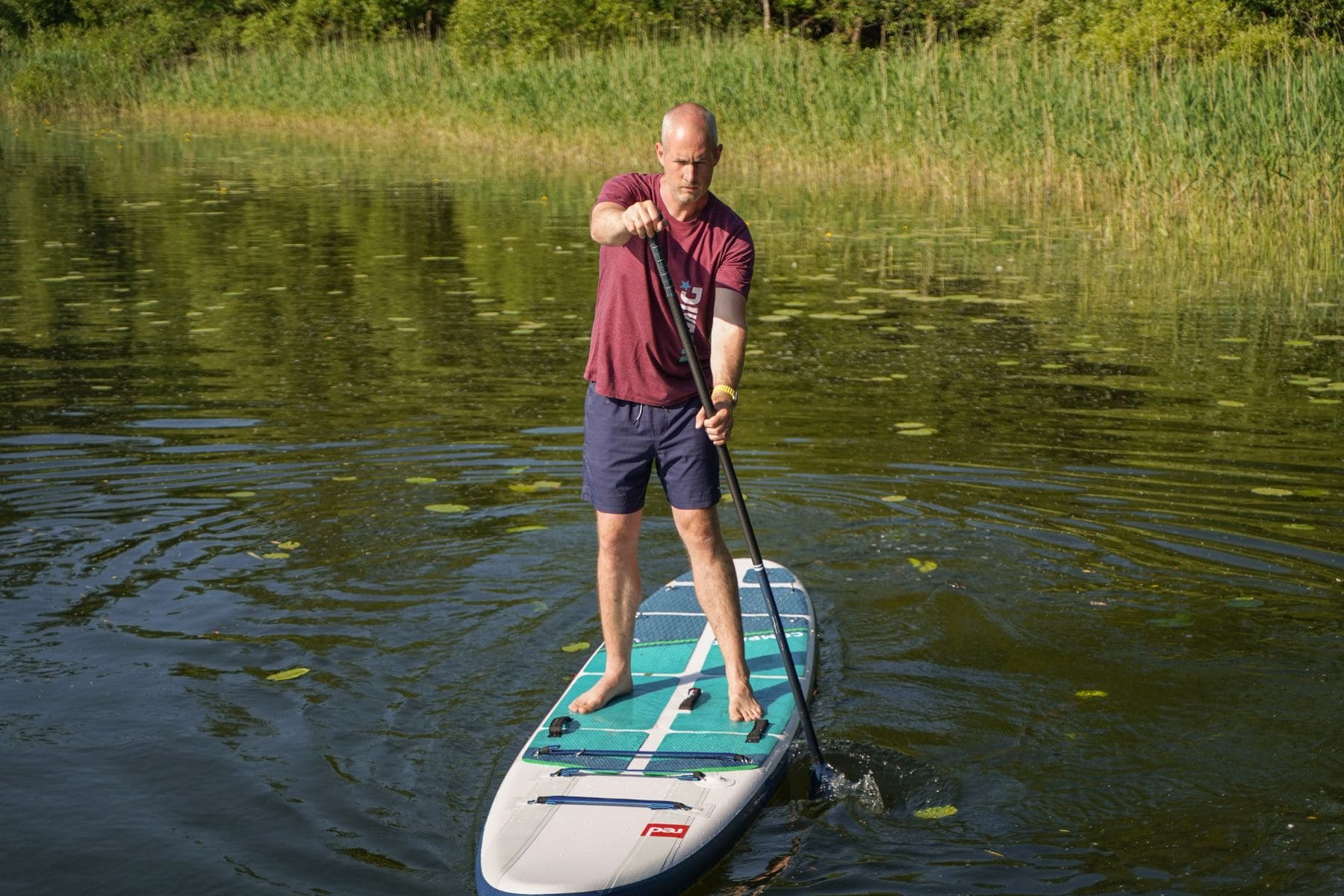
A planing hull board is generally wide and flat and is somewhat reminiscent of a surfboard. It is intended for on-top-of-the-water rides and is easily maneuverable. If you are into surfing, yoga, and recreational paddling, this is the hull type to look into.
Check out the Red Paddle Co. 10’6” Paddle Board for an example of a planing hull!
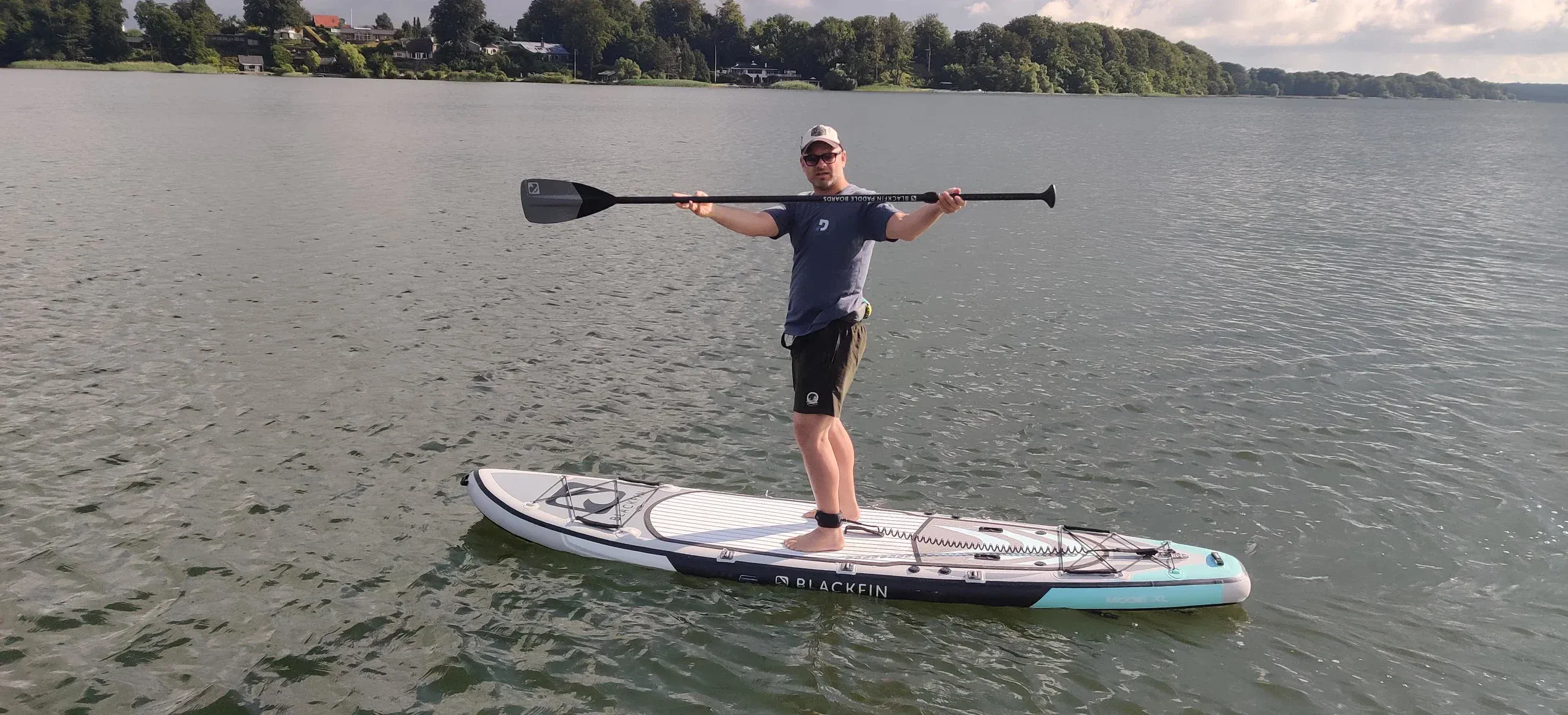
A displacement hull is differentiated by its pointy nose, the one often met in canoes and kayaks. This feature helps it cut through the water, thus pushing it to the sides and the nose itself. As a result, you smoothly glide through the waves at a fast speed. If touring, camping and racing are your main priorities for the board, this is the hull to choose.
Check out the Blackfin V 12’6” Paddle Board for an example of a displacement hull!
Paddle Board Material
There are a variety of materials which can be used when building a paddle board. Most commonly solid paddle boards will be made with a foam core with an epoxy or fiberglass exterior. These materials ensure that the boards are lightweight whilst remaining strong and durable.
Inflatable SUPs tend to be made using strong PVC with drop-stitch technology for reinforced, durable seams. The core is filled with air, the high pressure of the air in the centre provides a strong core. Some inflatable paddle boards will have more than one chamber to fill with air such as a double chamber. Paddle boards that feature double chamber construction have better stability and rigidity on the water.
Check out the Starboard 12’6 touring deluxe double chamber board!
Volume and Capacity
Volume and capacity are the main factors to consider and are determined by your size. To ensure your board is stable and provides the best buoyancy you will want to purchase a board made for your size. This will also make it easier to maneuver the board once on the water too.
Volume and weight capacity are primarily influenced by your weight, however, the board width, height and thickness will also influence these factors and will determine the board performance.
Volume: The volume is measured in liters. The higher the volume the higher the weight capacity of the board and the more stable and buoyant it will be on the water.
Weight Capacity: Measured in pounds, the weight capacity lets you know how much weight the board can take and remain efficient on the water. If you are heavier than the weight capacity the board won’t float as well and it will affect the performance of the board.
Paddle Board Length
The length of a board will affect the performance of the board and most notably the speed. The length also determines what water conditions the SUP can handle. Paddle board length is measured using feet and inches.
Short (10’ and under): Shorter boards are excellent for surfing and for kids. The length makes them more maneuverable, this increased maneuverability makes them perfect for surfing waves.
Check out the Roc Explorer 10’ as an example of a short paddle board!
Medium (10’ to 12’): Medium length boards tend to be best for all-round paddle board use, recreational use or for yoga. They tend to have a rounder shape and planing hulls making them stable and buoyant with the ability to handle most water conditions.
Check out the Blackfin X 10’6” as an example of a medium paddle board!
Long (12’ and above): Long length boards are excellent for racing, long distance and touring. These boards are the fastest thanks to their length and tend to track a lot straighter in the water. Long paddle boards often come with displacement hulls.
Check out the Tower Xplorer 14’ as an example of a long paddle board!
As well as determining speed the length of a board will also influence the weight capacity and volume. The length will also influence the portability and weight of the paddle board and should be considered when looking at transporting and storing your SUP.
Paddle Board Width
Similarly to the length of the paddle board the width influences the performance of the board as well as the weight capacity and volume. Generally the greater the width of the board the better the stability, and vice versa, a board that is skinnier will be less stable.
Ranging between 25” to 36” the width of the SUP you choose will be dependent on your paddle boarding needs. When choosing the correct width you will want to consider your body type, weight and ability.
Narrow boards: These boards will be best for speed, however, compromising on stability. If you are a more advanced paddle boarder looking for a challenge a narrow board will provide exactly this. Narrower boards are also better for smaller, lighter weight people as they tend to have a smaller volume and weight capacity than wider boards.
Wide boards: Wider boards are excellent for stability and usually have a higher volume and weight capacity. These boards are perfect for recreational use and excellent for activities such as surfing and yoga, however, the length will also need to be taken into consideration.
Width is an important factor, however, you need to also consider the volume, weight capacity and length, to ensure your board is the best fit for your needs. A longer narrower board will be better for racing, a shorter wider board will be more suited to surfing, whilst a longer, wide board will be ideal for yoga.
Paddle Board Thickness
The last dimensions to consider when purchasing a SUP is thickness. Overall, the thickness will determine the volume and weight capacity of a board. The thinner a board, the smaller the volume and therefore the lower weight capacity. Thicker boards will have higher volume and therefore higher weight capacity.
Thickness will also determine how well the board handles water, thinner boards will be better on flatter water surfaces, whilst thicker boards will handle chop and waves better.
Paddle Board Fins
Each paddle board comes with fins to provide stability and good tracking. The most common fin set-ups are the single fin, the tri-fin and the 2+1 fin setup. Most fins are removable, especially the larger center fin. Paddle boards, with the 2+1 fin setup, will have permanent smaller fins attached.
Larger fins will provide straighter tracking whilst smaller fins, especially in a tri-fin and 2+1 fin setups will improve the stability and maneuverability of the board. Fin setups are the same in both solid and inflatable SUPs, however, they are more likely to be removable in inflatable SUPs to make them easier to store.
Paddle Board Accessories
Each SUP will come with its own added extras and accessories. There are a range of accessories available and most of the time you can purchase these extra accessories separately to add to your board. The most important accessories for paddle boarding are:
Paddle: The most important accessory to any paddle board is the paddle. SUP paddles are like kayak/canoe paddles, with an extended handle and blade. When choosing a paddle there are a few factors to consider, including whether it floats, the weight and the handle of the paddle.
Most paddles will have adjustable handles which you can adjust to best suit the paddle boarder’s height. The length should reach your wrist when standing straight with your hand straight above your head.
Check out our list of best SUP paddles for 2026 here!
Leash: A leash ensures you are attached to the board, this is important for when you fall into the water, to ensure you do not lose the board. Most leashes tend to be coiled, which means they do not get in the way when paddle boarding, however, there are specific leashes for other uses, i.e. paddle surfing, river paddle boarding. Leashes are sometimes sold separately.
Life Jacket: The importance of wearing a good quality life vest can not be understated. Every year people drown in water sport related activities because they were not wearing a life jacket. Make sure to be safe and wear a life jacket.
Check out our list of best Life Jackets for 2026 here!
Attachment points/ D-rings: D-rings are an excellent extra when looking for a board. D-rings provide attachment areas where you can tie-down personal belongings, add seats, an SUP wind sail, fishing rods and many more to your board. They provide the freedom to customize your board as you see fit.
Bungee systems: Bungee systems are a great added extras that often come included with the paddle board, however, you can also buy these separately. They allow you to secure personal belongings when on your board, making sure your cargo stays safe and secured and allowing you to bring more on your trips.
If you already have a paddle board or you just bought one, leave a comment in the comment section below and share your experience with it.