Touring Paddle Board Buyers Guide
Paddle Board Hull
A touring paddle board should have a displacement hull. A displacement hull is differentiated by its pointy nose, the one often met in canoes and kayaks. This feature helps it cut through the water, thus pushing it to the sides and the nose itself.
As a result, you smoothly glide through the waves at a fast speed. If touring, camping and racing are your main priorities for the board, this is the hull to choose.
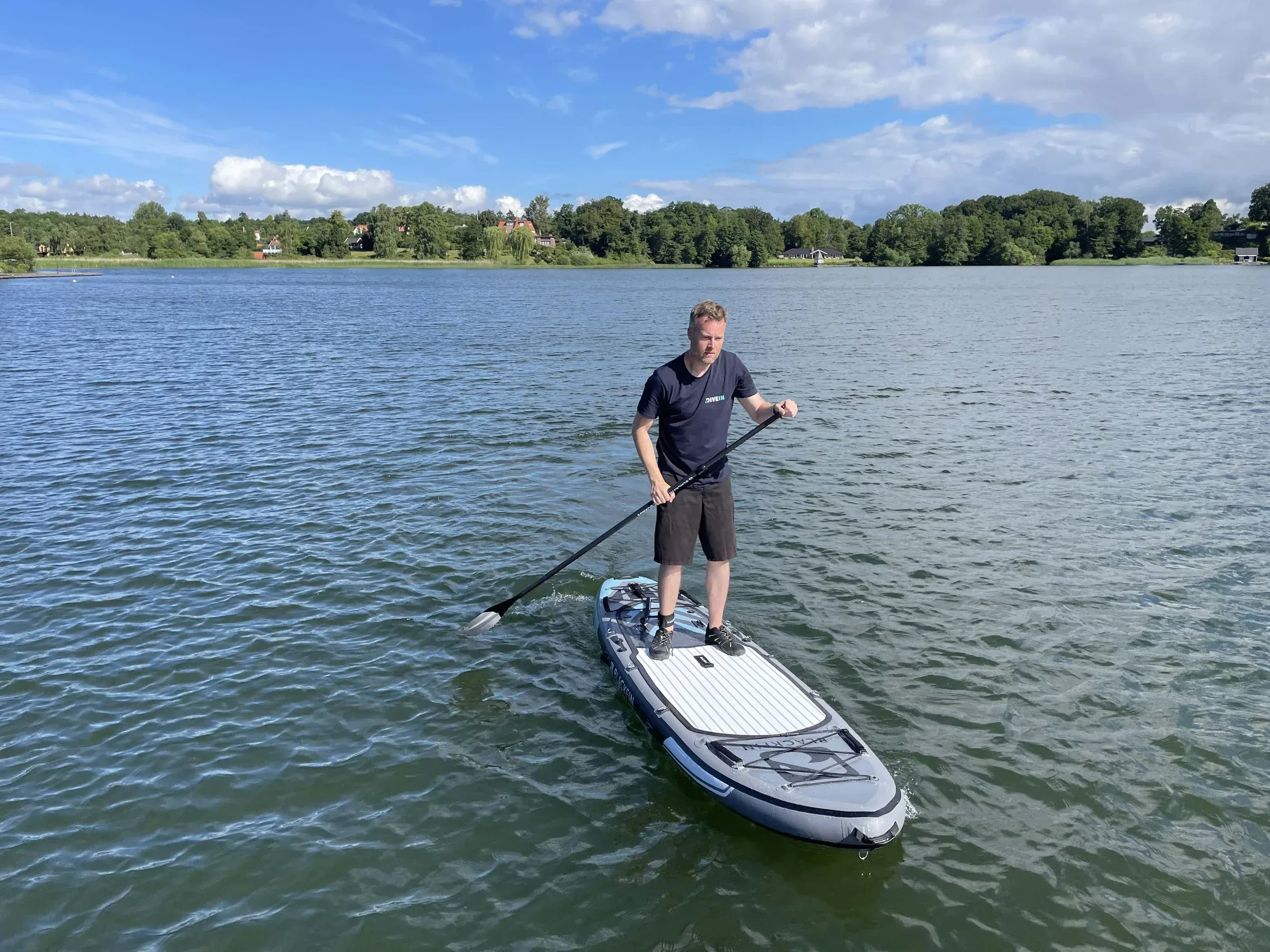
Check out the Blackfin Model XL. It’s a utility board that has extra width, but its rocker and pointed nose lifts it out of the water instead of forcing the SUP to push through it.
Paddle Board Material
Inflatable SUPs tend to be made using strong PVC with drop-stitch technology for reinforced, durable seams. The core is filled with air, the high pressure of the air in the center provides a strong core.
Some inflatable paddle boards will have more than one chamber to fill with air such as a double chamber. Paddle boards that feature double chamber construction have better stability and rigidity on the water making them better for touring.
All inflatables flex more than their solid brethren. But the more the SUP flexes, the more it sinks into the water and creates drag. So, the more rigid a board, the less drag and more speed.
Check out the Bluefin Cruise Carbon 12 Double Chamber Board!
Volume and Capacity
Volume and capacity are the main factors to consider and are determined by your size. To ensure your board is stable and provides the best buoyancy you will want to purchase a board made for your size.
This will also make it easier to maneuver the board once on the water too.
Volume and weight capacity are primarily influenced by your weight, however, the board width, height, and thickness will also influence these factors and will determine the board performance.
Volume: The volume is measured in liters. The higher the volume the higher the weight capacity of the board and the more stable and buoyant it will be on the water.
Weight Capacity: Measured in pounds, the weight capacity lets you know how much weight the board can take and remain efficient on the water. If you are heavier than the weight capacity the board won’t float as well and it will affect the performance of the board.
With this in mind for a touring SUP, it follows that the more gear you have, the higher the weight capacity you’re going to want.
Paddle Board Length
The length of a board will affect the performance of the board and most notably the speed. The length also determines what water conditions the SUP can handle. Paddle board length is measured using feet and inches.
Touring paddle boards should be mainly long length but there are some exceptions where medium boards, like the Isle Explorer 116, can make good touring boards.
Long (12’ and above): Long-length boards are excellent for racing, long distance, and touring. These boards are the fastest thanks to their length and tend to track a lot straighter in the water. Long paddle boards often come with displacement hulls.
The longest board on this list, The Tower Xplorer, has 14 feet of length with a significant rocker. That makes this one the most impressive performance board for touring in terms of tracking.
Paddle Board Width
Generally the greater the width of the board the better the stability, and vice versa, a thinner board will be less stable. When choosing the correct width for a touring board you will want to consider your body type, weight, and ability but you will generally be looking for a narrow board.
Narrow boards: These boards will be best for speed, however, compromising on stability. If you are a more advanced paddle boarder looking for a challenge a narrow board will provide exactly this. A longer narrower board will be better for racing whereas a wider board will be better for stability.
The Starboard Deluxe has a width of only 30 inches, making it the narrowest here. It is also the fastest because of its slicing profile.
Paddle Board Thickness
You will also want to consider the thickness of the board as it relates to the capacity and volume. The thickness will also determine how well the board handles water, thinner boards will be better on flatter water surfaces, whilst thicker boards will handle chop and waves better.
Paddle Board Fins
Each paddle board comes with fins to provide stability and good tracking. When choosing a touring paddle board you want to consider a larger fin set up for better tracking over distances.
Paddle Board Accessories
Each SUP will come with its own added extras and accessories. There are a range of accessories available and most of the time you can purchase these extra accessories separately to add to your board like a leash or a D-ring, or add to the experience with water shoes for example. The most important accessories for paddle boarding are:
Paddle: The most important accessory to any paddle board is the paddle. SUP paddles are like kayak/canoe paddles, with an extended handle and blade. When choosing a paddle there are a few factors to consider, including whether it floats, the weight, and the handle of the paddle.
Most paddles will have adjustable handles which you can adjust to best suit the paddle boarder’s height. The length should reach your wrist when standing straight with your hand straight above your head.
Check out our list of best SUP paddles here!
Leash: A leash ensures you are attached to the board, this is important for when you fall into the water, to ensure you do not lose the board. Most leashes tend to be coiled, which means they do not get in the way when paddle boarding, however, there are specific leashes for other uses, i.e. paddle surfing, river paddle boarding. Leashes are sometimes sold separately.
Life Jacket: The importance of wearing a good quality life vest can not be understated. Every year people drown in water sport related activities because they were not wearing a life jacket. Make sure to be safe and wear a life jacket.
Check out our list of best Life Jackets here!
Attachment points/ D-rings: D-rings are an excellent extra when looking for a board. D-rings provide attachment areas where you can tie down personal belongings, add seats, an SUP wind sail, fishing rods and many more to your board. They provide the freedom to customize your board as you see fit.
Bungee systems: Bungee systems are a great added extras that often come included with the paddle board, however, you can also buy these separately. They allow you to secure personal belongings when on your board, making sure your cargo stays safe and secured and allowing you to bring more on your trips.
If you already have a paddle board or you just bought one, leave a comment in the comment section below and share your experience with it.