What is the Duffy 22 Bay Island?
The Duffy 22 Bay Island is a 22-foot fiberglass displacement-hull electric harbor cruiser, the largest enclosed-interior model in the Duffy Electric Boats catalog. The hull is hand-laid fiberglass with a composite stringer grid, an 8-foot 6-inch beam, a 29-inch draft, and a 12-passenger rated capacity. Power is electric only, with a 7.5 kW motor driving a single shaft and the patented Duffy Power Rudder for close-quarters maneuvering. Top speed is 5 knots, cruise speed sits closer to 4 knots for full-day endurance, and the boat is built around displacement cruising rather than planing-speed running.
Battery options have evolved across the production years. Lead-acid battery banks remain the entry-trim option, while lithium-ion battery upgrades have been available from roughly 2020 forward. Charging is 110V shore-power only, with no DC fast-charging available. Standard equipment includes the bimini top, perimeter bench seating around the cockpit, hardwood table mounts in the center, an AM/FM stereo, and the single-screen helm display. Side curtains, JL Audio upgrade, lithium battery upgrade, and the galley module are options on the spec list.
Who is it good for?
The right buyer is the harbor-cruise household running 50 to 100 hours a season on protected harbor water, on lake-and-river inland communities, and in marina-and-canal residential developments. Newport Beach, Naples, Sarasota, Lake Norman, Lake Travis, and the Hamptons are all natural homes. The boat is a floating living room for cocktail cruising, sunset runs, and slow tours of waterfront real estate. I watched a Newport Beach family rotate eight guests through a 2021 Duffy on a Saturday afternoon last summer, three short loops around the harbor at 4 knots, and the boat had the cocktail-cruise rhythm dialed in.
Cross-shoppers from pontoon boats who want silent operation and a more refined cocktail-cruiser aesthetic are the second core profile. The Duffy trades the pontoon's open-deck flexibility for a more enclosed and finished cabin layout, with hardwood deck accents on the premium trims and a marine-grade vinyl finish that holds up better in continuous sun exposure.
Owners on noise-restricted lakes and harbor districts are the third profile. The Duffy operates silently enough to qualify on water bodies that exclude even electric outboards under their noise rules. Marina communities where the local social currency is "we Duffy on Saturday afternoon" are the natural fit.
Who is it not good for?
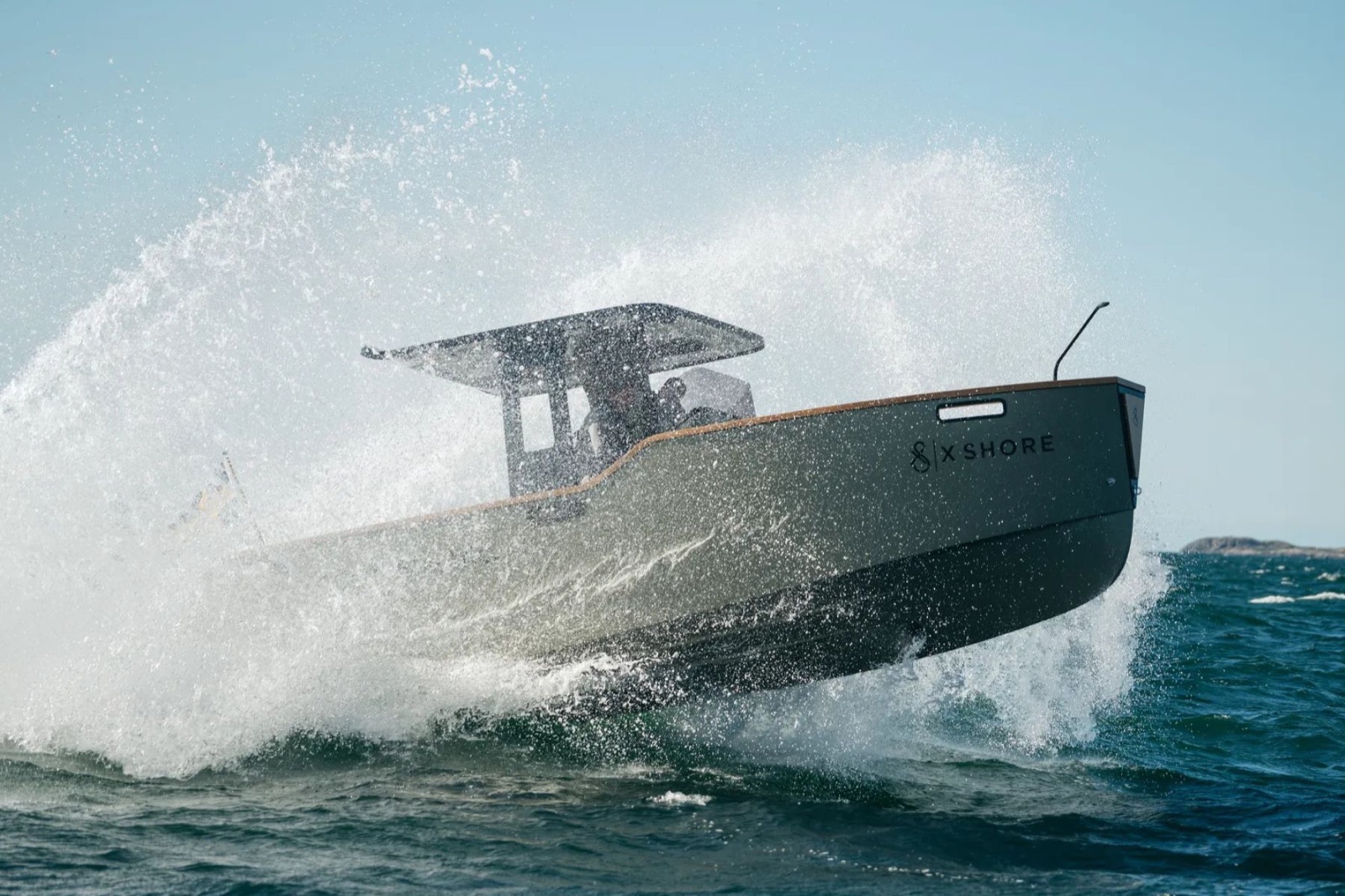
Speed-priority buyers are wrong-targeted. The 5-knot top speed is the design center, not a limitation to be solved with a bigger battery or a hotter motor. Households who want planing-speed performance should look at the X Shore Eelex 8000 or the Candela C-8, both of which run cruise speeds 4 to 6 times faster.
Long-range cruising households are wrong-targeted. The 8-hour cruise endurance at 4 to 5 knots translates to roughly 30 to 40 nautical miles per charge. That is right for harbor cruising and short loops. It is not right for owners running 50-plus mile day trips.
Owners without reliable 110V shore power at the home slip should think hard. The boat charges from a standard household outlet over 8 to 12 hours. Without that infrastructure at the dock or in the boathouse, the use case stalls fast. Duffy ownership presumes the marina has charging, the slip has shore power, and the routine includes plugging in after each use.
Pricing
A 2026 22 Bay Island is roughly $85,000 to $120,000 new depending on battery option (lead-acid versus lithium), audio package, and trim level. Lithium-equipped builds with the JL Audio upgrade, the side curtains, and the galley module clear the upper end of that band. The 2011 base price of $59,000 has not held. Current MSRP and dealer pricing reflect the move to lithium and the 14 years of inflation since the original quoted figure.
Used pricing is wide. A 2018 to 2020 hull with lead-acid batteries running 200 to 400 hours sits in the $32,000 to $48,000 band, with the catch that the battery age is the line every used buyer needs to verify (replacement costs $4,500 to $7,500). A 2021 to 2023 hull with the lithium upgrade and lower hours is $48,000 to $65,000.
The value buy is a 2020 to 2023 hull with the lithium battery upgrade, the JL Audio package, the side curtains, and a documented battery-age inspection. Asking prices in the $42,000 to $58,000 band match the use case for most harbor-cruise households.
What works
- Patented Duffy Power Rudder gives genuinely tight close-quarters maneuvering. The boat turns in roughly its own length, which is what makes harbor and canal use practical.
- Perimeter bench seating around the cockpit fits 12 passengers under the standard bimini. The seating geometry supports the floating-living-room use case.
- Silent electric operation passes noise-restriction rules that exclude electric outboards. Lakes and harbors with strict noise ordinances accept the Duffy where they reject other electric platforms.
- Brand recognition in the Newport Beach, Naples, and Lake Norman markets supports a firm resale price. Used Duffys do not sit on the brokerage market for long in the social-cruiser communities.
- Hardwood deck accents and the marine-grade vinyl interior on the premium trims hold up better than the segment median in continuous sun exposure.
What doesn't
- 5-knot top speed is the design center. Buyers who think they will run at 8 or 10 knots with a different motor or battery setup are misreading the boat.
- Lead-acid battery banks still ship on entry-trim builds. Battery replacement at the 5 to 7 year mark costs $4,500 to $7,500 for the lead-acid pack and more for the lithium upgrade.
- 110V shore-power charging only. No DC fast-charging is available, and an empty pack takes 8 to 12 hours to fully charge from a standard outlet.
- Owners report control-system safety lockouts (key in on, control switch in forward or reverse, boat refuses to engage) that clear with a key-cycle reset. Not a defect, but a known characteristic that confuses first-time owners.
- No galley as a standard fitment. The Duffy is engineered for picnic-style cocktail cruising, not full overnight cabin cruising.
Year-by-year notes
2018 to 2019 hulls are the original 22 Bay Island platform with lead-acid batteries as the standard battery bank, the original helm electronics, and the standard bimini.
2020 added the lithium battery upgrade as a more-common factory option and refined the helm electronics with a single-screen display upgrade.
2021 to 2023 hulls have the more common lithium battery option, refined cockpit upholstery, and the JL Audio mid-tier as a more-common factory order.
2024 to 2026 hulls add minor cosmetic refinement, an updated helm display, and incremental refinements to the Power Rudder hardware. The construction process and the displacement-hull design have been carried over largely unchanged.
Cost of ownership
Operating cost on the Duffy is the line where the boat shines. Electricity at typical residential rates costs roughly $5 to $12 per full charge, and a typical 4-hour cocktail cruise uses one quarter to one third of a full pack. Annual operating fuel-equivalent cost is under $200 for most households.
Battery replacement is the recurring big-line item. Lead-acid packs cost $4,500 to $5,500 every 5 to 7 years. Lithium packs cost $7,500 to $11,000 every 8 to 12 years. Plan the reserve and the timing accordingly.
Insurance on a $50,000 hull is $700 to $1,400 a year. Marina dockage in the Newport Beach, Naples, and Lake Norman markets costs $3,000 to $7,000 annually for a covered or in-water 22-foot slip with shore power.
Plan a $700 to $1,500 a year reserve for routine maintenance plus a battery service event in the back half of the ownership window. Power Rudder hardware, bimini frame, hardwood trim refinish, and stereo head-unit are the recurring small lines.
Resale is roughly 26 to 30 percent five-year depreciation on a clean 22 Bay Island, which is firm for an electric boat. The brand recognition in the harbor-cruise communities holds the price.
Best year and trim to buy
A 2020 to 2023 hull with the lithium battery upgrade, the JL Audio package, the side curtains, the bimini, and a documented battery-age inspection is the value buy. Asking prices in the $42,000 to $58,000 band match the use case for most harbor-cruise households.
Verify three things before close. First, confirm the battery age and run a load-test on the pack at the dock. A tired lead-acid pack drops the value of the boat by $4,500 to $7,500. Second, run the Power Rudder through full close-quarters maneuvering and confirm clean engagement in both directions. Third, walk the cockpit upholstery and the bimini for sun damage that would indicate prior outdoor storage without a cover.
For 2026-new buyers, the lithium battery upgrade, the JL Audio package, the side curtains, and the galley module is the spec that supports the use case best and resells well at year 5.
Alternatives
The Candela C-8 is the premium electric step-up with hydrofoil technology and 22-knot cruise capability for buyers who want range and speed in the electric drivetrain. The X Shore Eelex 8000 is the electric daycruiser alternative with planing-hull performance for buyers who want electric without the displacement-speed envelope. The Axopar XC Cross Cabin is the gasoline cross-shop for households that want similar 22-foot-class cabin cruising without the electric battery-management profile.