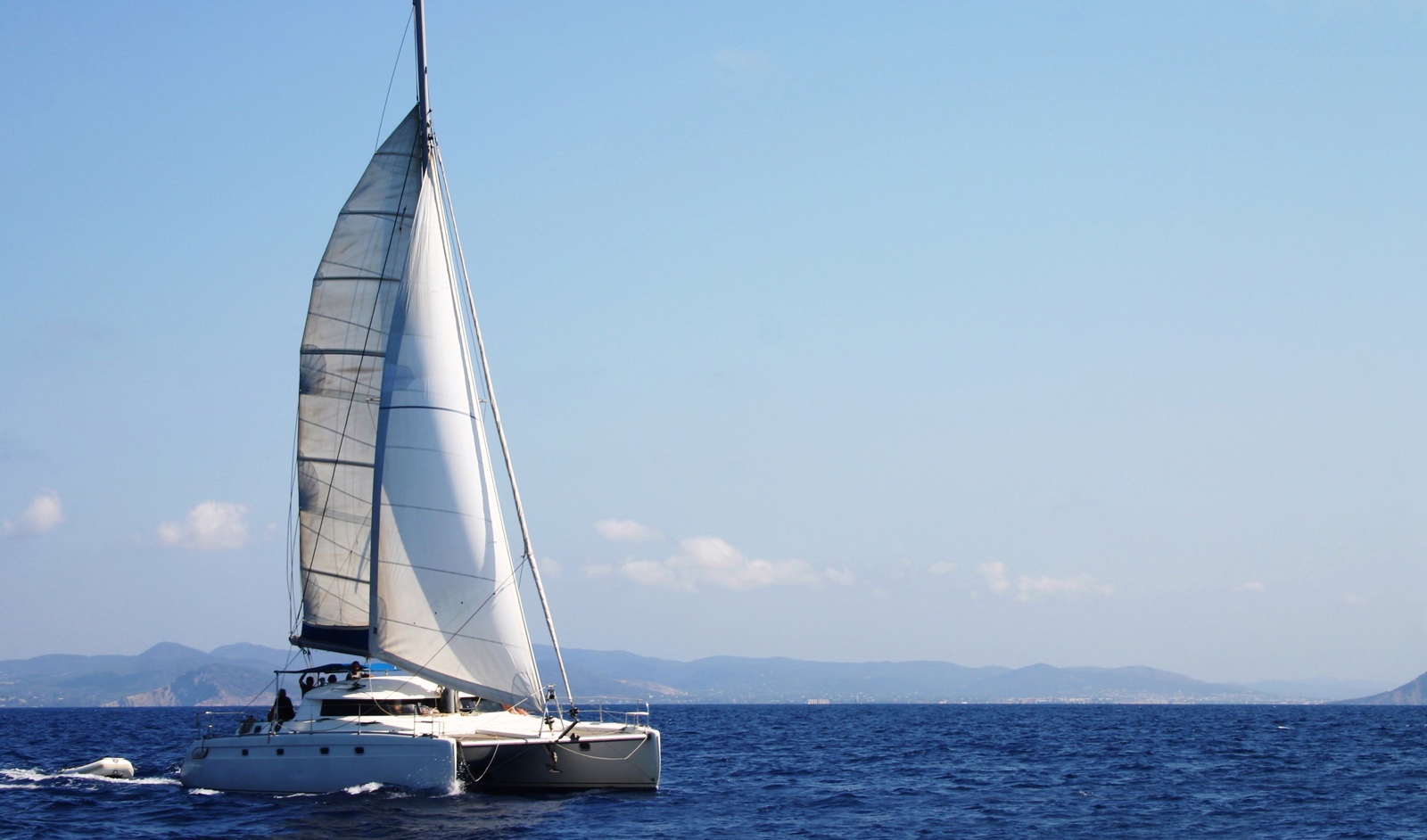
The Jeanneau Sun Odyssey 410 is a 40-foot French production cruising monohull, designed by Marc Lombard and launched for the 2018 model year. Jeanneau has been building production sailboats since the 1950s and sits with Beneteau and Bavaria as one of the dominant volume builders in the European cruising shelf. The Sun Odyssey 410 took the segment by surprise on launch because of the walk-around side-deck layout that stepped down to the cockpit without the traditional coach-roof climb, and the boat has been the company's mainstay 40-footer through the early 2020s.
What is the Jeanneau Sun Odyssey 410?
The 410 is a 40-foot 4-inch fiberglass cruising monohull. Beam is 13 feet 1 inch, displacement is 19,250 pounds, draft is 6 feet 11 inches with the deep keel or 5 feet 5 inches with the shoal-keel option. The hull is a Marc Lombard chined design with a hard chine running aft from amidships, which gives the boat a wider waterline beam for accommodations volume and a stiff ride at moderate heel. The sailplan with the standard rig totals about 870 square feet, with a furling mainsail option and a self-tacking jib option through the build sheet.
The drivetrain is a 45-horsepower Yanmar diesel saildrive. Saildrives put the prop on a leg that exits the hull amidships rather than at a shaft strut aft, which gives a quieter installation and a cleaner bilge but adds the saildrive seal service line every five to seven years. Fuel is roughly 53 gallons, water roughly 87, with a holding tank and a small generator option through the build.
The accommodations come in two-cabin owner trim or three-cabin charter trim. Owner trim has a real owner stateroom forward with an island berth and a separate head with a stand-up shower, plus an aft stateroom on one side and a saloon and galley amidships. Charter trim splits the aft into two cabins and adds a second head. The walk-around side decks are the headline ergonomic feature. The cabin top steps down to the cockpit, which means crew moves from the foredeck to the cockpit at the same level rather than climbing over the coach roof. Twin helms give clear sightlines from both sides and open the cockpit between them.
Who is it good for?
Coastal-cruising couples and families with one or two kids are the core buyer. Chesapeake, Long Island Sound, Maine coast in summer, San Francisco Bay, Pacific Northwest, Caribbean charter. The two-cabin owner layout fits a family for a long weekend or a two-week cruise. On a charter base in the Mediterranean a few summers back I spent a week on a 410 in the Sporades, working up from Skiathos through Skopelos and Alonissos, and the walk-around side decks made setting and dousing the headsail at anchor a one-person job that did not require any rope-work over the coach roof.
Owners stepping up from a 35-to-37-foot first cruiser are the second profile. Same family of production-spec French build philosophy, a step up in volume, a step up in helm electronics, and the chined hull's stiffness at heel. Charter buyers in the Caribbean and Mediterranean placement programs are the third. Three-cabin charter trim is a real charter layout and the dealer support across the placement bases is well-established.
Who is it not good for?
Bluewater passage-makers should walk past the 410 toward a heavier-displacement hull. The Sun Odyssey is a coastal cruiser, not a bluewater boat. Standing-rigging fittings, chainplate access for inspection, bulkhead structure at the keel root, and the saildrive's seal service interval are all production-spec items rather than offshore-spec. The boat can cross oceans (people have done it) but the design brief is coastal.
Racing-oriented owners should also look elsewhere. The 410 is a production cruiser tuned for comfort under sail rather than performance. The chined hull is stiff at heel but the displacement and the rig spec are not racing numbers.
Buyers who weight the heaviest-displacement build at the same length should look at Hallberg-Rassy, Hylas, or Outbound. The Jeanneau is a different category of boat at a different price point.
Pricing
New 2026 Sun Odyssey 410 builds at the dealer land between roughly $295,000 and $385,000 depending on keel choice, rigging spec, electronics package, and equipment options. Base sailaway pricing is at the low end; a fully equipped boat with electronics, dodger, bimini, generator, and cruising-spec sails sits near the top.
The used market spans roughly $215,000 at the bottom (2018-2019 charter-fleet boats with high hours) to $325,000 at the top (clean 2022-2023 owner-spec boats with low hours). The sweet spot is the 2020-2023 owner-spec build with the standard rig, the Yanmar saildrive, an updated electronics package, and a charter-free or lightly-chartered survey history. Those land in the $250,000 to $295,000 band.
Depreciation on a clean Sun Odyssey 410 lands somewhere near 25 to 30 percent off MSRP over five years. That is in the same band as Beneteau Oceanis at the same length and a step behind heavier-displacement names like Hallberg-Rassy or J Boats cruisers.
What works
- Walk-around side decks step down from cabin top to cockpit cleanly. The ergonomics are the headline.
- Twin helms give clear sightlines from both sides and open the cockpit between them.
- Chined hull is stiff at heel and gives a wider waterline beam for accommodations volume.
- Two-cabin owner layout has a real owner stateroom forward with an island berth and a separate head.
- 45-horsepower Yanmar diesel saildrive is a known quantity with broad parts and service support.
- Jeanneau dealer network is broad in North America and the Mediterranean charter bases.
What doesn't
- Build is production-spec, not bluewater. Standing-rigging and chainplate access want attention on long passages.
- Charter-fleet history is common on used boats and adds wear that needs a careful survey.
- Saildrive seal service is a recurring cost every five to seven years, $1,500 to $3,000 each time at a yard.
- Twin-helm setup means two sets of helm electronics and two binnacles to maintain.
- Light-displacement hull pounds a little in steep short-period chop.
- Resale curve is fine but a step behind heavier-displacement names at the same length.
Year-by-year notes
The Sun Odyssey 410 launched for 2018 on the Marc Lombard chined hull with walk-around side decks. The 2020 model year brought refinements to the electronics and the cockpit layout. The 2022 build adopted the current generation of dash electronics and the latest interior trim patterns. Production continues through 2026 with the same fundamental platform. There is no defect cutover year. Buyers should screen on charter-fleet history, saildrive seal service, standing-rigging age, and the survey on bulkhead structure rather than year-chasing.
Cost of ownership
Annual recurring costs on a coastal-cruising Sun Odyssey 410 land in a different shape than power-boat costs. Annual yard haul-out, bottom paint, and zinc anode service runs $1,500 to $3,000. Saildrive seal service every five to seven years adds $1,500 to $3,000 at the yard. Standing-rigging inspection at five-year intervals and full replacement at ten to twelve years is a $6,000 to $10,000 line. New cruising sails (main, jib, asymmetric) at the end of their working life run $8,000 to $14,000 for a full inventory.
Insurance on a $270,000 hull is $2,400 to $4,200 a year in coastal North American markets. Slip rental for a 40-foot boat runs $10,000 to $20,000 in major coastal markets. A five-year hold on a 2021 used Sun Odyssey 410 bought at $275,000, used 60 sailing days a year on the Chesapeake with slip storage in Annapolis, lands at roughly $24,000 to $36,000 a year all-in including insurance, slip, sails amortized, haul-out, and saildrive service.
Best year and trim to buy
The 2020-2023 Jeanneau Sun Odyssey 410 in owner-spec (two-cabin) trim with the standard rig, the 45-horsepower Yanmar saildrive, an updated electronics package, and a charter-free or lightly-chartered survey history is the right buy in 2026.
Verify five things pre-purchase. First, the saildrive seal service is current or budgeted into the offer price. Second, the standing rigging age is documented and the chainplates have been inspected. Third, the bulkhead structure at the keel root shows no stress cracking or fiberglass tabbing failure. Fourth, the engine hours match the file and the Yanmar service file shows current oil and impeller intervals. Fifth, if the boat has any charter-fleet history, the survey covers the engine and the gel coat in real detail.
Alternatives
The direct cross-shop is the Beneteau Oceanis 40, which covers the same coastal-cruising brief with a different design philosophy and a similar entry price. Both boats share the Beneteau Group parent and a shared drivetrain. The differences come down to ergonomic preferences: the walk-around side decks on the Jeanneau versus the more traditional side-deck geometry on the Oceanis. A sea trial on both is the right way to decide.
The step-down cross-shop is the Hanse 388, the German alternative at 38 feet with a self-tacking jib and a different cockpit layout. The Hanse is oriented around shorthanded sailing in a way the Jeanneau is not. For couples who tack often with one crew below or off-watch, the Hanse's self-tacking jib is a real ergonomic advantage. For families that sail with full crew on most days, the Jeanneau's larger sailplan and bigger accommodations volume are the better fit.
For buyers considering whether a monohull is the right choice at all, the Leopard 46 PC sits in as a power-catamaran reminder that the question of monohull versus multihull is worth asking before signing on either. A cruising catamaran at similar length carries more accommodation volume, more deck space, level sailing, and very different slip and storage math. Households split roughly half and half on the catamaran-versus-monohull question, and the right answer is the answer that matches the cruising calendar.
The honest summary on the Sun Odyssey 410 is this. The boat is a current-generation coastal cruiser at 40 feet with broad dealer support, an established charter pedigree, and a Marc Lombard hull that handles the design brief well. For coastal-cruising couples and families, the boat is one of the standard answers in the 40-foot French production-cruiser shelf. The walk-around side decks are a real ergonomic upgrade over the older Sun Odyssey 409 and 419 platforms, and the dealer network in North America and the Mediterranean is the broadest in the segment. For households cross-shopping inside the production-cruiser tier, the 410 versus the Beneteau Oceanis 40 is the most-common sea-trial pairing.