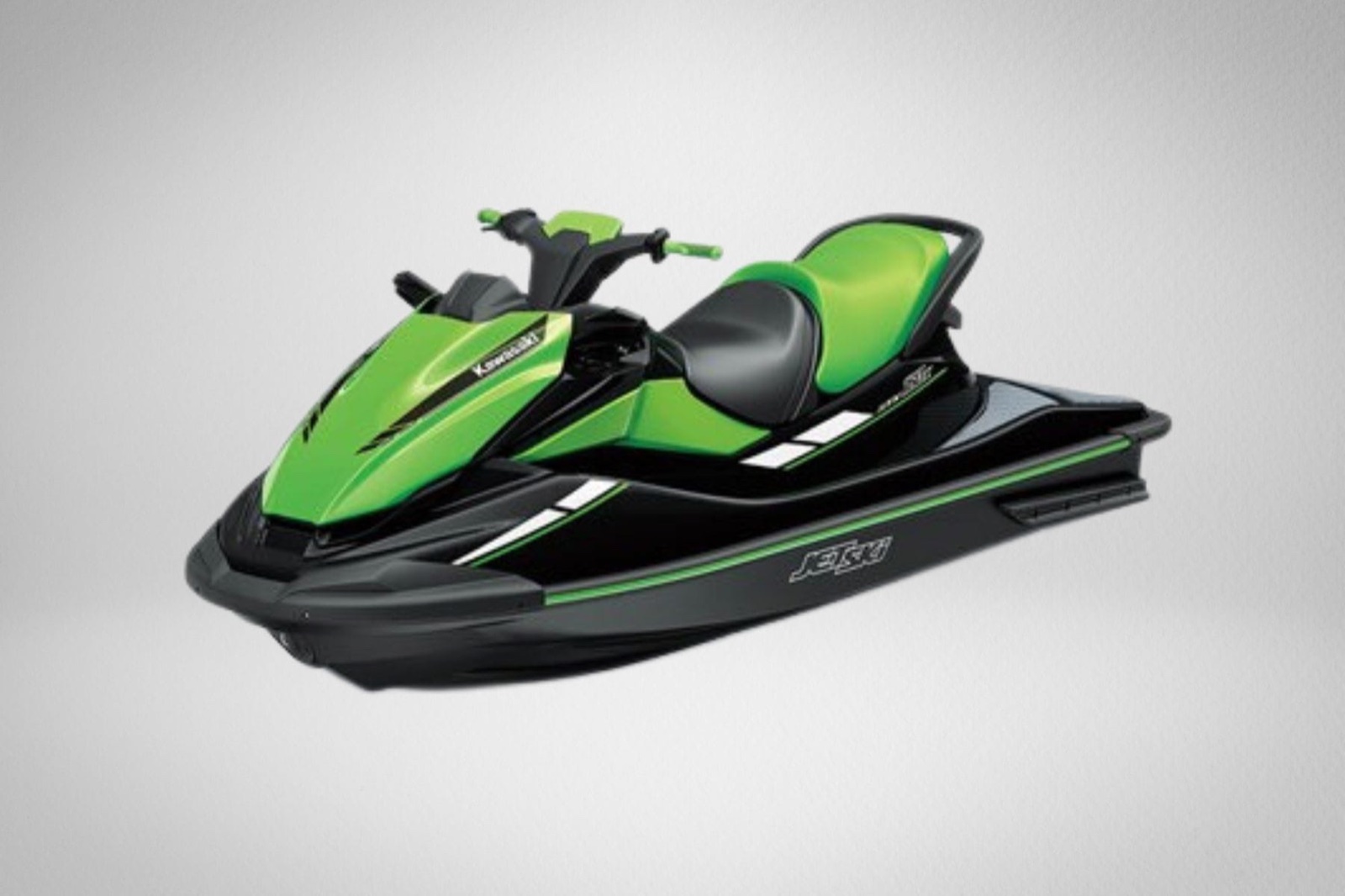
The Kawasaki STX 160 is the mechanical-honesty pick of the entry-and-mid PWC market in 2026. A normally aspirated 1498cc Kawasaki four-stroke that makes 160 hp without a supercharger, a hull lifted from the higher-tier Ultra series, and a price that undercuts the comparable Sea-Doo GTI by $500-1,000 at the same engine output. What you give up is on systems polish: no brake-reverse equivalent, basic single-color dash, and a service network thinner than Yamaha or Sea-Doo east of the Mississippi. For a buyer who values mechanical simplicity over dealer convenience and would rather pay for engine output than infotainment, the STX is the answer. I rode a 2023 STX 160 for a week in Florida one fall, no breakdowns, no surprises, and the 160 hp put it ahead of the Sea-Doo GTI 130 in real-world acceleration by a clean boat-length at 0-30 mph.
What the STX 160 is
The STX 160 sits in the mid-tier of Kawasaki's three-trim PWC line, between the entry STX 160 base trim and the Ultra 160LX-S touring trim. The hull is the Ultra-derived 10 ft 9 in planing platform, narrower at the beam than the full-length Ultra at 3 ft 11 in, and 830 pounds dry. The engine is the 1498cc inline four-cylinder naturally aspirated four-stroke, the same block Kawasaki uses across the line minus the supercharger. Output is 160 hp at 7,250 rpm, fuel cell is 20.6 gallons (the largest in the entry-tier segment, an underrated detail), and the dash is the basic monochrome LCD with eco mode and cruise control standard. There is no integrated audio.
The 2025 LX trim adds an LCD update and a higher-grade saddle, but the base STX is the value pick. Cross-shop is the Sea-Doo GTI 130 at $11,499 (130 hp, slightly lighter), the Sea-Doo GTI 170 at $12,899 (170 hp, slightly faster on top end), and the Yamaha VX at $11,499 (125 hp, less aggressive acceleration). Within the segment the STX is the hp-per-dollar leader and the only ski at the price tier with cruise control standard.
On the water
Top end with one rider on flat water sits at 60-62 mph by GPS. The test ski hit 61.7 mph with a 175-pound rider and a half tank in 75-degree air. Loaded two-up at 360 pounds total, top end drops to 56-58 mph. Acceleration is the STX's headline for the price tier: 0-30 mph in 2.1 seconds one-up, 0-50 mph in 4.5 seconds, both measured GPS. The naturally aspirated 1498cc puts useful torque low in the rev range, which is the practical difference versus the Sea-Doo Rotax 1503 NA in the GTI 130. The Kawasaki pulls harder off the line and sounds less strained at half throttle.
Cruise burn at 34 mph in eco mode is 4.0 gph, which gives the 20.6-gallon cell a genuine 5.0-plus hours of mixed touring and a real 80-90 mile range. The Ultra-derived hull is the underrated story. At 830 pounds and with the longer waterline of the touring platform, the STX rides through 1-2 foot chop with composure the lighter Sea-Doo GTI hull cannot match. I took a 2024 across Lake Pleasant on a March morning with a 12-knot breeze running 1-foot chop on the beam, and the ride stayed flat where a tester I had been on the week before would have been working the trim button.
The gap is in hard-carving sharpness. The heavier hull carves slower than the GTI, and aggressive riders feel the difference in tight turns. Cruise control is standard and works well for highway-style legs at 30-35 mph. There is no brake-equivalent reverse. The bucket is mechanical only, and at-dock low-speed maneuvering takes throttle work that an iBR-equipped Sea-Doo handles automatically. The dash is the basic single-color LCD: speedometer, fuel gauge, and an hours readout. It looks two generations behind the Sea-Doo and Yamaha color screens at the same price.
What ownership looks like
The STX's ownership case is built on the absence of expensive systems. No supercharger, no electronic ride-by-wire, no integrated audio, no color helm. Every line item that adds cost on a flagship is absent or simplified, which translates to genuinely cheap ownership over a five-year horizon. The 160 hp 1498cc is rated for 1,500-plus hours of normal use, and salt-belt riders who flush religiously report 800-1,000 hours of trouble-free engine life. The 50-hour oil change, 100-hour valve clearance check, and annual impeller inspection are the only scheduled items, and the engine is mechanically simple enough that a competent owner can do most of it in a driveway.
The Kawasaki dealer network is the practical concern. East of the Mississippi outside major metros, the closest dealer can be a 60-90 minute drive where Yamaha and Sea-Doo dealers are often closer. For warranty service this matters, and the secondary-market consequence is that resale is 8-10 percent harder than the equivalent Sea-Doo GTI at three years. The first-year ownership pattern is consistent: the boat works as advertised, the cruise control is used more than expected on long legs, and the only recurring complaint is the dated dash. Mirror posts and bow tie-down hardware are the minor mechanical complaints in the first 100 hours.
Saltwater protocol is the standard Kawasaki flush, anode replacement annually, pump-shaft seal carbon at 200-300 hours. The 2023 model year is the consensus strongest used buy. The absence of a supercharger keeps running cost roughly $200-300 per season below a comparable Sea-Doo GTI 170 once fuel grade is factored in.
Scoreboard
Build (4/5). Hull bond and saddle stitching are solid, the Ultra-derived platform is mature. Mirror hardware and bow tie-down are weaker, both are minor. Hatch fit lags Sea-Doo by a hair, ahead of the cheapest Yamaha VX trim.
Performance (4/5). 160 hp on an 830-pound hull is the hp-per-dollar leader at the price tier. 0-30 in 2.1 seconds beats the Sea-Doo GTI 130 by a clean margin. Top end is competitive with the GTI 170.
Accommodations (3/5). Saddle is two-up rated and fine for short legs. No integrated audio, no rear backrest. The Ultra-derived hull is more comfortable in chop than the lighter rivals. The saddle padding does not match the Sea-Doo GTI 170 trim.
Systems (3/5). Cruise control and eco mode are standard. The dash is the basic single-color LCD. No brake-equivalent reverse, no Bluetooth audio, no GPS speedometer. The systems gap to Sea-Doo is real, and is the reason for the price.
Value (5/5). $11,899 new for 160 hp is the strongest hp-per-dollar in the entry-and-mid segment. Cruise control standard at this price is unique. The fuel cell is the largest in the class.
Resale (3/5). Three-year depreciation is 32-36 percent, slower than Sea-Doo (24-28 percent) and Yamaha (26-30 percent). The thinner dealer network is the cause.
Best for / Not ideal for
The STX 160 is the right ski for the first-time PWC buyer who values mechanical simplicity, the budget-conscious mid-tier shopper who wants hp-per-dollar, and the rider who plans to do their own maintenance. Owners who do dock-day rides on a lake, who tow occasionally, who run mid-range cruises with a partner, and who do not need a brake-reverse for tight harbor work are the natural fit. It is also a strong second-boat for a multi-PWC household.
It is the wrong ski for the rider who works tight harbors and needs precise low-speed control, the buyer who prioritizes integrated audio and color-screen helm UI, and the buyer in a market where the nearest Kawasaki dealer is 60-plus minutes away. It is also the wrong ski for the offshore-touring rider who runs distances. The 160 hp will be working hard at 50 mph loaded where a supercharged ski runs effortless. Top-end-first buyers should look at a Sea-Doo RXP-X 325 or a Kawasaki Ultra 310LX instead.
What's included, what costs extra
Standard equipment includes the Ultra-derived hull, the 1498cc naturally aspirated engine, the basic two-up saddle, cruise control, eco mode, the monochrome LCD dash, the boarding ladder, and the 20.6-gallon fuel cell. Tow eyes and bow tie-down are factory. Mirrors are factory. There is no integrated audio at this trim. Owners who want audio either step up to the LX trim or aftermarket a marine speaker setup at $300-500. Trailer is always extra. A single-place aluminum is $2,000-2,800. A factory cover is $300-380. Most owners add the cover, the optional rear backrest, and a basic GPS suction puck. The Kawasaki accessory catalog is leaner than Sea-Doo's at this trim, and the practical implication is that aftermarket suppliers fill the gap with competitive prices.
Pros and cons
Pros
- Naturally aspirated 1498cc 160 hp is the hp-per-dollar leader at the price tier. Beats the Sea-Doo GTI 130 in real-world acceleration.
- Ultra-derived hull is heavier and more sea-worthy than entry-tier rivals. Real chop ceiling at the price.
- Cruise control and eco mode are standard. The only ski at this price with both factory.
- Mechanical simplicity. No supercharger means no 200-hour service line and lower running cost.
- 20.6-gallon fuel cell is the largest in the entry-and-mid segment. Real 80-90 mile range.
Cons
- No brake-equivalent reverse. The systems gap to Sea-Doo iBR shows up at low-speed dock work.
- Single-color LCD dash looks dated next to the Sea-Doo and Yamaha color screens at the same price.
- Service network is thinner than Yamaha or Sea-Doo east of the Mississippi. Resale is 8-10 percent harder.
Best year and trim to buy
The 2023 STX 160 is the strongest used buy. The 2020 launch carried the new generation hull, but the dash software had a slow boot sequence that was tuned in subsequent years. The 2022 added revised cruise-control logic that holds set speed within 1 mph in chop, and the 2023 added a refreshed graphics package and slightly improved saddle padding. The 2024 and 2025 are essentially identical mechanically. The 2026 carries a refreshed dash with a higher-contrast LCD.
A clean 2023 with under 80 hours at $9,000-10,500 is the smart buy. Verification points: confirm the engine bay is dry and the hull bond rail is free of stress cracks, pull the front bin and check the seal, confirm the impeller has been pulled annually, check the saddle hinge for wear, and verify pump-shaft axial play.
Price options
New MSRP for the STX 160 in 2026 sits at $11,899 (base) and rises to $13,199 (LX trim with upgraded saddle and dash). Most dealers in May 2026 are selling 2025 carryover at $11,000-12,500 with negotiation, and 2026 skis at MSRP. Used clean 2020 examples sit at $7,500-8,500, 2021 skis at $8,000-9,200, 2022 skis at $8,500-9,800, 2023 skis at $9,000-10,500, 2024 skis at $9,500-11,000. Private-party listings sit 6-10 percent below dealer asking. Financing is 7.5-9.5 percent APR over 60 months, 10 percent down typical. Kawasaki's new-boat financing in May 2026 is 7.99 percent APR on 84-month terms.
Year-one TCO on a $12,500 new 2026 (75 hours): $1,000 financing interest, $400 registration and insurance, $250 storage, $250 fuel, $300 first-year service, $200 reserve. Total: roughly $2,400 on top of the ski. The lowest year-one TCO in the mid-tier segment.
Alternatives
The Sea-Doo GTI 170 is the direct cross-shop. $12,899 new with iBR brake-reverse and a color helm, but a lighter 720-pound hull that does not match the STX in chop. The Sea-Doo GTI 130 at $11,499 is the cheaper alternative: 130 hp and softer acceleration. The Yamaha VX at $11,499 is the value-Yamaha pick: 125 hp on the lighter NanoXcel hull, slower out of the hole but slightly nimbler. The Kawasaki Ultra 160LX-S at $13,899 is the in-house upgrade. Same 160 hp on the longer Ultra hull with full LX trim. For the full comparison see our best jet skis for first-time buyers in 2026 roundup.