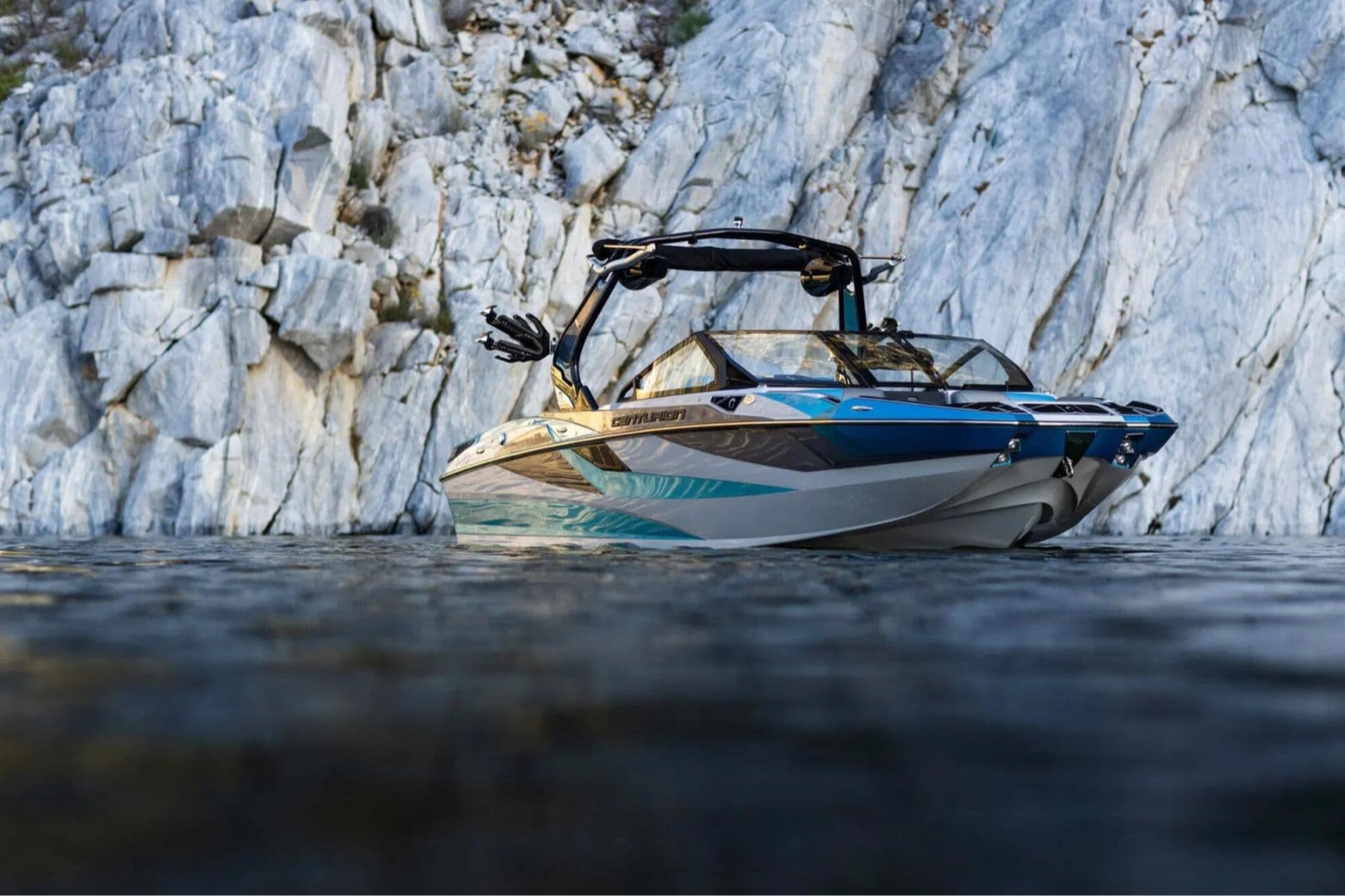
The Malibu Wakesetter 23 LSV is one of the boats most wake-surfing households end up cross-shopping when they decide to go premium. Malibu has been building inboard wakeboats since the 1980s and the 23 LSV has been the volume model for over a decade. The current generation introduced Surf Gate, Power Wedge II, and the integrated ballast system that together make the boat able to throw a clean surfable wave on demand without the rider having to move ballast bags around the cockpit.
What is the Wakesetter 23 LSV?
The 23 LSV is a 23-foot 6-inch fiberglass V-drive inboard wakeboat. Beam is 8 feet 6 inches, dry weight sits around 5,400 pounds before ballast. The V-drive layout places the engine at the rear of the boat with the prop shaft running forward then back to a drive aft of the engine. The setup opens the mid-cockpit for a full lounge and shifts the boat's weight rearward, which is part of what produces the surfable wave.
Surf Gate is the headline system. Two hydraulically actuated tabs at the transom direct water flow to one side or the other, shaping a clean surf wave on either the port or the starboard side without the rider having to balance the boat with weight on the deck. The Power Wedge II is a hydraulic foil mounted at the transom that adjusts the running attitude of the hull, which changes the wave shape and lets the boat plane at lower speeds with heavy ballast aboard. The integrated ballast system fills hard tanks under the floor with a series of pumps, and the controls run through the helm touchscreen.
The Indmar V8 gas inboard is the standard drivetrain. Several horsepower options have run through the production, with the larger Monsoon and Raptor variants standard on heavier-spec builds. The engine sits centerline at the rear of the boat with a V-drive transmission turning the shaft forward and back to the drive aft of the engine.
Layout is built for a full party. Wraparound bow lounge, wraparound rear lounge, a forward-facing helm with a touchscreen, and a swim platform that takes a full surf step setup. Eight to ten people fit comfortably for a day on the water.
Who is it good for?
Wake-surfing-first households are the core buyer. The 23 LSV produces a wave most riders consider among the cleanest factory waves at this length. For families with two or three surfers in the household running 30 to 70 days a season on a private lake or a club-restricted lake, the boat is the right tool. I worked a long July weekend aboard a 23 LSV on Lake Travis pulling four adults through their surf sessions one after another, the boat producing a wave clean enough that everyone got at least one long ride. That is the brief.
Owners stepping up from a sterndrive bowrider into a real inboard wakeboat are the second profile. The V-drive layout, the integrated ballast, and the Surf Gate are a different experience from a sterndrive boat with bagged ballast on the floor.
Multi-sport households who want one boat that surfs, wakeboards, and pulls a slalom skier are the third use case. The Wakesetter does all three well enough that families who run two or three sports do not need two boats.
Who is it not good for?
Day-cruising-only buyers who do not surf or board. The Wakesetter premium and the V-drive maintenance burden do not make sense for owners who use the boat for swim trips and lake cruising. A bowrider or a deck boat is the better tool.
Buyers shopping on entry price. The 23 LSV starts at a premium and the option lines push the build past $200,000 quickly. Households on tighter budgets should look at the Axis A22, which is Malibu's volume value brand and shares much of the engineering.
Trailer-storage owners running the boat on a weekend-by-weekend basis are the third wrong fit. The ballasted weight, the deep V-drive hull, and the size all argue for slip storage or a hoist. Trailering a 5,400-pound dry hull plus a thousand-plus pounds of ballast on a weekly basis is not the right ownership pattern.
Pricing
New 2026 pricing on the Wakesetter 23 LSV in standard configurations lands roughly $175,000 to $235,000 depending on engine choice, options, and electronics. The full-option build with the top engine, the upgraded sound system, and the surf-step package pushes past $235,000 at the dealer.
The used market is broad. Clean hulls from 2017 to 2023 range $72,000 to $185,000 depending on year, engine option, hours, and ballast spec. The current Surf Gate and Power Wedge II generation, which started around 2014, has carried forward with refinements rather than redesigns, so the used market is comparable across years. Depreciation slows after year four, which makes the 2020-2021 used hulls a strong value spot.
What works
- Surf Gate produces a clean surfable wave on demand on either side.
- Power Wedge II changes wave shape and lets the boat plane at lower speeds.
- Integrated ballast fills in minutes with intuitive helm controls.
- V-drive layout opens the cockpit for a full lounge and a real swim platform.
- Indmar V8 power gives the torque the heavy ballasted hull needs.
- Malibu dealer network supports the boats well across the decade.
What doesn't
- Entry price is high and the option lines climb steeply.
- Ballasted weight stresses a trailer and a launch ramp.
- The hull lives in a slip or on a hoist for most owners.
- Engine maintenance burden over a decade is meaningful on a hard-used wakeboat.
- Surf Gate actuators are an electromechanical system that needs occasional service.
- First-time V-drive owners face a maintenance learning curve.
Year-by-year notes
The current generation of the Wakesetter 23 LSV started around 2014 with the introduction of Surf Gate. Power Wedge II followed shortly after, and the integrated ballast and touchscreen helm have moved forward through several refinements. The 2020-onward boats carry the current touchscreen helm and the updated Surf Gate actuator design. Engine options have shifted across the years, with the larger Indmar Raptor variants becoming more common on heavier-spec builds. There is no defect cutover year to screen for on the current generation, but the 2020-onward boats have the most current systems.
Cost of ownership
Annual costs are higher than a typical bowrider because of the engine and the ballast hardware. The Indmar V8 wants oil and filter service every 50 hours, plus impeller service annually and a manifold and riser inspection at the four-to-five-year mark. Ballast pumps need periodic flushing and replacement every five to eight years depending on use. Surf Gate actuators are an electromechanical part that may need service at year five or beyond.
Insurance on a $130,000 hull runs $1,800 to $3,400 a year depending on use case and storage. Slip rental at a wake-friendly lake marina varies wildly by region. A five-year hold on a 2022 Wakesetter 23 LSV bought at $145,000 with 200 hours, used 50 days a season on a private lake with hoist storage, lands at roughly $12,000 to $18,000 a year all-in over the hold.
Best year and trim to buy
2020-onward Wakesetters with the current Surf Gate, Power Wedge II, the updated touchscreen helm, and the higher Indmar engine option are the right buy in 2026. Verify five things before signing. First, the ballast pumps cycle cleanly and fill within the spec time. Second, the Surf Gate actuators move smoothly on both sides without hesitation or grinding. Third, the engine service file shows current 50-hour service plus the manifold and riser inspection at the appropriate hour mark. Fourth, the hull bottom and the V-drive shaft have no signs of impact damage. Fifth, the upholstery is intact, because re-doing a Wakesetter interior is a serious expense.
Sea trial notes
A sea trial on a Wakesetter 23 LSV should focus on the systems that define the boat. First, run the boat at cruise without ballast. The hull should plane cleanly, the engine should pull through the rev range without hesitation, and the steering should feel tight. Second, fill the ballast to a typical surf setup. The pumps should cycle within the spec time, and the helm display should show all tanks filling smoothly. Third, dial in a surf wave on either side using Surf Gate and the Power Wedge. The wave should form cleanly within a few seconds of the boat reaching surf speed, and the surfable face should be smooth and well-shaped. Fourth, check the touchscreen helm response. The system runs everything from ballast to engine displays to media, and any lag or glitches are worth investigating.
A long summer day on Lake Powell with the 23 LSV is a typical environment. The boat hauls four to six adults through their surf sessions cleanly, the wave stays consistent across the session, and the engine handles the heavy ballast load without overheating. That is the brief.
A second walk-around on a used hull should focus on the wear points. Inspect the Surf Gate actuator boots for cracks or water ingress. Check the ballast pumps for any signs of mineral buildup at the inlets. Look at the V-drive shaft and the coupler for alignment. Pull the engine cover and look at the manifolds and risers for any rust or carbon staining. Check the upholstery, because the cockpit lounges are exposed to sun and wet riders all season, and re-doing a Wakesetter interior is a serious expense.
Alternatives
The direct cross-shop on wave quality is the Nautique G23, which produces a competing surf wave on a similarly priced hull. The volume-value cross-shop is the Axis A22, which is Malibu's own value-tier brand at materially less money and a less refined wave. For buyers stepping down in length to a shorter Wakesetter with a similar feature set, the Malibu 22 LSV is the natural alternative on the same platform philosophy.