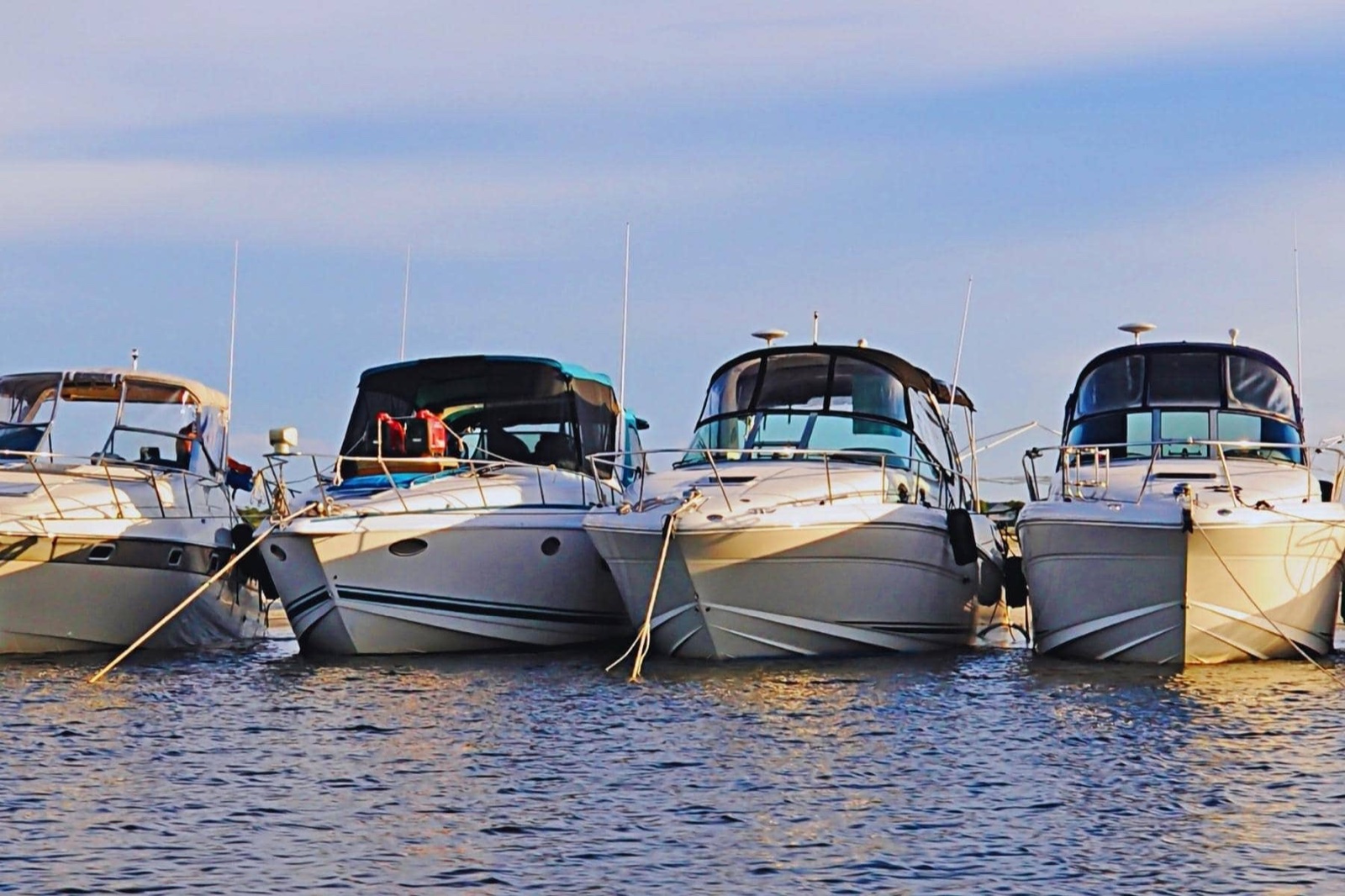
What is the Regal 33 XO?
The Regal 33 XO is a 34-foot 1 inch outboard-powered express cabin cruiser with a 10-foot 4 inch beam, a 21-degree deadrise, 150 gallons of fuel, a 36-gallon fresh water tank, and a 29-gallon holding tank. The hull dries at 13,700 pounds before the outboards. Standard power is twin Yamaha F300 V6 outboards on the bracketed transom; the F350 V6 and the new F350 V8 are upgrades. Top speed lands near 42 mph with the standard pair, with a comfortable 28 to 31 knot cruise that holds roughly 2.0 mpg combined.
The cabin layout sleeps four. A mid-cabin king berth sits below the helm, a convertible forward V-berth zips between twin and double configurations, and the dinette converts as a backup berth for two more in a pinch. The galley carries a refrigerator and a single-burner stove, the head encloses a portable shower, and the cockpit aft of the helm fits eight for entertaining.
Who is it good for?
The right buyer is the weekending household running 30 to 80 hours a season on coastal water and protected bays. Tampa Bay, the Florida intracoastal, the Chesapeake, the Long Island Sound, and the Pacific Northwest sounds are the natural homes. Owners who want a 33-foot weekender without the annual sterndrive bellows replacement cycle land here. We spent a Friday-to-Sunday weekend on a 2022 hull out of St. Petersburg, two couples aboard, two anchorages overnight in Boca Ciega Bay. The mid-cabin king worked as a real bed, not a folded-out compromise.
Cross-shoppers from the Sea Ray Sundancer 320 are the second core profile. The 33 XO trades a small amount of cabin volume for the outboard maintenance profile, and the swap is the right one for owners who keep the boat 5 to 10 years and have run sterndrive service bills before.
Coastal cruisers who want shallow-draft access into backwaters and beach anchorages are the third profile. The 22-inch draft with engines up means the boat can nose into spots a sterndrive 32-footer cannot reach.
Who is it not good for?
Liveaboard households and 60-plus night cruisers will find the cabin tight. The mid-cabin king is a real bed but the cabin headroom and the head-shower geometry are designed for two-night to four-night cruises, not for a Bahamas season afloat. Owners who want full genset, reverse-cycle AC, washer-dryer, and a stand-up enclosed shower should look at a longer platform or a more traditional express cruiser.
Buyers cross-shopping a flybridge or pilothouse cabin cruiser are wrong-targeted. The 33 XO is an open express layout with a hardtop and a single-helm console. Owners who want a second helm or a true wheelhouse should look at a Beneteau or a Jeanneau in this length range.
Saltwater dock-kept hulls without diligent service take a depreciation hit faster than dry-stack or covered-slip equivalents. Outboards forgive a lot, but the bracket geometry and the trim hardware still need annual flush-and-service.
Pricing
A 2026 33 XO with twin Yamaha F300 V6 outboards and a base option list is $345,000 to $385,000. Adding the F350 V6 upgrade, the lithium house bank, the reverse-cycle AC, the genset, the bow thruster, and the premium audio pushes the build into the $400,000 to $420,000 range. The new F350 V8 outboards land near the top of that band and carry their own lead time.
Used pricing has held up. A 2017 to 2019 hull with under 400 hours is $199,000 to $245,000 depending on engine spec and condition. A 2020 to 2022 hull with the same engines and a clean service history sits in the $250,000 to $310,000 band. A 2023 to 2024 hull with the F350 upgrade and the loaded option list clears $325,000 and sometimes $345,000. Across recent listings the average sat near $267,000 across all model years.
The value buy is a 2021 to 2022 hull with twin Yamaha F300 V6 outboards, the lithium house bank, the reverse-cycle AC, and a documented Yamaha-service history. Asking prices in the $250,000 to $290,000 band match the use case for most weekending households.
What works
- Twin Yamaha outboards eliminate the sterndrive bellows-and-gimbal cycle entirely. Annual maintenance is a Yamaha 100-hour service plus a flush routine, and the 1,000-hour interval is the same as on a center-console rigging.
- 21-degree-deadrise hull with the proven Regal lineage holds 3-foot chop at 28 knots cruise without the sharp pound that fatigues a long day on the water.
- Cockpit volume aft of the helm is segment-leading at 34 feet. Eight-person entertaining works, the swim platform is wide and stable, and the engine well still leaves usable seating.
- Mid-cabin king berth is a real sleeping arrangement, not a token. What owners report across two-night and four-night cruises consistently rates the cabin volume as enough for a couple plus two.
- Outboard maintenance saves roughly $3,000 to $4,000 a year versus the equivalent twin-sterndrive Sundancer cross-shop, which compounds across an 8 to 10 year ownership window.
What doesn't
- Cabin volume is slightly under the Sundancer 320 at the same overall length. Buyers shopping for maximum cabin should weigh that trade carefully against the maintenance savings.
- Genset and reverse-cycle AC are options, not standard. A boat without those two items is fine for day cruising but limits overnight stays in hot or cold weather.
- Outboard transom layout adds an engine well that takes some cockpit length back. The aft cockpit is wide but not as long as a sterndrive equivalent.
- Loaded 2026 hulls clear $420,000 with the twin F350 V8 upgrade, which puts the boat in cross-shop range with longer platforms.
- The portable-shower head compartment is a compromise. Owners who want a stand-up enclosed shower will not find it here.
Year-by-year notes
2017 to 2019 hulls came with twin Yamaha F300 V6 outboards as the standard pair and the original Regal cabin layout. Some early hulls used the F350 V6 as the top option.
2020 to 2021 hulls refined the helm electronics package, added the lithium house bank as an option, and updated the cockpit upholstery and color palette.
2022 to 2023 hulls have the refined Garmin chartplotter package, the optional reverse-cycle AC standardized as a more-common factory order, and the cabin headliner finish updated.
2024 introduced the Yamaha F350 V8 as the top-tier engine option and refined the cockpit storage layout. Bow thruster became a more-common factory-order item on hulls heading to coastal markets.
2025 to 2026 hulls carry over the 2024 layout with minor cosmetic updates and helm-display firmware refinement.
Cost of ownership
Twin-Yamaha operation keeps a clean cost line. Annual 100-hour service for the pair costs $800 to $1,400. Fuel burn at 28-knot cruise sits near 28 to 32 gph combined, so a typical 50-mile day uses 25 to 30 gallons of premium fuel.
Insurance on a $275,000 hull is $4,500 to $7,500 a year depending on storage and use case. Marina dockage in the Florida, Chesapeake, and Pacific Northwest markets costs $7,000 to $14,000 annually for a covered or in-water 34-foot slip.
Plan a $4,000 to $6,500 a year reserve for routine maintenance plus a Yamaha cylinder inspection at the 1,000-hour mark and a hull-bottom service at year 5. Reverse-cycle AC, genset (if equipped), bow thruster, and lithium house bank are the recurring big-line items.
Resale offsets the rest of the math. Five-year depreciation on a clean 33 XO is roughly 26 to 30 percent against a segment median closer to 32 to 38 percent for sterndrive cabin cruisers in this length. The outboard rigging supports demand on the secondary market for buyers tired of sterndrive bellows.
Best year and trim to buy
A 2021 to 2022 hull with twin Yamaha F300 V6 outboards, the lithium house bank, the reverse-cycle AC, the bow thruster, and a documented Yamaha-service history is the value buy. Asking prices in the $250,000 to $290,000 band match the use case for most weekending households on the Mid-Atlantic and the Gulf. We sat through a pre-purchase sea trial off Annapolis last fall where the buyer flagged a soft fuel-fill access panel on a 2021 hull, and the broker adjusted the asking by $4,500 to cover the repair. Worth the inspection in every case.
Verify three things before close. First, confirm the Yamaha service log shows annual 100-hour service for both engines and a recent compression check. Second, walk the bracket bolt heads and the transom fairing for any visible corrosion or loose fasteners on saltwater-dock hulls. Third, run the air conditioning and the genset (if equipped) through a full cycle on shore power.
For 2026-new buyers, the twin Yamaha F350 V6 with the lithium house bank, the reverse-cycle AC, and the bow thruster is the spec that resells best at year 5 and supports the use case for most coastal weekenders without paying the F350 V8 premium.
Alternatives
The Sea Ray Sundancer 320 is the direct sterndrive cross-shop, with larger cabin volume, the traditional express-cruiser layout, and the trade of the sterndrive bellows-and-gimbal maintenance cycle. The Chris-Craft Launch 27 150th Anniversary Edition is the right pick for households who want the Regal-tier finish without the overnight commitment, with a smaller daycruiser footprint and a single-engine layout. The Jeanneau Merry Fisher 1295 Fly is the alt cabin-cruiser idea with twin outboards plus a flybridge for buyers who want a higher helm and more all-weather capability than an express layout offers.