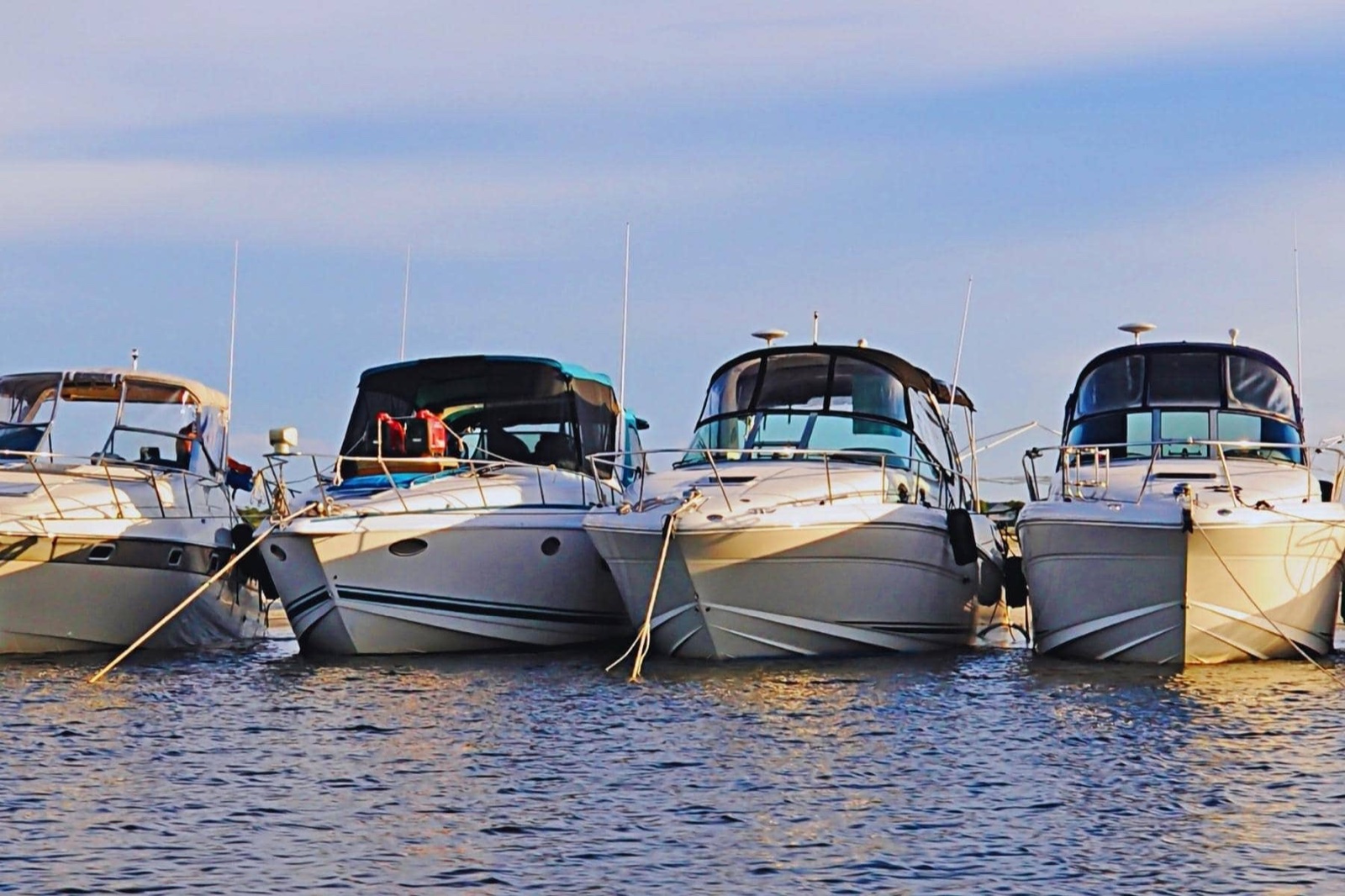
The Sea Ray Sundancer 320 is the boat other 32-foot cabin cruisers get compared to. Sea Ray has been building Sundancers since the 1970s, and the current 320 launched for 2019, six model years ago. It sits at the top of our 2026 cabin cruisers guide because the cabin space, the engine options, and the dealer network all add up to a boat that's hard to beat at this length, and one that's still worth most of what you paid for it five years on.
What is the Sea Ray Sundancer 320?
The Sundancer 320 is a 32-foot 9-inch fiberglass express cruiser. Beam is 10 feet 7 inches, draft is 41 inches, dry weight is 13,305 pounds. Two engine choices. The sterndrive build uses twin Mercury MerCruiser 6.2L gas engines, 350 horsepower each, on Bravo Three X drives, the standard setup across most of the production. The outboard build, new for 2024, uses twin Mercury 350 Verado V10 outboards with Joystick Piloting included. People are increasingly choosing the outboard build because it has less scheduled maintenance.
The cabin is what makes this boat worth the money. Forward stateroom with a V-berth that converts to a queen. Mid-cabin berth that fits two adults, though if you try to sit up in there you'll bang your head on the underside of the cockpit sole. The headroom is sized for sleeping, not for hanging out, and it's the first thing first-time express-cruiser shoppers notice on a walkthrough. Enclosed head with a stand-up shower and an electric marine toilet. Galley with a fridge, two-burner stove, and microwave. 60-gallon freshwater tank, 38-gallon holding tank. The cockpit fits eight under the radar arch, with a wet bar and grill standard from 2020 onward. From 2021, the helm has triple Garmin GPSMap displays and Mercury VesselView. The 5kW generator and reverse-cycle AC are standard from 2020. We spent a summer night aboard a 2021 at a Chesapeake slip in 90-plus-degree heat, AC running on shore power for the first half then on the genset after midnight, and the boat stayed cool and quiet enough to actually sleep on. That's the spec that turns a weekend boat into a livable one.
Who is it good for?
Weekending families. Friday afternoon to Sunday evening on the boat, kids or guests aboard, a real queen bed, a kid-friendly mid-cabin, a shower, a working galley, and AC for a hot summer night. The 320 is basically a one-bedroom apartment on the water. If your weekends are "marina A to anchorage B to marina C," this is your boat.
Owners stepping up from a 28-to-30-foot bowrider or a big day-boat are the second group. You get the cabin and the systems a day-boat doesn't have, while keeping the cockpit room and swim-platform access you already use.
Coastal cruisers running 50–100 hours a season on protected water and inland lakes are the third group. People hopping between marinas. We saw the value of the Sea Ray dealer network firsthand last summer on the Chesapeake: a 320 owner pulled into a transient slip in Annapolis with a fuel-pump warning lit on the dash, walked to the marina's Sea Ray service desk, and had a tech aboard the boat inside forty minutes. That dealer footprint is wider than any direct competitor's, and it's a big part of why the boat holds its value the way it does.
Who is it not good for?
Day-only owners are the wrong buyer. The cabin, the generator, the AC, the holding tank: you're paying for things you won't use, and a Cobalt 336 or Regal 33 XO does the day-boat job better for less money.
Anyone wanting to trailer the boat home should walk past too. At 32 feet 9 inches and 10 feet 7 wide, you're past most state thresholds for routine trailering. A tri-axle trailer plus a tow vehicle that can pull it is a $14,000 add-on most buyers don't see coming. The 320 lives in a slip.
Buyers far from a Sea Ray dealer are the third exclusion. The dealer network and the resale value are tied together. The boat holds its price partly because it's easy to sell through a Sea Ray dealer. If your local market doesn't have one, you're buying a different value equation. Look hard at the closest dealer relationship before you sign.
Pricing
New 2026 sterndrive Sundancers go for roughly $398,000 to $462,000 depending on dealer, electronics, and options. The 2024-onward outboard V10 build is more. Current-year hulls with full electronics often pass $475,000 at the dealer.
The used market spans $47,000 at the bottom (older 2002-2007 first-generation hulls with 1,500-plus hours and deferred service) to $544,000 at the top (current-year demonstrators loaded with options). The first-generation 320 (2002-2007, with Volvo diesel or V8 gas options at 500–750 horsepower) averages around $131,000, but it's a different boat from the current generation. For current-generation sterndrive hulls from 2018-2022 with 200-500 hours, expect $172,000 to $268,000 on the broader market. The outboard build averages around $389,000 used because most listings are recent-year hulls.
A clean current-generation sterndrive 320 loses about 24-28 percent of new MSRP over five years. That's better than anything else in the segment, and over a long hold the actual cost of owning one ends up close to a less-expensive competitor. The dealer network and the used-market support are why the depreciation curve flattens after year four.
What works
- Forward V-berth converts to a real queen and the mid-cabin berth fits two adults. Four people sleep aboard for real, not just four people on paper.
- Sterndrive build tops out at 44.7 mph, cruises at 34 mph burning about a gallon per mile, with a 159-mile range on the standard tank.
- 5kW generator and reverse-cycle AC standard from 2020. The boat is comfortable enough for a marina overnight in summer heat.
- Triple Garmin GPSMap and Mercury VesselView at the helm from 2021. The electronics feel current.
- Holds its value better than anything else at this length. Brokers move clean Sundancers in 60-90 days at fair money.
- Outboard V10 build from 2024 onward gives a quieter, lower-maintenance setup with Joystick Piloting standard. The configuration most new buyers now ask for.
- Wet bar and grill standard from 2020. Eight people fit in the cockpit under the radar arch.
What doesn't
- Sterndrive bellows replacement every two to three years is $3,000-3,800 for both drives. First-time sterndrive owners don't expect this bill.
- At 32 feet 9 inches and 10 feet 7 wide, the boat lives in a marina slip. Trailering means a tri-axle rig and a serious tow vehicle, another $14,000 you don't need.
- Even on a clean 2019-2020 used 320 you're starting around $172,000.
- Sterndrive impeller and gimbal-bearing service add labor every year that an outboard build doesn't have.
- Mid-cabin headroom is for sleeping, not sitting up. First-time buyers notice this on the sea trial.
- The outboard build is materially more money. Used V10 hulls run $400,000 and up.
Year-by-year notes
The current generation launched for 2019 on the 32-foot 9-inch hull, which carries through to the 2026 catalog. The 2020 model added the 5kW generator, reverse-cycle AC, and the cockpit wet bar and grill as standard. The 2021 model went to triple Garmin GPSMap displays with Mercury VesselView at the helm. The 2024 model added the outboard build with twin Mercury 350 Verado V10 outboards and Joystick Piloting standard, sold alongside the continuing sterndrive option. The first-generation 320 (2002-2007, with Volvo diesel or V8 gas options at 500-750 horsepower) is a different boat on a different hull. Don't confuse it with the current model when shopping used. There's no defect cutover year on the current generation worth screening for, but those pre-2019 first-gen hulls have very different ownership math.
Cost of ownership
Annual costs are higher than segment average because of the sterndrive maintenance. Mercury 6.2L engine service every 100 hours is $400-700 in parts and $400-600 in dealer labor per engine. Bravo III drive service (impeller, gimbal bearing, gear oil) is $600-1,200 per drive. Bellows replacement every two to three years is $3,000-3,800 for both drives. We watched a first-time Sundancer owner open the third bellows invoice at a Chesapeake yard and visibly flinch. The boat itself was faultless. The math just hadn't been part of the picture he had in his head when he bought it. The outboard V10 build trades all of this for standard outboard service, which is part of why the 2024-onward outboard variant is taking share.
Insurance on a $200,000 hull is $2,400-4,200 a year on the coast. A 32-foot covered slip in a major coastal market is $9,000-18,000. Owning a 2020 used sterndrive 320 bought at $215,000 with 200 hours, used 75 hours a season on the Chesapeake with marina-slip storage, costs roughly $26,000-40,000 a year all-in over a five-year hold, covering insurance, fuel, service, slip, and the capital cost spread out.
Best year and trim to buy
The 2020-2022 sterndrive Sundancer 320 with the 5kW generator, reverse-cycle AC, the wet bar and grill, and the triple Garmin GPSMap helm (standard from 2021) is the right buy in 2026 for most weekending households. You get broad model-year coverage on the used market, and the maintenance pattern is well-documented. The 2024-onward outboard V10 build is the right buy if you'd rather have outboards and have the budget for the higher entry price.
Five things to check before buying. First, the bellows service is current and in the file. Second, the impeller and gimbal-bearing service is at the right hour mark. Third, the generator has been started and run regularly. Gensets that sit unused develop fuel-system issues that surface on first start. Fourth, the holding-tank and watermaker systems work. Test them on the sea trial. Fifth, the engine service file shows current 100-hour work. A clean 2021 sterndrive 320 with the genset, AC, triple Garmin, and 200-350 hours should land between $215,000 and $258,000 at a Sea Ray-experienced dealer with the file in order.
Alternatives
The premium cross-shop is the Cobalt 336, which trades Sea Ray's dealer network and resale strength for a step up in materials and hardware. Most-compared at the same length is the Regal 33 XO, which leans more toward day-boat use with a smaller cabin and a sport-cruiser feel rather than express-cruiser. For the same weekending brief at materially less money, the Bayliner Ciera 8 is the budget alternative. A step down in build but an entry price that opens the segment to first-time cabin-cruiser buyers.