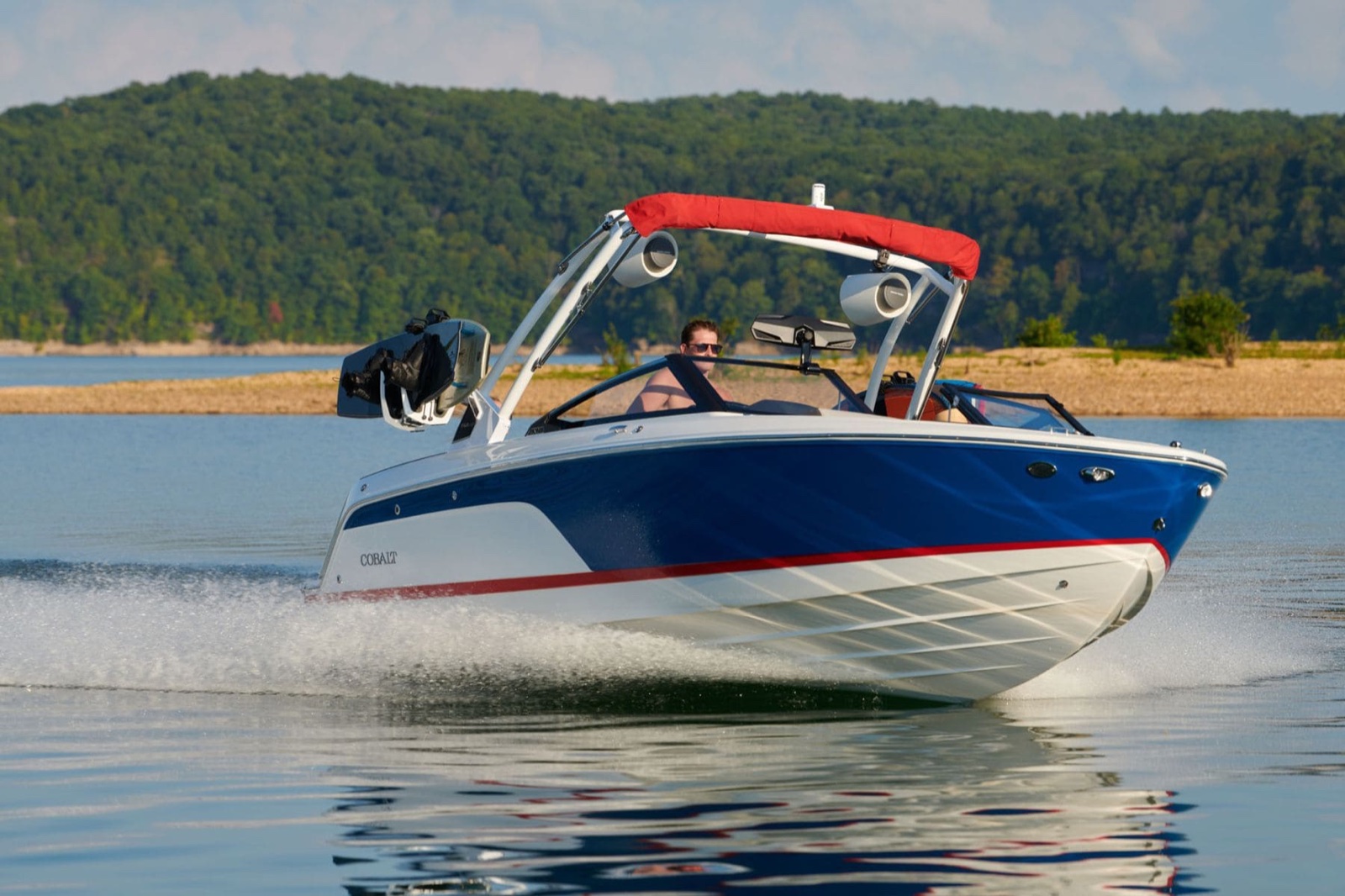
What is the Cobalt 336?
The Cobalt 336 is a discontinued 33-foot 6-inch crossover platform built by Cobalt from roughly 2012 through 2016. The hull is a hand-laid fiberglass build with a vacuum-bagged stringer grid, Kevlar reinforcement at the keel, an 8 layer fiberglass bottom doubling to 16 layers at the keel, and stainless hardware throughout. The 336 was Cobalt's case that a 33-foot platform could be both a 14-passenger bowrider and a real overnighter, with full head, galley, and a cabin that lives under the helm and passenger consoles.
Power is twin sterndrive only. The volume rigging across the production years was twin MerCruiser 6.2L Bravo III gas engines totaling 700 to 850 hp. Twin Volvo Penta gas engines were also available, and twin Volvo Penta D6 diesel sterndrives reaching 860 hp combined were the top-of-the-line option. The joystick docking system was offered as an upgrade on later builds and is the option to look for on the used market.
The cabin layout is what separates the 336 from a traditional express cruiser. A 9-foot leather settee that converts to a berth lives behind the helm console, with a 27-inch flat-screen TV, a Blu-Ray entertainment center, and reverse-cycle AC and heat for four-season comfort. The opposite passenger console encloses a full marine head with a stand-up shower compartment. The cockpit aft of the helm fits 14 passengers across the U-stern lounge, the bow lounge, and the wraparound mid-cockpit seating.
Who is it good for?
The right buyer is the build-first weekending household planning a 10-plus year hold on a 33-foot crossover. Owners who already have a smaller Cobalt R6 or CS22 and want to step up into the crossover segment without losing the brand's build characteristics are the core profile.
Cross-shoppers from the Sea Ray Sundancer 320 who care more about build than recency are the second profile. The Cobalt build runs a tier above the equivalent Sundancer at the same length, with hand-stitched vinyl, hardwood cabin trim, and a finish that holds up at 1,500-plus hours where competitors start showing wear at 1,000 hours.
Freshwater-lake and inland-river owners are the third profile. The boat is happy on Lake of the Ozarks, on the Tennessee River, on the upper Great Lakes inside a reasonable forecast, and on the larger inland reservoirs where 33 feet plus a 14-passenger crossover makes sense for entertaining. We spent a July afternoon aboard a 2015 hull at a Lake Cumberland marina, eight adults and two coolers on the U-stern lounge, the genset running the AC at the dock while the kids cycled in and out of the cabin head between swims. The boat absorbed the load without any sense it was being asked to do something outside its design.
Who is it not good for?
Outboard cross-shoppers should look elsewhere. The Regal 33 XO offers the same length with twin Yamaha outboards on a bracketed transom, no bellows, and a different maintenance profile. Buyers who want to leave sterndrive service behind should specify outboard instead.
Recency-first buyers are wrong-targeted. Production ended in 2016 and the buyer is shopping the secondary market only. For a current-production Cobalt in this size band, the larger A29 and A32 platforms are the natural targets, but they are not crossovers in the same sense as the 336.
Saltwater coastal owners running heavy hours should weigh the trade. The twin Bravo III bellows service line in saltwater costs $1,500 to $1,800 per side every 2 to 3 years, and the boat was engineered for freshwater service. Florida Keys, San Diego Bay, and Long Island Sound use is possible with a religious flush-and-service routine, but the math adds up against an outboard cross-shop.
Pricing
Production ran from 2012 to 2016 at original MSRPs of $230,000 to $305,900 depending on engine choice and option load. The boat is a used-market-only purchase in 2026, with no factory-new units available.
Used pricing has held up surprisingly well for a discontinued model. A 2012 to 2013 hull with 600 to 1,000 hours costs $129,000 to $155,000 depending on engine spec and condition. A 2014 to 2015 hull with the joystick docking system and the genset costs $155,000 to $185,000. A 2016 hull with the loaded option list, the diesel upgrade, and a clean service history can clear $200,000 and sometimes $210,000.
The value buy is a 2014 to 2016 hull with the twin Volvo Penta or MerCruiser 6.2L Bravo III gas engines, the joystick docking, the 5 kW genset, the reverse-cycle AC, and a documented Volvo or MerCruiser service log. Asking prices in the $150,000 to $185,000 band are the right zone for most build-first weekending households.
What works
- Hand-laid hull with vacuum-bagged stringer grid is segment-leading construction. Owners report 1,500-plus hour hulls still showing tight gelcoat, no flex at the keel, and stiff stringers under standard care.
- All-stainless hardware throughout the boat, including cleat backers, rub-rail screws, and rub-strake hardware. Corrosion is rare even on the saltwater dock-kept hulls.
- Crossover layout with the 14-passenger cockpit plus a full cabin under the consoles is genuinely unique. The boat does daycruising, family entertaining, and overnight stays without compromise.
- Joystick docking system on later builds eases close-quarters handling. First-time twin-engine drivers acclimate fast.
- Resale floor is the firmest in the segment. Five-year depreciation runs 22 to 28 percent against a segment median closer to 32 to 38 percent for sterndrive cabin cruisers in this length.
What doesn't
- Production discontinued in 2016. Factory-new 2026 units are not available. The buyer is shopping the secondary market only.
- Twin Bravo III bellows service is a recurring 2 to 3 year line at roughly $1,500 to $1,800 per side. Plan $3,000 to $3,800 for the full job.
- Twin sterndrive maintenance adds up across an ownership window. Annual outdrive service, oil changes, anode replacement, and gimbal inspections cost $1,400 to $2,400 a year for the pair.
- Crossover layout is neither a pure bowrider nor a pure express cruiser. Buyers who want one or the other will find compromises in either direction.
- Loaded 2015 to 2016 hulls clear $200,000 used, which is a price band where some buyers expect a current-production model with newer electronics and a refreshed warranty.
Year-by-year notes
2012 to 2013 hulls came with the original 336 platform, the twin Bravo III gas option, and the basic helm electronics package. The cabin layout, the 9-foot leather settee, the entertainment center, and the head with shower were standard from the start.
2014 added the joystick docking option (Volvo Penta IPS or MerCruiser equivalent), refined helm electronics, and expanded the option list around the genset and the reverse-cycle AC.
2015 to 2016 hulls have the most refined trim, with updated cockpit upholstery, a slightly redesigned bow seating, and the Volvo Penta D6 diesel sterndrive as a more-common factory upgrade.
2017 forward Cobalt discontinued the 336 and shifted the crossover idea to the larger A29 and A32 platforms. Buyers who want a current-production Cobalt in this size band should look at the A28 and A29.
Cost of ownership
Twin sterndrive operation costs real money. Annual MerCruiser or Volvo outdrive service, oil change, anode replacement, and basic engine inspection costs $1,400 to $2,400 for the pair. Bellows replacement at year 2 to 3 costs $3,000 to $3,800 for the pair. We watched a 336 owner at an Ohio River marina open his second bellows invoice in five years and shrug. He had budgeted for it, had the service log to prove it, and his boat showed at survey like a three-year-old hull.
Fuel burn at 26 knot cruise sits near 28 to 32 gph combined for the gas engines, and roughly 22 to 26 gph for the Volvo Penta D6 diesel pair. A typical 50-mile day uses 25 to 35 gallons of premium fuel for the gas builds, less for the diesel.
Insurance on a $170,000 hull costs $3,000 to $5,500 a year depending on storage. Marina dockage in the Lake of the Ozarks, Lake Cumberland, and Great Lakes markets costs $4,000 to $9,000 annually for a covered or in-water 33-foot slip.
Plan a $4,500 to $7,500 a year reserve for routine maintenance plus a bellows replacement at year 2 to 3 of ownership. Reverse-cycle AC, genset, hardtop, and lithium house bank (if equipped) are the recurring big-line items.
Resale offsets the rest of the math. Five-year depreciation on a clean 336 runs roughly 22 to 28 percent against a segment median closer to 32 to 38 percent for sterndrive cabin cruisers in this length.
Best year and trim to buy
A 2014 to 2016 hull with the twin Volvo Penta or MerCruiser 6.2L Bravo III gas engines, the joystick docking system, the 5 kW genset, the reverse-cycle AC, and a documented Volvo or MerCruiser service log is the value buy. Asking prices in the $150,000 to $185,000 band match the use case for most build-first weekending households.
Verify three things before close. First, confirm the bellows service interval and pull the latest sterndrive service report for both engines. Second, walk the cabin headliner, the leather settee, and the cockpit upholstery for any moisture or wear that would indicate prior water intrusion. Third, run the joystick docking system through full close-quarters maneuvering on the sea trial and confirm clean engagement on both engines.
For the diesel buyer, target a 2015 or 2016 hull with the Volvo Penta D6 sterndrives and a clean Volvo service log. Diesel resale tracks slightly higher than gas on the secondary market for this platform.
Alternatives
The Sea Ray Sundancer 320 is the direct express-cruiser cross-shop with the traditional cabin-cruiser layout, larger cabin volume, and a current-production 2026 option for buyers who want factory warranty. The Regal 33 XO is the outboard alternative for buyers who want to leave the sterndrive bellows service line behind, with twin Yamaha outboards on a bracketed transom and a similar 33-foot platform. The Chris-Craft Launch 27 150th Anniversary Edition is the smaller premium daycruiser for households who do not need the overnight cabin commitment and want the classic Chris-Craft brand and styling.