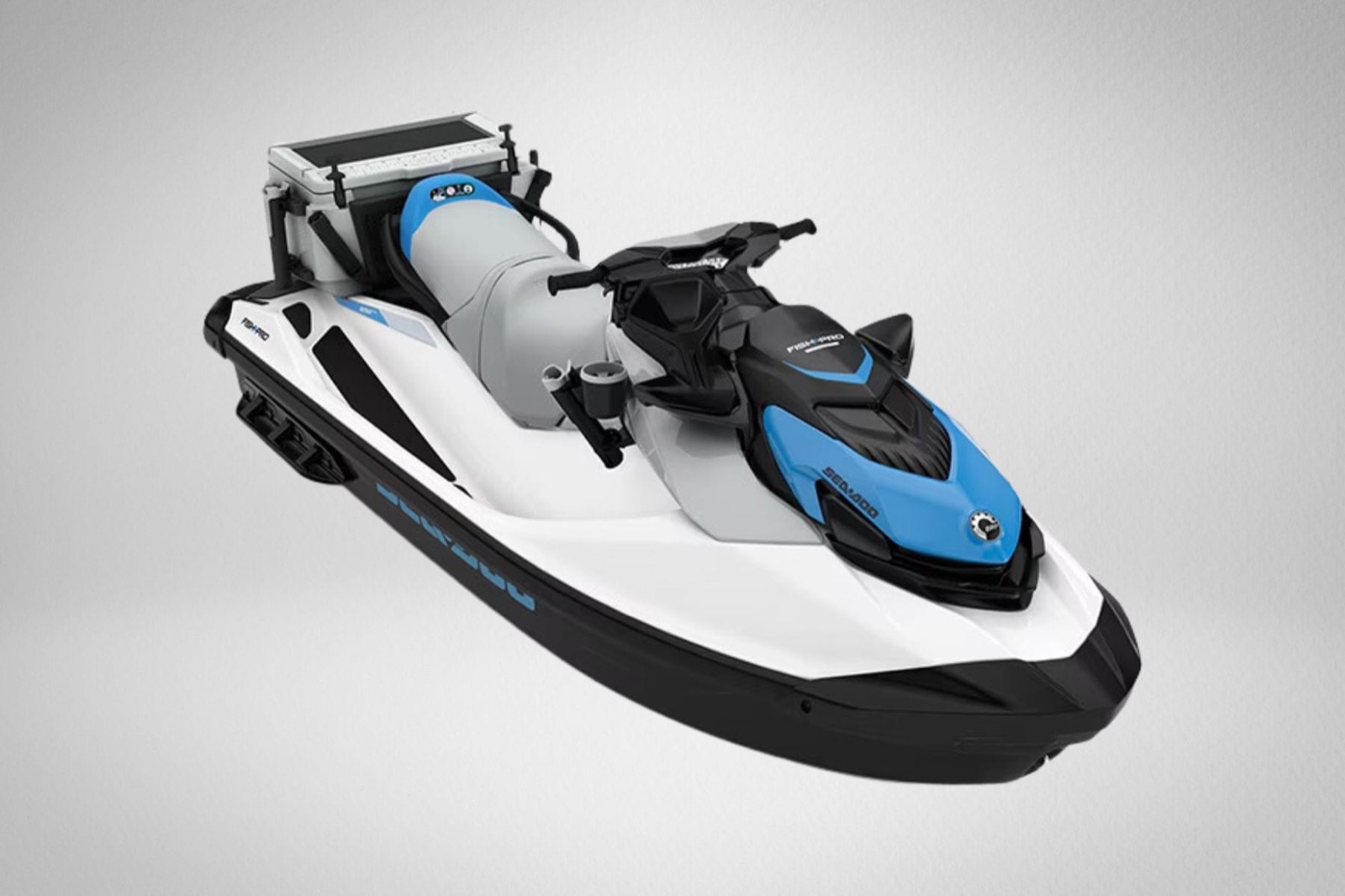
The Fish Pro Trophy is the only PWC on the market built for honest offshore fishing. The naturally aspirated 1630 ACE Rotax at 170 hp, the 18.5-gallon fuel tank, the livewell with auto-fill, the 7-inch Garmin chartplotter, and a factory trolling mode add up to a fishing rig that gets 20 to 25 miles offshore and fishes for four hours without compromise. We took a 2024 Trophy out of Marathon in the Florida Keys in winter 2026: two anglers, full livewell, 28-mile round trip with about 30 percent fuel left at the dock. The takeaway is simple. If you fish offshore or run to islands, the Trophy is the right ski at the price. If you fish inside the bay, you are paying $7,000 for features you will not use, and the Fish Pro Scout is the smarter buy. Used 2022 to 2024 hulls are $15,800 to $19,500, and the 2023 model year is the sweet spot once the 7-inch Garmin and the revised livewell pickup were in production.
What is the Sea-Doo Fish Pro Trophy?
The Trophy is the top of Sea-Doo's three-step fishing line, above the Sport and the Scout. The hull is the larger ST3 platform, four inches wider in the beam than the Scout's GTI hull and a foot longer at 12 ft 3 in. That extra width matters because it gives the casting platform a wider footprint, and the hull volume soaks up offshore chop the Scout pounds in.
The drivetrain is the 1630 ACE Rotax in 170 hp tune. This is the most powerful naturally aspirated engine Sea-Doo has put on a PWC. It is not supercharged. That is a deliberate choice for a fishing platform: no supercharger washer service every 200 hours, no clutch wear at idle, and lower fuel burn at cruise than the supercharged 230 and 300 hp engines in the GTX and RXP-X 300 lines.
The fishing kit is where the Trophy earns its extra money over the Scout. You get a livewell with auto-fill function (push a button at the ramp and the pump fills the well from the lake), a Garmin 7-inch chartplotter with fish finder and in-hull transducer, five flush-mount rod holders, the LinQ rail with removable cooler, a fixed casting platform aft of the seat, an anchoring system in the bow, and the factory three-speed trolling mode at 5, 7, and 9 mph. The fuel tank is 18.5 gallons versus the Scout's 13.7, giving you the offshore range that defines this segment.
What's it like on the water?
Top speed is 55 mph in stock trim, cruise is 32 mph at 6,400 rpm with a fuel burn of 5.2 gph. That math gives you about 113 miles of theoretical range and 70 to 80 miles of real-world fishing range with the livewell pump running and idle time at the spot. We logged 28 miles round-trip out of Marathon with two anglers, full livewell, and finished with about 30 percent fuel at the dock.
The fishing-specific numbers are where the Trophy proves itself. The factory trolling mode at 5, 7, and 9 mph stays within 0.3 mph in calm water, which is precision compared to the throttle-feel idling on the Scout. The livewell auto-fill takes about 90 seconds at the ramp from empty. The pump itself is the one thing the Trophy gets wrong: at speeds over 10 knots the intake can ingest air, and owners on long offshore runs come back to a livewell full of dead bait. Most owners fix this by topping up the well before cruising back in, or by adding an aftermarket pickup with a forward-facing scoop. Sea-Doo revised the pump tube routing for 2023, which helps but does not eliminate the issue.
Casting-platform stability is the Trophy's quiet advantage. The wider ST3 hull is flat to about 11 degrees of heel before lean becomes a problem, and the fixed platform aft gives a second angler a foot position. Two anglers casting at right angles is workable, where the Scout is a one-stander boat. Rough-water behavior in 2 to 3 feet of chop is composed up to 35 mph, the hull soaks the chop the Scout pounds in. Above 35 mph in 2-foot wind chop you feel the sea state, but the Trophy is genuinely an offshore-capable platform up to small-craft-advisory conditions.
Who is the Sea-Doo Fish Pro Trophy for?
The Trophy is for the angler who wants to fish where a 22-foot center console fishes, on a ski budget. Florida Keys flats-to-bluewater runs. Long Island Sound striper runs. Lake Texoma stripers chased 8 miles down-lake. We did a 28-mile round-trip out of Marathon and the Trophy delivered both anglers home dry with bait still kicking after we patched the well at the halfway mark. It is also for the boater stepping up from a Fish Pro Scout who hit the range limit and wants more tank, more electronics, and more livewell.
It is not for you if your fishing is all bay or pond inside 5 miles. The Scout does that job for $7,000 less and uses the GTI hull, which is plenty stable in protected water. It is not for you if you need three-up family duty, because the fixed casting platform takes the rear seat real estate. And it is not for true bluewater work, 30 miles offshore in big swell. For that you want a Yamaha FX HO Fishing Edition buddy-boating with you or a real 22-foot center console.
Pricing
A 2026 Fish Pro Trophy 170 starts at $22,649 MSRP. With dealer prep, freight, and a trailer most rigs land between $24,000 and $26,500 out the door. There is essentially no haggle on a new Trophy in 2026, dealers are selling them at sticker.
The used market is where the value is. The Trophy launched in 2022, so there is a clean four-year used pool. The brokerage average across all years is around $20,700. 2022 hulls with 40 to 80 hours of use trade at $15,800 to $17,500. 2023 hulls with similar hours run $17,000 to $19,500. 2024 hulls with under 50 hours are $19,500 to $22,000 and approach the new-boat price. The 2026 buyer's sweet spot is a 2023 hull in the 30 to 80 hour range, which puts you at roughly 30 percent off new with the updated livewell pickup and the larger Garmin display.
Year-by-year notes
The Trophy is in its first generation, so there are no big structural changes year-to-year. Three updates are worth knowing.
2022 was the first model year. The livewell pump pickup design is the most issue-prone of any year. The Garmin display was 7-inch but with an earlier ECHOMAP firmware that lagged on autoload of waypoints. 2022 Trophy owners often retrofit a forward-facing livewell scoop or relocate the intake.
2023 brought the production fix to the livewell pickup tube routing, which helps but does not fully eliminate air ingestion at speed. The chartplotter received a firmware update. This is the year most buyers in the used market target.
2024 added the BRP Connect app integration on the dash display and updated graphics on the deck. 2025 and 2026 are mechanically identical to 2024 with minor color and trim changes. The 10.25-inch dash display some dealers advertise is on the related GTX and RXT lines, not the Fish Pro Trophy.
Cost of ownership
The Trophy is cheaper to own than its supercharged stablemates because there is no supercharger service. The 1630 ACE naturally aspirated engine takes a 100-hour oil and filter service that costs $250 to $400 in dealer labor and parts. The 200-hour service adds a spark plug change and gearcase oil for another $150 to $200.
Fuel use is moderate for the segment. At 5.2 gph cruise and average fishing days of 4 to 5 hours, you are using 20 to 25 gallons per outing. At $5 per gallon for 91-octane non-ethanol you spend $100 to $125 per fishing day.
Insurance on a $20,000 used Trophy is $300 to $550 per year depending on state and storage. Trailer storage adds $0 to $1,200 per year if you are not garaging it. Dry-stack slip for PWCs runs $1,200 to $2,400 per year on the Florida coast.
We refueled a 2023 Trophy at the Marathon ramp in winter 2026 after a half-day offshore. The bill was $87 for 14.5 gallons. Total five-year ownership cost on a $17,500 used 2023 Trophy used 60 hours per year is about $2,800 to $4,200 per year, mostly fuel and slip.
Best year and spec to buy
The right choice for 2026 is a 2023 Fish Pro Trophy with 30 to 80 hours of documented use, the revised livewell pickup, dealer-installed transducer, and a single-PWC trailer. Add a forward-facing livewell scoop on day one if the previous owner has not, it is a $180 part and a 45-minute install at any Sea-Doo dealer.
Look for one with the LinQ cooler still on the rail (it walks off), and check the in-hull transducer firmware version on the Garmin display. We talked to a 2023 owner at the Marathon ramp who had 220 hours on his Trophy. He had replaced the impeller wear ring once and added the aftermarket livewell scoop. Nothing else had been done to it. He said he would buy another one. That pattern shows up consistently when you talk to Trophy owners who fish theirs hard.
Alternatives
The Sea-Doo Fish Pro Scout is the in-house alternative and the smarter buy if you fish protected water. It is $7,000 cheaper, has a smaller livewell and 13.7-gallon tank, and uses the GTI hull rather than the ST3.
The Yamaha FX HO Fishing Edition is the closest cross-shop. Yamaha builds its fishing edition on the FX platform with a four-stroke 1.8L engine, dual livewells, and similar rod holder count. The Yamaha has more touring comfort, the Sea-Doo has the better trolling mode and the in-hull transducer in stock form.
For a budget bay-fishing alternative the Yamaha VX Cruiser HO with an aftermarket fishing rack costs $14,000 to $16,000 new and covers 80 percent of the inshore use case.