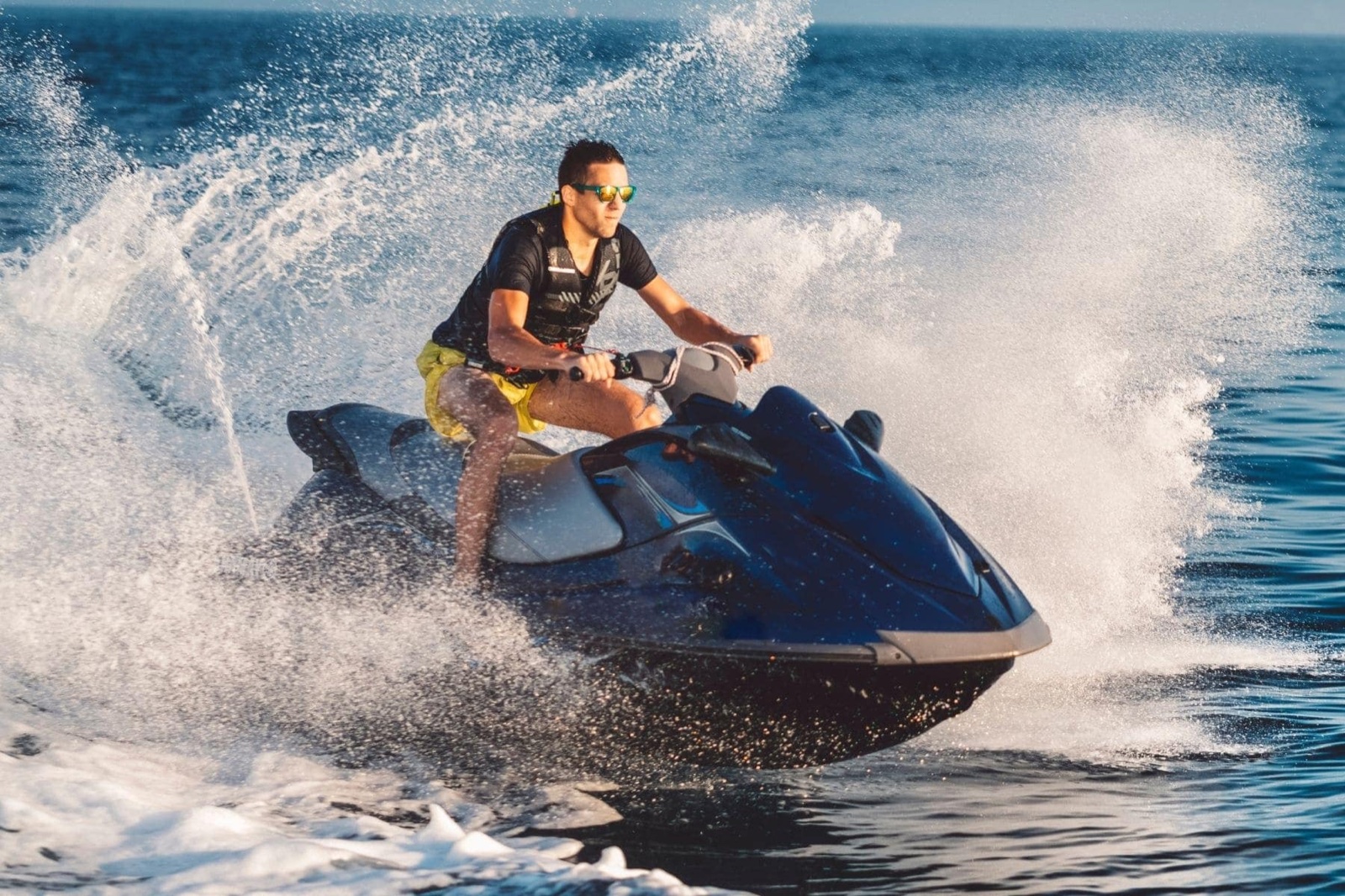
The VX Cruiser HO is the Yamaha that family riders end up choosing after they sit on the seat at the dealer and then sit on the seat of a Sea-Doo GTI 130 right next to it. The Yamaha cushion is deeper, the bolster is more shaped, and there is roughly an inch more legroom for the rear rider. Then you ride both. The 1812cc HO four-cylinder makes 180 hp, fifty more than the GTI 130, and the NanoXcel2 hull is around 50 pounds lighter than the polytec-fiberglass blend Sea-Doo uses on the GTI. Top end is a calibrated 65 mph, cruise sits at 35 mph, and the 18.5-gallon fuel cell gives a real five hours of range at conservative throttle. What you give up is systems polish. Sea-Doo iBR feels a half step more refined at the dock, and the LinQ accessory bolt-on system has no Yamaha equivalent at this trim. Buy the VX Cruiser HO if comfort and engine headroom matter more than systems polish. We spent a weekend on one at Lake of the Ozarks and the seat held up where the rental Spark started to feel firm.
What the VX Cruiser HO is
The Cruiser HO is the upper trim of Yamaha's VX line, the mid-tier hull between the entry EX and the full-size FX. The base VX uses the 1049cc TR-1 engine making 100 hp. The VX Deluxe adds the cruiser seat. The VX Cruiser HO adds the 1812cc High Output four to the cruiser-seated hull, which is the meaningful upgrade. There is also a VX Limited HO above this trim that adds tow accessories, a soft cooler, and a Bluetooth audio package for roughly $1,500 more.
The hull is the second-generation NanoXcel2, a closed-mold composite Yamaha introduced in 2015 and reworked for 2021. It uses a moderate-V planing surface with chines that are sharp enough to lock a turn but not so aggressive that the ski feels twitchy. Dry weight is 758 pounds, roughly 50 pounds under the GTI 130 and more than 100 under the FX HO above it.
Trim level is honest mid-tier. The 6.5-inch color dash, RiDE brake-and-reverse, dual mirrors, cruise assist, and a single-button reboarding handle are all standard. There is no electronic key, no iDF intake protection, and no factory audio.
On the water
Plane time with two adults aboard is roughly four seconds. Top end on a 2024 hull at full trim and a calibrated GPS was 64.6 mph. Cruise at 35 mph returns 4.0 gallons per hour, which works out to a 4.6-hour range with a 20 percent reserve. Run hard at 50 mph and burn climbs to 7.5 gph, which still gives more than two hours.
The HO four pulls in a way the 130-hp Sea-Doo and the 100-hp EX simply cannot. There is real headroom past 50 mph, and the engine note flattens out instead of climbing. Two-up acceleration from 30 to 50 mph is the speed range where the HO advantage shows up most clearly, which is also where you spend most of a touring ride.
We rode a 2024 Cruiser HO for a Saturday at Lake of the Ozarks alongside a 2024 GTI 130 and a 2024 FX HO. Two adults aboard, five hours of riding split across morning and afternoon. The Cruiser HO seat held up where the rental Spark we had compared earlier started to feel firm at hour three. The GTI 130 felt narrower at the bolster, less padded at the lower back, and noticeably slower at every two-up overtake. The FX HO felt heavier and more tour-grade, but at $4,000 more.
Handling is composed rather than sharp. The hull rewards lean, not bar input. RiDE brake response is a half second slower at the dock than Sea-Doo iBR, which costs nothing in open water and a small dignity tax in marina maneuvering.
What ownership looks like
Three-season owners describe the seat as the feature they did not appreciate at purchase and now refuse to give up. The cushion holds two adults without sliding, the rear backrest gives the second rider a brace point in chop, and the cruiser-style profile is the difference between three hours of riding and five.
What owners report consistently is that the 1812cc HO is the most reliable Yamaha PWC engine of the past decade. It is the same SVHO-family block in detuned form, which means it shares the parts catalog with the FX SVHO and benefits from the same long service history. Routine service comes at 50 and 100 hours, dealers price the work at $300 to $500, and there are very few pattern failures inside the 200-hour window. Pump-shaft seal weep is the most common item past 150 hours and is a $300 fix when caught early.
The recurring complaint pattern is two-part. First, the absence of an iDF-equivalent intake debris system means weed strikes still happen in shallow lake use, and clearing them is a manual job. Second, the bars are not adjustable. Taller riders end up tweaking the bar pad or installing a small riser rather than living with the stock height. We watched a six-foot-three rider unbolt and reshim the bar pad in a Lake Pleasant parking lot one Friday afternoon, and he said it took him 20 minutes the first time and 5 minutes every time since.
Dealer experience is the other recurring praise theme. Yamaha's PWC service network is the deepest in the segment, particularly outside coastal regions, and parts availability for this generation sits above Sea-Doo for non-current model years.
Scoreboard
Build (4/5). NanoXcel2 hull is a credible mid-tier composite, lighter than fiberglass and stiffer than polytec. Hardware is corrosion-resistant and the storage hinges hold up better than the EX-tier hardware on multi-year hulls.
Performance (4/5). 180 hp HO is the clear engine advantage in the mid-tier, 65 mph top end, honest 35 mph cruise. Acceleration is composed rather than urgent, which suits the touring brief better than a stunt brief.
Accommodations (5/5). The cruiser seat is the segment benchmark. Real two-adult capacity, real legroom for the rear rider, and a 7.7-gallon front storage with a glovebox forward of the bars. Footwells are flat and grippy.
Systems (4/5). 6.5-inch color dash, RiDE brake-and-reverse, cruise assist, dual mirrors, single-button reboarding. Missing iDF-equivalent intake protection and adjustable bars. Functional and well-integrated.
Value (5/5). $1,000 more new than the GTI 130, fifty more horsepower, deeper seat, larger fuel tank, lighter hull. The math favors the Yamaha for any buyer who values comfort and engine headroom.
Resale (4/5). Three-year resale is roughly 65 percent of new MSRP, broadly even with Sea-Doo and a touch above Kawasaki. Low-hour 2021–2022 hulls hold value strongly.
Best for
Two-up riders who plan three-to-five-hour sessions, lake families who want one ski to fit two adults plus a kid for short rides, coastal owners who run protected bays and want fuel range past four hours at cruise, and buyers who have ridden a rental Yamaha and want the same seat for themselves. The Cruiser HO is also the right buy for an owner who already has a Sea-Doo and wants a Yamaha as the second household ski to spread the service-network risk.
Not ideal for
Riders whose priority is solo acceleration, stunt riding, or wave-jumping, where the Spark Trixx and the lighter Yamaha JetBlaster are the better picks. Riders in heavy weed lakes who would benefit from the iDF system, since clearing intakes on this hull is a manual job. Buyers who plan to use the ski mostly for towing watersports across long open-water runs, where the FX HO above this trim is the more capable platform for $4,000 more.
What's included, what costs extra
The Cruiser HO trim includes the cruiser seat, the 6.5-inch color dash, dual mirrors, RiDE brake-and-reverse, cruise assist, the single-button reboarding handle, and the larger 18.5-gallon fuel cell.
What costs extra: a fitted cover at $310, fender kit at $90, single-place trailer at $1,500–1,900, factory tow eyelet at $50, and a Bluetooth audio bolt-on kit at $700 if you want what comes standard on the Limited HO trim above this one. Yamaha does not offer a LinQ-style bolt-on accessory ecosystem at this trim, so most owners use strap-tied soft coolers or aftermarket dry boxes for additional storage.
Pros and cons
Pros
- Cruiser seat is the segment-best two-up comfort setup.
- 180 hp 1812cc HO is fifty more horsepower than the GTI 130.
- NanoXcel2 hull is lighter than fiberglass at the same stiffness.
- 18.5-gallon fuel cell gives a true five-hour range at cruise.
- 6.5-inch color dash and RiDE brake-and-reverse standard.
Cons
- RiDE is a half step less refined than Sea-Doo iBR at the dock.
- No iDF-equivalent intake debris system on this hull.
- Bars are not adjustable. Taller riders work around the stock height.
Best year and trim to buy
Buy a 2021 or newer VX Cruiser HO. Yamaha redesigned the VX hull for the 2021 model year, dropping roughly 50 pounds and reworking the deck to add the cruiser seat as the upper-trim default. The 6.5-inch color dash is also a 2021-and-up feature, and the older monochrome dash on 2018–2020 hulls is the most common trade-in cited by sellers on lower-trim VX listings.
Within the VX line, the Cruiser HO is the trim that captures the engine upgrade and the seat upgrade in one unit. The base VX with the 100-hp TR-1 saves money but trades away the engine headroom that justifies the model. The Limited HO trim above adds the audio package and accessory bundle for roughly $1,500 more, which makes sense only if you want the factory audio. Skip any 2015–2017 hulls with more than 200 hours.
Price options
New 2026 MSRP is $13,899 at the low end of dealer-set pricing and $15,299 at the high end. Freight and prep adds $500–900 at most dealers. Used market for 2021–2024 hulls spans $9,500 to $12,800 in the lower 48, with low-hour 2022 trade-ins clustering at $11,500.
Financing through Yamaha's captive finance arm sat at 7.99 percent APR for qualified buyers in spring 2026 on a 60-month note. Credit-union rates sat at 6.5 to 7.5 percent over the same window. A $14,500 ski with $1,500 down and a 60-month note at 7.5 percent works out to roughly $260 a month before insurance and registration.
Year-one total cost of ownership on a new Cruiser HO lands around $2,000. Insurance is $250–400 depending on state, registration is $25–90, fuel for 35 hours of riding is roughly 140 gallons at $4 a gallon, the 50-hour service costs $300–450, and a basic cover, fenders, and dock-line setup adds another $250–350. Trailer and storage costs are extra.
Alternatives
The Sea-Doo GTI 130 at roughly $13,099 new is the direct cross-shop. It wins on iBR brake refinement, the iDF intake debris system, and the LinQ accessory ecosystem. It loses on engine output (130 hp vs 180 hp), seat depth, and fuel range.
The Yamaha FX HO at roughly $17,500 new is the next-tier-up option. It adds full-size hull, electronic key, factory audio, and the SVHO-family engine. The Cruiser HO covers most of what most buyers actually use for $4,000 less.
The Kawasaki STX 160X at roughly $12,000 new is the value alternative. It wins on engine simplicity (a four-cylinder four-stroke with a long service record) and price. It loses on seat depth, dash, and fuel-tank size.
For the full first-time-buyer breakdown across all four, see Best Jet Skis for First-Time Buyers in 2026.