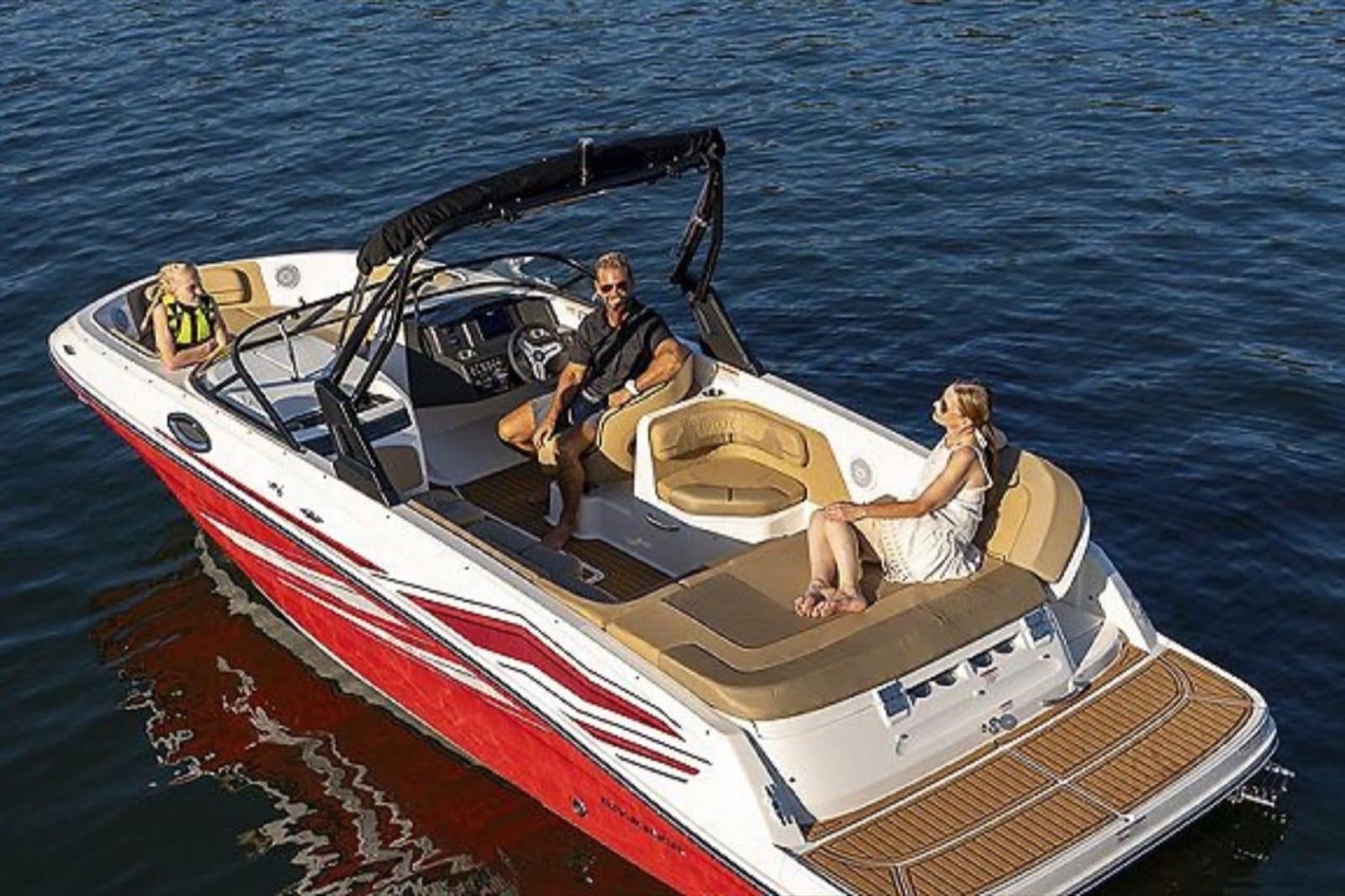
The Sea Ray SPX 230 is the middle of the SPX bowrider range and the size most families settle on after a season or two with something smaller. Sea Ray has been building bowriders for half a century, and the SPX series replaced the old 19 SPX, 21 SPX, and 23 SPX SLX boats with a cleaner tier of trim and engine choices. The 230 has been in production in its current form since the 2017 model year, and the 2026 catalog keeps the same hull with refreshed graphics and a slightly updated helm electronics package.
What is the Sea Ray SPX 230?
The SPX 230 is a 23-foot fiberglass sterndrive bowrider with an 8-foot 6-inch beam. Dry weight is about 4,400 pounds on the standard build, which keeps it inside a normal two-axle trailering footprint with a half-ton tow vehicle that has the right hitch package. The hull is a modified-V planing layup with a moderate deadrise sized for inland lakes and protected coastal water rather than open chop.
Power is a MerCruiser 4.5L gasoline sterndrive driving a Bravo Three X drive, available at 250 or 270 horsepower depending on model year and dealer order. The 270 is the option to look for on a used hunt because it gives you headroom with eight people aboard and a tube on the tow point. Fuel is 50 gallons, which is enough for a full Saturday on the water with the AC off and a deliberate cruise speed.
The cockpit lays out in a familiar way for the segment. Two captain chairs at the helm, a U-shaped seating area aft with a removable filler, a swim platform with a telescoping ladder, and the bow seating forward of the walkthrough. Standard storage runs under most of the bench cushions plus a deeper in-floor locker that fits a wakeboard if you angle it right. The head compartment in the port console is a popular option and the one most families end up choosing, even if it is sized for kids more than for adults.
I spent a long July weekend aboard a 2021 SPX 230 on Lake of the Ozarks during the early-evening cruise window. The boat held a comfortable 28 mile per hour cruise with seven adults aboard, the wake stayed clean for tubing behind, and the sound system carried over the engine note without anyone having to lean forward to hear conversation. The same boat sat at a marina slip overnight and the freshwater cockpit-shower setup made the morning swim-stop cleanup easy. The build feels like what you would expect at this length and price tier, not more and not less.
Who is it good for?
Inland-lake families running 40 to 80 hours a season. The SPX is sized for a Saturday on the water with kids and gear, an occasional wakeboard pull, and a Sunday cruise. The 270-horsepower engine option keeps it from feeling underpowered when the boat is loaded, and the dealer network gives you a service relationship in nearly every state.
Owners stepping up from a 19 or 21 footer who want more cockpit room without going to a 27. The 230 is the size where two families on a day trip stops being a tight squeeze. Three rows of seating usable means the front bench is not the only place for guests.
Resale-minded buyers planning a five-to-seven-year hold. Clean SPX 230s sell quickly when listed at fair money, partly because of the Sea Ray badge and partly because the broker channel for the brand is established in every freshwater market. The depreciation curve flattens after year three and the boat holds its price reasonably well through year seven.
Who is it not good for?
Surf-wake buyers should walk past. A sterndrive bowrider does not throw a surfable wave the way a Malibu 22 LSV or an Axis A22 does. If your weekends are about surfing behind the boat, the SPX is the wrong tool.
Outboard-curious buyers should think hard about it. Sterndrive maintenance is a real annual line and the 2020s have seen most of the bowrider segment shift toward outboard rigging. The SPX has not made that jump yet. After two seasons of bellows service and impeller swaps, some owners get frustrated and trade into an outboard build instead.
Budget-tight first-time buyers can do better. A used Bayliner VR6 covers a similar weekend brief at materially less money. The SPX premium over a Bayliner at the same length is real and the badge alone does not pay it back.
Pricing
New 2026 SPX 230s land between roughly $74,000 and $92,000 depending on engine choice, dealer, and option package. The most common build at the dealer includes the 270-horsepower engine, the cockpit sound upgrade, the head compartment, and the bow filler cushion, which puts the out-the-door price near the middle of that range.
The used market for 2018-to-2023 hulls in clean shape with 100 to 300 hours falls between $38,000 and $62,000. The bottom of that band is a high-hour boat in a slow regional market. The top is a low-hour 2023 with the right options and a current service file at a dealer that knows the boat.
Five-year depreciation on a well-kept SPX 230 sits around 30 to 35 percent off new. That is better than the average mid-tier sterndrive bowrider but not as flat as a Sea Ray cabin cruiser at twice the length. The dealer network and the broker channel are the reason the curve stays where it does.
What works
- 8-foot 6-inch beam gives a wider cockpit than 21-foot competitors and keeps three rows of seating actually usable.
- MerCruiser 4.5L at 270 horsepower is a low-strung gas engine with a long freshwater service life when the maintenance file stays current.
- Sea Ray dealer network is the broadest in the segment, which matters on a sterndrive that needs annual yard time.
- Resale holds better than most 23-foot sterndrive bowriders. Clean five-year-old hulls move in 60 to 90 days at fair money.
- Cockpit sound system, bow filler cushion, and the optional head compartment make the boat workable for full weekends rather than half-day outings.
- Standard swim platform with telescoping ladder fits two adults and a kid at the same time, which is the load it sees most often.
- Tow point handles tubes and an entry-level wakeboard pull without lifting the stern.
What doesn't
- Sterndrive bellows replacement every two to three years runs $1,400 to $1,900 with parts and labor. First-time owners do not budget for it on the spreadsheet.
- No surf wake. The shape of the wake behind a sterndrive bowrider is not surfable, no matter how much ballast you stack.
- Vinyl gets hot at noon on a south-facing lake. Most owners add a Bimini extension before the second season.
- Storage under the seats is shallow. A long family weekend means towels and bags pile up in the bow.
- MerCruiser service intervals add labor every year that an outboard build does not have.
- The price gap over a Four Winns H190 at one length down has narrowed through the 2020s, and the SPX value proposition leans on the badge more than it used to.
Year-by-year notes
The SPX 230 launched for the 2017 model year on the current hull. The 2019 model added the upgraded cockpit sound system as part of the popular dealer build. The 2020 model went to the refreshed graphics and trim panels and bumped the standard engine to the 270-horsepower 4.5L. The 2022 model added a cleaner helm electronics package. The 2024 model refreshed the upholstery patterns and minor trim details, with no hull change. There is no defect cutover year to screen for on the current production. Pre-2017 SPX 23 boats are a different generation on a different hull and should be evaluated separately.
Cost of ownership
Annual costs run higher than a comparable outboard bowrider because of the sterndrive service. The MerCruiser 100-hour service costs $400 to $600 in parts and roughly the same in dealer labor. Bravo Three X impeller and gimbal-bearing work adds $400 to $700 per year. Bellows replacement at the two-to-three-year mark adds $1,400 to $1,900. Bottom paint on a freshwater slip-stored boat costs $300 to $500 a year in materials. Insurance on a $55,000 hull is $700 to $1,200 a year in most freshwater markets.
A five-year hold on a 2021 SPX 230 bought at $52,000 with 150 hours, used 60 hours a season on an inland lake with trailer storage and an annual dealer service, lands at roughly $4,200 to $6,500 a year all-in including insurance, fuel, service, and the spread-out capital cost. The maintenance line is bigger than an outboard equivalent, which is the trade for the Sea Ray badge and the dealer access.
Best year and trim to buy
The 2020-to-2023 SPX 230 with the 270-horsepower MerCruiser 4.5L, the upgraded helm electronics, the cockpit sound system, and the head compartment is the right buy in 2026. Five things to verify pre-purchase. First, the bellows service is current with a dated yard invoice. Second, the impeller and gimbal-bearing work are in the file at the right hour mark. Third, the engine alarm history is clean on a VesselView pull. Fourth, the upholstery has not faded through the gelcoat-level layer on the south-exposed cushions. Fifth, the trailer rollers and bunks are not chewed up from a previous owner storing it badly. A clean 2022 with 180 hours and the right options should land between $52,000 and $60,000 with a Sea Ray-experienced dealer or a careful private seller.
Alternatives
The smaller-footprint cross-shop is the Chaparral 19 H2O Sport, which covers the lake day-boat brief at a lower entry price with a tighter cockpit and a similar dealer pattern. The closer-priced direct alternative at slightly smaller length is the Four Winns H190, where the build and finish quality are close to Sea Ray but the dealer footprint is narrower. The value entry is the Bayliner VR6, which trades a tier of build quality and resale strength for an entry price that opens the segment to first-time buyers. For families who really want surfable wakes, the Malibu 22 LSV is a different category of boat at a materially higher price.