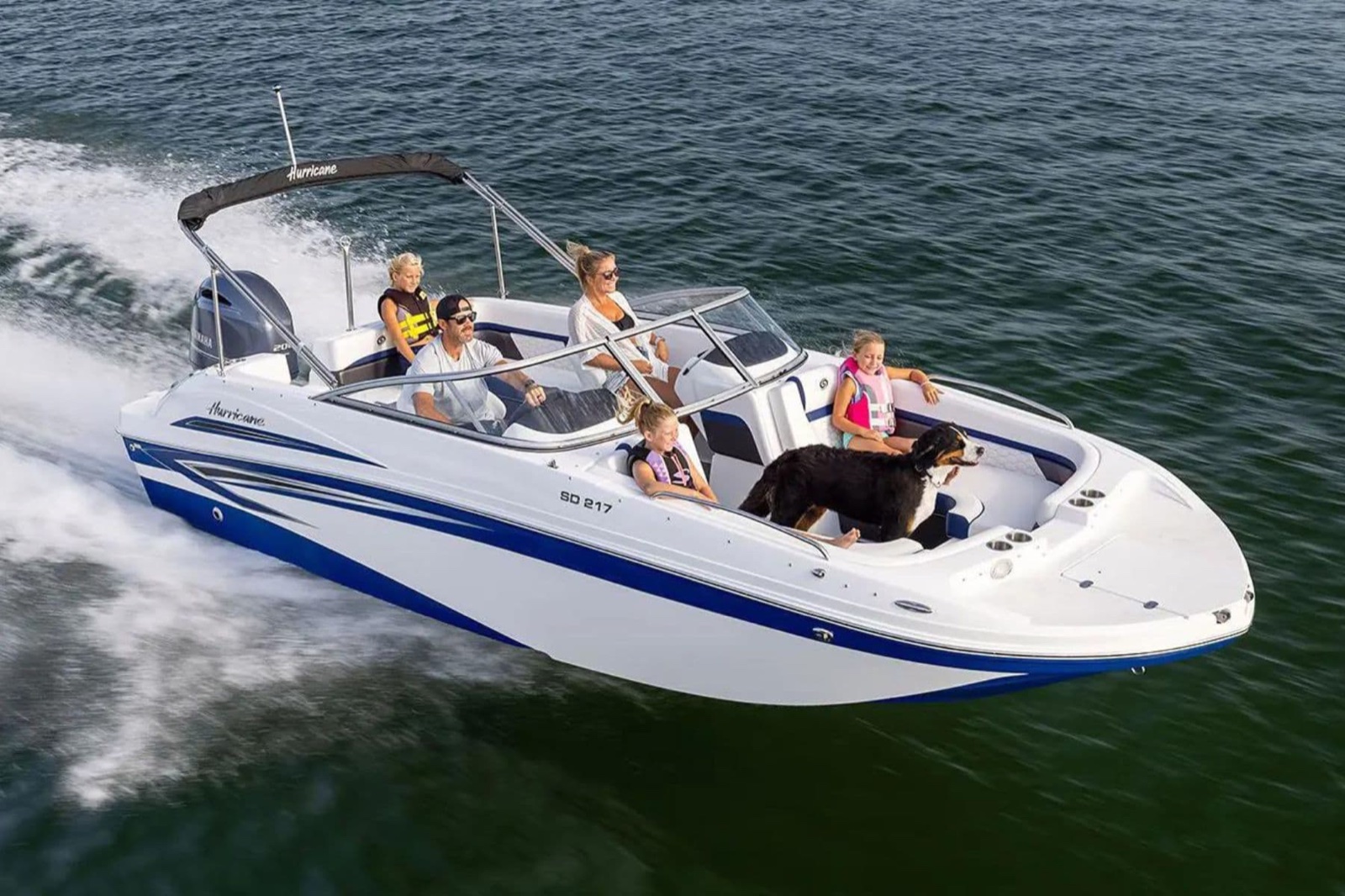
What is the Starcraft SVX 211?
The Starcraft SVX 211 is a 20-foot 11-inch family deck boat with an 8-foot 6-inch beam, a 14-degree transom deadrise, a 2,685-pound dry weight, a 45-gallon fuel tank, and a max horsepower rating of 200. Power options across the 2020 to 2026 model years include the Mercury 200, the Yamaha F150 to F200, and the Suzuki 200. The hull is foam-cored fiberglass with a composite transom, and Starcraft backs the build with a lifetime hull warranty and a 6-year blister warranty.
The cockpit fits 14 passengers across forward bow seating, port and starboard L-lounges in the cockpit, a stern sun pad, and a walk-through to the integrated swim platform. Standard equipment from 2020 forward includes the bimini top, the marine-grade Bluetooth stereo, the snap-in carpet floor, the bow filler cushion, and the swim ladder. There is also an SVX 211 IO sterndrive variant for buyers who prefer the Mercruiser Bravo III layout, but the OB outboard version is the volume seller and the focus of this review.
Who is it good for?
The right buyer is the first-time deck-boat household running freshwater lakes and rivers for 30 to 100 hours a season. The boat fits a family of six plus friends comfortably, takes the dog and the cooler and the wakeboard tow rope without compromise, and the 14-degree deadrise is happy on calm-to-1-foot inland water. We watched a Tennessee River dealer hand over a loaded 2024 last summer to a family who had been cross-shopping pontoons for the same money, and the cockpit fit two parents, four kids, a grandmother, and a labrador without anyone shuffling.
Entry-budget households where dollars-aboard matters more than long-hold build quality are the second core profile. A used 2020 to 2022 SVX 211 OB at $26,000 to $42,000 puts a real 21-foot deck boat under the price of a comparable used wake-tower SUV, which is the math many first-time owners need.
Lake-and-river families running through the Great Lakes states, the Tennessee River, and the inland Texas reservoirs are the third profile. The boat is happy on inland water, the trailer fits behind a half-ton truck, and the single-outboard service profile is the simplest in the segment.
Who is it not good for?
Saltwater coastal owners should look elsewhere. The hardware grade, the gelcoat finish, and the cockpit drainage layout are calibrated for freshwater use. Saltwater operation is possible with a religious rinse routine, but the boat is not engineered for it.
Build-first households planning a 10-plus year hold are wrong-targeted. The SVX 211 is a 4 to 7 year boat for most owners, after which the gelcoat scuffs, the vinyl wear, and the cockpit hardware start to look their age. Buyers who want a boat that still looks new at year 10 should weigh the Hurricane SunDeck 2400 or a step-up deck boat platform.
Watersports-priority buyers who need a tower, a surf shaper, or a serious wakeboard pull will hit the limits fast. The 200 hp single outboard pulls a tube and a wakeboarder fine, but it is not a tournament-grade wakesurf platform.
Pricing
A 2026 SVX 211 OB with the Yamaha F150 and a base option list runs roughly $50,000 to $58,000. The Suzuki 200 upgrade plus the bimini, the trim tabs, the dual-battery switch, the depth finder, and the audio upgrade pushes the build to $65,000 to $72,000.
Used pricing has held up better than expected. A 2020 to 2021 hull with under 200 hours is $26,000 to $42,000. A 2022 to 2023 hull with low hours and a clean service log sits in the $44,000 to $58,000 band. A 2024 to 2025 hull clears $55,000 routinely and sometimes $60,000 for the loaded configurations. Across recent SVX 211 OB listings the average sat near $63,000, with low-end listings starting at $25,900.
The value buy is a 2020 to 2022 hull with the Yamaha F150 or F200, factory trim tabs, the bimini, and a clean trailer in the $30,000 to $44,000 band. The 211 IO sterndrive variant runs slightly less on the used market but adds the bellows-service line that the OB version avoids.
What works
- 14-passenger capacity at a 20-foot 11-inch length is a deck-boat geometry trick that owners notice. Perimeter seating wraps the cockpit and bow, and four to six adults can move around without stepping over each other.
- Hole shot of roughly 4.3 seconds with the Suzuki 200 upgrade is fast for the segment. Reaching 30 mph in 7.6 seconds means the boat pulls a wakeboarder out of the water cleanly.
- Top end of 46.6 mph with the Suzuki 200 is at the top of the segment for a single-outboard 21-foot deck boat.
- Lifetime hull warranty plus 6-year blister warranty across all model years takes some of the build-quality risk off the table for first-time buyers.
- 6 gph at 25 mph cruise gives a 7-plus hour day on a 45-gallon tank, which is more cruising range than the segment median for a 21-foot platform.
What doesn't
- 14-degree deadrise is calm-water-first by design. Honest 2-foot chop will slap the bottom and the boat will run wet through any cross-wind cruise.
- Trim tabs, dual-battery switch, depth finder, audio upgrade, and bow filler cushion are all options on the base spec. Buyers who skip the dealer-package upgrade later pay full retail to add these items.
- Hardware grade and gelcoat finish are honest entry-tier. Buyers comparing fit-and-finish against a Cobalt or a Chaparral will notice the gap.
- Snap-in carpet floor is a love-or-hate trim. It looks tired faster than a vinyl-wrapped deck and adds a cleaning routine after sandy or muddy days.
- Resale runs roughly 34 to 40 percent five-year depreciation against a higher-end-deck-boat segment median closer to 28 percent.
Year-by-year notes
2018 to 2019 hulls are the original SVX 211 OB platform with the painted hull, the snap-in carpet, and the original bimini design. The cockpit layout has carried over largely unchanged into the 2026 model year.
2020 added the Mercury 200 as a more-common factory-rigging choice and refined the cockpit storage layout. Independent 2020 boat tests posted the 4.3-second hole shot and 46.6 mph top end with the Suzuki 200 upgrade.
2021 to 2023 hulls have refined helm electronics options, a slightly updated bimini frame, and the dual-battery switch as a more-common factory-order item.
2024 to 2026 hulls add updated cockpit color palettes and minor cosmetic refinement. The lifetime hull warranty and the 6-year blister warranty carry across all years and ownership transfers.
Cost of ownership
Single-outboard running keeps operating cost reasonable. At 25 mph cruise burning 6 gph, a typical 4-hour day uses 24 gallons of fuel and a fraction of an oil-change interval. Annual outboard 100-hour service is $300 to $600 depending on the engine brand.
Insurance on a $40,000 hull is $700 to $1,400 a year depending on storage and use case. Trailer storage at home or in a covered shed is the typical home, with marina dockage running $1,500 to $4,000 annually for inland-lake markets.
Plan a $600 to $1,200 a year reserve for routine maintenance plus a snap-in carpet replacement at year 4 to 5. Trim-tab actuators, bilge-pump service, and bimini hardware are the recurring small lines.
Resale runs softer than higher-end deck boats. Five-year depreciation on the SVX 211 is roughly 34 to 40 percent, which is the entry-tier trade. Buyers planning a 4 to 7 year hold should price the depreciation into the buy decision.
Best year and trim to buy
A 2021 to 2023 OB hull with the Yamaha F200 or Suzuki 200, factory trim tabs, the bimini, the dual-battery switch, and a clean trailer is the value buy. Asking prices in the $36,000 to $50,000 band match the use case for most first-time deck-boat households.
Verify three things before close. First, walk the cockpit floor and check the snap-in carpet condition; replacement is straightforward but adds cost. Second, confirm the outboard service log is current and run the engine through full throttle range on the sea trial. Third, check the trailer hub bearings and tires, since the trailer is part of the package and gets less attention than the boat.
For 2026-new buyers, the Yamaha F200 with factory trim tabs, the bimini, the dual-battery switch, and the audio upgrade is the spec that resells best at year 5. The Suzuki 200 upgrade is the right pick for buyers who care most about hole shot and top end.
Alternatives
The Hurricane SunDeck 2400 is the step-up deck boat for buyers who want more length, more freeboard, and a build that holds value better across a longer ownership window. The Bayliner VR6 is the entry-price bowrider alternative for households who prefer the traditional bowrider layout to the deck-boat bow geometry. The Four Winns H190 is the smaller higher-end bowrider for buyers who do not need 21 feet and prefer build quality and finish over passenger capacity.