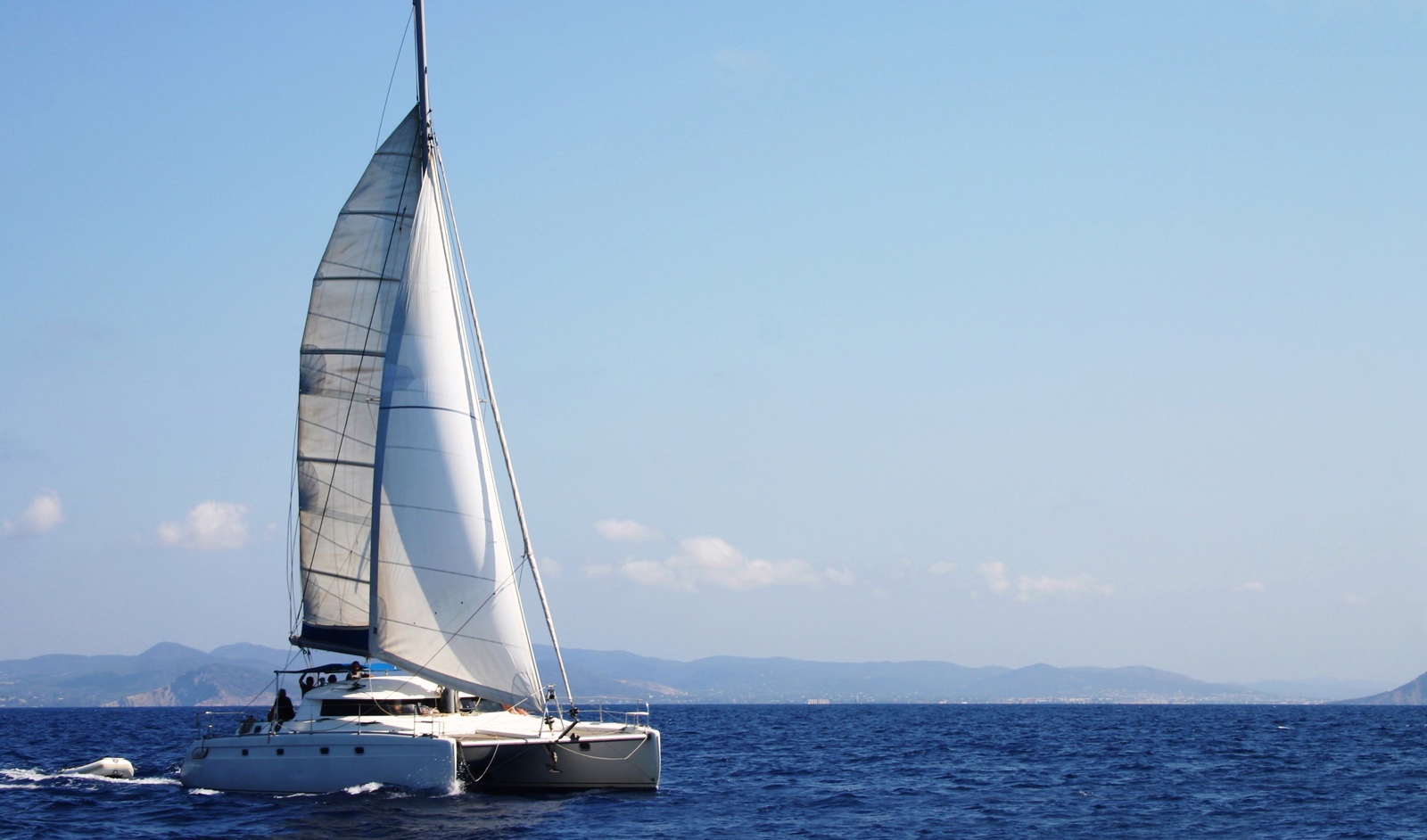
What is the Twin Vee 360 GFX?
The Twin Vee 360 GFX is a 35-foot 10-inch power catamaran with an 11-foot 10-inch beam, a 16-inch draft, an 8,710-pound dry hull weight before the engines, and 318 gallons of fuel split across twin 159-gallon below-deck tanks. The hull is an asymmetric twin-sponson catamaran with lifting strakes, reverse chines, and air induction between the sponsons. The transom takes quad outboard rigging, with Yamaha F300 V6 and F425 V8 outboards as the typical pairs across the 2018 to 2024 production years. Mercury Verado 400 quads were also offered.
The forward cabin includes a V-berth, a settee that converts as a backup berth for two, an enclosed head with a portable shower, and a galley with a refrigerator and a single-burner stove. The cockpit aft of the helm fits up to eight for offshore fishing, with a tackle station, a recirculating livewell, fish boxes, and rod holders along the gunwale. Twin Vee replaced the 360 GFX in the lineup with the GFX2 series at smaller lengths, so 2024 marks the end of the 360 production window for most buyers shopping the used market.
Who is it good for?
The right buyer fishes deep offshore grounds 50 to 100 miles out and wants a cat-hull ride that holds 4 to 6 foot chop at 25 to 30 knot cruise. Mid-Atlantic canyon runners, Gulf rig fishermen, and South Florida bluewater households who run weekly 80-mile days are the core profile. The boat eats chop differently than a deep-V, and the air induction between the sponsons makes the ride genuinely soft at speed. I rode a 2022 on a Hatteras canyon run last spring in a head-on 4-foot sea, 27-knot cruise, and the helmsman never had to grab the wheel hard. The hull tracked straight enough that two of us were drinking coffee in the cockpit.
Tournament-fishing teams who want quad-engine redundancy on a long-range platform are the second profile. Losing one outboard in mid-run does not end the day. The 318-gallon fuel capacity supports a 200-plus mile day at 1.8 to 2.0 mpg combined burn, and the forward cabin gives the team a place to sleep when running multi-day events.
Cross-shoppers from 36-foot express cruisers who want offshore-fishing capability are the third profile. The 360 GFX trades cabin volume and traditional cabin-cruiser refinement for cat-hull ride and quad-engine fishing capability, and the swap is the right one for households whose use case has shifted from weekending to fishing.
Who is it not good for?
Inshore-only buyers are over-targeted. The boat is engineered for offshore use, the fuel burn does not make sense for inshore running, and the catamaran beam complicates marina placement and trailer use.
Build-first households who want flagship-tier fit and finish at this price point should weigh the trade. Twin Vee build quality runs below the World Cat 325CC and Grady-White Freedom-line median. What owners report is fit-and-finish lapses, exposed wiring, and gelcoat finish that does not match the premium segment.
Owners without access to a strong Twin Vee dealer should think hard. Warranty service experience varies significantly across the dealer network, and the consistent owner take is that warranty disputes can leave the buyer holding the bill. A diligent pre-purchase survey and a strong dealer relationship are not optional on this platform.
Pricing
A new 360 GFX with quad Yamaha F300 V6 outboards listed in the $420,000 to $480,000 band across 2021 to 2023, with the F425 V8 quad upgrade pushing the build to $520,000 to $560,000. Twin Vee discontinued the 360 size in the GFX2 refresh, so 2024 is generally the last new-build model year for most buyers.
Used pricing has settled into a wide band. A 2018 to 2019 hull with quad outboards in the 1,000-plus hour range is $240,000 to $310,000 depending on engine spec and condition. A 2020 to 2022 hull with low hours and a clean hull-tunnel inspection sits in the $310,000 to $390,000 band. A 2023 hull with the F425 V8 quad upgrade and a documented service history clears $400,000 and sometimes $420,000 for the loaded configurations.
The value buy is a 2021 to 2022 hull with quad Yamaha F300 V6 outboards, a clean hull-tunnel inspection (no documented water intrusion), and a documented Yamaha-service history. Asking prices in the $310,000 to $370,000 band match the use case for most long-range offshore households, with the trade that the buyer accepts the surveyed-and-cleared status of the hull tunnels.
What works
- Asymmetric cat hull with air induction between the sponsons holds 4 to 6 foot chop at 25 to 30 knot cruise. The consistent owner take across the GFX line is that the boat tracks straight in 5-foot conditions with hands off the wheel for short stretches.
- 318 gallons of fuel on twin 159-gallon below-deck tanks gives honest 200-plus mile range with quad outboards at 1.8 to 2.0 mpg combined cruise burn.
- 16-inch draft is shallow for a 36-foot platform and opens beach anchorages, shallow inlets, and shoal-running that a deep-V comparable cannot reach.
- Quad-engine redundancy is real. Losing one outboard at 80 miles offshore does not end the day, which is the line that justifies the engine count for serious tournament use.
- Forward V-berth plus settee sleep four legitimately for overnight tournament weekends or coastal cruising.
What doesn't
- What owners report across multiple model years is hull-water intrusion in the steering-control tunnel, with some cases of crack-induced water entry into supposedly sealed sections. A pre-purchase hull-tunnel pressure test is non-negotiable.
- Foam absorption in older hulls (pre-2020) has been a source of weight gain and listing. The composite-construction generation forward of 2020 is generally cleaner.
- Build fit and finish is below the premium-segment median at this price. Exposed wiring, less-refined upholstery, and a hardtop electronics box that is optional rather than standard are the line items that surprise cross-shoppers.
- Quad-outboard fuel burn at WOT clears 100 plus gph combined. This is not a casual-cruising platform.
- Warranty service experience varies significantly across the dealer network. A strong local Twin Vee dealer is the line that makes ownership work.
Year-by-year notes
2018 to 2019 hulls are the original 360 GF and early GFX builds with the quad-outboard transom and the original cabin layout. Some hulls in this window had water-intrusion issues in the steering-control tunnel.
2020 to 2021 hulls refined the construction process and addressed some of the earlier intrusion issues. Triple Garmin GPSMap and the Yamaha Helm Master EX joystick became standard on most builds.
2022 to 2023 hulls have the refined cockpit layout, updated electronics options, and a more consistent build profile. The F425 V8 quad upgrade became more common as the spec choice on this model year.
2024 marks the end of new-build production for the 360 size as Twin Vee transitioned to the GFX2 series at smaller lengths. The 400 GFX2 took the long-range offshore role at 40 feet and 750 gallons of fuel.
Cost of ownership
Quad-outboard operation carries significant lines. Annual 100-hour service across four outboards costs $1,800 to $3,200 depending on engine brand and dealer. Fuel burn at 25 to 30 knot cruise sits near 30 to 35 gph combined, so a typical 100-mile day uses 50 to 60 gallons of fuel.
Insurance on a $350,000 hull is $7,000 to $12,000 a year depending on storage and use case. Marina dockage in the offshore-fishing markets costs $9,000 to $18,000 annually for a covered or in-water 36-foot slip with the catamaran-beam allowance. I watched a Florida tournament team rotate two 360 GFX hulls through a Stuart marina last winter and the slip premium for the cat beam was the biggest line on the dockage invoice.
Plan a $6,000 to $10,000 a year reserve for routine maintenance plus a quad-outboard 1,000-hour service event in the back half of an ownership window. Hull-tunnel inspection, livewell pumps, hardtop hardware, and Helm Master EX firmware updates are the recurring small lines.
Resale is softer than premium V-hull center consoles in this length. Five-year depreciation on a clean 360 GFX is roughly 30 to 38 percent against a Grady-White Freedom or Pursuit segment median closer to 28 to 32 percent. The Twin Vee badge does not extend to the secondary market the way World Cat or Boston Whaler does.
Best year and trim to buy
A 2021 to 2022 hull with quad Yamaha F300 V6 or F425 V8 outboards, a clean hull-tunnel inspection (with a written pressure-test report from a qualified surveyor), no documented water intrusion, and a recent Yamaha Helm Master EX firmware update is the value buy. Asking prices in the $310,000 to $370,000 band are the right zone.
Verify three things before close. First, commission a pressure test of the steering-control tunnel and the sealed sections of the hull. This is the single most important pre-purchase line on this platform. Second, pull the latest Yamaha service report and check compression numbers and hours on all four outboards. Third, walk the hull bottom for any signs of foam absorption or repaired delamination, and check the tunnel air-induction openings for damage.
For 2022 to 2023 used buyers, the F425 V8 quad upgrade with the hardtop electronics box and the Helm Master EX joystick is the spec that resells best.
Alternatives
The World Cat 325CC is the direct power-cat cross-shop, with a more refined build profile, a twin-outboard layout that keeps fuel burn lower, and a stronger warranty-service experience across the dealer network. The Grady-White Freedom 415 Dual Console is the premium V-hull alternative in a similar length range for buyers who want flagship fit and finish, a dual-console family layout, and the SeaV2 hull ride. The Boston Whaler 280 Outrage is the smaller premium offshore center console for buyers who do not need 36 feet and prefer the Whaler build profile.