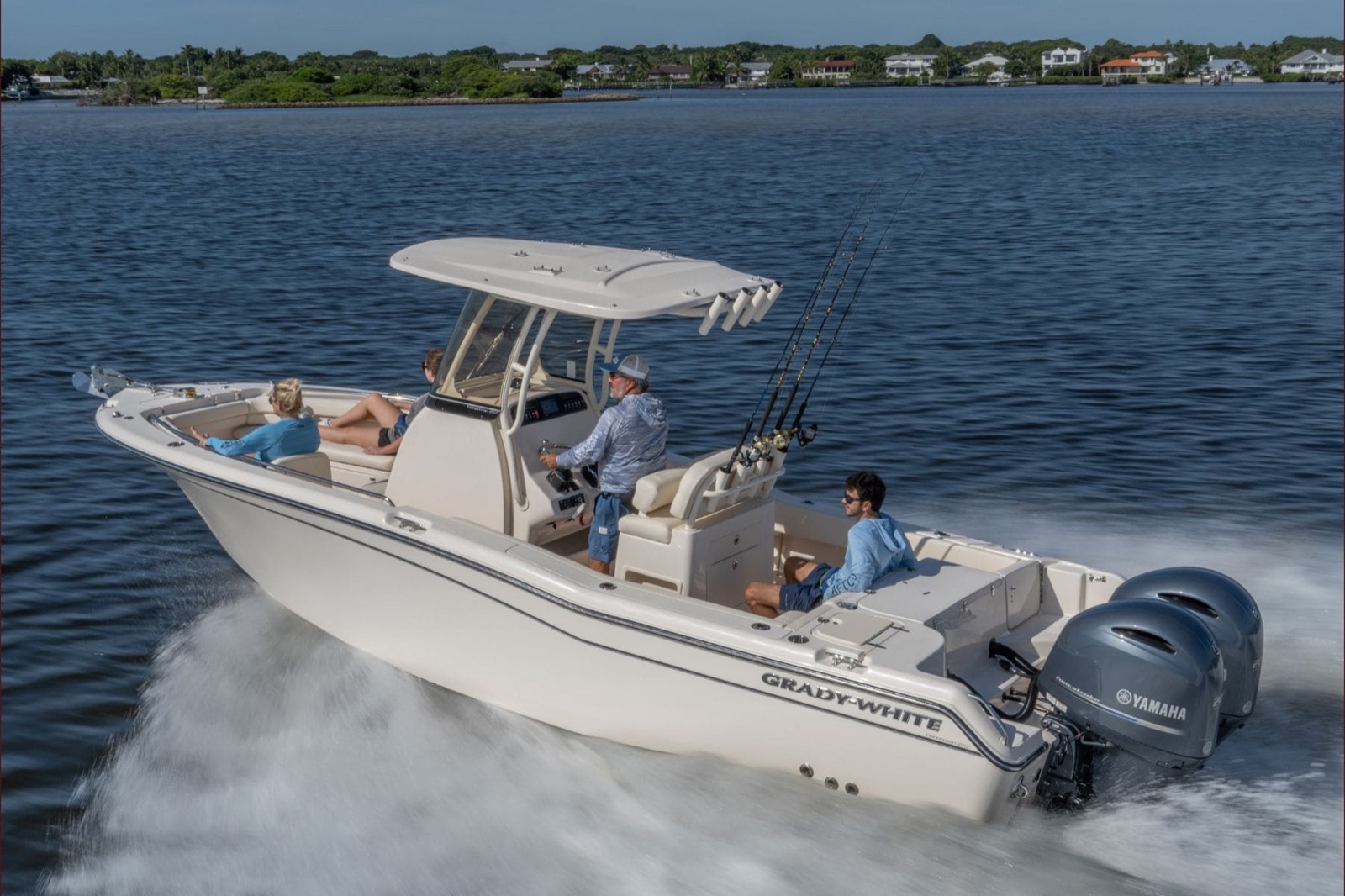
What is the Boston Whaler 280 Outrage?
The 280 Outrage is the mid-size offshore center console in Boston Whaler's flagship fishing line. It runs 28 feet 5 inches overall on a 9-foot-4-inch beam, twin Mercury Verado 300s on the transom, and a foam-injected unibody hull that gives the boat its swamped-but-floats reputation. The current generation has been on the water since 2019, with the meaningful systems upgrades arriving for the 2021 model year. The boat is purpose-built around fishing-first ergonomics, with day-cruising capability bolted on for buyers who treat the 280 as the family weekender as well as the outboard the canyon trip leaves on.
In the segment, the 280 is the build-quality reference point. It is not the most spacious 28-foot console you can buy, and it is rarely the best value on a feature-per-dollar basis. What it does is sit at the top of the resale curve and behave predictably enough in heavy water that owners stop second-guessing the boat at the inlet.
Who is it good for?
Buyers who plan a long hold and want a hull that will outlast two engine packages. Coastal saltwater families who fish hard but also need a boat the kids will tolerate on a calm-day cruise. Cross-shoppers from Robalo and Sea Hunt who have run the math and accept that paying the Whaler extra up front recovers most of itself at the back end. Owners who put 100-plus hours a year on the boat and care about hardware fatigue at year five and beyond.
The single best fit is the offshore fisher who runs 30 to 50 nautical miles to fish the canyons or the inshore reefs and wants a 28-footer that handles the run home in a building chop without beating the crew. Owners report the 280 flattens out at cruise even with a following sea, and the boat does not stuff the bow on the back of a wave the way some lighter-weight competitors will. We ran a 2022 hull out of Hatteras last September in a building 3-to-4-foot quartering sea, and the boat ate the run at 28 knots cruise with a dry helm and no slam through the trough.
Who is it not good for?
The 280 is not the right boat if the priority is dollars per cockpit foot. A Robalo R242 will give you a similar amount of fishing space for around 35 percent less money used, and the Sea Hunt Gamefish 25 puts more pad real estate on the same length. If overnighting matters, the 280 has a portable head under the console and a forward bench, and that is the extent of the cabin story. Buyers who want a real berth at this length should be looking at a smaller cabin cruiser rather than a console.
The boat is also overspec for protected-water owners who never see real chop. Inland lakes and slow-river use will not exercise the deep-V or the unibody construction, and the Whaler tax becomes harder to defend when the boat does not need it.
Pricing
New 280 Outrages run roughly $285,000 to $340,000 depending on options, electronics tier, and whether the buyer takes the Verado 300s or the upgraded V10 350s offered from 2023 onward. Tri-axle aluminum trailers add about nine thousand to the line. The full electronics package, twin 12-inch Garmin GPSMaps with radar and the autopilot integration, runs another twelve to fifteen thousand over base.
On the used side, 2020 and 2021 hulls with 200 to 400 hours have been transacting in the $172,000 to $205,000 range. A 2022 with under 200 hours sits closer to $215,000 to $245,000. A 2017 or 2018 with 350 to 450 hours can be found in the $145,000 to $165,000 band, but pre-2019 buyers should budget for an electronics refresh and inspect the transom carefully. The depreciation curve is shallowest from year three onward, which is why owners frequently recommend the three-to-five-year-old hull as the value buy.
What works
- Foam-injected unibody construction. The boat will float upright even fully swamped at rated load.
- Twin Verado 300s show a documented 56 mph top end and a 30-knot cruise at about 1.7 mpg combined, segment-competitive given the dry weight.
- The 21-degree deadrise and reverse chines combine to enter 4-foot chop dry and keep the helm dry through the run, even with a quartering sea.
- Hardware grade is flagship across cleats, rod holders, rails, and the welded-aluminum T-top frame. The T-top in particular shows no fatigue at 1,000-plus hours where lesser frames have started to crack.
- Twin 54-gallon in-floor fish boxes flanking the cockpit sole, plus pump-outs, plus 20 rod holders standard.
- Holds its price firmly. Five-year retention sits within 25 percent of new on clean-history hulls, and brand demand keeps inventory turning fast on the used market.
What doesn't
- Whaler costs 15 to 25 percent more than direct competitors at the same length. For shoppers focused on the spec sheet rather than the brand math, that gap is hard to close.
- Cockpit volume is real but not generous. The 280 is narrower in usable fishing space than a similarly sized Sea Hunt Gamefish 25 or a Robalo R242.
- Cabin amenities are minimal. The under-console enclosure is a head and a bench, not a berth. Overnighting is possible but not comfortable.
- Wet-transom complaints surface on older hulls. Owners report a small but persistent pattern of water intrusion at the transom on pre-2019 boats, particularly where scuppers were re-routed in the 2019 redesign.
Year-by-year notes
The current 280 hull arrived in 2019 with the redesigned cockpit and updated scupper routing. The 2019 model is the first year of the current generation but had early-production scupper drainage quirks that owners flagged on long offshore runs. By 2020, those issues had been quietly resolved at the factory.
For 2021, Boston Whaler made Mercury VesselView integration standard along with the dual 12-inch Garmin GPSMap glass, which is the configuration to look for on the used market. The 2022 model brought subtle interior trim revisions and an upgraded JL Audio package. The 2023 model year introduced the Mercury V10 350 as an option alongside the standard Verado 300s, and 2024 saw the cockpit pedestal seating refreshed.
If you are shopping a 2017 or 2018 hull, expect to pay for a transom moisture survey before closing. The wet-transom issue is not universal but is documented on the older boats often enough that surveyors look for it specifically. A surveyor in Wrightsville Beach pulled a 2017 280 last winter that read dry on the upper transom and damp at the engine bracket, which knocked $15,000 off the asking price after the buyer's deposit.
Cost of ownership
Annual operating cost on a 280 sits in the $14,000 to $22,000 range for an owner running 80 to 120 hours a year on the East Coast or Gulf. The breakdown is roughly: $4,500 to $7,500 for fuel at typical offshore mix, $2,500 to $3,500 for insurance, $1,200 to $1,800 for storage if covered, $2,000 to $3,500 for annual service on the twin Verados, and a maintenance reserve of about $2,500 a year for the hull and electronics.
The Mercury Verado 300s have proven reliable through 2,000 hours when serviced on schedule, and the Whaler hull itself routinely shows up still serviceable at 25-plus years. The biggest single budget item over a five-year hold is the eventual electronics refresh, since the original Garmin units begin to feel dated by year six even though they remain functional.
Best year and trim to buy
The value buy is a clean 2021 hull with the Verado 300s, dual Garmin glass, the standard JL Audio package, and a documented service history under 400 hours. Expect to pay $182,000 to $205,000 with trailer depending on geography and condition. That boat gets you VesselView integration out of the gate, the post-redesign scupper routing, and most of the depreciation already taken.
Avoid the 2019 hull unless the seller has documentation of the early scupper resolution. Avoid pre-2017 hulls without a clean transom moisture survey. The 2023 with the V10 350s is appealing on paper but the value case does not yet hold up against a 2021 Verado 300 hull at $40,000 less.
Alternatives
If the budget will not stretch to the Whaler money, the Robalo R242 is the strongest cross-shop. The Grady-White 236 Fisherman is the soft-rider alternative two feet shorter, with a slightly different fishing-cruising balance. The Regulator 23 is the tournament-bias option at the smaller end of the same range.