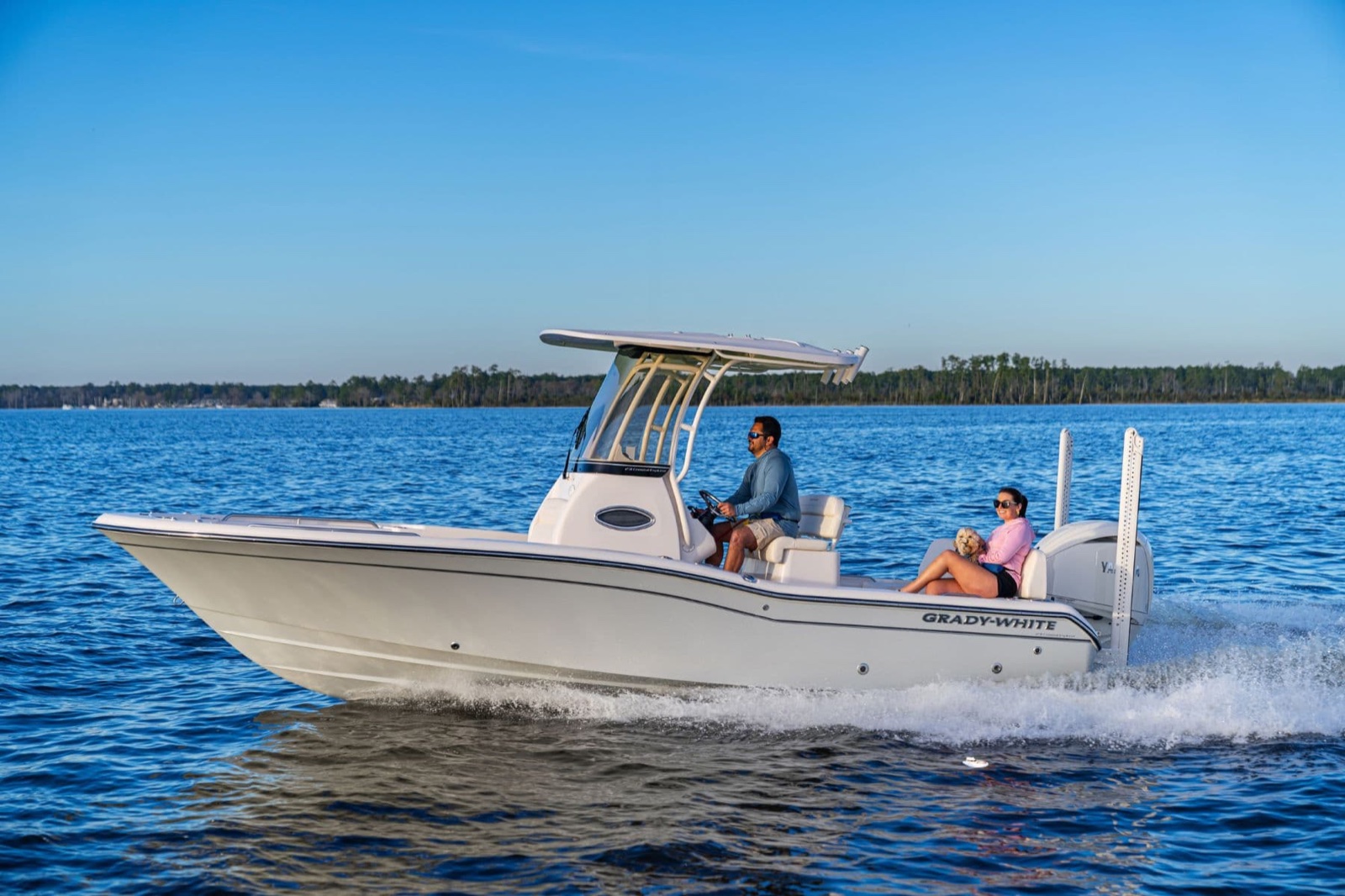
What is the Grady-White 236 Fisherman?
The Grady-White 236 Fisherman is a 25 foot 7 inch center console with a 20-degree-deadrise SeaV2 hull, an 8 foot 6 inch beam, an 18.5 inch draft, and a 4,135 pound dry weight before the outboard. It is single-engine only, with a Yamaha F300 standard and the F350 as the upgrade. Fuel capacity is 100 gallons, the standard livewell is 15.5 gallons aft with an optional 25-gallon upgrade under the deluxe lean bar, and the boat carries roughly 338 quarts of insulated fish-box volume across one 160-quart aft box and two 89-quart forward boxes. Passenger capacity is up to 10.
The hull went all-composite for the 2016 model year. Pre-2016 hulls used a wood-cored transom and stringers, which is the cutover line every used buyer needs to know about. Build quality on post-2016 boats is hand-laid fiberglass with stainless hardware, and Grady documents a hand-rolling resin process that owners credit for the boat's long service life.
Who is it good for?
The right buyer fishes coastal and nearshore, runs single-engine, and wants a head enclosure on a 24-foot footprint. Mid-Atlantic, Gulf, and Florida Atlantic anglers who run 5 to 30 miles offshore on a typical day are the core market. Owners report comfortable 50-mile offshore runs in the right forecast, with one account of double-stacked 5-foot waves crossed at 25 knots without complaint, but the boat is happiest in 2 to 3 foot conditions at 22 knots cruise. We ran a 2021 hull out of Morehead City last October in a building northeast chop, and the SeaV2 came home dry at 23 knots cruise with a quartering 2-to-3-foot sea.
Family-and-fishing crossover families are the second core market. The forward seating, the console head with a door, the swim platform, and the sociable cockpit layout add up to a boat that does Saturday fishing and Sunday tubing without compromising either side. Used buyers shopping the $90,000 to $130,000 band are the third profile, because the depth of the secondary market keeps inventory available and prices honest.
Who is it not good for?
Buyers who want twin-engine redundancy should look elsewhere. The 236 is single-engine only by design and by transom geometry. Anyone who runs 40 plus miles offshore as a routine and wants a second motor for the home leg should step up to a 28 or 30 foot platform with twin outboards.
Big-water offshore runners who routinely see 4-foot-plus seas will eventually want a 24-degree-deadrise hull. The SeaV2 at 20 degrees does well in honest chop and head seas, but it is not a deep-V that punches through 5-foot wind chop without effort. Owners who run the canyons or routinely cross open Gulf water in unsettled forecasts will be happier in a Regulator 23 or a Pursuit S 268 Sport.
Buyers who insist on the older pricing without accepting the wood-transom risk also miss the right boat. Pre-2016 hulls do show up at $40,000 to $60,000, and many are still solid, but the moisture-meter reading and the transom inspection are not optional on those years.
Pricing
A 2026 Fisherman 236 lists from roughly $148,000 with the Yamaha F300 and the standard equipment package, climbing to $190,000 to $192,000 loaded with the F350, the deluxe lean bar with the 25-gallon livewell, the upgraded electronics, the powder-coated hardtop, and outriggers.
Used pricing has settled into a wide band. A 2018 hull with the F300 and 200 to 400 hours is $80,000 to $105,000. A 2020 to 2021 hull with the same engine and lower hours sits in the $110,000 to $135,000 band. A 2023 to 2024 hull with the F350 and a clean service history clears $140,000 and sometimes $165,000 for the loaded configurations. Across recent listings the average sat near $125,000 across all model years.
The value buy is a 2018 to 2020 hull with the F300, the 25-gallon livewell upgrade, and a documented annual-service history with the Yamaha dealer. Asking prices in the $90,000 to $115,000 band are the right zone.
What works
- SeaV2 hull is the single most-cited design strength across owner accounts. Predictable in 2 to 3 foot chop, dry helm at 22 to 25 knots cruise, no sharp pound on the back side of a wave.
- All-composite construction from 2016 forward means no wood-rot exposure in the transom, stringers, or deck cores.
- Fuel capacity at 100 gallons gives honest 200-plus mile range with the Yamaha F300 at 28.5 mph cruise burning roughly 10.6 gph.
- Console head enclosure with a real door at 25 feet 7 inches LOA is rare in the segment and is the trim that turns a fishing boat into a family boat.
- Build quality holds across 1,000 plus hours. Owner accounts through year 8 show no transom softening, no stringer flex, and tight gelcoat under standard care.
What doesn't
- Single-engine only by design. Buyers who want twin-engine redundancy have to look at a different builder or a longer platform.
- Loaded 2026 hulls clear $190,000, which is a price band where some cross-shoppers expect twin outboards and either a more aggressive deadrise or more cockpit volume.
- Pre-2016 hulls used a wood-cored transom that does soften with age. The risk is real, the price gap is real, and the moisture-meter reading is not optional on those years.
- Standard 15.5-gallon livewell is small for a serious bait fisherman. The 25-gallon upgrade under the deluxe lean bar is the option to specify.
- Leaning-post comfort gets mixed marks from taller owners. Helmsmen over 6 feet 2 inches have flagged the bolster height as feeling less secure at full cruise speed in chop.
Year-by-year notes
2016 is the cutover to all-composite construction, the model year where the wood-rot conversation stops. Standard rigging on early hulls was the Yamaha F300 with a Garmin chartplotter package.
2017 to 2019 hulls are the volume used market. Yamaha F300 rigging was standard, and most of these boats came with the basic livewell, T-top, and electronics package. The F350 became available later in this window. Some 2017 to 2018 hulls had Yamaha F300 cylinder-wall reports that came up across owner accounts. Ask for compression numbers from the most recent service.
2020 added the optional 25-gallon livewell under the deluxe lean bar, plus minor cockpit-storage refinements.
2021 to 2023 hulls have the refined hardtop, expanded electronics options, and a Yamaha F350 that became more common as the spec choice.
2024 to 2026 hulls add Yamaha digital throttle and shift, helm screen upgrades, and revised seating geometry that addresses some of the leaning-post complaints from earlier owners.
Cost of ownership
Single-engine running keeps operating cost reasonable. At 28.5 mph cruise burning 10.6 gph, a 100-mile day uses roughly 35 gallons of fuel and a fraction of an oil-change interval. Annual Yamaha 100-hour service costs $400 to $700.
Insurance on a $115,000 hull is $1,800 to $3,000 a year depending on storage and use case. Dry-stack storage in the Mid-Atlantic and Gulf is the typical home and costs $3,000 to $6,000 annually.
The boat holds its price well. Five-year depreciation on a clean Fisherman 236 is roughly 22 to 28 percent against a segment median closer to 35 percent for single-engine center consoles in this length. Owners who service the Yamaha on schedule and keep the boat covered routinely sell at year 5 or 6 within striking distance of replacement-cost depreciation. A friend who keeps his 2018 Fisherman 236 on a dry-stack in Stuart, Florida pulled it for sale last spring at 410 hours and a $99,000 ask, and had a deposit inside two weeks.
Reserve roughly $1,500 to $2,500 a year for routine maintenance plus a Yamaha cylinder-wall inspection at the 1,000-hour mark on F300-rigged boats. Hardtop, livewell pumps, and washdown plumbing are the recurring small lines.
Best year and trim to buy
A 2018 to 2021 hull with the Yamaha F300, the 25-gallon livewell upgrade, the powder-coated T-top, and a documented annual service history with the Yamaha dealer is the value buy. Asking prices in the $90,000 to $130,000 band match the use case for most single-engine center-console buyers.
Verify three things before close. First, confirm the transom moisture reading is dry across the lower transom and the engine bracket area. Second, pull the latest Yamaha service report and check compression numbers across all six cylinders. Third, walk the deck cores at the bow casting platform and the console base for any soft spots.
For 2026-new buyers, the F350 with the deluxe lean bar, the powder-coated hardtop, and the upgraded electronics is the spec that resells best at year 5.
Alternatives
The Robalo R230 is the lower-price entry point in this length, with a comparable single-engine layout and a softer build budget that buyers willing to give up the SeaV2 ride and the resale curve will find acceptable. The Boston Whaler 230 Outrage is the obvious cross-shop, with foam-cored construction, a different ride feel, and similar high-tier positioning. The Regulator 23 is the right pick for buyers whose use case is offshore in 4-foot-plus conditions and who want a 24-degree-deadrise hull and twin-engine availability at a higher price ceiling.