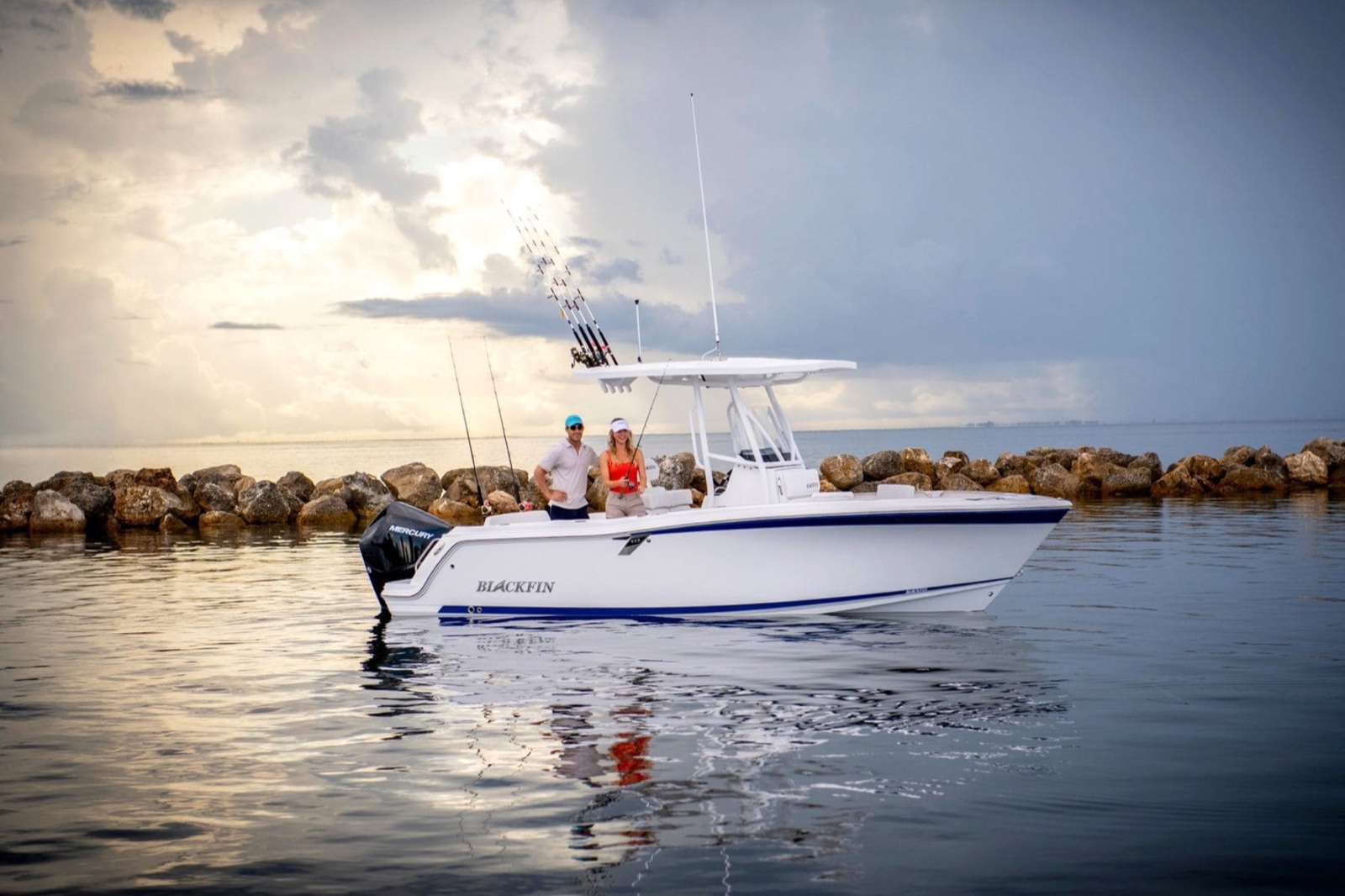
What is the Boston Whaler 230 Outrage?
The Boston Whaler 230 Outrage is a 23-foot single-engine center console with the Whaler Unibond foam-cored hull, an 8-foot 6-inch beam, a 16-gallon transom livewell, and a 10-passenger rated capacity. The Unibond construction is what defines the brand: a closed-cell foam core sandwiched between fiberglass laminates produces a hull that is certified unsinkable, with the foam doubling as both flotation and structural reinforcement. Cut a Whaler in half and both halves float. That is not marketing copy; it is a documented design property of the construction process.
Power is single-outboard, with the Mercury 300 V8 outboard as the typical rigging choice across the 2018 to 2026 production years. Boston Whaler is owned by Brunswick, which also owns Mercury, so Whalers ship with Mercury rigging from the factory. The hardtop is a fiberglass structure with stainless tubes, the console encloses a head compartment for a portable toilet, and the forward seating wraps the bow with the Outrage signature bump-out coaming that expands legroom in the bow cockpit. Fish lockers sit in the port and starboard cockpit decks plus a forward locker ahead of the console.
Who is it good for?
The right buyer is the offshore-minded angler who cares about the unsinkable construction and the resale price more than a soft ride. What owners report on the Whaler community boards consistently shows the boat at 1,000 to 2,000 hours of saltwater service still tracking strong, with foam cores that do not absorb water and a hull that holds gelcoat finish across a decade of use. We spent a wet October morning out of Wrightsville on a buddy's 2019 230 Outrage chasing albies, and the boat shook off three-foot chop on the inlet with stainless that still looked new and a deck that drained as advertised.
Buyers planning a 15-plus year hold are the second profile. The Whaler resale curve is the firmest in the single-engine center-console segment, with five-year depreciation running roughly 18 to 24 percent against a segment median closer to 30 percent. Owners selling at year 10 routinely recover within striking distance of replacement-cost depreciation.
Solo and small-group fishermen who run nearshore and inshore are the third profile. The boat fishes four comfortably, fishes two with room to spare, and the bump-out coaming geometry makes the bow seating a real social area when not fishing. The single-engine layout keeps the operating cost manageable and the maintenance profile clean.
Who is it not good for?
Buyers who care about the softest possible ride in 3-foot-plus chop should weigh the trade. The foam-cored Unibond hull transmits more sea than the SeaV2 Grady-White at the same length, which owners describe honestly as "solid but rough" in head-sea conditions. Some owners trade ride comfort for the unsinkable construction; others find the trade not worth the extra money.
Price-sensitive shoppers should look at the Grady-White 236 Fisherman, which does most of what the 230 Outrage does for 15 to 25 percent less money. The Whaler badge carries real value in the resale market, but the new-buy extra is real and not every household needs to pay it.
Buyers who want twin-engine redundancy are wrong-targeted. The 230 Outrage is single-engine only by design and by transom geometry. Anyone who wants twin-outboard redundancy at this length should look at a longer Whaler platform or a different builder.
Pricing
A 2026 230 Outrage with a Mercury 300 V8 outboard and the standard equipment package runs $165,000 to $185,000. The hardtop upgrade, the optional electronics package, the Seakeeper option, the trolling motor, and the powder-coated outrigger pair pushes the build to $200,000 to $215,000.
Used pricing has held up well. A 1999 to 2005 first-generation hull (different platform but same nameplate) runs $30,000 to $55,000 depending on engine and condition. The current platform from 2018 forward shows a wider band: a 2018 to 2020 hull with under 400 hours is $65,000 to $95,000. A 2021 to 2022 hull with low hours and a clean service log sits in the $100,000 to $130,000 band. A 2023 to 2024 hull with the loaded option list clears $135,000 and sometimes $160,000. Across the recent listing average the used market sat near $124,900 across all model years.
The value buy is a 2020 to 2022 hull with a Mercury 300 V8, documented annual fresh-water flush records, the standard hardtop, and a clean transom inspection. Asking prices in the $90,000 to $120,000 band match the use case for most single-engine offshore households.
What works
- Unibond foam-cored hull is genuinely unsinkable. Foam cores do not absorb water in normal service, the boat retains buoyancy after structural damage, and the build process is documented down to the foam-density spec.
- Self-bailing cockpit is real and works as advertised. Owner reports and professional reviews both confirm flooding-and-draining cycles work without taking on permanent water.
- Stainless hardware throughout (cleat backers, rub-rail screws, bow-rail mounts, transom bolt heads). Corrosion is rare even on saltwater dock-kept hulls.
- Bump-out coaming around the bow expands seating and legroom in a way that the segment median does not match. The 230 Outrage feels like a bigger boat in the bow cockpit.
- Resale price is the firmest in the single-engine 23-foot center-console segment. Used 230 Outrages do not sit on the brokerage market for long.
What doesn't
- Foam-cored hull transmits chop differently than a SeaV2 or 24-degree-deadrise hull. Owners describe the ride as "solid but rough" in head-sea conditions.
- Whaler costs 15 to 25 percent more than Grady-White at the equivalent length. The Grady-White 236 Fisherman does most of what the 230 Outrage does for 75 to 80 percent of the cost.
- Bow rod racks are plastic rather than stainless. Whaler reports they hold up well; owners who want stainless racks add them aftermarket.
- A small number of owner reports document elevated moisture readings on hull cores within the first year of factory-new ownership, even on boats where no holes were drilled. Pre-purchase moisture inspection is part of the survey.
- Single-engine only. Twin-engine buyers have to step up to a longer Whaler.
Year-by-year notes
2018 to 2019 hulls came with the Mercury 300 V8 as the volume rigging and the original hardtop layout. Some early-batch hulls had factory moisture issues that owner reports flagged.
2020 introduced minor cockpit storage refinements and updated helm wiring.
2021 to 2023 hulls have refined helm electronics packages, the standard Garmin chartplotter, and a slightly updated bow-cockpit layout.
2024 to 2026 hulls add updated cockpit color palettes, the Mercury V8 300 as the volume rigging, and incremental hardtop hardware refinement. The construction process and the Unibond foam-core hull have been carried over largely unchanged from 2018.
Cost of ownership
Single-outboard operation runs a clean cost line. Annual Mercury 100-hour service is $400 to $700. Fuel burn at 28-knot cruise sits near 9 to 11 gph, so a typical 50-mile day uses 16 to 20 gallons of fuel.
Insurance on a $115,000 hull is $1,800 to $3,000 a year depending on storage and use case. Dry-stack or in-water storage in the offshore-fishing markets is $4,000 to $9,000 annually.
Plan a $1,800 to $3,000 a year reserve for routine maintenance plus a Mercury cylinder inspection at the 1,000-hour mark and a hardtop hardware refresh at year 5. Hardtop, livewell pumps, washdown plumbing, and trolling-motor service are the recurring small lines.
Resale offsets the rest of the math. Five-year depreciation on a clean 230 Outrage is roughly 18 to 24 percent against a segment median closer to 30 to 35 percent for single-engine center consoles in this length. The Whaler badge holds the price.
Best year and trim to buy
A 2020 to 2022 hull with the Mercury 300 V8, the standard hardtop, the optional Garmin upgrade, the powder-coated outrigger pair, and a documented annual fresh-water flush record is the value buy. Asking prices in the $90,000 to $120,000 band are the right zone for most single-engine offshore households. We watched a clean 2021 230 Outrage move at a Morehead City brokerage in 11 days last October, at full asking, to a buyer who had been hunting Whalers in that range for six months. That is the segment.
Verify three things before close. First, run a moisture-meter reading across the lower transom, the engine bracket area, and the hull at the foam-core seams. Second, pull the latest Mercury service report and check compression numbers. Third, walk the cockpit deck cores at the bow casting platform and the console base for any soft spots, and check the gelcoat at the keel and the chines for spider cracks.
For 2026-new buyers, the Mercury 300 V8 with the hardtop upgrade, the Garmin chartplotter package, the outrigger pair, and the Seakeeper option (for Mid-Atlantic and Gulf offshore use) is the spec that resells best at year 5.
Alternatives
The Grady-White 236 Fisherman is the direct cross-shop with the SeaV2 hull, a softer offshore ride at 22 to 25 knots cruise, and a 15 to 25 percent lower price ceiling. The Robalo R230 is the value-segment alternative for buyers who can give up the Whaler premium and the unsinkable Unibond construction. The Regulator 23 is the top-tier offshore cross-shop with a 24-degree-deadrise hull for buyers whose use case is 4-foot-plus seas regularly and who want a deeper-V offshore platform at a higher price ceiling.