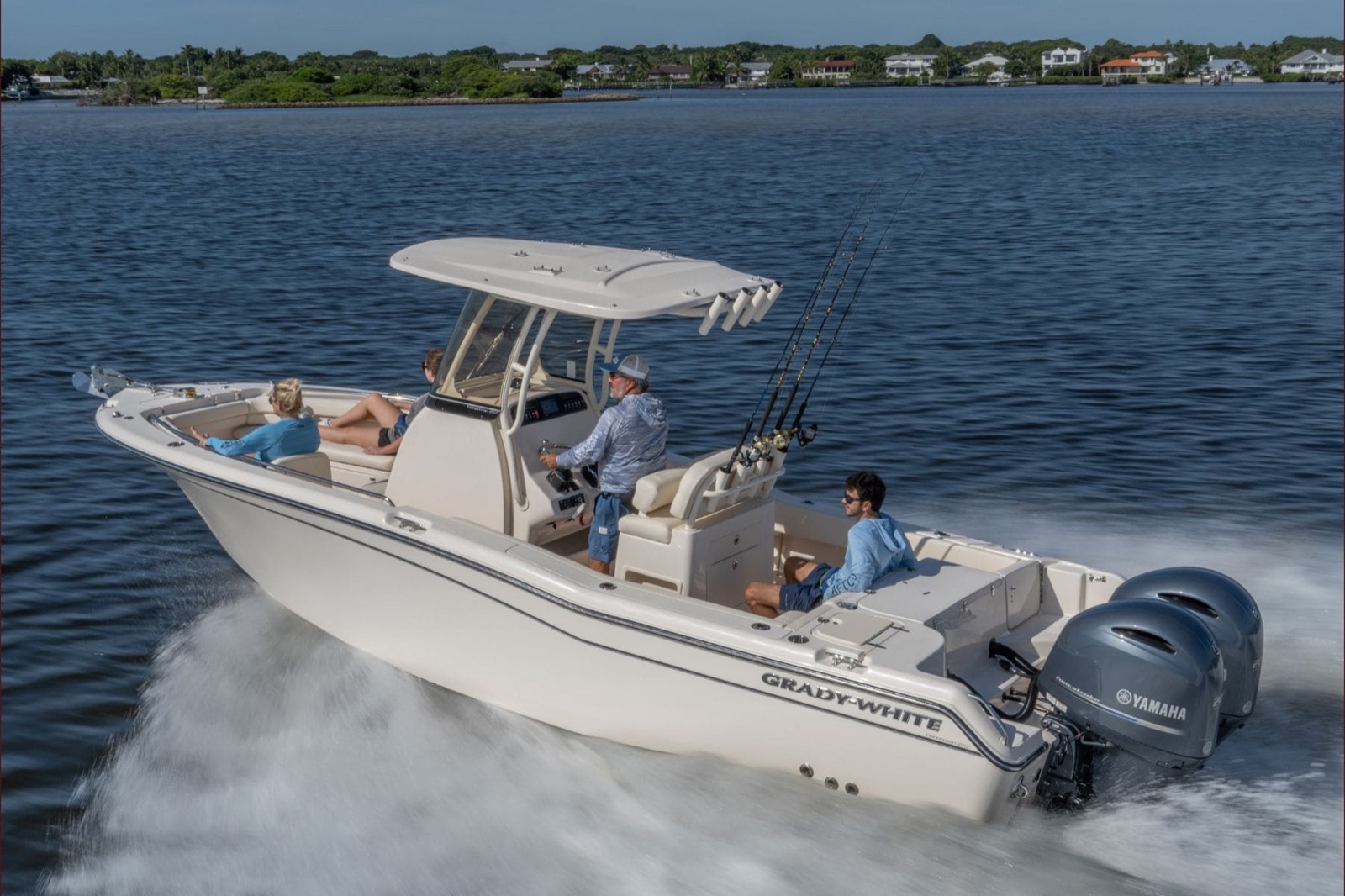
What is the Robalo R230?
The Robalo R230 is a 22-foot 6-inch single-outboard center console built around an 8-foot 6-inch beam, a deep-V hull, and a 9-passenger rated capacity. The hull is hand-laid fiberglass with a composite stringer grid and a fiberglass T-top with stainless support tubes. Power is single-outboard, with a Yamaha 200 hp standard and a Mercury or Yamaha 250 hp upgrade across the 2018 to 2026 production years. The 12-inch Simrad helm display became standard from the 2020 model year forward, flanked on both sides by stainless LED push-button switches and water-resistant DC breakers.
The cockpit layout is fishing-first with family-friendly geometry. A forward casting deck legitimately fits two anglers without crowding, the aft jump seats fold down flush to create an elevated aft casting platform, and dual livewells with recirculation sit at the transom. The center console encloses a head compartment that takes a portable toilet. A hardtop electronics box, outriggers, dual-battery switch, and trim tabs sit on the option list across most model years.
Who is it good for?
The right buyer is the first-time center-console household running bay and light-offshore water in the Carolinas, the Florida Atlantic, the Gulf coast, and the Mid-Atlantic. The 22-degree-deadrise hull tracks well in 2 to 3 foot conditions, the Yamaha 250 hp upgrade gives a 46 mph top end, and the cockpit fits five for fishing or four for cruising.
Saltwater bay-and-light-offshore households are the second core profile. The R230 is happy on Tampa Bay, the Indian River Lagoon, the Pamlico Sound, and the inshore Gulf, with the deep-V hull and the dual-livewell layout supporting both flats fishing and bay-mouth running. We watched a R230 owner work a Charlotte Harbor edge on a glassy April morning, two anglers on the bow casting at right angles while the boat sat flat enough that no one bothered to wedge a foot under a rail. That is the use case this boat was drawn for.
Cross-shoppers from Whaler who want 85 percent of the build at half the price are the third profile. The Robalo build runs honestly below the Boston Whaler 230 Outrage standard at the same length, but the 230 Outrage costs a lot more and not every household needs to pay it. Owners who want a fishing platform that holds up across 5 to 8 years of saltwater use, without the Whaler price ceiling, find the R230 the right shape.
Who is it not good for?
Build-first owners planning a 15-plus year hold are wrong-targeted. The Whaler-versus-Robalo build delta compounds at year 5 and beyond, with the documented Robalo issues (soft deck cores in spots, water intrusion under aft seats, fit-and-finish lapses in hidden compartments) showing up more on older hulls than the equivalent Whaler.
Heavy offshore households running 4-foot chop regularly should weigh the trade. The R230 is happy in 2 to 3 foot conditions. Sustained 4-foot running pushes the hull and the cockpit drainage layout toward their design limit. A Regulator 23 or a Pursuit S 268 Sport is the better tool for sustained offshore use.
Serious bait fishermen who need a real livewell from the factory should plan an upgrade. What owners report is a factory bait tank that struggles to keep half a scoop alive. The R230 design provides space for a larger aftermarket tank, and most serious bait fishermen install one.
Pricing
A 2026 R230 with the Yamaha 200 hp and a base option list costs $92,000 to $105,000. The Yamaha or Mercury 250 hp upgrade plus the dual-battery switch, the hardtop electronics box, the outrigger pair, the JL Audio upgrade, and the 12-inch Simrad helm electronics package pushes the build to $114,000 to $120,000.
Used pricing is wide. A 2018 to 2019 hull with the Yamaha 200 hp and 200 to 500 hours costs $28,000 to $50,000 depending on engine spec and condition. A 2020 to 2022 hull with the 250 hp upgrade and lower hours sits in the $55,000 to $85,000 band. A 2023 to 2024 hull with the loaded option list and a clean service log clears $90,000 and sometimes $110,000. Across recent listings the average sat near $109,000 across all model years, weighted toward the newer hulls.
The value buy is a 2021 to 2022 hull with the Yamaha or Mercury 250 hp, the 12-inch Simrad helm, the hardtop electronics box, the outrigger pair, and a documented annual Yamaha service log. Asking prices in the $58,000 to $80,000 band match the use case for most bay-and-light-offshore households.
What works
- Yamaha 200 hp standard with the 250 hp upgrade gives a 46 mph top end and a 28-knot cruise burning roughly 8 to 10 gph.
- Deep-V hull with 22-degree deadrise enters 3-foot chop with controlled spray and a manageable cockpit-dryness profile.
- Forward casting deck legitimately fits two anglers without crowding. Two-angler fishing on the bow at the same time is the design intent.
- Aft jump seats fold down flush to create an elevated aft casting platform. The cockpit is appropriate for light-tackle casting in the shallows, trolling, or bottom fishing.
- 12-inch Simrad helm display is standard from 2020 forward. The helm layout (center display, flanking LED switches, water-resistant DC breakers) is segment-leading at the price band.
What doesn't
- Owners report soft deck cores in some hulls and deck-core rotting in worst cases. The fix is a factory or aftermarket re-core, which is not cheap. Pre-purchase deck moisture inspection is non-negotiable.
- Battery placement under the aft seats with poor sealing leads to water intrusion. Owners recommend testing livewells and hatches with water during the sea trial to confirm proper drainage.
- Factory bait tank is undersized for serious bait management. The aftermarket upgrade is the standard fix and adds $1,500 to $4,000 to the package math.
- Fit-and-finish in hidden compartments (under-deck storage, console interior, livewell plumbing) runs below the Whaler standard. Some hulls show factory rubbish in the bilge and unsealed cooler-rack mounting points.
- Porpoising occurs at high trim settings on uneven wake. Owners learn the trim window for cruise and adjust accordingly.
Year-by-year notes
2018 to 2019 hulls came with the Yamaha 200 hp standard, the original helm electronics, and the basic livewell layout. Some early hulls have the documented soft-deck and water-intrusion issues. Pre-purchase inspection is critical.
2020 introduced the 12-inch Simrad helm display as standard, refined the cockpit layout, and updated the dual-livewell plumbing.
2021 to 2023 hulls have the refined Simrad package, the more-common Yamaha or Mercury 250 hp upgrade, and improved cockpit storage geometry. Some 2021 to 2022 hulls still show the deck-core issues owners flagged across the model years.
2024 to 2026 hulls add minor cosmetic refinement, an updated hardtop construction, and incremental cockpit storage improvements. The construction process and the hull design have been carried over largely unchanged from the 2018 launch.
Cost of ownership
Single-outboard operation costs a clean line. Annual Yamaha 100-hour service costs $400 to $700. Fuel burn at 28-knot cruise sits near 8 to 10 gph, so a typical 50-mile day uses 14 to 18 gallons of fuel.
Insurance on a $70,000 hull costs $1,200 to $2,200 a year depending on storage and use case. Dry-stack storage in the Carolinas and Florida saltwater markets costs $2,500 to $5,000 annually.
Plan a $1,500 to $2,500 a year reserve for routine maintenance plus a Yamaha cylinder inspection at the 1,000-hour mark and a hardtop hardware refresh at year 5. Hardtop, livewell pumps, washdown plumbing, and trolling-motor service are the recurring small lines.
Resale runs roughly 28 to 32 percent five-year depreciation on a clean R230, which is firm for a mid-tier center console. The Robalo brand recognition on the Gulf and Carolina markets supports the floor.
Best year and trim to buy
A 2021 to 2023 hull with the Yamaha or Mercury 250 hp upgrade, the 12-inch Simrad helm, the hardtop electronics box, the outrigger pair, the dual-battery switch, and a documented annual service log is the value buy. Asking prices in the $58,000 to $80,000 band match the use case for most bay-and-light-offshore households.
Verify three things before close. First, run a moisture-meter reading across the cockpit floor, the forward casting deck, and the transom for any signs of soft cores. Second, fill the livewells and the under-seat storage with water and watch for drainage paths and any leaks into the battery compartment. Third, pull the latest Yamaha service report and check compression numbers. Fourth, plan to upgrade the bait tank if serious bait fishing is the use case. We watched a Wrightsville Beach surveyor walk a 2022 R230 with a moisture meter for almost an hour before the sea trial. The owner thanked him later when the boat passed clean and the deal closed without a price renegotiation.
For 2026-new buyers, the Yamaha 250 hp upgrade with the 12-inch Simrad, the hardtop electronics box, the outrigger pair, and the upgraded bait tank from a Yamaha dealer is the spec that resells best at year 5.
Alternatives
The Grady-White 236 Fisherman is the premium cross-shop with the SeaV2 hull, a 15 to 25 percent higher price ceiling, and a build that holds up better across a 10-plus year hold. The Boston Whaler 230 Outrage is the foam-cored unsinkable Whaler at 1.5 to 2.0 times the Robalo price for buyers who pay for the Whaler badge and the firmest resale floor in the segment. The Sea Hunt BX 22 is the bay-boat alternative for buyers whose use case is shallow flats and bay-mouth running rather than light offshore.