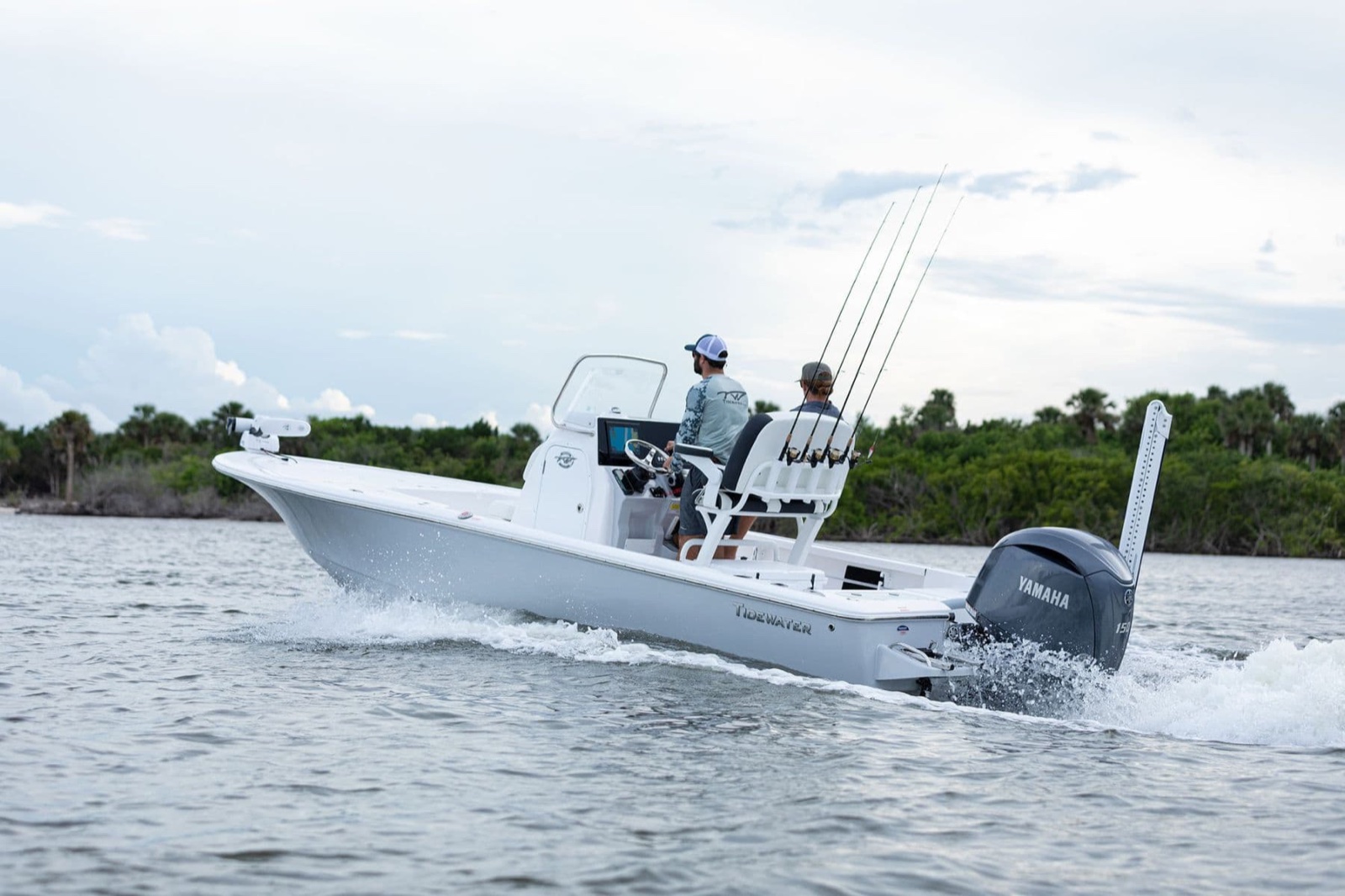
What is the Sea Hunt BX 22?
The Sea Hunt BX 22 BR is a 22-foot 2-inch single-outboard bay boat with an 8-foot 4-inch beam, a 12-inch engine-up draft, and a 7-passenger rated capacity. The hull is hand-laid fiberglass with a composite stringer grid, a fiberglass T-top with stainless support tubes, and a forward casting deck with an aft casting platform. The BR designation marks the boat as the bay-and-recreational variant in the Sea Hunt BX line, sitting between the smaller flats-targeted skiffs and the larger BX 24 platform.
Power is single-outboard, with engine options from the Yamaha F150 to the Yamaha or Mercury 250 hp at the top of the spec sheet. The Mercury 150 four-stroke and the Yamaha F200 are the volume rigging choices on the used market. Owners consistently recommend the F200 minimum and many wish they had stepped up to the F250.
Standard equipment from the 2020 model year forward includes the Garmin chartplotter, JL Audio mid-tier, dual livewells with recirculation, trim tabs, and the powder-coated T-top with the LED courtesy lighting package. The leaning-post livewell upgrade, the dual-battery switch, the Power-Pole pre-rig, the hardtop electronics box, and the upgraded JL Audio package sit on the option list across most model years.
Who is it good for?
The right buyer is the first-time bay-boat household running the Carolinas, the Florida panhandle, and the inshore Gulf for 50 to 100 hours a season. The boat is happy on Pamlico Sound, Tampa Bay, Choctawhatchee Bay, and the inshore Mississippi waters. The 22-foot length and the 8-foot 4-inch beam fit a single-axle trailer behind a half-ton truck, the sterndrive-free outboard layout keeps maintenance manageable, and the forward-casting-deck-plus-aft-platform layout supports two anglers without crowding. We spent an October morning on Mosquito Lagoon fishing reds out of a buddy's 2022 BX 22 with the F250 upgrade, and the boat ran a 31-mph cruise to the spot, held a steady drift on the wind, and got us back to the ramp with 14 gallons left in the tank.
Cross-shoppers from Pathfinder who want 80 to 85 percent of the build at 70 percent of the price are the second core profile. The Sea Hunt build sits honestly below the Pathfinder standard at the same length, but the value math works for households who do not plan a 15-plus year hold and would rather put the brand savings into electronics or a Power-Pole rig.
Carolina and panhandle households are the third profile. Sea Hunt has a deep regional presence in those markets, the dealer network is strong, and the resale price is firm because the regional buyer pool is consistent.
Who is it not good for?
Build-first owners planning a 15-plus year hold are wrong-targeted. The Pathfinder 2400 TRS versus Sea Hunt build delta compounds at year 5 and beyond, with the documented Sea Hunt issues (deck drainage, water intrusion at the console, wiring quality) showing up more on older hulls. Buyers who want a 15-year hold should specify Pathfinder or Shearwater.
Heavy long-crossing households running 25-plus mile bay-mouth runs as a routine should weigh the trade. The BX 22 is happy on 5 to 15 mile crossings in 2 to 3 foot conditions. Sustained longer runs in honest chop push the hull toward its design limit. A 24-foot platform with a deeper-V hull is the better tool.
Shallow-flats anglers needing a genuine 12-inch operating draft with the engine down should look at a tunnel-hull skiff or a smaller flats boat. The 12-inch number on the Sea Hunt spec sheet is engine-up. The boat needs 20 to 22 inches to get on plane.
Pricing
A 2026 BX 22 BR with the Yamaha F200 and a base option list is $78,000 to $86,000. The Yamaha or Mercury 250 hp upgrade plus the leaning-post livewell, the dual-battery switch, the Power-Pole pre-rig, the hardtop electronics box, and the upgraded JL Audio package pushes the build to $90,000 to $95,000.
Used pricing is wide. A 2018 to 2019 hull with the Yamaha F150 or Mercury 150 four-stroke and 200 to 500 hours is $15,000 to $35,000 depending on engine spec and condition. A 2020 to 2022 hull with the F200 or F250 upgrade and lower hours sits in the $42,000 to $68,000 band. A 2023 to 2024 hull with the loaded option list and a clean service log clears $72,000 and sometimes $90,000 for the loaded BR configurations. Across the BX 22 BR listings the average sat near $79,000.
The value buy is a 2021 to 2023 hull with the Yamaha F250, the leaning-post livewell, the Power-Pole pre-rig, the dual-battery switch, and a documented annual Yamaha service log. Asking prices in the $52,000 to $72,000 band match the use case for most Carolina and panhandle households.
What works
- Yamaha 150 to 250 hp outboard options cover the use case from solo bay running to two-angler tournament-style fishing. The F250 upgrade gives a 46 mph top end and a 28 to 30 knot cruise.
- 17-degree deadrise hull holds 2-foot chop on a 10-mile crossing without complaint. What owners report is that the boat is fairly dry when trimmed correctly.
- Forward casting deck plus aft casting platform fits two anglers without crowding. Three-angler use works for short runs.
- Dual livewells with the optional leaning-post upgrade support real bait management for bay tournament fishing.
- Used 2021 hulls at $48,000 to $62,000 are 30 to 35 percent under the Pathfinder 2400 TRS equivalent at the same year.
What doesn't
- Documented deck-drainage issue. Water accumulates on the deck at the transom when two or more people are in that area, and the water does not fully drain until the boat is on plane. Sea Hunt has acknowledged the scuppers exit under water at certain load conditions.
- Water intrusion into the center-console storage area during washdowns has been reported on a slice of hulls, with standing water accumulating in the console interior.
- Wiring quality is sloppy on some hulls. Owner reports document warranty work to clean up minor electrical issues including non-functional switches and components.
- Standard livewell layout is undersized for serious bait management. The leaning-post livewell upgrade is the standard fix and adds $1,200 to $2,400 to the package math.
- 12-inch draft on the spec sheet is engine-up. The boat needs 20 to 22 inches of water to get on plane, which is real planning information for shallow-flats anglers.
Year-by-year notes
2018 to 2019 hulls came with the Mercury 150 four-stroke or Yamaha F150 as the volume rigging, the original Garmin helm electronics, and the basic livewell layout. Some hulls show the documented drainage issue more prominently.
2020 added the leaning-post livewell as a more-common factory option, refined the cockpit storage layout, and updated the dual-livewell plumbing.
2021 to 2023 hulls have the refined Garmin package, the more-common Yamaha F200 or F250 upgrade, and improved cockpit storage geometry. Some hulls in this window still show the deck-drainage issue at the transom.
2024 to 2026 hulls add minor cosmetic refinement, an updated hardtop construction, and incremental cockpit storage improvements. The construction process and the hull design have been carried over largely unchanged from the 2018 launch.
Cost of ownership
Single-outboard operation keeps a clean cost line. Annual Yamaha 100-hour service is $400 to $700. Fuel burn at 28-knot cruise sits near 8 to 10 gph for the F250 spec, so a typical 50-mile bay day uses 14 to 18 gallons of fuel.
Insurance on a $60,000 hull is $900 to $1,800 a year depending on storage and use case. Dry-stack storage in the Carolinas and panhandle saltwater markets is $2,200 to $4,500 annually.
Plan a $1,200 to $2,200 a year reserve for routine maintenance plus a Yamaha cylinder inspection at the 1,000-hour mark and a hardtop hardware refresh at year 5. Hardtop, livewell pumps, washdown plumbing, and trolling-motor service are the recurring small lines.
Resale is roughly 28 to 32 percent five-year depreciation on a clean BX 22 BR, which is firm for a mid-tier bay boat. The regional brand recognition supports the price.
Best year and trim to buy
A 2021 to 2023 hull with the Yamaha F250, the leaning-post livewell upgrade, the Power-Pole pre-rig, the dual-battery switch, the Garmin chartplotter, and a documented annual Yamaha service log is the value buy. Asking prices in the $52,000 to $72,000 band match the use case for most Carolina and panhandle households.
Verify three things before close. First, run a hose into the cockpit and watch the drainage path; confirm the deck drains at rest, not just on plane. Second, walk the center-console storage area and the console interior for any water-stain marks indicating prior intrusion. Third, pull the wiring under the helm and at the battery box to check for sloppy splices or unused connectors. Fourth, plan to upgrade the bait tank or specify the leaning-post livewell if serious bait fishing is the use case.
For 2026-new buyers, the Yamaha F250 with the leaning-post livewell upgrade, the Power-Pole pre-rig, the hardtop electronics box, and the upgraded JL Audio package is the spec that resells best at year 5.
Alternatives
The Shearwater 23 LTS is the top-tier bay-boat cross-shop with Kevlar-reinforced construction at a 25 to 35 percent higher price ceiling, for buyers who want a build that holds across a 10-plus year hold. The Pathfinder 2400 TRS is the tournament-grade alternative for buyers who want a deeper hull, more range, and the firmest resale price in the bay-boat segment. The Robalo R230 is the center-console alternative for anyone who fishes more open water than the bay-boat layout suggests, with a similar price band and a different hull profile.