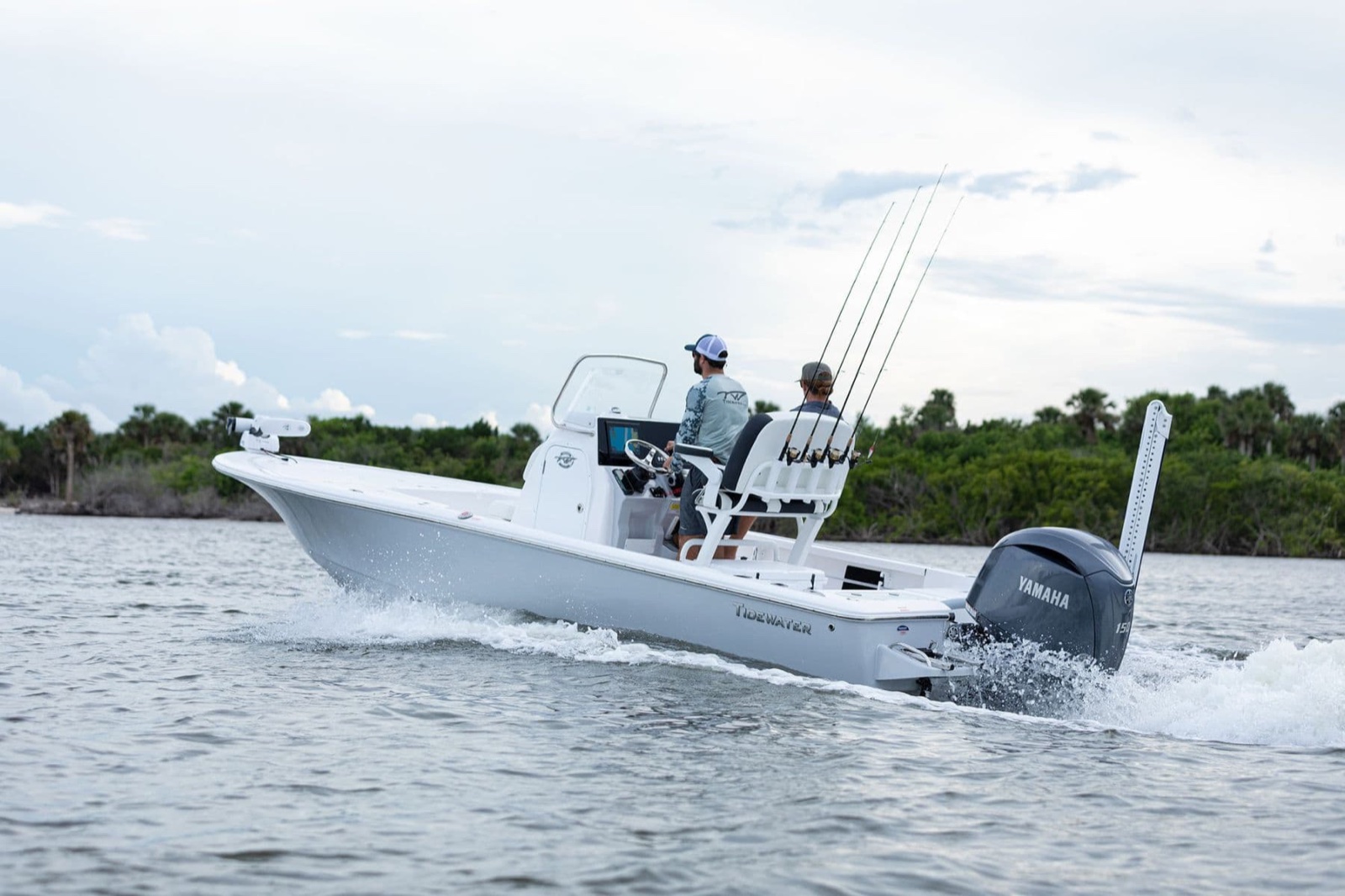
What is the Shearwater 23 LTS?
The Shearwater 23 LTS is a 22-foot 6-inch modified-V bay boat with an 8-foot 2-inch beam, a 17-degree deadrise, a 12-inch draft, and a 70-gallon fuel capacity. The hull dries at roughly 3,500 pounds with a Yamaha F250 outboard. Power is single-outboard only, with the 200, 225, 250, and 300 hp Yamaha and Mercury V6 outboards as the typical rigging choices. Livewell capacity is a segment-leading 64 gallons across the dual-livewell setup, and the boat is rated for 8 occupants.
Construction is the Shearwater HPI process: hand-laminated biaxial fiberglass with Dupont Kevlar reinforcement on the outer hull, a full-length inner hull, and a high-strength closed-cell foam injected between the two under pressure. The build is rated unsinkable and carries a limited lifetime hull warranty. The forward casting deck and the aft casting platform together support two anglers, and the console encloses a head compartment that takes a marine toilet on the option list.
Who is it good for?
The right buyer fishes the flats and the bay mouths along the Florida coast, the Gulf, and the Carolinas. The 12-inch draft opens shallow water that a deeper-V bay boat cannot reach, and the 17-degree deadrise holds 2-foot chop on the run home without the sharp pound that fatigues a flatter skiff. Anglers running 12-inch water in Tampa Bay, the Indian River Lagoon, and the Pamlico Sound consistently rate the boat as the right shape for that use case. I poled a 2022 across a Mosquito Lagoon flat one March dawn looking for tailing reds, and the platform stayed dead steady at 12 inches of water with two of us on the bow.
Build-first households planning a 10-plus year hold are the second profile. The consistent owner take is that Shearwater hulls at 1,000-plus hours of saltwater service hold up under standard care, with the Kevlar-reinforced laminate showing no obvious fatigue at year 8 and beyond.
Cross-shoppers from Pathfinder and Sea Hunt who want the Kevlar-reinforced hull and the foam-core double-hull build at a slightly lower price entry are the third profile. The 23 LTS slots between Sea Hunt's volume bay boats and Pathfinder's tournament-grade rigs.
Who is it not good for?
Top-end-priority buyers are wrong-targeted. The 23 LTS with a Yamaha F250 hits roughly 44 mph at WOT with one aboard, and a Yamaha F300 pushes the top end into the high 40s. A stripped-down V-hull bay boat at the same engine spec is 4 to 6 mph faster. If wide-open-throttle running is the priority, this is not the right hull.
Buyers who want twin-engine offshore redundancy should look elsewhere. The 23 LTS transom is engineered for single-outboard rigging, and the use case ends well short of the 30-mile offshore run where a twin-outboard center console makes more sense.
Owners who tolerate poor service experiences should be aware that what owners report across multiple model years is warranty service that is inconsistent across the Shearwater dealer network. The hull is excellent, but the service experience varies, and a strong relationship with the local dealer separates a happy owner from an unhappy one.
Pricing
A 2026 23 LTS with a Yamaha F250 and a base option list is $98,000 to $115,000. The F300 upgrade plus the dual-livewell upgrade, the Garmin chartplotter package, the JL Audio premium upgrade, the powder-coated T-top, and a Power-Pole pair pushes the build into the $125,000 to $135,000 range.
Used pricing has held up. A 2018 to 2020 hull with the Yamaha F250 and 200 to 400 hours is $58,000 to $74,000. A 2020 to 2022 hull with the same engine and lower hours sits in the $68,000 to $85,000 band. A 2023 to 2024 hull with the F300 and a clean service log clears $80,000 and sometimes $95,000 for the loaded configurations. Across the broader Shearwater used market, listings range from roughly $30,000 for older hulls to $220,000 for the largest models in the line.
The value buy is a 2020 to 2022 hull with the Yamaha F250, the dual-livewell setup, the Garmin chartplotter, the powder-coated T-top, and a documented annual-service history with the Yamaha dealer. Asking prices in the $66,000 to $80,000 band match the use case for most flats-and-bay-mouth households.
What works
- Hand-laminated biaxial fiberglass with Dupont Kevlar reinforcement on the outer hull and the foam-injected double-hull core is build quality the segment notices. What comes up across owner accounts through year 8 and 1,000 hours is no laminate fatigue under standard care.
- 12-inch draft opens shallow flats that a deeper-V bay boat cannot reach. Tampa Bay, Pine Island Sound, and the Indian River Lagoon are the natural homes.
- 17-degree deadrise holds 2-foot chop on the bay-mouth run home without the sharp pound that fatigues the helmsman by the end of a long day.
- Forward and aft casting platforms together support two anglers without the layout crowding common at this length.
- 64-gallon dual-livewell capacity is segment-leading at this length and matters for serious tournament bait management.
What doesn't
- Single-engine outboard only. No twin-engine layout for offshore redundancy or higher-speed running.
- Top end is 4 to 6 mph below a stripped V-hull at the same engine spec. Buyers who want WOT speed will be happier in a Pathfinder or a tournament Skeeter.
- What owners report across multiple model years is warranty service that is inconsistent across the Shearwater dealer network. Build out a relationship with the local dealer before purchase.
- Cross-wind 20-knot chop will get the cockpit wet despite the high console. The boat throws spray well, but no bay boat in this length stays dry in a stiff cross-wind run.
- Console-head compartment is a portable-toilet setup, not an enclosed stand-up.
Year-by-year notes
2018 to 2019 hulls came with the original Garmin GPSMap chartplotter, the standard single livewell, and the Yamaha F250 as the volume engine choice. The dual-livewell upgrade was a popular option order.
2020 added refined cockpit storage layout, a slight T-top revision, and the dual-livewell setup as a more-common factory order. Yamaha F300 became more common as the spec upgrade.
2021 to 2023 hulls have the refined Garmin package, the standard powder-coated T-top, and the JL Audio mid-tier as the typical audio spec. Some 2022 hulls had warranty issues that owner accounts documented across the dealer network.
2024 to 2026 hulls add a refreshed cockpit color palette, helm-display upgrades, and incremental hardware refinement. The Yamaha F300 V6 is the volume engine choice on 2025 and 2026 builds.
Cost of ownership
Single-engine running keeps operating cost reasonable. At 28-knot cruise the Yamaha F250 burns roughly 6 to 8 gph, so a typical 50-mile fishing day uses 12 to 18 gallons of fuel. The annual Yamaha 100-hour service costs $400 to $700.
Insurance on an $80,000 hull is $1,200 to $2,400 a year depending on storage and use case. Dry-stack storage on the Florida and Gulf coasts is the typical home and costs $2,500 to $5,000 annually. I watched a Charleston buyer pull a 2021 23 LTS out of dry stack for a Cape Romain trip last fall and the boat was in the water and fishing inside 25 minutes from the stack call.
Plan a $1,500 to $2,500 a year reserve for routine maintenance plus a hull-bottom service at year 5 if the boat is dry-stack stored. Livewell pumps, T-top hardware, washdown plumbing, and trolling-motor service are the recurring small lines.
Resale on Shearwater hulls is roughly 26 to 30 percent five-year depreciation, which is firm for a premium-built single-engine bay boat. Owners who service the Yamaha on schedule and keep the boat covered routinely sell at year 5 within striking distance of replacement-cost depreciation.
Best year and trim to buy
A 2020 to 2023 hull with the Yamaha F250 V6, the dual-livewell setup, the Garmin chartplotter, the powder-coated T-top, and a documented annual-service history with the Yamaha dealer is the value buy. Asking prices in the $66,000 to $85,000 band are the right zone for most flats-and-bay-mouth households.
Verify three things before close. First, confirm the transom moisture reading is dry and the bracket bolt heads show no obvious corrosion. Second, pull the latest Yamaha service report and check compression numbers across all six cylinders. Third, walk the deck cores at the bow casting platform and the aft platform for any soft spots. Fourth, check the dealer relationship. The warranty experience varies across the network and a strong local dealer is half the ownership math.
For 2026-new buyers, the Yamaha F300 V6 with the dual-livewell setup, the powder-coated T-top, a Power-Pole pair, and the Garmin upgrade is the spec that resells best at year 5 and supports the use case for serious flats anglers.
Alternatives
The Pathfinder 2400 TRS is the tournament-grade premium cross-shop, with a deeper hull, more range, and a higher price ceiling for buyers who want to fish the flats and run light offshore on the same boat. The Sea Hunt BX 22 is the lower entry-price bay boat for buyers who want a comparable layout without the Kevlar-build extra cost. The Robalo R230 is the center-console alternative for households who want bay-boat fishing capability with a more open offshore layout and a similar price entry.