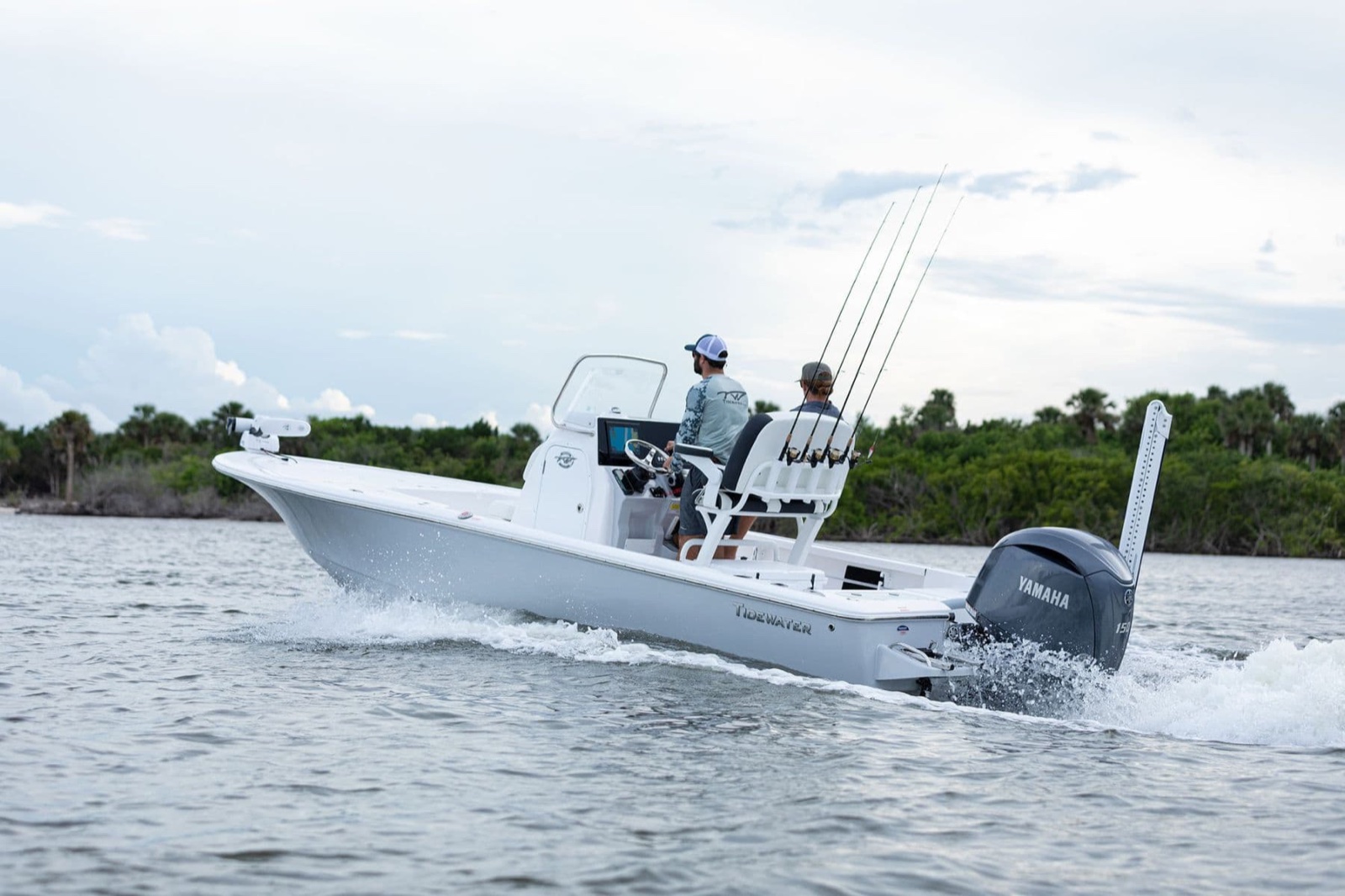
The Pathfinder 2400 TRS is the bay boat the segment compares everything else against. Pathfinder is one of three brands inside Maverick Boat Group out of Fort Pierce, Florida, alongside Hewes and Maverick. The line pioneered the modern bay-boat segment thirty years ago, and the 2400 TRS is the model that has held the rank-one position in our 2026 bay-boats guide because the hull, the standard equipment package, and the price-on-resale all line up against the segment.
What is the Pathfinder 2400 TRS?
The 2400 TRS is a 23-foot 11-inch fiberglass hybrid bay boat. The hull is what makes the boat different. Length-overall just under 24 feet, an 8-foot 6-inch beam, 12 inches of draft at rest, a 15-degree transom deadrise with bow flare, 80 gallons of fuel, and roughly 2,950 pounds dry with a Yamaha F300 mounted. The hull is set up to fish the flats and run a 15-to-25-mile bay-mouth crossing on the same trip without picking sides. The 12-inch draft opens up grass beds and oyster bars that exclude deeper-V hulls, and the bow flare and 15-degree deadrise are tuned to handle 2-foot chop on the run home rather than punishing the helm.
The standard equipment list earns the extra money. An Atlas hydraulic jack plate with six inches of setback is fitted from the factory, which lets the F300 climb on plane in skinny water rather than blowing out the prop on a hot launch. A 36-volt trolling motor pre-rig is standard rather than aftermarket, with the wiring runs and the bow-mount block-out done at the factory. Twin Garmin GPSMap multifunction displays at the helm, a 38-gallon livewell with recirculation on the port side, an optional 38-gallon release well on the opposite side, an insulated 31-gallon fish box under the forward deck, JL Audio, and trim tabs are all part of the standard build on 2021-onward boats. The Llebroc helm seat with armrests and individual flip-up bolsters is the first thing owners notice on a long crossing.
A late-fall poling-platform day out of Pine Island Sound on a 2022 hull made the design intent clear. We held station over a turtle-grass flat in maybe 15 inches of water, then ran 19 miles back to the ramp with a 12-knot crosswind at a 28-knot cruise without taking spray at the helm.
Who is it good for?
Florida and Gulf Coast flats anglers running 50 to 100 hours a season are the core buyer. Families whose typical day is poling a flat, running fifteen to twenty-five miles to a bay-mouth bottom, and getting back to the dock for a swim are the right fit. The 12-inch draft handles redfish flats and tarpon channels that a 22-degree center-console rules out, and the 15-degree deadrise plus the F300 gives the boat the legs to cover ground that a true skiff cannot. Carolinas inshore and lower-Chesapeake anglers fit the same use case at slightly different distances.
Cross-shoppers from Scout, Robalo, and Sea Hunt who want shallower draft without giving up the bay-mouth crossing are the second profile. Owners moving up from a 18-to-21-foot center console find the 2400 TRS adds the cockpit volume and the storage capacity for a day's worth of fishing without losing the skinny-water access that pulled them off a deeper hull.
Who is it not good for?
Pure offshore families running 4-foot chop on a regular basis are the wrong fit. The 15-degree deadrise is bay-first, and a long offshore run in a real sea state will pound the hull and the helm in ways that a 23-degree center console will not. Owners whose typical week includes 30-mile runs to live-bait grounds in open water should buy a Regulator 23, a Boston Whaler 230 Outrage, or a Grady-White instead.
Trailer-launch buyers needing an under-22-foot LOA for road permits or covered storage will not fit the 23-foot 11-inch hull. Owners planning to run twin Power-Poles should also screen the boat carefully. The factory port-side stern ladder becomes inoperable when two Power-Poles are installed, which is a real problem for families where someone swims off the stern. Single-pole installs do not see the issue.
The third exclusion is owners outside a Maverick Boat Group dealer footprint. Customer service direct from the factory is dealer-routed, and owners outside a dealer's geography have flagged warranty response as poor. Buyers in the Pacific Northwest or the Great Lakes who want a TRS should screen the local dealer relationship as carefully as they screen the boat.
Pricing
New 2026 base pricing on the 2400 TRS hull with a Yamaha F300, the Atlas jack plate, the 36-volt trolling motor pre-rig, and twin Garmin GPSMap displays lands around $117,000 to $135,000 depending on dealer and trim adds. Stepping up to the F350 is a $5,000-to-$8,000 line. Optioning a Power-Pole package, audio upgrades, outriggers, and a fully equipped livewell-and-release-well configuration can push the build close to $145,000.
The used market goes from $52,000 at the bottom (older hulls in the 600-plus-hour range with deferred service) to roughly $168,000 at the top (current-year hulls with full electronics and dual-Power-Pole packages), with the average market price across the production run near $130,000 in 2026 listings. The sweet spot for buyers is the 2020-to-2023 hull with the F300, the Atlas jack plate, twin Garmin, and 100 to 250 hours, which lands in the $62,000 to $92,000 band on the broader market and $72,000 to $82,000 at a Maverick Boat Group dealer with the maintenance file in order. Five-year depreciation is about 22 to 26 percent off new MSRP, segment-leading.
What works
- 12-inch draft at rest opens up flats that exclude deeper-V boats from the same segment.
- Atlas jack plate with 6 inches of setback is standard. The boat climbs on plane in skinny water rather than blowing the prop on a hot launch.
- 36-volt trolling motor pre-rig is standard, not an aftermarket add. Bow-mount block-out and wiring runs are factory-set.
- Twin Garmin GPSMap multifunction displays at the helm and a 38-gallon livewell with recirculation are standard rather than upper-trim options.
- Yamaha F300 gets the boat to 54-plus miles per hour at wide-open throttle and a 30-knot cruise that holds segment-leading economy.
- Llebroc helm seat with armrests and individual flip-up bolsters is a real day-fishing helm rather than a token perch.
- Holds its price firmly. Brokerage inventory moves within 60 to 90 days at fair pricing.
What doesn't
- High-tier money. Used prices stay firm, and the floor for a clean 2021 hull with the F300 and the Atlas plate sits above $62,000.
- Porpoising at higher speeds has been reported by owners running the wrong prop. Prop selection is a real pre-purchase verification line.
- Scuppers have been flagged as slow to clear water back out of the cockpit. Fishing from the stern in any meaningful chop puts water on the deck.
- Twin Power-Pole installs make the port-side stern ladder inoperable. Single-pole installs do not see the issue.
- Single battery is standard. Owners running a 36-volt trolling motor plus the electronics plus livewells should order the dual-battery and switch upgrade at the dealer.
- Customer service direct from Maverick Boat Group is dealer-routed. Owners outside a dealer geography have flagged poor warranty response on hull defects.
Year-by-year notes
The current 2400 TRS generation has been in production since the 2020 model year on the same hull. Standard equipment has filled out over the production run, with the 36-volt trolling motor pre-rig, the Atlas jack plate, and the dual-display Garmin standard moving from upper-trim options to base catalog by the 2021 model year. The optional 38-gallon release well opposite the standard livewell entered the catalog mid-cycle. The Yamaha F300 has been the primary engine across the production run, with the F350 available as the upgrade. There is no single defect cutover year for buyers to screen on, but reports of bow-cap-to-hull gel coat separation on a small share of older hulls point to a careful pre-purchase inspection of the bow joint regardless of model year. Maverick Boat Group's warranty response to gel coat issues has been mixed, and pre-existing repairs that were paid out-of-pocket are a useful negotiating point on used hulls.
Cost of ownership
Annual recurring costs are reasonable for a high-tier saltwater bay boat. The Yamaha F300 service interval is 100 hours, with a service kit costing $300 to $450 in parts and $250 to $400 in dealer labor. The 300-hour valve-clearance check steps the labor budget up at the three-year mark for typical bay-fishing households. Bottom paint costs $400 to $700 in materials annually for owners who keep the boat wet at a slip, less for trailer-stored boats. Insurance on a $75,000 hull value costs $900 to $1,500 a year on Florida coastal markets, $700 to $1,200 in lower-cost geographies. Slip rental and storage drive the larger variable.
The Atlas jack plate adds a service line that other bay boats avoid. A jack plate relay or hydraulic line failure costs $300 to $700 to repair at a dealer-experienced shop. The trolling motor pre-rig itself is low-maintenance, but the 36-volt battery bank needs replacement on the 4-to-6-year cycle, which is a $700 to $1,200 line every five years.
A five-year hold on a 2021 used 2400 TRS bought at $80,000 with 150 hours, run at 70 hours a season on the Florida Gulf Coast with trailer storage and saltwater rinse-down after each use, lands at roughly $5,000 to $8,000 a year all-in including insurance, fuel, service, and amortized capital cost.
Best year and trim to buy
The 2021-to-2023 2400 TRS with the Yamaha F300, the Atlas jack plate factory-rigged, the 36-volt trolling motor pre-rig, twin Garmin GPSMap displays, and the optional 38-gallon release well opposite the standard livewell is the right buy in 2026. The 2024 and 2025 hulls add modest refinements, but the depreciation cost over the next two years weighs against the new-or-near-new buy unless the buyer wants a specific recent configuration.
Verify five things pre-purchase. First, the prop is correctly matched to the boat's typical load and the running attitude is clean without porpoising at cruise. Second, the bow-cap-to-hull joint is clean with no gel coat separation, and any prior repair work is documented. Third, the Atlas jack plate moves smoothly under power across the full setback range. Fourth, the scupper clearance is acceptable on a stern-loaded test (a useful field check is to load three adults aft and see whether water lines the deck at idle). Fifth, the maintenance file shows current 100-hour Yamaha service work and any 300-hour valve-clearance check in the right window.
Alternatives
The closest cross-shop on price is the Sea Hunt BX-22, which sits roughly twenty-five percent under the Pathfinder at the same length with build that is segment-mid rather than segment-top. The direct competitor with a slightly different hybrid balance is the Shearwater 23 LTS, which leans further toward fishability where the Pathfinder leans further toward family-day mixed use. For buyers who run more open-water than skinny-water, the Robalo R230 is the offshore-leaning cross-shop with a deeper V at similar money.