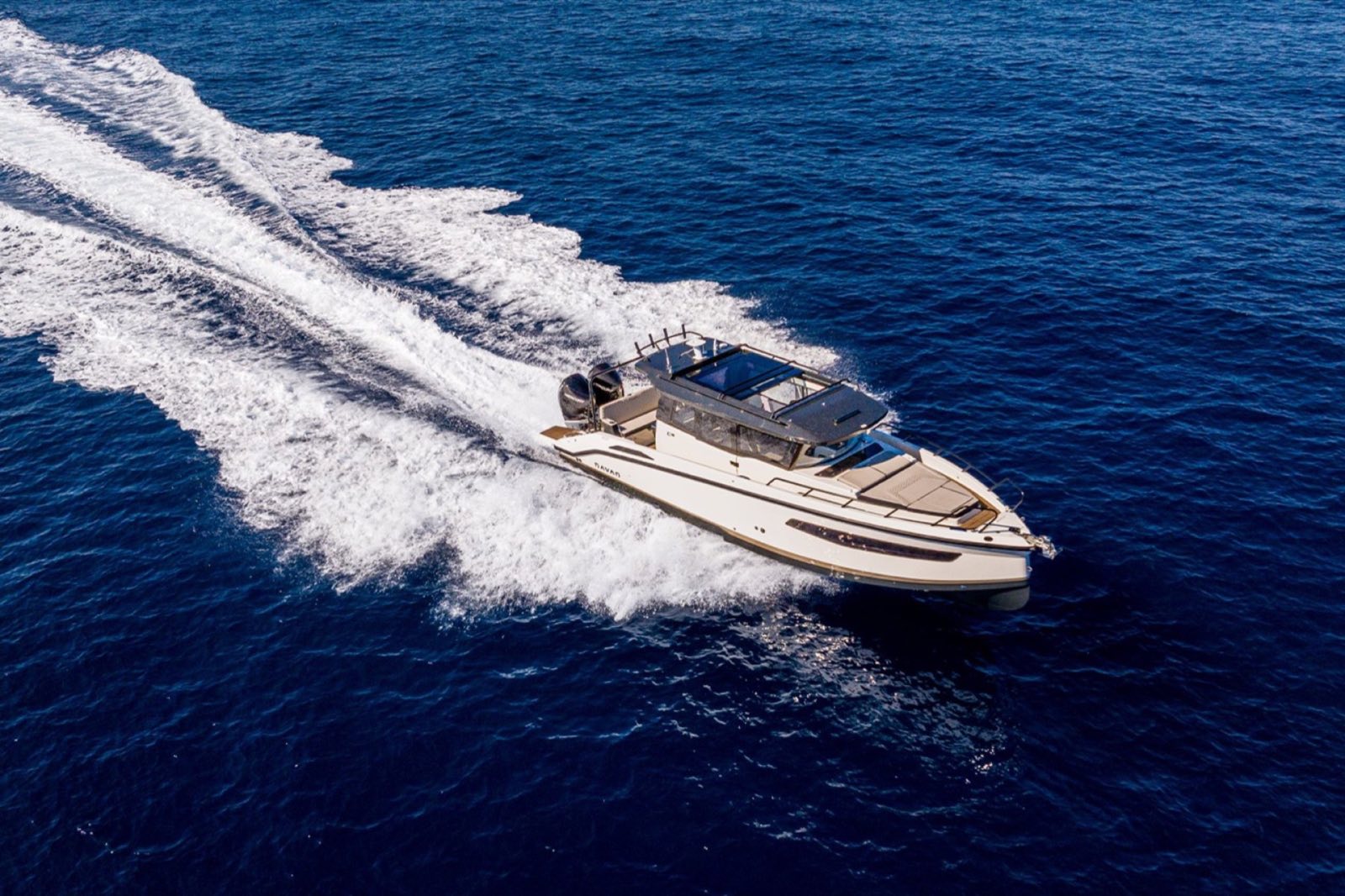
The Regulator 23 is the smallest boat Regulator builds, and the one that shows you most clearly what the brand is about. Regulator Marine has been hand-laying deep-V center consoles in Edenton, North Carolina since 1988. The 23 sits at the top of our 2026 center-consoles-under-30 guide because the hull, the build records, and the price-on-resale all line up against a segment that mostly competes on cockpit volume and electronics.
What is the Regulator 23?
The 23 is a 23-foot 5-inch fiberglass center console that measures 27 feet 6 inches with the bracket and engines hung off the transom. The hull is the headline. An 8-foot 6-inch beam, a 24-degree transom deadrise on a hard-chine deep-V, a Carolina flare that throws spray sideways instead of at the helm, and a dry weight of 7,120 pounds with twin Yamaha F150 four-strokes mounted. Fuel is 149 gallons, the holding tank 9 gallons, the freshwater tank 20.
The construction is what owners pay the premium for. Hand-laid fiberglass with vinylester resin to slow blistering, closed-cell foam coring through the structural laminates, Polybond bonding for the stringer grid, the deck, and the liner to the hull, RTM (resin transfer molded) hatches, a through-bolted deck cap, and stainless throughout the visible hardware. In practice, what you get is a hull that stays stiff when water finds a stress crack, gelcoat that doesn't bubble after years in saltwater, and a build sheet a surveyor can read a decade in. The same construction shows up on the larger Regulators (the 26, 28, 31, 34, 38), so the 23 buys you the same build philosophy as the upper-tier hulls in a smaller footprint.
Two engine setups define the 2026 lineup. Twin Yamaha F150 four-strokes is the redundancy build that most long-day anglers prefer. Single Yamaha F300 is the lower-cost single-engine build, holding a 29.5-mile-per-hour cruise and burning roughly 14 gallons per hour, which works the 149-gallon fuel tank into a real long-day range. Forward seating, a hardtop, the transom tuna door, the 30-gallon pressurized livewell, the 46-gallon fishbox-livewell convert option, the 350-quart in-deck fishbox, and a rigging station are part of the standard or near-standard build on 2018-onward boats.
Who is it good for?
Nearshore anglers fishing 1 to 15 miles out in 2-to-3-foot conditions are the core buyer. The 24-degree deadrise and the Carolina flare hold a dry helm in chop that pounds a 21-degree or 22-degree hull at the same length. From everything we read across owner reports. Owners on The Hull Truth, the Regulator owner Facebook group, and a couple of named dealer-service writers. The first thing that comes up is the same thing every time: the 23 lets you fish two more days a month in conditions where a lighter-deadrise hull would call it off. Owners trading up from a Boston Whaler 230 Outrage or a Grady-White Coastal Explorer at similar length describe the same outcome on the same fishing grounds.
Owners planning to keep the boat ten-plus years are the second profile, and the math works in their favor. Three years of roughly ten-percent depreciation followed by a flat curve is what makes the Regulator premium make sense over a long hold. What this means for you is the cost of ownership over a decade is closer to a Grady or a Whaler than the sticker premium suggests. The 23 in particular is rarer on the used market than the 26, which props the resale price up further. The brand is also why some coastal-yacht owners spec a Regulator 23 as a tender or a fishing day-boat behind a 50-plus-foot motoryacht.
Who is it not good for?
Buyers who need a berth, a real head enclosure, or any cabin space at all should not buy the 23. The console serves as weather shelter and that is the extent of the accommodations. Families with kids who occasionally come aboard for a swim should add the optional forward-seating package and accept that overnighting is not part of the brief.
Anglers fishing 30-plus miles offshore in any real sea state should also walk past the 23 toward the Regulator 26 or the 28. The 23 is a 1-to-15-mile boat by hull volume and fuel capacity. The 24-degree deadrise can take the chop that a longer offshore run produces, but the cockpit and the helm are sized for nearshore work, not for canyon work.
Budget-tight buyers fit the third exclusion. Regulator's dealer network does not discount, and the price premium over a Grady-White 231 Coastal Explorer at the same length sits at 25 to 35 percent at purchase. Buyers who plan to flip in three years see most of that premium back at resale, but anyone tight on the entry-cost side should walk to a Robalo R230 or a Scout 235 instead.
Pricing
New 2026 pricing on the Regulator 23 in standard configurations is roughly $185,000 to $215,000 depending on engine choice (twin F150s versus single F300), electronics package (Garmin or Simrad at the helm, with the dealer typically defining the spec), and option lines. Stepping up to the hardtop, the forward-seating package, the freshwater washdown, the rigging station, and a fully equipped electronics package can push the build past $230,000. The dealer network is concentrated in the Atlantic and Gulf, with limited Pacific and Great Lakes coverage that adds freight cost on remote builds.
The used market spans $45,000 at the bottom (mid-to-late-1990s hulls in the 1,500-plus-hour range with deferred service) to $224,000 at the top (current-year hulls with full electronics and twin-F150 packages), and the average asking price across the production sits near $139,000 in 2026 listings. The sweet spot for buyers in 2026 is the 2018-to-2022 hull with current-spec hatches, post-2011 layup, and 200 to 500 hours, which lands in the $85,000 to $145,000 band. What this gets you, practically: five-year depreciation on a clean Regulator 23 is about 15 to 20 percent off MSRP. That's the segment-leading number by a wide margin, and it's the reason people pay the premium at the dealer in the first place.
What works
- 24-degree deep-V hard-chine deadrise into a head sea. The Carolina flare keeps the helm dry at 25 mph in 3-foot chop where lighter-deadrise boats pound and spray.
- Vinylester resin, closed-cell foam coring, Polybond bonding, RTM hatches, through-bolted deck cap. The build matches what owners see on tear-downs.
- Loses less than 10 percent of new on clean hulls at three years, segment-leading by a wide margin.
- 30-gallon pressurized livewell, 46-gallon fishbox-livewell convert, 350-quart in-deck fishbox, plus a transom tuna door. The fishing-feature package matches what is on a 28-foot competitor.
- Twin Yamaha F150 rigging gives redundancy on long days. Single Yamaha F300 rigging gives the lower-cost build with a 29.5-mile-per-hour cruise at roughly 14 gallons per hour.
- Regulator's written warranty is long, and owners report the company honors it without dealer-runaround on legitimate hull or build issues.
- 149-gallon fuel tank holds the boat to a real all-day range with reserve.
What doesn't
- Cockpit is tight for four anglers actively fishing. Three is the comfortable working capacity. The Regulator 26 is the right boat for crews that grow.
- No standard head enclosure on the base layout. The console is the only weather shelter.
- Hatch sealing is not segment-leading. Owners flag damp lockers on long days and spray-driving sea states.
- Spider and stress cracks at gunwale-to-deck joints have been reported on a small share of older hulls. Pre-purchase inspection of those joints is non-negotiable.
- Older hulls from the 1990s and early 2000s had a reputation among owners for spray reaching the helm in big chop. The reputation has narrowed on post-2011 boats but hasn't fully disappeared in owner reports.
- Dealer network is concentrated on the Atlantic and Gulf. Pacific and Great Lakes buyers are paying freight on parts logistics for warranty and service work.
Year-by-year notes
The Regulator 23 has been in production since 1996 with the 24-degree deadrise platform unchanged through the modern era. The current generation uses the same layup from roughly 2017 onward. Pre-2011 hulls are the ones owners flag for spray reaching the helm in big chop, with hull design and gunwale-to-deck joint refinements on later production improving spray management and joint integrity. The 2017-onward boats carry the current Polybond bonding, RTM hatch, and through-bolted deck cap construction. The transom tuna door, the rigging station, and the forward-seating package have moved from upper-trim options to part of most dealer builds across the 2020-onward production. Yamaha rigging shifted from twin F150 dominance toward single F300 popularity through the 2020s, with both setups available on current builds. There is no single defect cutover year for buyers to screen on.
Cost of ownership
Annual recurring costs are higher than the segment average because the build supports a long ownership cycle. Yamaha service intervals on twin F150s or a single F300 follow the manufacturer's 100-hour schedule. A 100-hour service kit costs $300 to $500 in parts on a single F300 and $600 to $1,000 on twin F150s, plus dealer labor of $250 to $400 per engine. The 300-hour valve-clearance check at the three-year mark steps the labor budget up materially. Bottom paint costs $400 to $700 in materials annually for slip-stored boats, less for trailer-stored hulls. Insurance on a $120,000 hull value is $1,400 to $2,400 a year in Atlantic and Gulf coastal markets. Slip rental and storage drive the larger variable.
A five-year hold on a 2019 used Regulator 23 bought at $115,000 with 250 hours, used 80 hours a season nearshore on the Carolina coast with trailer storage and a saltwater rinse-down after each trip, lands at roughly $7,500 to $11,500 a year all-in including insurance, fuel, service, and amortized capital cost. The amortized cost is lower than it looks because the resale price at year five sits within ten percent of what you paid for the boat on a clean hull.
Best year and trim to buy
The 2018-to-2022 Regulator 23 with twin Yamaha F150s or a single F300, the post-2017 layup, current hatch sealing, and 200 to 500 hours is the right buy in 2026. Twin F150s give long-day redundancy and the slightly higher resale price on the used market. Single F300 gives a lower-cost build with a real 29.5-mile-per-hour cruise that holds the 149-gallon fuel tank into a long-day range. Both are correct buys depending on use case.
Verify five things pre-purchase. First, the hatches seal cleanly on a hose test and the lockers stay dry on a long-day sea trial. Second, the gunwale-to-deck joints have no spider or stress cracks. Third, the maintenance file shows current 100-hour Yamaha service plus the 300-hour valve-clearance check at the appropriate hour mark. Fourth, the bonding lines along the stringer grid are visible and clean (Regulator's Polybond joinery shows on inspection). Fifth, the broker or seller has documentation on any prior warranty work, which Regulator's dealer network handles without runaround on legitimate issues.
Alternatives
The closest cross-shop on construction philosophy is the Boston Whaler 230 Outrage, which trades the deep-V Carolina-flare sea-keeping for closed-cell-foam unsinkability at a slightly lower premium. The most-compared cross-shop on hull is the Grady-White 231 Coastal Explorer, where the SeaV² hull is the alternative to the 24-degree Regulator deadrise, and Grady's price sits 25 to 35 percent under at the same length. For buyers stepping back to a value tier, the Robalo R230 is the structural cross-shop with a deeper-than-class deadrise at materially less money.