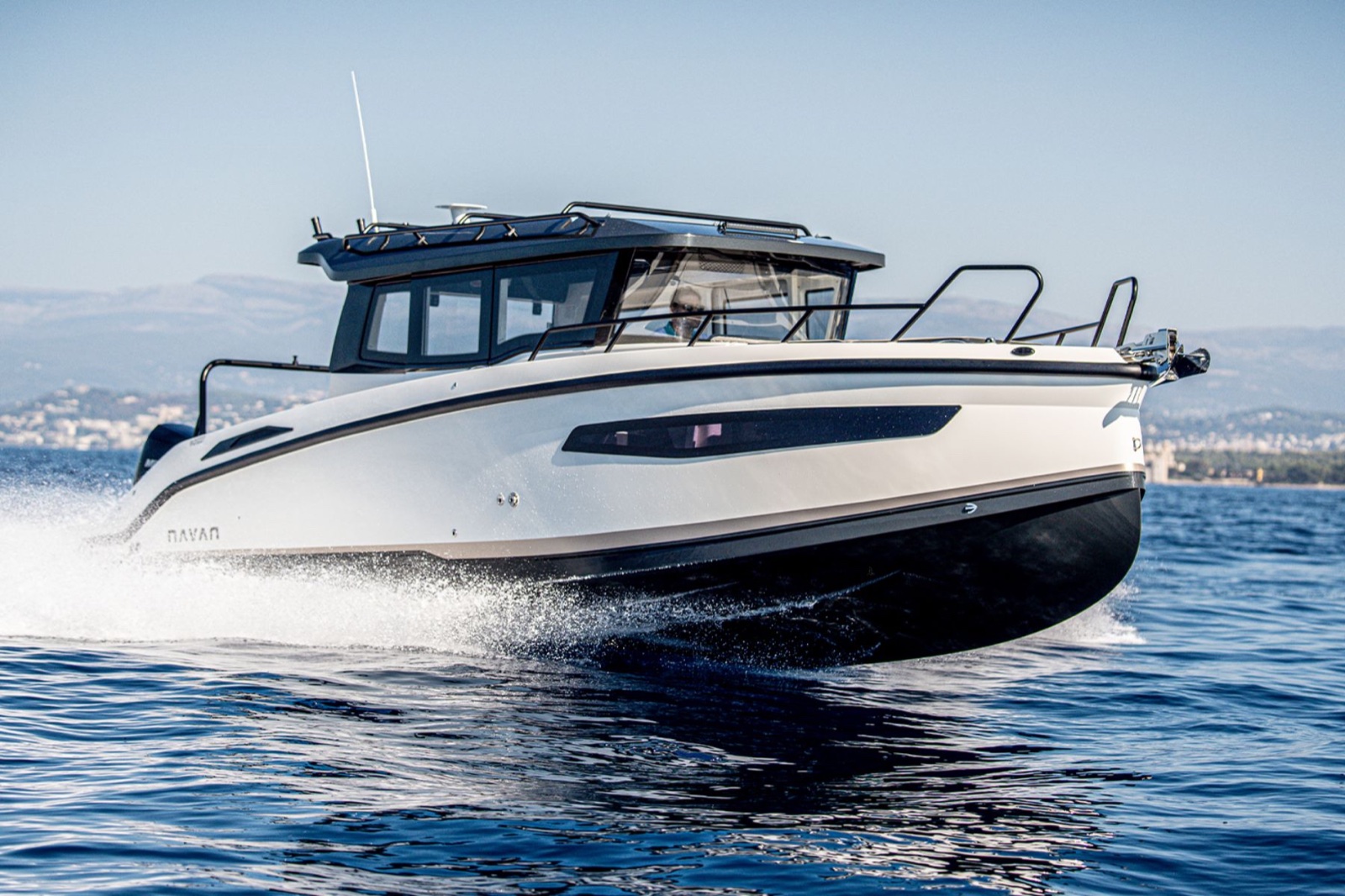
The Robalo R242 is the boat that turns up on most first-time center console shortlists. Robalo has been building boats out of Nashville, Georgia since 1968, and the R242 is the model that does the value-tier job at 24 feet better than any of its in-house siblings. It is what families buy when the math on a Grady-White 236 Fisherman does not work and the boat still needs to handle a Saturday inshore run and a Sunday family cruise.
What is the Robalo R242?
The R242 is a 23-foot-11-inch fiberglass center console with an 8-foot-6-inch beam. The hull is a hand-layup with honeycomb coring through the structural sections, a 21-degree transom deadrise, and a moderate flare forward. Engine config is single outboard, with Yamaha F250 and F300 the two common rigs on the dealer lot. Most used inventory in 2026 carries the F300, which is what we would recommend for the boat.
The cockpit layout is practical. Forward seating with insulated coolers under the cushions, a center console with sink and porta-potti space, a 25-gallon livewell at the transom, raw-water washdown, and a T-top with rod-storage rocket launchers. Garmin or Simrad electronics ship factory-ready at the dash, and the cable chase is tidy for the price tier. Storage volumes are honest, not generous, which is what you expect on a value-tier 24-footer.
The boat hits a 25 to 30 knot cruise comfortably with the F300 and tops out in the high 40s depending on prop choice and load. Fuel burn at cruise is competitive enough that owners running 30 to 40 mile inshore loops on a Florida bay or a Carolina sound do not feel like the boat is the bottleneck. We ran a 2022 R242 out of Wrightsville one fall morning with three anglers and a cooler aboard, and the boat held a 26-knot cruise into a 1 to 2 foot chop without pounding. The 21-degree deadrise is not a deep-V, but it is enough for the inshore work the boat is built for.
Who is it good for?
The first buyer is the price-sensitive first-time center console family. The R242 brings a real 24-foot fishing platform under six figures, and for a family stepping up from a runabout or a bay boat, that is a substantial gap closed. We watched a couple sign a deal on a used 2020 R242 at a Charleston broker last spring, and the conversation was the same one every Robalo buyer has. They had cross-shopped a Grady, they had shopped a Boston Whaler 230 Outrage, and the price was what brought them to Robalo. Five years of ownership at a similar use cycle made the math work.
The second buyer is the family mixing inshore fishing with weekend cruising. The forward seating is genuinely useful for kids, the T-top covers a real cockpit, and the boat is sized to trailer behind a half-ton truck. A boat at this length does not have to choose between fishing and family use, and the R242 splits the difference well.
The third buyer is the owner planning to keep the boat five to seven years and sell to trade rather than to chase resale value. The depreciation curve on a Robalo is steeper than a Grady, but the entry price is lower, so the absolute dollars lost over a hold are closer than the percentages suggest.
Who is it not good for?
Tournament anglers chasing offshore canyon work should walk past. The R242 is a 1 to 15 mile boat by hull, fuel, and rigging. The 21-degree deadrise is fine for inshore and nearshore use, it is not the offshore deep-V that the Regulator 23 or a Yellowfin gives you in real seas.
Buyers obsessed with hidden-compartment finish quality should also look up the tier. Robalo's build philosophy is to put the money where the buyer looks and to save it where the buyer does not. The result is a clean cockpit and a less clean stringer bay. The boat is honest about this. If you are the buyer who lifts every hatch on the dealer lot, you will see the gap.
Owners who plan to flip the boat at three years and want the premium-brand resale curve should walk to Grady, Scout, or Whaler. The Robalo depreciation pattern is closer to 25 to 30 percent in three years on a clean hull, which is fine if you bought to use, harder if you bought to exit.
Pricing
New 2026 R242 pricing sits between roughly $88,000 and $115,000 at the dealer depending on engine choice (F250 versus F300), electronics package, and option lines like the hardtop, the fresh-water washdown, and the trolling-motor mount. Most lot inventory falls in the $98,000 to $108,000 band with the F300 and a Garmin package.
The used market for 2018 to 2023 hulls sits between $42,000 and $78,000. A clean 2020 R242 with an F300 and 200 hours typically trades in the high fifties to low sixties at a broker. The 2022 onward boats with the gasket fix sit a few thousand higher because the rear-door issue is the most common owner concern, and resolving it is worth the premium. Five-year depreciation on a Robalo lands around 30 to 35 percent off MSRP. That is the segment's steeper side, but it pairs with a lower entry price that makes the per-year ownership cost competitive.
What works
- 30 to 35 percent under a comparable Grady or Scout at the same length and rigging.
- 21-degree deadrise and an efficient hull, the F300 returns fuel numbers that match a more expensive segment.
- Forward seating layout is practical for the family-and-fishing mix.
- Post-2021 rear dive door gasket fix resolved the known water-intrusion issue.
- Garmin or Simrad-ready dash with tidy cable chase for the price tier.
- 25-gallon livewell and a bait-rigging station that match a boat at the next price band up.
- Trailers cleanly behind a half-ton tow vehicle.
What does not
- Finish on hidden compartments is the consistent owner complaint.
- Pre-2021 rear dive door gasket let water in when waves broke over the stern.
- Resale is weaker than Grady, Scout, or Whaler at the same length.
- Hardware spec is mid-tier, not the stainless-throughout finish of the premium brands.
- Storage volumes are honest, not generous, at 24 feet.
- T-top finish and powder coat have been flagged by owners on saltwater boats past the five-year mark.
Year-by-year notes
The R242 has been in production since 2017 on the current 23-foot-11-inch hull. The 2018 to 2020 boats are the ones with the rear dive door gasket issue. Owners report water intrusion when a wave broke over the stern, mostly in following sea conditions and during washdown of a cockpit at the dock. Robalo addressed the gasket on the 2021 model, and post-2021 boats have no broad water-intrusion pattern in owner accounts. The 2022 model added a refreshed Garmin-ready dash with a cleaner cable chase. The 2024 model brought minor cockpit-trim updates and an upgraded T-top mount. There is no other broad defect screen worth calling out, but the rear gasket on any used 2018 to 2020 boat is the non-negotiable check.
Cost of ownership
Annual recurring costs are typical for a single-outboard 24-footer. Yamaha F300 service every 100 hours runs $300 to $500 in parts and $250 to $400 in dealer labor. The 300-hour valve-clearance check pushes labor higher in that service interval. Bottom paint is $300 to $500 in materials annually for slip-stored boats, less for trailer-stored.
Insurance on a $70,000 hull is $900 to $1,800 a year depending on coastal market and use. Slip rental and storage are the variable that dominates the annual line item, and most R242 owners trailer the boat. A five-year hold on a 2021 used R242 bought at $62,000 with 220 hours, used 70 hours a season on a Florida bay with trailer storage and a freshwater rinse after each trip, lands at roughly $5,500 to $9,000 a year all-in including insurance, fuel, service, and amortized capital cost.
Best year and trim to buy
A 2022 or 2023 R242 with the Yamaha F300, the post-2021 rear-door gasket, and the current Garmin-ready dash is the right buy in 2026. We watched a Florida broker walk a buyer through a 2022 hull last May, and the pre-purchase checklist was the standard one. Verify five things. First, the rear dive door gasket sits cleanly and shows no salt or water staining. Second, the F300 service file shows current 100-hour work and the 300-hour valve check if the hour count is past 300. Third, the stringer-bay finish is acceptable to your eye when you actually look at it. Fourth, the T-top hardware shows no powder-coat lift on a saltwater boat. Fifth, the trailer is sized for the boat and has clean bearings and brake service.
Alternatives
The premium cross-shop is the Grady-White 236 Fisherman, 25 to 35 percent more money at a similar length with a SeaV2 hull and a finish tier above Robalo. The closed-cell-foam alternative is the Boston Whaler 230 Outrage, which costs more and holds resale better. For buyers looking to step down a foot to a smaller hull at the same brand and price tier, the Robalo R230 is the in-house option.