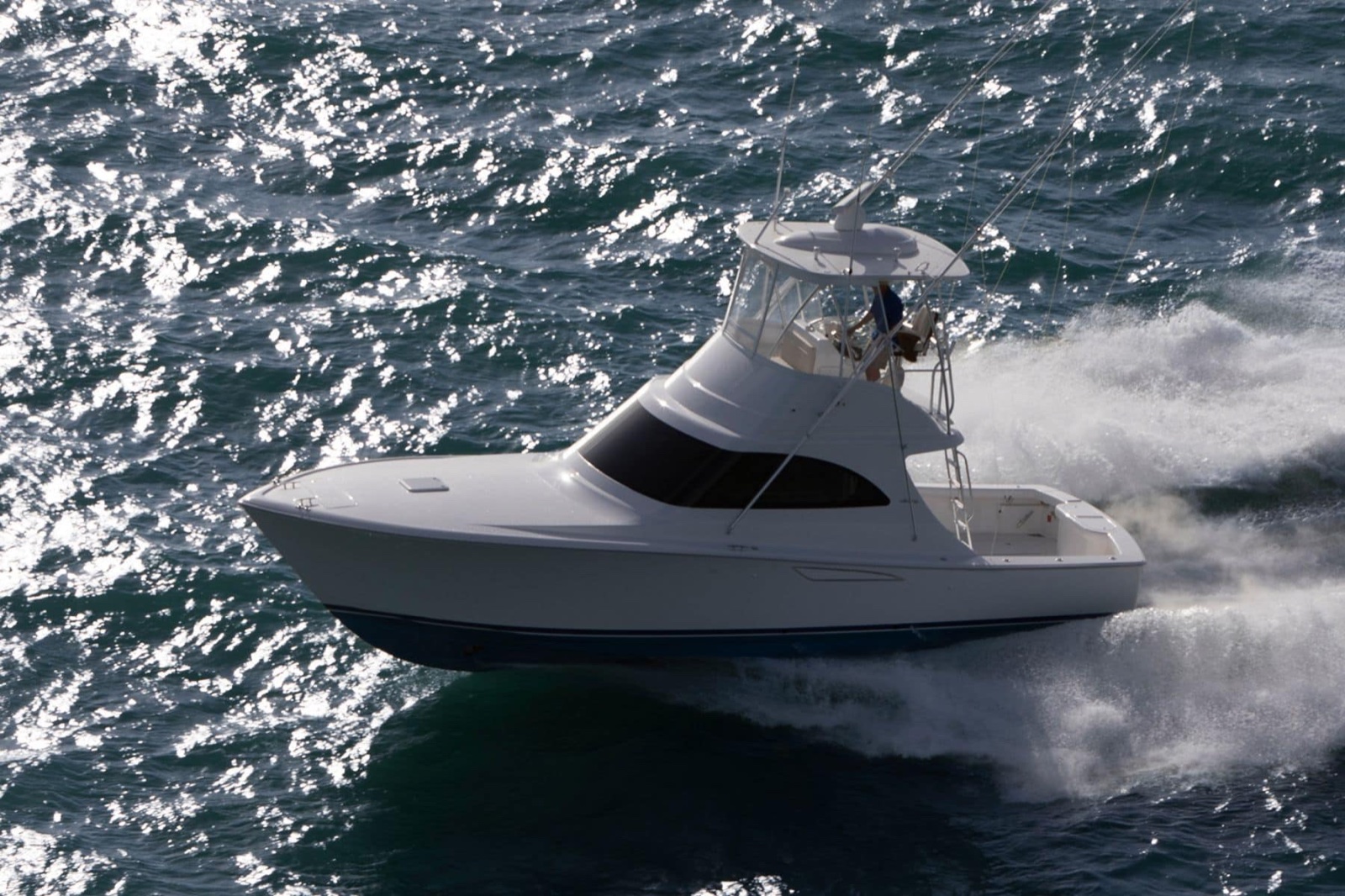
The Viking 52 Convertible is the boat tournament teams point at when they want a 50-foot sportfisher built to fish and hold its price. Viking Yacht Company has been building convertibles in New Gretna, New Jersey since 1964, and the 52 sits in the middle of a lineup that runs from the 38 up to the 90. The 52 is at the top of our 2026 tournament-sportfisher guide because the build, the engine options, and the dealer network all add up to a boat that pays back the entry cost over a long hold.
What is the Viking 52 Convertible?
The 52 Convertible is a 53-foot 4-inch resin-infused fiberglass sportfisher. Beam is 16 feet 8 inches. Draft is 4 feet 11 inches. Dry weight is roughly 63,000 pounds. Fuel capacity is 1,500 gallons, water is 200 gallons. Two engine options. The MAN i6-800 twin diesel build is the standard package and gives a 30-knot cruise and a 36-knot top end. The MAN V8-1000 upgrade pushes top speed past 40 knots and is the choice for teams that want every knot on a long run to a canyon. Both are inboard configurations on shafts, with the gear and shaft alignment Viking has been refining since the 1970s.
The hull construction is what owners pay for. Resin-infused vacuum-bagged fiberglass, balsa-cored hullsides for stiffness and sound deadening, solid hand-laid laminate below the waterline for impact resistance, and a Northern Lights generator standard. The mezzanine in the cockpit is the layout signature. It sits aft of the salon door at the right height for a crew to watch a spread and step down to the cockpit fast when a fish hits. The transom livewell, the rocket launcher, the in-deck fishboxes, and the rod stowage are all part of the standard build.
Below decks the layout works for tournament crew. Forward stateroom with an island queen, two guest staterooms, two heads, a galley up off the salon, and a salon that doubles as the eating and electronics space. There are nicer cabin layouts at 53 feet. There are not many that fit four crew aboard for a five-day canyon run and then let them fish hard for those five days.
Who is it good for?
Tournament teams running marlin, tuna, and wahoo circuits are the core buyer. The 52 is the right boat for an owner who keeps a slip in Oregon Inlet, Stuart, or Cabo and puts 75 to 150 hours a season on the engines chasing leaderboard money. The cockpit is built for fish fighting, the flybridge is built for spotting and running, and the construction holds up to the hours.
Owners stepping up from a 42 or a 46 sportfisher are the second profile. You get the cockpit volume, the fuel range, and the second guest stateroom that a smaller convertible doesn't have, while keeping the build quality and the dealer relationship you already know. The third profile is the long-range cruising owner who fishes hard a third of the year and cruises a third of it. The 52 covers both briefs without compromising on either, which is rare at this length.
I spent a morning aboard a 2022 hull at the Lauderdale Boat Show two seasons ago, walking the cockpit with a service writer who had been at the New Gretna yard for fifteen years. He pointed at the mezzanine hinges, the deck non-skid, the chase pipe routing, and the gear oil sight glass without looking. That kind of institutional memory in the dealer network is part of what you pay for.
Who is it not good for?
Weekending families who want a cabin-first boat should not buy the 52. The cabin works for tournament crew, not for a household of six on a long weekend. A Princess 55 or a Sunseeker 55 covers that brief better at a similar price point.
Anyone who can't carry $250,000 a year in operating costs as a baseline should walk past too. Fuel, slip, insurance, service, and capital cost on a $2.5 million asset add up fast, and the boat doesn't reward part-time use. Convertibles want hours. They develop problems sitting at the dock that don't show up on a boat that runs.
The third exclusion is the buyer shopping for resale value alone. The 52 holds its price, but the entry cost is high enough that the absolute depreciation in dollars over five years is still six figures. If preserving capital is the brief, a different vehicle is the better tool.
Pricing
New 2026 pricing on the 52 Convertible runs roughly $2.65 million to $3.2 million depending on engine choice, tower spec, electronics package, and option lines. The base i6-800 build with a fiberglass tower and standard Garmin electronics lands near the lower end. The V8-1000 build with a full tuna tower, dual Furuno radars, a Seakeeper 9, and full teak interior pushes past $3.2 million. Allow another $150,000 to $300,000 for custom paint, tower extras, and rod stowage upgrades on a build-to-order hull.
The used market for the current generation spans roughly $1.65 million at the lower end (early 2018 hulls with high hours and base engines) to $2.75 million at the upper end (2022-2023 hulls with V8-1000s and full towers). The sweet spot for a buyer in 2026 is a 2020-2022 hull with the V8-1000 upgrade and 800 to 1,500 hours, which lands in the $2.0 to $2.5 million band. Five-year depreciation on a clean current-generation 52 sits below 25 percent, which is segment-leading at this length.
What works
- Resin-infused hull with balsa-cored hullsides and solid laminate below the waterline. The construction holds up to ocean hours.
- Twin MAN i6-800 or V8-1000 diesels give a 30-knot cruise and a 36 to 42-knot top end depending on engine choice. The V8 build is the tournament spec.
- 1,500-gallon fuel tank works the canyon runs without a reserve worry.
- Cockpit layout is built around fighting fish. Mezzanine, transom livewell, rocket launcher, rod stowage, and in-deck fishboxes are all standard.
- Viking's New Gretna and Florida service yards know the boats line by line. The institutional memory in the dealer network is rare in any segment.
- Holds its price better than any direct competitor at 50 to 55 feet.
- Three-stateroom, two-head layout works for tournament crew on a multi-day trip.
What doesn't
- Entry cost is high enough that small-business owners and family-office buyers are the realistic profile, not weekending households.
- Fuel burn at cruise is roughly 80 gallons per hour. A 100-hour season is $60,000 in fuel alone at current prices.
- Service costs (gear oil, injectors, generator, sea strainers, tower maintenance, paint) add $25,000 to $40,000 a year on top of fuel.
- Cabin layout is built for crew, not for family. Anyone who wants a master suite plus a guest cabin plus a kid cabin should look at a Princess or a Sunseeker instead.
- Dealer network is Atlantic-and-Gulf heavy. Pacific and overseas owners are paying freight on warranty parts.
- Build-to-order lead times run 18 to 30 months. New buyers wait.
Year-by-year notes
The current generation 52 Convertible launched for 2018 on the resin-infused hull that carries through to the 2026 catalog. The 2020 model year added the V8-1000 engine option alongside the continuing i6-800 build. The 2021 model upgraded the standard electronics package to Garmin and added the Seakeeper 9 as a near-standard option. The 2023 model refreshed the salon layout and the helm seating on the flybridge. There is no defect cutover year to screen for, but the V8-1000 build is the configuration most current buyers prefer, and it commands the higher used-market price by roughly 8 to 12 percent over the i6 build at the same hours.
Cost of ownership
Annual recurring costs on a 52 Convertible used 100 hours a season are real money. Fuel at 80 gallons per hour cruise burns 8,000 gallons a year, which at $5 to $6 per gallon dockside is $40,000 to $48,000 a year. Slip rental at a Stuart or Outer Banks marina at $25 a foot per month is roughly $16,000 a year. Bottom paint and waxing on a 53-foot hull is $8,000 to $12,000 a year. Engine service on the MAN diesels at the manufacturer's interval is $4,500 to $7,500 per engine per year depending on hours. Tower maintenance, generator service, sea strainer cleaning, and underwater gear inspection adds another $8,000 to $12,000. Insurance on a $2.2 million hull value is $25,000 to $40,000 a year in Atlantic and Gulf coastal markets.
A five-year hold on a 2021 used 52 Convertible bought at $2.3 million with 600 hours, used 100 hours a season out of Stuart with a covered slip and full service file, lands at roughly $250,000 to $310,000 a year all-in including insurance, fuel, service, slip, and amortized capital cost. The amortized cost is lower than it looks on paper because the resale price at year five sits within 15 percent of what you paid.
Best year and trim to buy
The 2020-2023 Viking 52 Convertible with the MAN V8-1000 engines, a full fiberglass tower, dual Garmin or Furuno electronics, and a Seakeeper 9 is the right buy in 2026 for tournament owners. Hours between 600 and 1,500 are the sweet spot. Anything below 400 hours on a five-year-old boat is suspicious and wants a hard look at why the boat hasn't run. Anything past 2,500 hours wants a major service inspection.
Verify six items pre-purchase. First, the engine logs show current injector and gear oil service on schedule. Second, the cockpit deck and mezzanine show no soft spots on a sounding-mallet check. Third, the tower welds and rocket launcher hardware show no stress cracks. Fourth, the generator has run regularly and is current on impeller and oil service. Fifth, the Seakeeper service is up to date if fitted. Sixth, the dealer relationship transfers cleanly. Viking's service network is half of what you pay the premium for, and an owner who has been outside the network for years can't hand that relationship over.
Alternatives
The closest dual-purpose cross-shop is the Tiara 43 LE, which trades the tournament cockpit for a more family-friendly weekending layout at a smaller length. For tender-and-chase work behind the 52, a lot of Viking owners spec a Regulator 23 for nearshore days and chase duty, which keeps the build philosophy consistent across the two boats.