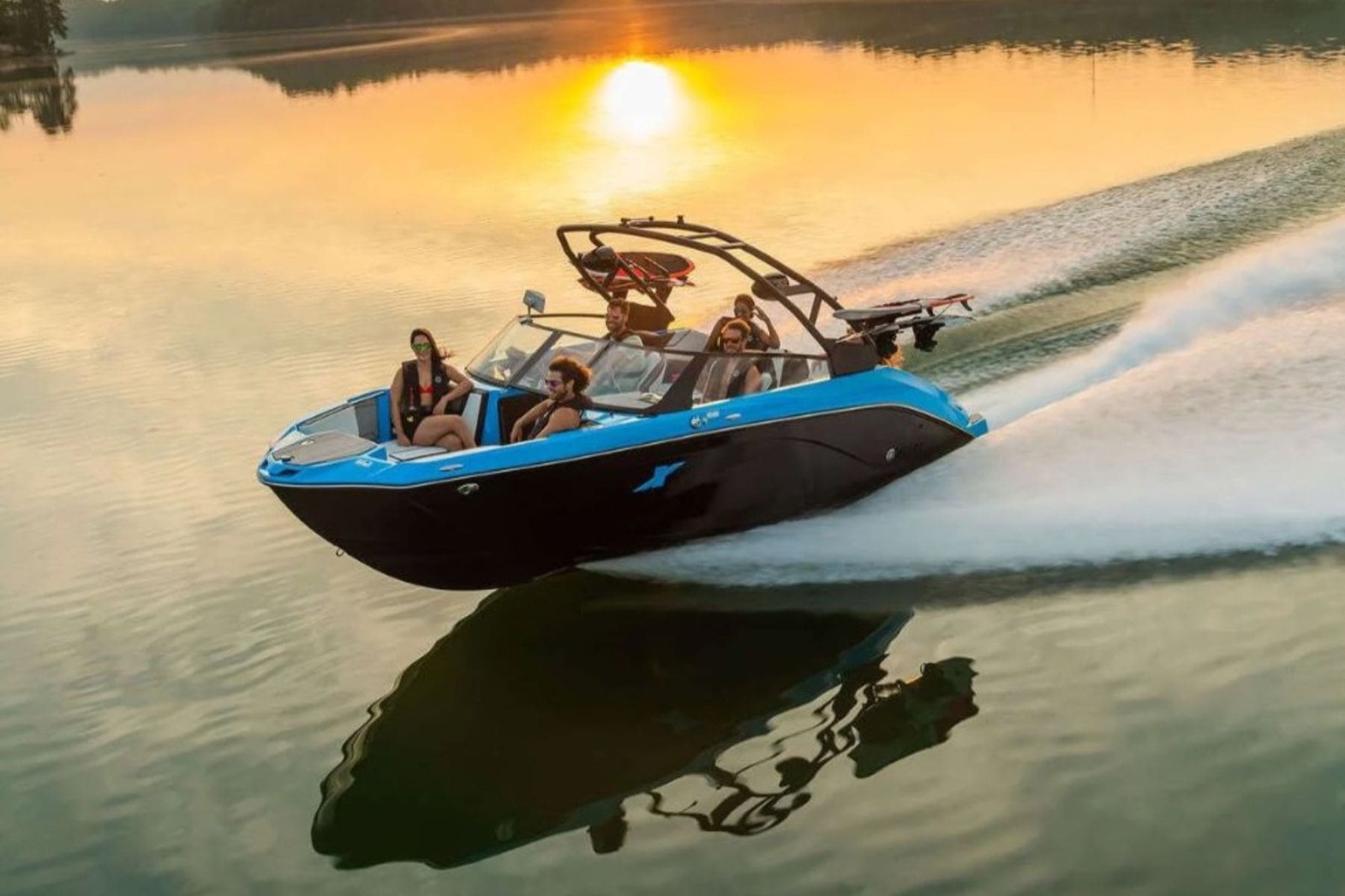
The Yamaha 222XD sidesteps the inboard-versus-outboard debate at 22 feet by running twin Yamaha 1.9L HO waterjets and adding the SurfPointe wake-surf system as a parallel sport-mode answer. Yamaha has been building waterjet sport boats since 1998, longer than any other modern volume manufacturer in the segment, and the 222XD launched for the 2023 model year as the top-of-line wake-series 22-footer. The boat has held the rank-one position in our 2026 bowriders-under-$40k-used guide because the drivetrain, the surf-system spec, and the price position all line up against the segment.
What is the Yamaha 222XD?
The 222XD is a 22-foot fiberglass bowrider with an 8-foot 6-inch beam, 4,118 pounds dry, a 70-gallon fuel tank, and a 10-person capacity rating. The drivetrain is what stands out. Twin Yamaha 1.9L HO four-cylinder four-stroke marine engines (the high-output evolution of the older 1.8L HO platform) drive twin waterjets to a 360-horsepower combined output. There is no propellor, no sterndrive, no outdrive bellows. The waterjet spins an impeller inside a duct and accelerates water out the back. Draft sits under two feet at rest, which puts the boat into shallow-water territory that a sterndrive simply cannot enter.
The SurfPointe wake-surf system is the second standout. The system pairs a custom hull design tuned for surf-wave production with internal ballast tanks and electric WakeBoosters that shape the wave on each side. The Connext touchscreen at the helm controls the surf system, the audio, the depth finder, and the Garmin chartplotter integration. Yamaha's DRiVE low-speed-handling system gives the boat a docking and station-keeping spec that nothing in the broader jet-boat segment matches. The seat plan fits 10 persons by the rating, with a U-shaped stern lounge, a fold-down sun pad, forward bow seating with a portable cooler underneath, and a head compartment under the console sized for portable use.
Who is it good for?
Lake families running mixed-use days are the core buyer. Households whose typical day mixes cruising, swimming, tubing, and an hour or two of wakesurf time on the same outing fit the 222XD well. The twin-jet drivetrain handles shallow launches, beach approaches without a bow ladder, and the kind of accidental rock or sandbar contact that ruins a sterndrive prop without complaint. The SurfPointe surf system gives the boat a real wakesurf wave at a price point that opens the segment to households who would otherwise be cross-shopping older non-surf bowriders.
Watersports households who tow more than they cruise are the second profile. The boat plays competently as a tow-sports platform across tubing, wakeboarding, slalom, and surf, even though the surf wave does not match a dedicated Malibu 22 LSV or Axis A22 on customization. Owners with mixed-water itineraries who care more about prop-free shallow access than tournament-grade wave shape are the right fit. We watched a Lake of the Ozarks dealer rig three 222XDs in a single delivery week last May, all going to families who had been running older Yamaha jet bowriders and wanted the surf system without the wakeboat price tag.
Buyers in shallow-water lakes where a sterndrive prop is a recurring repair line fit the third profile. Owners running reservoirs with stump fields, rocky shorelines, or shallow launches see the value math return as years of avoided lower-unit work.
Who is it not good for?
Saltwater coastal cruisers are the wrong buyer. Jet impellers in salt are a real maintenance commitment. Salt scaling on the impeller and inside the duct is a recurring service line, and the warranty and service network do not lean toward saltwater use. Households running coastal use cases should buy a sterndrive or an outboard.
Owners running 40-plus mph regularly should also walk past the 222XD. The twin-jet vibration and noise above 45 mph is louder than a single sterndrive at the same speed, and the boat is at its best at the 29-mph optimum-cruise number rather than at wide-open throttle. Buyers who plan to run flat-water blasts as their primary use case should look at a Cobalt or a Cobalt-class sterndrive instead.
Buyers who prioritize the tournament-grade surf wave over price fit the third exclusion. The SurfPointe wave has a sweet spot and works for intermediate riders, but the wave produces less push than a Malibu 22 LSV or an Axis A22, and beginners can find the rope-let-go transition harder. The Connext touchscreen surf interface is less intuitive than dedicated-wakeboat controls, with a wave that is on-or-off rather than fully customizable.
Pricing
New 2026 222XD pricing is roughly $69,700 to $104,000 depending on trim, electronics package, and dealer location, with the average dealer-floor build sitting near $94,999. The starting price for a base build with the standard tech package lands around $85,000. The boat is positioned as the higher-end 22-footer in the Yamaha wake series, with the 222XE and other wake-series models running below at lower price points.
Used-market inventory is thin because the 222XD launched for the 2023 model year and fewer than 20 listings appear on most national searches in 2026. Used 2023-2024 hulls in the 50-to-200-hour range track $65,000 to $88,000 in the current market. The under-$40k used pricing target in the rank-one guide referenced is for the broader 22-foot Yamaha jet-bowrider lineage (older 222 series and predecessors) rather than the 222XD specifically. Buyers shopping the 222XD as the model in this review should expect to spend $65,000-plus for a clean used hull.
Five-year depreciation on Yamaha jet boats is 30 to 35 percent off new MSRP for clean hulls, similar to Sea Ray and better than Bayliner across the segment. The structural reason to buy near-new is the small used-market supply, which keeps prices firm even three years post-launch.
What works
- Twin Yamaha 1.9L HO four-stroke waterjet drivetrain (360 horsepower combined). No propellor to ding on a shallow launch and no outdrive bellows to service.
- SurfPointe wake-surf system with custom hull design, internal ballast tanks, and electric WakeBoosters. Real surf-wave production at a price below dedicated-wakeboat segment.
- 0-to-cruise in 6.3 seconds, top end to 50 mph on current builds, and the boat plays athletically across the operating range.
- Optimum cruise at 29 mph holds 2.1 miles per gallon combined. Honest economy for a twin-engine layout.
- Yamaha DRiVE low-speed-handling system standard. The boat docks and station-keeps better than any sterndrive at the price.
- 10-person capacity rating. The wide cockpit fits a real family-day-plus-tow-sports profile in one boat.
- Connext touchscreen with Garmin chartplotter integration, JL Audio standard. The helm electronics package feels modern.
- Draft under 2 feet. Beach-friendly and forgiving on shallow approaches.
What doesn't
- Connext surf interface is less intuitive than dedicated wakeboat controls. The surf wave is on-or-off rather than fully customizable.
- SurfPointe wave has a sweet spot but produces less push than a Malibu 22 LSV or Axis A22. Beginners can find the rope-let-go transition harder.
- Top-end vibration and noise above 45 mph is louder than a single sterndrive at the same speed. Owners running flat-water blasts notice it.
- Build tier is mid-segment, not top. Fit-and-finish issues (vinyl seam quality, hardware fit, occasional rattles) have been flagged on a small share of new hulls. Most are dealer-handled.
- Service network for waterjet drives is thinner than Mercury sterndrive dealer coverage. Owners outside a Yamaha-experienced dealer footprint should screen the local dealer relationship.
- Used-market inventory is thin and prices remain firm. Buyers expecting deep used-market discounts will be disappointed.
Year-by-year notes
The 222XD launched for the 2023 model year as the top-of-line wake-series 22-footer in Yamaha's lineup. Launch boats carried twin Yamaha 1.8L HO waterjets, with later production stepping up to the twin 1.9L HO four-cylinder four-stroke high-output engines for the 360-horsepower combined output that current builds carry. The SurfPointe surf system has been part of the standard build across the production run. The Connext touchscreen with Garmin chartplotter integration has also been standard from launch. The 2024 and 2025 model years added refinements to the surf-system tuning and the audio package without changing the hull architecture or the drivetrain. The 2026 boats carry the same architecture as the 2024-2025 hulls. There is no defect cutover year for buyers to screen on, but the on-or-off Connext surf interface issue applies across the full production run.
Cost of ownership
Annual recurring costs are lower than a sterndrive at the same length because of the simpler waterjet drivetrain. Yamaha 1.9L HO waterjet service follows a 100-hour interval, with a service kit costing $200 to $350 in parts and $200 to $350 in dealer labor per engine. Impeller inspection at 100 hours is part of the standard service, with replacement at the 300-to-500-hour mark or sooner if rope, line, or weed contact has nicked the impeller. A waterjet impeller replacement is roughly $1,400 to $1,800 per side at a Yamaha-experienced dealer.
Bottom paint is rarely needed on a trailer-stored freshwater boat. Coastal trailer-stored hulls budget $300 to $500 in materials annually for a basic ablative job. Insurance on an $80,000 hull value is $900 to $1,600 a year in inland-lake markets. Slip rental and storage drive the larger variable.
A five-year hold on a 2024 used 222XD bought at $78,000 with 80 hours, run at 60 hours a season with trailer storage, lands at roughly $7,500 to $11,000 a year all-in.
Best year and trim to buy
The 2024-onward 222XD with the twin 1.9L HO waterjet drivetrain (360 horsepower combined), the SurfPointe surf system, the Connext touchscreen with Garmin chartplotter integration, and the Yamaha DRiVE low-speed-handling system is the right buy in 2026. The 2023 launch hulls with the older 1.8L HO drivetrain are also a reasonable buy at a modest discount, but the 1.9L HO step gives a small but real ceiling on top-end and acceleration that buyers planning long ownership should target.
Verify four things pre-purchase. First, the impeller condition is clean on inspection (rope and weed scoring is the most common issue; dealer-experienced inspection is the practical workaround). Second, the maintenance file shows current 100-hour Yamaha service work. Third, the Connext touchscreen and the SurfPointe controls function correctly under power, with the WakeBoosters moving cleanly and the ballast pumps cycling without faulting. Fourth, the fit-and-finish baseline shows no obvious vinyl-seam gapping or hardware-fit issues that signal a problem hull. A clean 2024 222XD with the SurfPointe system, current Connext firmware, and 80 to 150 hours should land between $74,000 and $86,000 at a Yamaha-experienced dealer with the maintenance file in order.
Alternatives
The budget cross-shop on the same length is the Bayliner VR6, which trades the twin-jet drivetrain and the SurfPointe surf system for a sterndrive build at materially less money. For buyers willing to step up to a dedicated wakeboat, the Axis A22 trades the jet maneuverability and the price advantage for tournament-grade surf-wave production with full customization. The top-build sterndrive cross-shop is the Cobalt R6, which trades the jet system and the surf platform for materials and hardware that step up the build tier on what is otherwise a similar mixed-use bowrider brief.