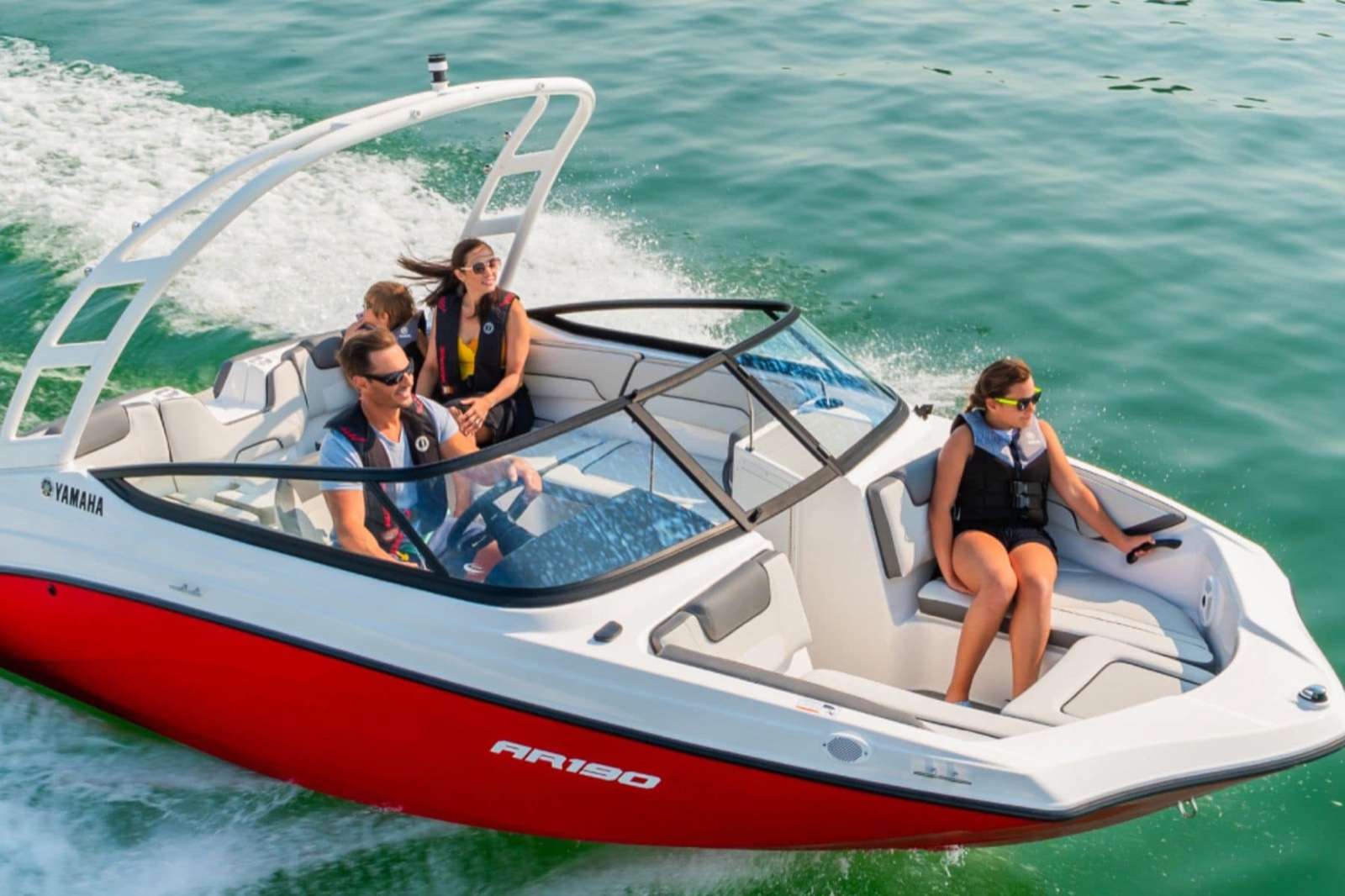
The Yamaha 242 Limited S is the flagship 24-foot jet bowrider Yamaha built between 2015 and 2023, and the boat most cross-shoppers landed on after looking at the smaller AR240 and the bigger 252SD. It's a twin-engine jet bowrider with a wide bow, a huge swim platform, and a price point that sat below most sterndrive competitors when new. Production wrapped after the 2023 model year, so the used market is where the action is now.
What is the Yamaha 242 Limited S?
The 242 Limited S is a 24-foot 1-inch fiberglass bowrider with an 8-foot 6-inch beam and a dry weight of 4,750 pounds. The drivetrain is twin 1.8-liter Yamaha four-stroke jet engines mounted in the engine compartment under the rear sun pad. No outdrive sticks out the back. No propeller hangs in the water. The intake grates are flush in the bottom of the hull, and the thrust comes out a pair of steerable jet nozzles at the transom.
The layout is what owners pay for. The bow seating area is wider than any sterndrive bowrider at the same length because there's no engine block taking up midship volume. Two adults fit comfortably in each bow lounger with room to actually stretch out, not perch sideways. The cockpit fits ten people for a day cruise. The captain's chair faces a helm with a Connext touchscreen from 2018 onward that handles navigation, music, drive mode, and the cruise-assist system in one screen. Behind the back-to-back lounge is a sun pad over the engine compartment. The swim platform extends past the transom and sits inches off the water, so kids and guests step on and off without climbing.
Standard equipment from 2019 onward includes Bluetooth audio, the articulating keel, dual-battery system, freshwater shower at the swim platform, and bimini top. Optional packages added the tower with board racks, premium audio, and a cockpit refrigerator. The Limited S trim sits at the top of the 242 lineup, so most used examples are loaded.
I ran a 2020 242 Limited S on Lake Travis one June afternoon in light chop and 95-degree heat. The hull handled boat wakes fine at cruise, the AC water spilling off the swim platform stayed cold for swimmers, and the boat backed into a sandy cove without anyone watching for rocks because there's no drive to worry about. That's the use case the 242 was built for, and it does it as well as anything in the segment.
Who is it good for?
Families who run 30 to 80 hours a season on lakes and rivers are the core buyer. The 242 tows skiers, pulls a tube, fits a wakeboard tower if you spec it, hauls ten people for a Sunday cruise, and beaches in shallow water without anyone worrying about hitting bottom. If your boating life is reservoir-and-river focused, the jet drivetrain pays for itself in peace of mind on the rocks.
Trailering owners are the second profile. The 242 sits behind a half-ton truck on a dual-axle trailer with no permits and no special routing. Storage at home in a garage or driveway saves the slip fee, and the boat winterizes in an afternoon without dealer involvement once you know the routine.
Owners trading up from a 20-foot bowrider are the third. The cockpit jump from 20 to 24 feet on a bowrider is significant, and the 242 in particular adds bow width and a swim platform that smaller boats can't match. People moving up from a Chaparral 19 H2O Sport or a Four Winns H190 describe the same thing: more space, more guest capacity, same trailerable footprint.
Who is it not good for?
Long-range cruisers should walk past. Twin 1.8-liter jets burn more fuel at a 30 mph cruise than a single sterndrive at the same speed, and the 75-gallon fuel tank gives a useful range of about 90 to 110 miles depending on load. If your idea of a Saturday is a 60-mile run out and back on Lake Michigan, the math gets unfriendly fast.
Quiet-helm buyers are the second exclusion. Yamaha jet engines run at higher rpm than a four-stroke outboard or a 6.2-liter sterndrive at the same boat speed. The helm is fine at idle and at planing speeds up to 25 mph, but past 35 the engine note becomes part of the experience. Some owners love it. Some find it tiring on long runs.
Saltwater coastal buyers are the third profile to think twice. The 242 handles salt fine when it's flushed and maintained, but jet pumps need attention after every saltwater day, and the intake screens grab grass and shell debris in bay water. A protected-water buyer treats this as routine. A buyer who wants to splash and forget should look at a coastal bay boat instead.
Pricing
New 242 Limited S boats sold in the $78,000 to $92,000 range across the final production years depending on options and dealer market. The used market in 2026 spans roughly $32,000 at the bottom (early 2015-2016 hulls with high hours and deferred service) up to $72,000 at the top (clean 2022 hulls with low hours and full options). The sweet spot is the 2019-2022 hull with the Connext helm and the articulating keel, in the $48,000 to $65,000 range with 150 to 350 hours.
Depreciation slowed after Yamaha announced the sport-boat program was ending. Supply is finite, demand for clean examples is steady, and brokers move good 242s in 30 to 60 days at fair money. Five-year depreciation on a clean 2020 sits around 25 to 30 percent, which is competitive with the sterndrive segment despite the twin-engine setup.
What works
- Twin 1.8-liter Yamaha jets give you a boat you can run in two feet of water and beach without thinking about it.
- The bow is genuinely wider than competitor sterndrives at the same length. Two adults per side, room to stretch out.
- The swim platform extends past the transom and sits inches off the water. Kids and guests get on and off without help.
- Connext touchscreen from 2018 handles everything in one place. The interface dates well.
- Articulating keel from 2018 fixes the low-speed steering complaint earlier jets had.
- Trailerable behind a half-ton truck, garage-storable, owner-winterizable.
- Production ending in 2023 puts a soft floor under used-market prices.
What doesn't
- Fuel burn at cruise is higher than a single-sterndrive boat of the same length.
- Helm noise above 35 mph is louder than an outboard or a quiet sterndrive.
- Pump intakes grab weeds and shells. You will use the cleanout ports.
- Long-term parts support is fine now but worth watching as the boat ages past 2030.
- Bow filler cushion and table assembly are bulkier to stow than some competitors.
- Twin-engine winterization is two engines of work, not one.
Year-by-year notes
The 242 Limited S launched for 2015 on the second-generation 24-foot Yamaha sport-boat hull. The 2016 model year refined the helm graphics. 2017 added the Connext infotainment system as standard. 2018 brought the articulating keel, which fixed the low-speed-steering complaint that came up on earlier model years and is the single biggest reason to skip a 2015-2017 boat if you can find a 2018 or newer at similar money. 2019 updated the upholstery and added more standard features in the Limited S package. The 2020-2022 boats are the most refined production years with the cleanest layout, best electronics, and the keel-fix in place. The 2023 model was the final year of production before Yamaha exited the sport-boat segment.
Cost of ownership
Annual costs on the 242 are lower than a comparable sterndrive because there's no outdrive to service. Yamaha jet engines follow a 100-hour service interval. Plug, oil, and filter work runs $150 to $250 in parts per engine, plus labor if you don't do it yourself. The impeller in each pump should come out for inspection every two seasons or 200 hours, whichever first, and replacement is roughly $200 to $400 per pump including the wear ring.
Insurance on a $55,000 used hull is $700 to $1,200 a year in inland-lake markets. Trailer storage at home is free, marina dry-stack at a coastal market runs $1,800 to $3,600 a season. A typical inland-lake owner running 60 hours a season at 8 to 10 gallons per hour spends $1,200 to $1,800 on fuel. Total all-in for a 2020 hull bought at $58,000 with trailer storage and self-service maintenance lands around $3,800 to $5,500 a year before fuel, plus fuel.
Best year and trim to buy
The 2019-2022 242 Limited S with the Connext helm, the articulating keel, the swim platform extension, and 150 to 350 hours is the right buy in 2026. The 2020 and 2021 hulls in particular show up regularly in the $52,000 to $62,000 band and carry the cleanest spec package.
Verify five things before you sign. First, both engines start clean and run without alarms through a full sea-trial cycle. Second, the impeller inspection is current and there's no scoring in the pump tunnels. Third, the cleanout ports work and don't show grass-jam damage. Fourth, the Connext screen wakes correctly and the touch responds across the panel. Fifth, the trailer brakes, bearings, and lights all work, because a 242 trailer that's been neglected is a $2,500 surprise.
Alternatives
Step up in size and you're looking at the Yamaha 252SD, which gives you another two feet of cockpit and a deeper bow with the same jet drivetrain. The Yamaha AR250 is the watersports-first sibling with the tower and the audio package as the priority. For a sterndrive cross-shop at lower entry price, the Chaparral 19 H2O Sport covers a smaller version of the same family-bowrider brief on a propeller-driven hull.