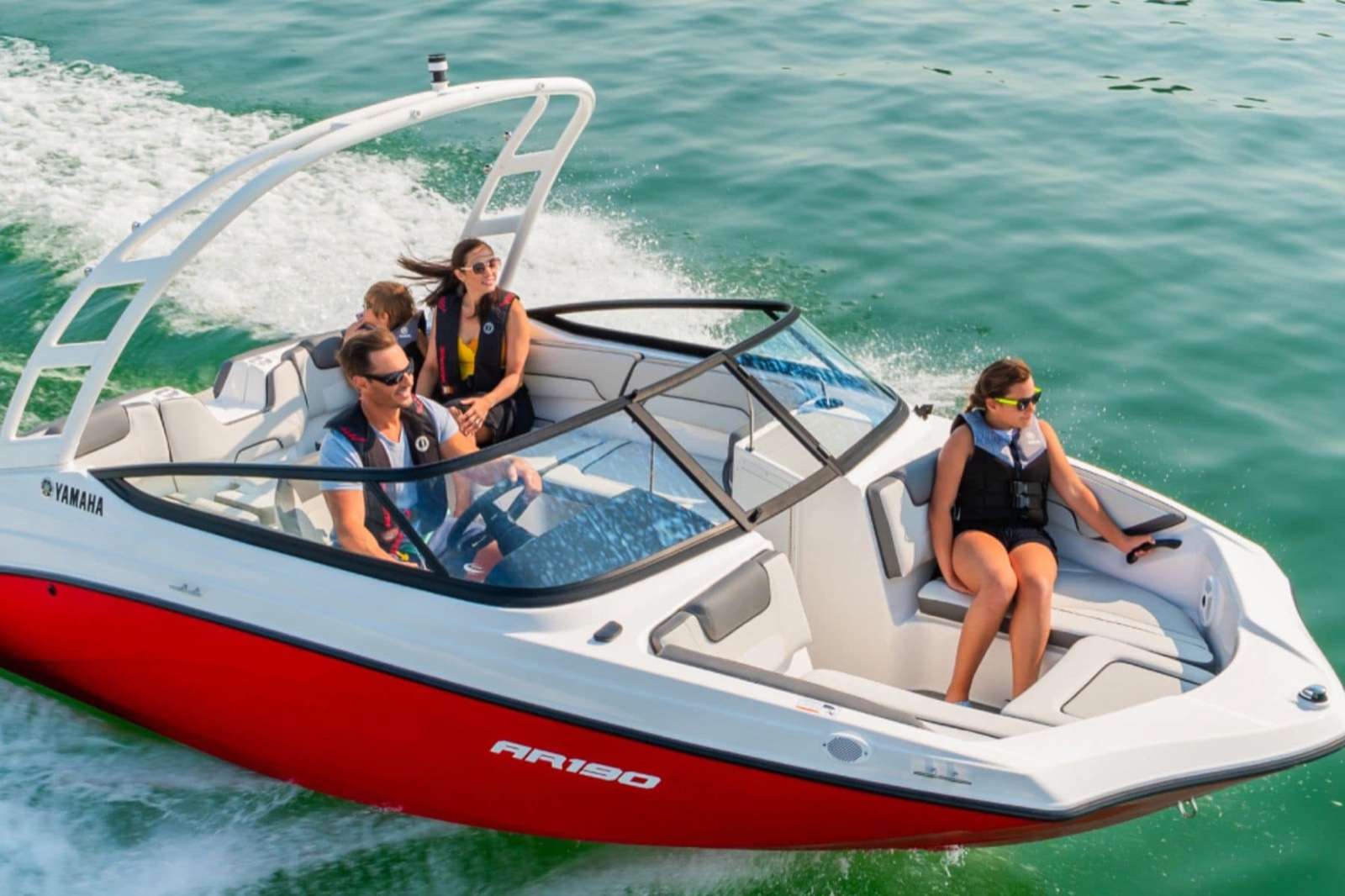
What is the Yamaha 252SD?
The Yamaha 252SD is a 24-foot 7-inch deck boat with a twin-jet drivetrain, an 8-foot 6-inch beam, and a 12-passenger rated capacity. The SD designation marks it as the deck-boat (sport-deck) variant in the Yamaha 25-foot family, sitting alongside the AR (high-performance) and SE (entry-deck) trims. Power is twin Yamaha 1.8L SVHO HO jets totaling roughly 360 hp combined, with the standard cooling, drive, and steering hardware all sourced from the Yamaha WaveRunner platform.
The DRiVE X control system is the line that defines the helm experience. It combines forward, reverse, and side-thrust control at a single-lever helm, and the close-quarters handling is genuinely easy for first-time twin-engine drivers. The Connext touchscreen at the helm integrates surf-system control, audio, navigation, and engine telemetry under one display. JL Audio is the standard audio package, with an upgrade available.
Standard equipment from 2021 forward includes the Connext touchscreen, JL Audio, the snap-in carpet, the swim platform with a telescoping ladder, the freshwater shower, and the bimini top. The surf system, the tower upgrade, the dual-axle trailer, the upgraded JL Audio package, and the depth-finder upgrade sit on the option list across most model years.
Who is it good for?
The right buyer is the lake family running 50 to 150 hours a season on freshwater inland and Great Lakes water. The boat is happy on Lake of the Ozarks, the Tennessee Valley reservoirs, the upper Great Lakes inside a reasonable forecast, and the Texas inland reservoirs. The 12-passenger capacity, the U-stern lounge with stern-facing swim seats, and the fast hole-shot make the 252SD a real watersports platform. We spent a Saturday on Lake Travis last June with a 2023 252SD pulling four kids on a tube in long rotations, and the boat planed cleanly between every pull without bogging through the turn.
Cross-shoppers from sterndrive deck boats who want jet-drive maintenance simplicity are the second core profile. The 252SD trades the sterndrive's prop-and-bellows service line for a jet-pump-and-impeller service line, and many owners find the jet-drive cost line lower across an 8 to 10 year ownership window.
Shallow-water families where prop strikes are a recurring repair line are the third profile. The jet drive has no prop to bend, no skeg to break, and the impeller sits in a recessed pump housing that is much harder to damage on rocks, gravel bars, and sandy bottoms.
Who is it not good for?
Saltwater coastal owners running heavy hours should weigh the trade carefully. Jet pumps in saltwater need a religious freshwater flush after every use, and the impeller and pump-housing service intervals are shorter in salt. Florida intracoastal, Pacific Coast, and Gulf coastal use is possible but not the design center.
Top-speed-priority buyers who want 50-plus mph capability should look elsewhere. The 252SD posts a 43.8 mph top in standard test conditions and 49 mph at WOT in light chop on certain test days. That is a step down from the previous 240 series, which posted 50.3 mph routinely. Buyers chasing top end should specify the 255 series or the AR variant.
Families without a strong Yamaha boat dealer in driving distance should think hard. The Yamaha jet-pump and impeller service is more specialized than a typical sterndrive Yamaha-outboard service, and the dealer footprint is thinner than the broader Yamaha-outboard network.
Pricing
A 2026 252SD with a base option list is roughly $98,000 to $115,000 dealer-discounted. The surf-system upgrade, the tower with bimini, the dual-axle trailer, the upgraded JL Audio, and the loaded electronics package pushes the build to $125,000 to $135,000.
Used pricing has held up well. A 2021 hull with under 200 hours is $69,000 to $85,000 depending on option load and condition. A 2022 to 2023 hull with the Connext upgrade and lower hours sits in the $88,000 to $108,000 band. A 2024 hull with the loaded option list and a clean service log clears $108,000 and sometimes $120,000. Across the recent listing average the used market sat near $114,000.
The value buy is a 2022 to 2023 hull with the Connext touch screen, the JL Audio premium upgrade, the surf-system, the DRiVE X control system, the tower with bimini, and a documented annual Yamaha service log. Asking prices in the $85,000 to $105,000 band match the use case for most lake-family households.
What works
- Twin Yamaha 1.8L SVHO jets eliminate the propeller-strike repair line entirely. No skeg to break, no prop to ding.
- Plane in roughly 2 seconds, 5.5 seconds to 20 mph. Hole-shot is fast enough for serious tow-sports use, including pulling tubes and wakeboarders out cleanly.
- DRiVE X control system gives forward, reverse, and side-thrust at the helm. Close-quarters handling around the dock and the gas pump is genuinely easy for first-time twin-engine drivers.
- Cockpit volume per foot is segment-leading. 12 passengers fit across forward seating, the U-stern lounge, the stern-facing swim seats, and the helm-side companion seats.
- Connext touchscreen integrates surf-system control, audio, navigation, and engine telemetry. The helm experience is segment-cleanest.
What doesn't
- Connext screen reboots and motherboard issues on a slice of 2021 to 2023 hulls. What comes up across owner accounts is loose solder joints, micro-cracks in the screen motherboard, and intermittent power-off events. Replacement is a warranty job on younger boats and a $1,500 to $3,000 line out of warranty.
- Loose-ground connections in the engine bay have caused intermittent "Stop Stbd Engine. Consult YAMAHA Dealer" fault codes on a documented slice of hulls. The fix is a careful ground-connection inspection and re-torque.
- Top speed of 43.8 mph in standard test conditions is roughly 15 percent below the previous 240 series, which posted 50.3 mph. Buyers expecting top-end speed will be disappointed.
- Jet impellers eat ropes, lake weeds, and sandy bottom debris. Owners learn to clear them with a hooked tool through the inspection port. Not a defect, but a known characteristic.
- Vinyl interior on early 2021 to 2022 hulls stains and dents more easily than the segment median. Late 2022 and 2023 hulls have the updated vinyl spec.
Year-by-year notes
2021 is the launch year for the 252SD platform. Early hulls have the most documented Connext reboot issues and the original vinyl spec that owner accounts flagged for staining and denting.
2022 added refined Connext firmware, an updated vinyl spec on later production hulls, and minor cockpit storage layout updates.
2023 hulls have the most refined trim with updated DRiVE X firmware, the JL Audio premium upgrade as a more-common factory order, and improved Connext screen mount hardware.
2024 to 2026 hulls add the refreshed cockpit color palette, an updated tower frame, a slightly redesigned swim platform, and incremental Connext firmware refinements that address some of the screen-reboot fault codes documented on earlier hulls.
Cost of ownership
Twin-jet operation has a different cost profile than a comparable sterndrive. Annual jet-pump service, impeller inspection, and engine service costs $700 to $1,200 for the pair. Impeller replacement at the 200 to 400 hour mark is $1,500 to $1,900 per side, the largest recurring line.
Fuel burn at 22 mph cruise is near 9 to 11 gph combined. A typical 4-hour family day uses 25 to 35 gallons of fuel.
Insurance on a $90,000 hull is $1,500 to $2,800 a year depending on storage and use case. Dry-stack or covered-slip storage in the lake-belt markets costs $2,500 to $5,500 annually.
Plan a $1,800 to $3,000 a year reserve for routine maintenance plus an impeller replacement event in the 200 to 400 hour window. Connext firmware updates, JL Audio component service, and tower hardware refresh are the recurring small lines.
The boat holds its price well. Roughly 28 to 32 percent five-year depreciation on a clean 252SD, firm for a high-tier deck boat. The Yamaha jet-boat brand recognition supports the floor in the lake-family market.
Best year and trim to buy
A 2022 to 2024 hull with the Connext touch screen, the JL Audio premium upgrade, the DRiVE X control system, the surf-system, the tower with bimini, and a documented annual Yamaha service log is the value buy. Asking prices in the $88,000 to $108,000 band match the use case for most lake-family households.
Verify these things before close. First, run the Connext screen through full power cycles and confirm no reboot or fault behavior on the sea trial. Second, pull the engine-bay ground connections and confirm clean torque on the ground bus and the positive bus. Third, inspect both impellers through the inspection ports and check for visible blade chipping or weld repair. Fourth, run the boat through full DRiVE X close-quarters maneuvering at the dock to confirm clean side-thrust on both engines.
For 2026-new buyers, the loaded SD trim with the surf-system, the JL Audio premium, the tower, and the dual-axle trailer is the spec that resells best at year 5 and supports the use case for most lake-family watersports households.
Alternatives
The Yamaha AR250 is the sister-model 25-foot Yamaha jet boat with a different deck layout, a more open social configuration, and the same drivetrain for buyers cross-shopping the AR-versus-SD trim line. The Hurricane SunDeck 2400 is the sterndrive deck-boat alternative for buyers who want a single-engine layout and a different maintenance profile. The Starcraft SVX 211 is the entry-tier deck-boat alternative at a smaller length for families who do not need 25 feet and want the lower price entry.