Boat & Sail

Builder · Core · Vernon, British Columbia

Kingfisher Boats

British Columbia builder, founded 1986. Welded-aluminum river and coastal boats for the Pacific Northwest market. Heavy plate, no rivets, built for shallow rocky water and saltwater shoulder seasons.

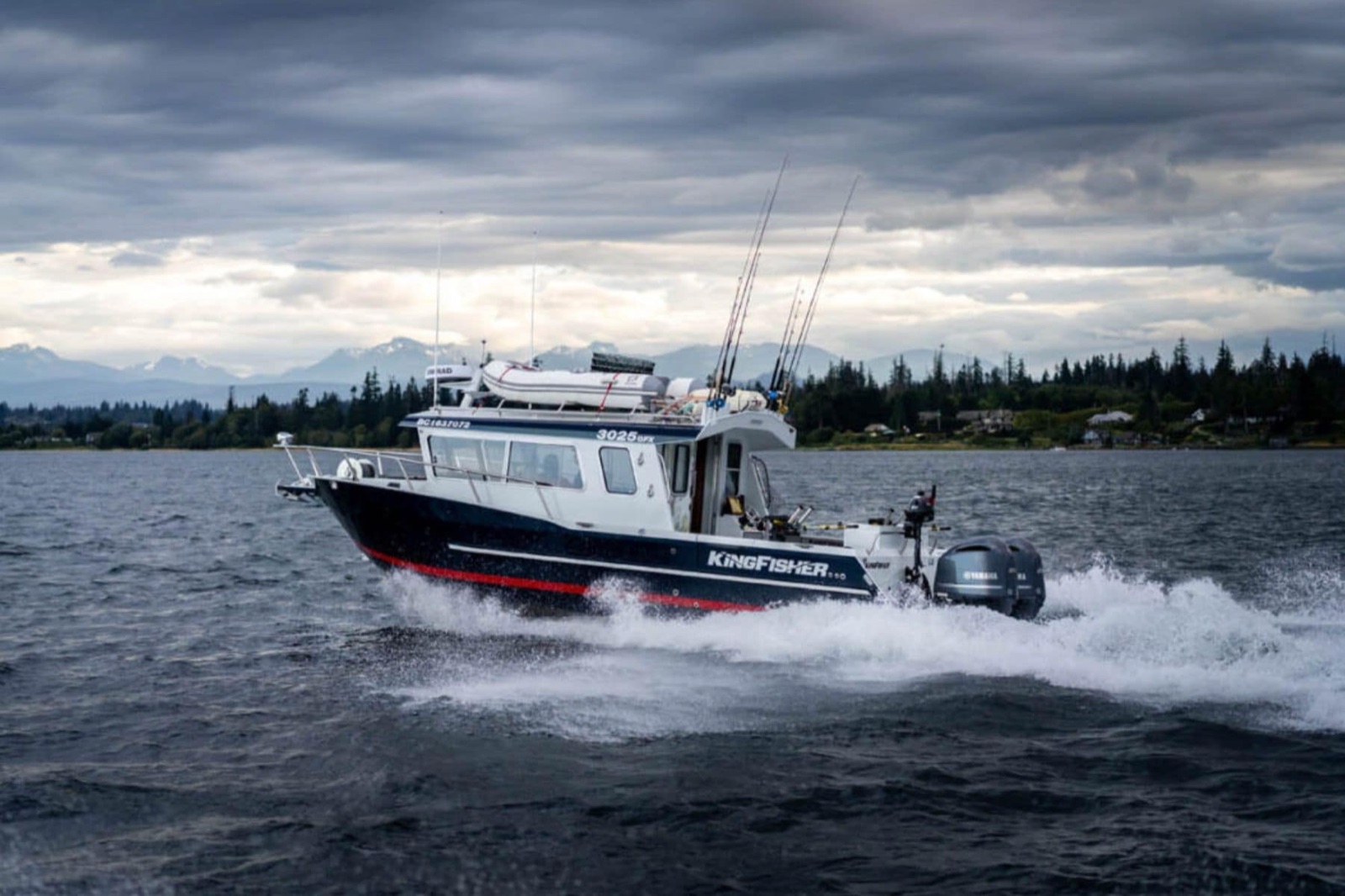
Kingfisher welded aluminum river boat on the Fraser
Founded
1986
Headquarters
Vernon, British Columbia
Ownership
Private
Tier
Core
Website
kingfisherboats.com

Kingfisher builds welded-aluminum boats from Vernon, British Columbia. Founded in 1986, family-owned, focused on the Pacific Northwest market: rivers, glacial lakes, and Inside Passage shoulder-season saltwater. The build philosophy is heavy aluminum plate (typically 0.160 inch on the hull, 0.125 inch on the deck), no rivets, and a layout that owes more to commercial workboats than to bass-tournament aluminum.

Outboard-only, no jet drives in the current core lineup though jet variants are available as factory options on most models.

Lineup

Current platforms.

Model breakdown

Each platform, what it does and where it falls short.

Kingfisher Boats Coastal Express series (2225 / 2625 / 2825 / 3025)

Coastal Express is the heated-cabin pilothouse line. 25 to 30 feet, walkaround layout with weather-protected helm.

Things we like

  • · Heated cabin standard for shoulder-season Pacific Northwest use
  • · Heavy aluminum plate construction

Things we don't

  • · 2017 to 2019 cabin window seals shrink in cold-climate use
  • · Pricing premium over Hewescraft and Duckworth equivalents

Kingfisher Boats Discovery series (1825 / 2025 / 2325)

Discovery is the multi-species fishing line. Open layout with hardtop option.

Things we like

  • · Multi-species fishing layout with rod-holder mounts
  • · Welded-aluminum durability for rocky-water use

Things we don't

  • · Smaller cabin volume than Coastal Express
  • · Hardtop option adds significant cost

Kingfisher Boats Falcon series (1725 / 1825 / 2025)

Falcon is the open river-boat line. Single outboard, river-and-lake spec.

Things we like

  • · Trailerable on a single-axle, opens up river itineraries
  • · Welded-aluminum hull suits rocky-water use

Things we don't

  • · Open layout limits use to fair weather
  • · Trailer bunk wear is the most common owner complaint

Buyer's guide

The Kingfisher Boats story and what to know on the used market.

Origin and ownership

Kingfisher was founded in 1986 by Mike Hambrook in Vernon, British Columbia. The brand grew through the 1990s and 2000s as the Pacific Northwest welded-aluminum segment expanded.

The brand has stayed family-owned and Canadian-built throughout. Production has stayed at the Vernon facility, single-site.

The Coastal Express series replaced the older Offshore series in 2018 and added a heated cabin as standard equipment. Pre-2018 Offshore hulls trade at a 10 percent discount.

Design philosophy

Kingfisher uses heavy welded-aluminum plate construction. Hull plate runs 0.160 inch (4 mm) typical with 0.125 inch (3.2 mm) on the deck. No rivets across the lineup.

Single Yamaha or Mercury outboard is the standard rigging. Jet variants are factory options on most platforms for shallow-river use.

Terminology you should know

Coastal Express
Heated-cabin pilothouse line, 25 to 30 feet. Replaced the Offshore series in 2018.
Discovery
Multi-species fishing line, 18 to 23 feet.
Falcon
Open river-boat line, 17 to 21 feet.
Welded plate
Hull and deck construction using welded aluminum plate (no rivets).

Used-market notes and known issues

2017 to 2019 Coastal Express cabin window seals shrink in cold-climate use. Replacement is a six-hour job.

Yamaha F250 corrosion pattern in saltwater use without annual flush, same as elsewhere.

Trailer bunk wear is the most common owner complaint on the Falcon series. Replace bunks at three years.

Concentrated dealer footprint in British Columbia, Alberta, Washington, Oregon, and Alaska. Outside that footprint, dealer coverage is thin. Service relies on the welded-aluminum trade and is independent of the dealer in most cases.

Resale

Kingfisher resale in the Pacific Northwest market is the strongest in the welded-aluminum segment. Three-year depreciation runs 10 to 15 percent on Coastal Express hulls. Outside the regional market, resale weakens significantly: a Coastal Express in Florida is a hard sell.

Where Kingfisher Boats fits

Buyers cross-shop Kingfisher against Duckworth, North River, Hewescraft, and Stabicraft on the Pacific Northwest welded-aluminum segment. The argument for Kingfisher is the heated-cabin pilothouse on a heavy-plate hull, dialed in for Inside Passage shoulder-season runs. Buyers in other regions should consider locally-built welded-aluminum brands instead.
FAQ

Frequently asked.

Why welded aluminum vs riveted?
Welded plate is stronger and more impact-resistant than riveted construction. The trade is more expensive production and slightly heavier hull. Pacific Northwest commercial-fishing heritage favors welded plate, which carries through to Kingfisher's design philosophy.
What's the 2018 cutover?
The Coastal Express series replaced the older Offshore series in 2018 and added a heated cabin as standard. Pre-2018 Offshore hulls trade at a 10 percent discount and remain the cleaner option for buyers who do not need the cabin heat.
What's the maintenance cost on a Coastal Express 2825?
Annual service on twin Yamaha F250 V6 outboards runs $1,600 to $2,200. Bottom paint $400 to $1,000. Storage $1,500 to $4,500. Insurance for a $180,000 hull runs $1,200 to $2,400.
Where are Kingfishers built?
Vernon, British Columbia. Family-owned facility, single-site.

Compare

Categories Kingfisher Boats fits.

Weekly

Get one honest boat review a week

One boat we ran, one guide worth reading, one model we'd shop next week. No press-release rewrites. Unsubscribe any time.