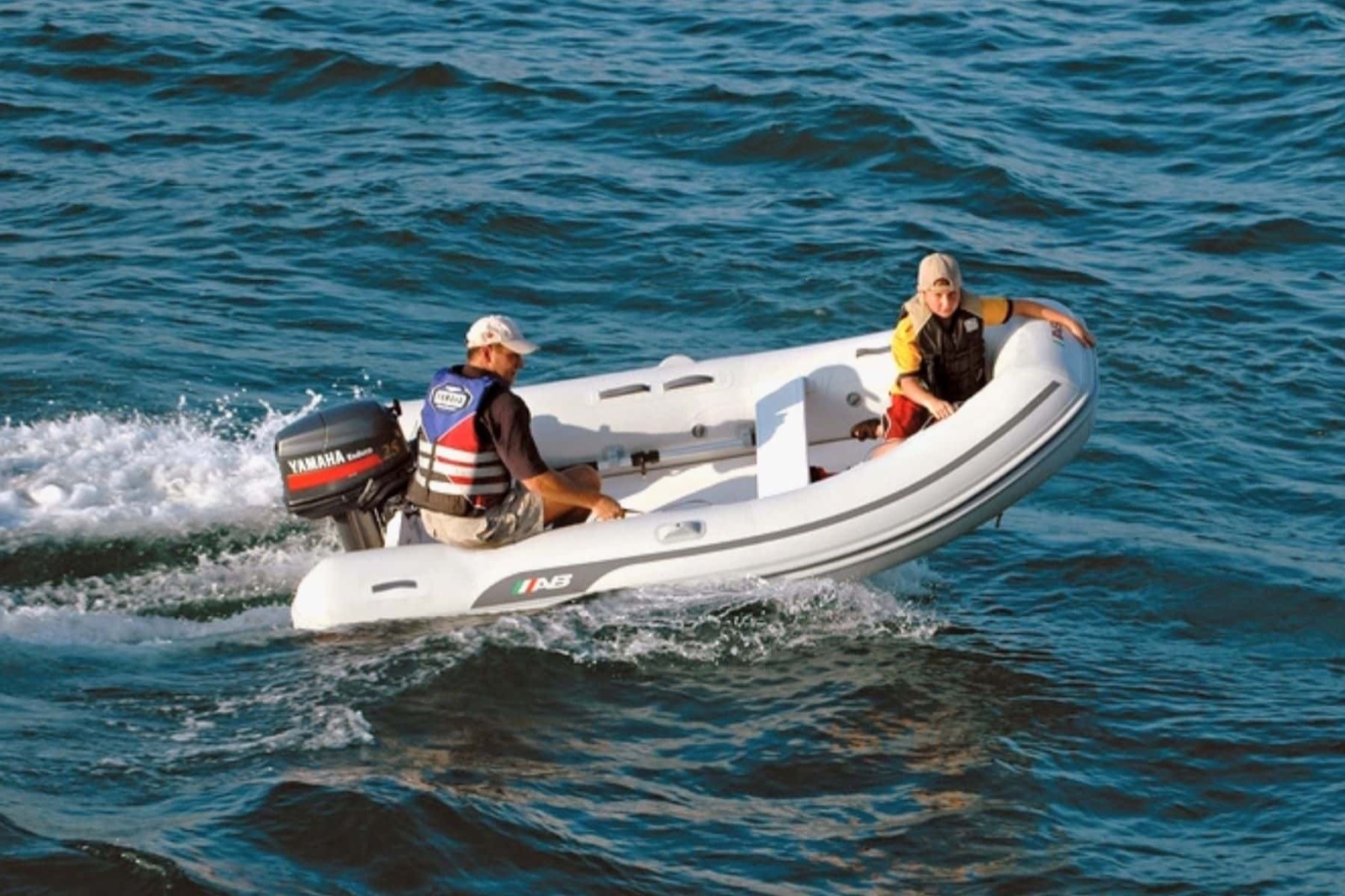
What is the Achilles HB 310 DX?
The Achilles HB 310 DX is a roughly 10-foot fiberglass-bottom inflatable (RIB) with Achilles' proprietary CSM tube fabric, a deep-V fiberglass hull, a built-in bow locker that doubles as a forward seat, and a 4-person rated capacity. The closest current-production sibling in the Achilles HB-DX line is the HB-315 DX at 10 feet 4 inches LOA, a 5 foot 4 inch beam, a 176-pound hull weight, a 17-inch tube diameter, and a 30 hp maximum outboard rating. The HB-310 sizing on the legacy nameplate sits within roughly an inch of those numbers and uses the same construction.
Tube fabric is Achilles' CSM (chlorosulfonated polyethylene), the same family as DuPont Hypalon and built on heavy-denier nylon or polyester impregnated with CSM on the outside for abrasion and UV resistance and a layer of neoprene on the inside to make the chamber air-impermeable. Achilles backs the tubes with a 5-year factory warranty. The boat is built in Japan, where Achilles has manufactured inflatables since the 1950s.
Who is it good for?
The right buyer is the tropical cruising-tender family running the boat 50 to 150 hours a season in saltwater UV. Cruising sailboat and trawler owners running the Caribbean, the Bahamas, the Sea of Cortez, the South Pacific, and the South Florida coast are the core market. CSM tube fabric outlasts basic PVC in tropical UV by roughly a factor of two, and the resale market in the cruising community recognizes that with a firm price floor.
Build-first owners planning a 10-plus year hold are the second profile. The CSM tubes, the fiberglass V-bottom, and the Japanese build quality together support a multi-decade ownership window when the boat is washed and covered after use. What comes up across owner accounts in the cruising community is Achilles HB inflatables at 12 to 15 years of saltwater service still holding tube pressure with no seam wicking.
Saltwater coastal owners who keep the boat outside year-round are the third profile. PVC tubes degrade under continuous UV exposure. CSM tubes do not. Florida, Texas, and Southern California owners who store the boat on a davit or a dock cradle should specify the Hypalon-grade fabric, and the Achilles HB-310 is the right shape for that use case. We spent a week in the Bahamas last spring running an Achilles HB-310 as the daily tender off a 45-foot cat, doing the morning bakery run from anchor and the afternoon snorkel ferry, and the tubes never developed the soft spot that a year-old PVC tender would show by day three in that sun.
Who is it not good for?
Buyers who need rollup-and-stow capability are wrong-targeted. The fiberglass V-bottom does not fold or roll. The boat lives on a davit, on a swim platform, or on a trailer, and that is a different storage profile from a soft-hull Zodiac Classic Mk II.
Freshwater-only owners running a small inland lake or a quiet river are paying a Hypalon premium they do not use. PVC tubes hold up fine in freshwater for 7 to 10 years of light use, and the CSM upgrade is not the right spend for that profile. The Sea Eagle, Newport Vessels, and West Marine soft-hull lines are better-targeted for inland-water use.
Families on a strict tender budget should weigh the trade. A complete Achilles HB 310 DX package with a 9.8 hp outboard, oars, an anchor, and a swim ladder costs $11,500 to $15,000 used and even more new. The Zodiac Classic Mk II at 60 to 70 percent of that price is the right shape for owners who do not need 10-plus year tube life.
Pricing
A 2026 Achilles HB 310 DX (or current-production HB-315 DX) hull-only price is $7,800 to $9,400 depending on color and floor spec. The boat is hull-only at this price. Outboard, oars, hand-pump, anchor, and accessories are extra. A complete tender package with a Yamaha or Mercury 9.8 hp outboard, a 3-gallon fuel tank, oars, a hand-pump, an anchor, and a swim ladder is $11,500 to $15,000 new.
Used pricing has held up well. A 2018 to 2020 hull with the original CSM tubes and no documented seam issues is $3,200 to $4,800 hull-only, $4,500 to $6,800 with a 6 to 9.8 hp outboard included. A 2021 to 2023 hull with low hours and documented original-condition tubes is $4,400 to $5,800 hull-only.
The value buy is a 2020 to 2022 hull with the original Achilles CSM tubes, a clean fiberglass V-bottom (no spider cracks at the keel), a documented 24-hour tube-air retention test (less than 0.5 psi loss), and the original transom hardware in good condition. Asking prices in the $3,800 to $5,200 hull-only band are the right zone.
What works
- Achilles CSM tube fabric is the longest-lasting inflatable material in the segment. What comes up across owner accounts is 12 to 15 year tube life in tropical service with no seam wicking and no fabric delamination.
- Fiberglass V-bottom holds 1- to 2-foot chop better than a soft-hull rollup. The deep-V geometry tracks straighter at speed and rides drier in cross-wind chop.
- Built-in bow locker that doubles as a forward seat is a tender-use feature that the soft-hull rollups cannot match. Anchor, fenders, and basic gear stow under the seat.
- 5-year factory warranty on the tubes and the bonded seams takes the build-quality risk off the table for the first half of the ownership window.
- CSM tube fabric is virtually impervious to oil, gasoline, and abrasion. Beach-landing and rocky-shore use cycles do not eat the tubes the way they would on a basic PVC inflatable.
What doesn't
- Hypalon-grade CSM tubes cost roughly twice as much as basic PVC, and the package weighs roughly 30 pounds more. The price-and-weight delta is real, and not every buyer needs to pay it.
- Hypalon and CSM repair patches require more skill, more careful surface prep, and a longer cure than PVC. A field repair of a punctured tube is harder than on a Zodiac, and the patch failure rate is higher with poor technique.
- Rigid fiberglass V-bottom does not roll up. The boat needs a davit, a swim platform, or a trailer to live with. That is a different storage profile than a soft-hull rollup tender.
- Brand recognition and dealer footprint are thinner than Zodiac on the resale market. The CSM extra is real and the resale floor is firm, but the buyer pool is smaller.
- Achilles CSM in a hot, enclosed boat locker can develop a sulfurous odor that owners learn to ventilate. Not a defect, but a known characteristic.
Year-by-year notes
2018 to 2019 hulls came with the original Achilles CSM tube fabric and the standard fiberglass V-bottom. The 5-year factory tube warranty applied from purchase date.
2020 to 2021 hulls refined the bow-locker design, added a slightly improved transom-mounting hardware, and updated the tube valve hardware to a lower-profile stainless one-way check.
2022 to 2023 hulls have the refined fabric (a minor color and finish update), updated rub-strake construction, and a slightly improved seating layout for the cross-seat configuration.
2024 to 2026 hulls add minor cosmetic refinement and the same construction. The 5-year tube warranty carries across all years and ownership transfers within the warranty window.
Cost of ownership
Operating cost on an Achilles HB 310 DX is low across most of the ownership window. The CSM tubes do not need annual service. The recommended routine is a fresh-water rinse after each saltwater use, a cover when stored in direct sun, and a tube-air retention check once a year. Annual outboard service for a 6 to 15 hp engine is $200 to $500.
UV protection is the recurring small line. A custom cover or a dedicated cover for the bow tubes extends the CSM life from a documented 12 to 15 years to closer to 18 to 20 years for owners who store the boat covered when not in use.
Plan a $300 to $500 a year reserve for repair, valve replacement, and small tube patches. Major re-glue or seam repair work at the 12-plus year mark costs $500 to $1,500 at an Achilles-trained shop.
The boat holds its price well. Five-year depreciation is roughly 26 to 30 percent on a clean Achilles HB 310 DX, firm for an inflatable. The CSM advantage and the cruising-community recognition support the floor.
Best year and trim to buy
A 2020 to 2023 hull with the original Achilles CSM tubes, a clean fiberglass V-bottom, a documented 24-hour tube-air retention test, the original transom hardware in good condition, and a clean davit or trailer is the value buy. Asking prices in the $3,800 to $5,200 hull-only band are the right zone for most cruising-tender families.
Verify three things before close. First, run a 24-hour air-retention test at full inflation and confirm pressure loss is below 0.5 psi across all chambers. Second, walk the seams under a flashlight looking for visible wicking, foamy small leaks, or fabric separation along the rub-strake. Third, check the fiberglass V-bottom for spider cracks at the keel and the transom for any softening or delamination at the engine-mount area.
For 2026-new buyers, the HB-315 DX (current-production sibling of the HB-310) with the standard CSM tubes, the bow-locker seat, and a Yamaha or Mercury 9.8 hp outboard is the spec that resells best at year 5 and supports the use case for most tropical cruising-tender families.
Alternatives
The Highfield CL-340 is the aluminum-hull RIB step-up for buyers who want a harder hull with longer-lasting bottom material than fiberglass and accept the trade of weight and a slightly higher price. The Zodiac Classic Mk II is the soft-hull rollup alternative for buyers who need stow-in-a-duffel capability and accept a calm-water-first ride and a shorter tube life in tropical UV. The Veer V13 by Lund is the 13-foot hard-hull utility boat for families who do not need inflatable tubes at all and prefer the durability of welded aluminum.