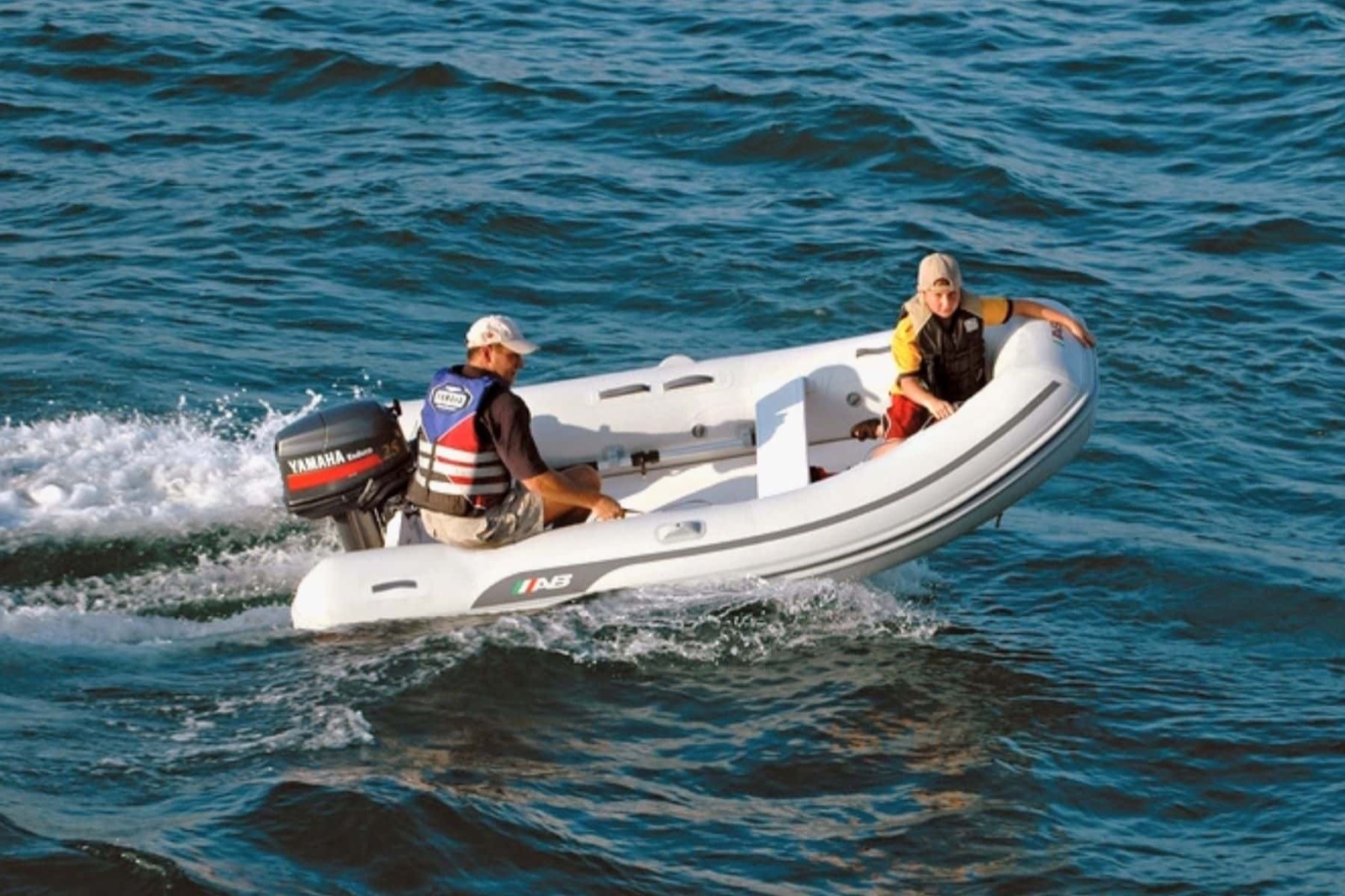
The Highfield Classic 340 has become the default tender for serious cruising sailboats and motoryacht owners who need a small boat that earns its keep. It is a welded-aluminum V-hull with ORCA Hypalon or PVC tubes, eleven feet two inches long, sixty-seven inches across the beam, and 154 pounds dry. Highfield is a New Zealand designed brand built in volume in China, distributed in North America through marine specialists rather than mass retailers, and the CL-340 has held the rank-one spot in our 2026 inflatable-boats guide because the build, the warranty, and the resale all line up against the segment.
What is the Highfield CL 340?
The CL-340 sits in the eleven-foot tender slot historically dominated by PVC-tube hypalon hybrids on plywood floors. Highfield's case is that a one-piece welded aluminum hull, a self-draining deck, a double-floor cavity that hides fuel lines and channels bilge water, a tall transom, and a full-length keel guard add up to a more durable platform than the fiberglass-and-PVC alternative at roughly the same hull weight. The Classic line is the entry tier in the Highfield range below the more equipped Sport and Patrol models, which means the CL-340 is the rough-and-ready option, not the most loaded one.
Three trims define the 2026 lineup. The base CL-340 is a tiller-steered open boat with two bench seats and the welded aluminum hull. The 340 FCT adds a small forward console with throttle and steering reach for owners who do not want to sit at the transom for long runs. The 340 GT adds a full center console with wheel steering and a forward jockey seat, which is the configuration most often paired with a 25-horsepower outboard for owners who run beyond pure tender duty into spearfishing, beach-shuttle, or solo runabout use. Tube material is the other meaningful spec choice. ORCA Hypalon carries a ten-year non-diminishing seam warranty against five years on the Valmex PVC, and the price step between the two is typically $800 to $1,400 at the dealer.
Who is it good for?
Cruising-yacht households are the first answer. Liveaboard sailors and motoryacht owners running tenders for groceries, dock-to-dock guest runs, beach landings, and offshore-from-anchor exploration make up the largest share of CL-340 owners. The aluminum hull tolerates dock collisions, beach landings on coral or shell, and the kind of accumulated abuse that thins gel coat on a fiberglass tender. On a quiet morning in George Town, Exuma, we watched a cruising couple lift a Highfield onto the foredeck of a 47-foot catamaran with no help and stow it before breakfast. The 154-pound dry weight is the reason that scene works.
Saltwater coastal owners running fifty or more hours a season on the same hull are the second profile. The Hypalon ten-year UV warranty does its work in the climates that age PVC the fastest, which is to say Florida, the Gulf, the Caribbean basin, the Sea of Cortez, and the Mediterranean. Buyers cross-shopping from a tired PVC-tube hypalon-hybrid tender will see the Highfield extra cost return as a firmer resale price and as ten-year tube life rather than as outright performance.
Who is it not good for?
Pure freshwater inland owners do not get back what they pay for the aluminum and Hypalon. A PVC-tube fiberglass RIB at thirty to forty percent under will outlive the use case for a Wisconsin or Minnesota lake-cabin tender that sees fifteen hours a season under cover. Budget-tier first-tender buyers fit the same exclusion. The CL-340 is a long-cycle ownership tool, not a starter dinghy, and buyers who plan to flip in two seasons should price the depreciation hit against a cheaper PVC-tube alternative rather than reach for the Highfield.
Owners who want a planing day-boat under their own use rather than a tender behind a yacht should also keep walking. The CL-340 will plane with one or two adults and a 25-horsepower outboard, but the open-bench layout, the absence of standard dry storage, and the eleven-foot length rule it out as a primary day-boat for groups beyond two adults plus modest gear. The boat is sized for tender duty.
Pricing
New 2026 pricing on the CL-340 hull alone spans from roughly $5,800 for the base PVC-tube tiller version to about $10,200 for the GT trim with Hypalon tubes and the center console. Outboard-included dealer packages with a 25-horsepower four-stroke (Honda BF20, Yamaha F25, Tohatsu MFS25D, Suzuki DF30) land in the $16,800 to $19,400 range depending on engine choice and trim. The Suzuki DF30 package on the FCT trim sits around $17,600 at the time of writing.
Used 2020-to-2023 hulls in the 50-to-200-hour range track $6,400 to $9,200 across coastal markets, with Hypalon-tube examples pulling the high end and PVC-tube boats settling lower. Five-year depreciation is about 22 to 26 percent off new MSRP, materially better than a PVC-tube fiberglass RIB at the same length where five-year depreciation more typically lands at 35 to 45 percent. The exit-value math is why buying new or near-new makes more sense than chasing the cheapest used hull. Yard work to refresh a tired PVC-tube tender frequently exceeds the residual value, which does not happen with a Highfield in the same age band.
What works
- Welded aluminum V-hull tolerates dock impact, beach landings, and shell or coral grit better than fiberglass at the same weight.
- ORCA Hypalon tubes carry a ten-year non-diminishing seam warranty, segment-leading.
- 154-pound dry weight lets one adult lift the hull onto a foredeck or single-davit setup without crew help.
- Double-floor design hides fuel lines, channels bilge water below the deck, and holds a dry standing surface.
- Tall transom and forward freeboard handle a chop chase from anchored mothership to dock without spray-soaking the operator.
- Five-year hull warranty stacked on the ten-year tube warranty, both non-diminishing on Hypalon tubes when registered at delivery.
- Resale price stays firm enough that a 2020 GT in good condition routinely lists at half of new MSRP four years on, well above segment averages.
What doesn't
- Aluminum-hull cost of roughly thirty percent more than PVC-tube fiberglass RIBs at the same length is unrecoverable for owners outside salt or beach environments.
- Bilge pump and navigation lights are optional, not standard. Plan on $300 to $600 in dealer-installed accessories before any serious open-water use.
- No dry storage standard. Owners commit to dry-bag organization for keys, phones, registration, and spare line.
- Hypalon tube repair requires neoprene-based glue with RFE hardener, not the plastic adhesives that work on PVC. A puncture in the field requires the right repair kit and overnight cure time, not a quick weld.
- Open-bench layout limits comfort on runs longer than thirty minutes, especially solo with a tiller.
Year-by-year notes
The CL-340 has been in production with limited spec changes since 2018. The 2018 owner's manual covers the same hull architecture as the 2026 boat. Tube-material choices and trim levels have expanded over time. ORCA Hypalon has been the recommended tube material in coastal-saltwater use through the entire production run. The FCT and GT trims became standard catalog items by 2020. Warranty terms (five years on the hull, five years on Valmex PVC tubes, ten years on ORCA Hypalon tubes including seams) apply across the production run when registered with the dealer at delivery. There is no defect cutover year for buyers to screen on, which is part of why the boat holds its price.
Cost of ownership
Annual recurring costs are modest. Tube-valve service is the recurring line, with the one-way check valves needing inspection and occasional replacement at roughly five-year intervals. Hypalon UV care comes down to rinsing salt off after use, keeping the tubes covered when the boat sits idle, and budgeting nothing on tube replacement inside the warranty window. Bottom paint costs $200 to $400 in materials for owners who leave the boat on a davit or trailer between uses, $400 to $700 for owners who keep it wet at a slip. Outboard service follows the engine manufacturer's interval schedule, around $200 to $350 for an annual service kit on a Yamaha F25 or Honda BF20. Insurance for a tender of this hull value is typically $150 to $350 a year as a rider on a yacht policy.
The 2020-to-2023 used-hull price range puts five-year all-in cost of ownership including outboard service, slip or davit setup, and insurance at roughly $1,500 to $2,500 a year on a coastal-use schedule, materially less than a comparable PVC-tube fiberglass RIB once the tube-replacement question on the older boat is priced in.
Best year and trim to buy
The 2020-to-2023 GT trim with ORCA Hypalon tubes is the right buy in 2026. The GT center console buys steering and throttle reach forward of the transom, which removes the long-tiller fatigue from any run beyond ten minutes. The Hypalon extra cost over PVC at used prices is typically $800 to $1,400 and pays back inside three years on coastal use through the warranty term and the firmer resale price. Verify tube-valve condition pre-purchase with a tube-pressure check, confirm the keel guard is original (a replaced keel guard suggests heavier grounding history), and confirm the transom plate has no stress-cracking around the outboard mount. A clean 2021 GT with Hypalon at 100 to 150 hours should land between $7,800 and $9,000 in 2026 markets. We sat in on a dealer-yard pre-purchase inspection in Stuart, Florida last spring where the surveyor caught a transom-bolt stress crack on an otherwise clean 2020 GT, and the seller dropped the asking price by $1,400. Worth the inspection fee, every time.
The base CL-340 with the tiller is the smart buy only for households running short anchorage-to-dock duty under five minutes per leg. The FCT split-trim is a compromise that owners frequently regret in favor of stepping up to the GT.
Alternatives
The closest peer in the collection is the Achilles HB-310-DX, a Hypalon-tube fiberglass RIB at a similar length and a different answer to the same brief for buyers who do not care about the welded-aluminum extra cost. The Zodiac Classic Mk2 is the legacy PVC-tube reference in the segment, a reasonable budget alternative for owners willing to trade hull life under five years for a thirty-percent lower acquisition cost. For freshwater-only owners whose use case earns no inflatable-tube extra cost at all, the Alumacraft 1448 Jon is a rigid all-aluminum cross-shop that solves the same shore-tied or cabin-tender problem at half the money.