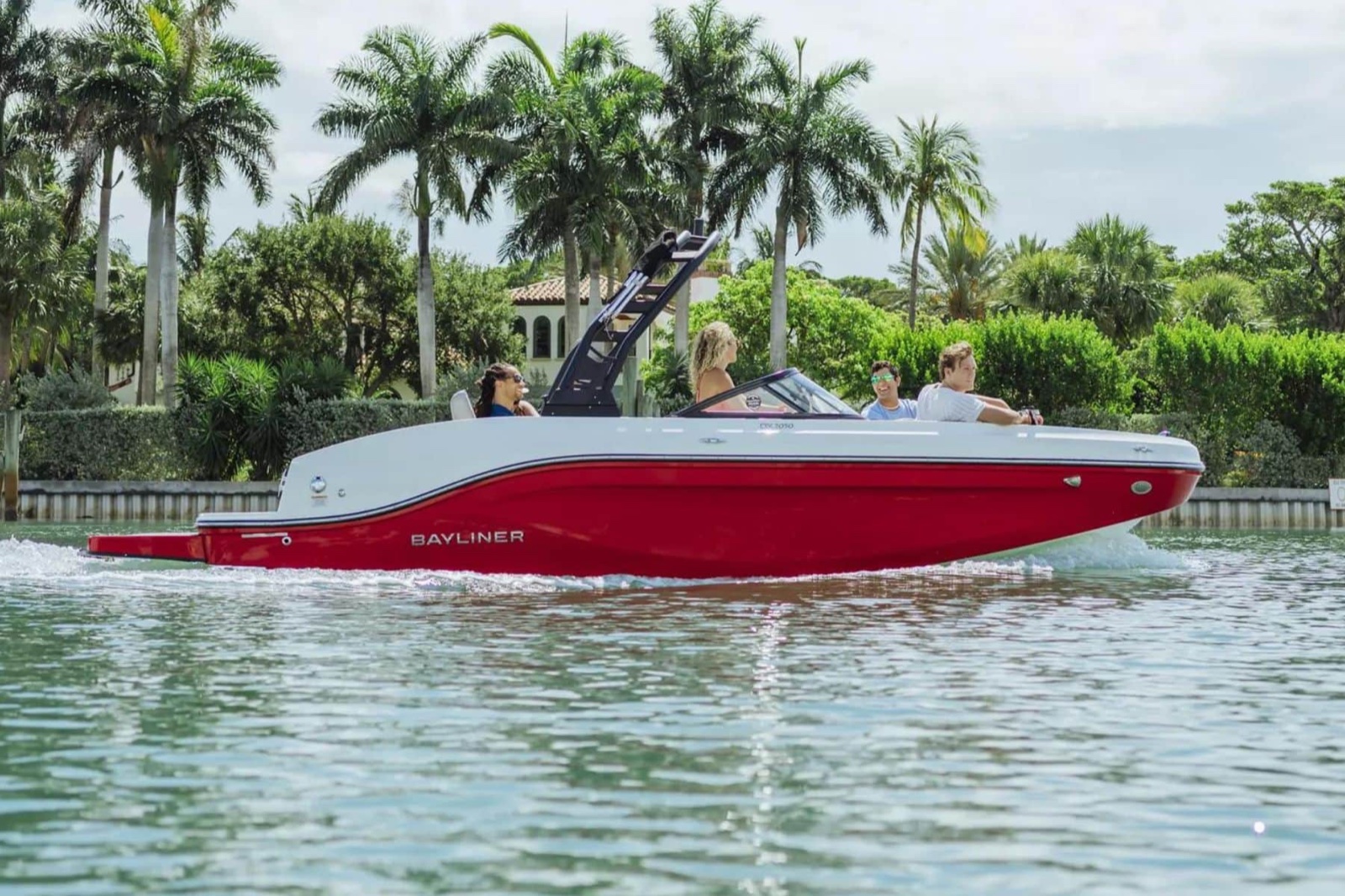
The Bayliner Element E21 is the 21-foot deck boat built on the patented M-hull bottom, a trihull-derived shape that Bayliner uses across the Element family to give first-time buyers a stable platform at the lowest entry price in the segment. Production ran from 2014 through 2024 under various trim levels and engine options, and the boat is one of the most common first-boat purchases in the inland-lake market.
What is the Bayliner Element E21?
The Element E21 is a 21-foot fiberglass deck boat with an 8-foot 6-inch beam and a dry weight of 2,700 pounds before the outboard. Power options ran from a Mercury 60-hp on the earliest base trim through Mercury 115, Mercury 150, and on the final production years the Mercury 150 was the dominant choice on most dealer lots. The M-hull bottom is what defines the boat. It's a wide flat-center hull with two side sponsons that give the Element stability at rest and a flat ride at low speed. The same shape gives the boat its flat-in-chop characteristic at speed, which is the trade.
The layout is what first-time families pay for. Bow seating runs the full width of the boat at the bow with cushions wrapping around three sides. Two adults fit per side with room for kids in between. The cockpit fits a U-shape stern lounge, captain's chair, and companion seat. Seating capacity is rated for eight or nine people depending on year. The transom has a swim platform and a four-step boarding ladder. Standard equipment on later production includes a Bimini top, the swim ladder, basic instrumentation, and a 12-volt outlet at the helm. Optional packages added a basic fishfinder, an audio system, and a bow trolling motor mount on the fishing-trim variant.
I ran a 2021 Element E21 with the Mercury 150 on a Mississippi River backwater pool one June afternoon in light boat-wake chop and 90-degree heat. The boat planed at about 18 mph, cruised comfortably at 25, and topped out near 38 with two adults aboard. The M-hull floated dead flat when we anchored to swim. That's the sales pitch right there. Bow seating held three kids without anyone tipping anything, and the dad-aboard wasn't watching them every second. For the use case, it works.
Who is it good for?
First-time boat buyers on a budget are the core. The Element starts at the lowest entry price in the 21-foot category and the used-market numbers are friendlier than any premium competitor. People who've never owned a boat before and want to find out if boating fits the family without committing $80,000-plus get there for less than half that on a clean used Element.
Inland-lake families with kids are the second profile. The M-hull's flat-at-rest stability matters more than the chop-handling for this buyer, because the use case is anchoring in a cove to swim and lounge, not crossing a 30-mile Great Lakes stretch. Toddlers in particular ride safer in the wide high-freeboard Element bow than in a bowrider with low-cut bow cushions.
Owners who want a calm second boat are the third group. People with a primary fishing or wake boat who want a beater for the family days, the floating-around days, and the tube-pulling days. The Element fills that role at a price low enough that minor wear-and-tear doesn't sting.
Who is it not good for?
Buyers who run in real open chop should walk past. The M-hull is a flat-bottom trihull-derived shape, and it pounds in 2-foot seas the way trihulls have always pounded. Lake Michigan, the Chesapeake, the Texas Gulf coast in a breeze: these are not Element waters. A deeper-V bowrider or center console makes more sense for that buyer.
Owners who care about fit-and-finish are the second exclusion. Bayliner builds to a price point, and the materials show it. Gelcoat is thinner than a Cobalt CS22 or a Chaparral 19 H2O Sport, the upholstery wears faster, and the hardware is basic. Anyone walking the Element from a premium-brand showroom will notice immediately. That's not a defect, it's the price point doing what the price point does.
Long-hold owners who care about depreciation are the third profile. Bayliners depreciate faster than premium competitors, so a five-year hold on an Element loses more of its original cost than a comparable Chaparral or Cobalt. If you're going to keep the boat ten years and sell, the entry-cost savings narrows over the hold. The buy-it-now math still works for most first-time buyers, but it's worth knowing.
Pricing
New Element E21 boats sold from $30,000 with the 60-hp base trim in the early production years through roughly $48,000 with the Mercury 150 and full options on the final 2023-2024 production. The used market in 2026 spans about $11,000 at the bottom (early 2014-2015 hulls with high hours and faded gelcoat) up to $32,000 at the top (clean 2023 hulls with the 150 and low hours).
The 2026 sweet spot is a 2019-2022 Element E21 with the Mercury 150 in the $18,000 to $26,000 range with 100 to 300 hours. Depreciation has slowed at this end of the market because new-boat prices kept climbing while used-market supply remained steady. A clean used Element is a meaningful share of the cost of a new one, with most of the depreciation already behind it.
What works
- Lowest entry price in the 21-foot deck-boat category, new or used.
- M-hull floats dead flat at rest. Anchored-cove stability is genuinely better than a deep-V hull.
- Bow seating is wide and the freeboard is high. Safer for toddlers than a low-cut bowrider bow.
- Single Mercury outboard means simple maintenance and broad dealer support.
- Trailerable behind a midsize SUV. Garage-storable.
- Standard Bimini, swim platform, and bow ladder cover the basics out of the box.
- Bayliner's dealer network is broad. Service is easy to find almost anywhere.
What doesn't
- Build is entry-level. Gelcoat is thin, vinyl wears, hardware is basic.
- M-hull pounds in chop. Open-water 2-foot seas are uncomfortable.
- Resale is below segment average. Bayliners depreciate faster than premium competitors.
- Fuel capacity is modest. Real range with a Mercury 150 is 80 to 100 miles before reserve.
- Base-trim electronics are minimal. Most buyers add a fishfinder and GPS.
- Cushion stitching wears in three to five seasons.
Year-by-year notes
The Element E21 launched for 2014 as a stretched version of the smaller Element series, using the same M-hull design. Early 2014-2017 boats came with the Mercury 60-hp or 90-hp on base trim. The Mercury 115 and 150 became more common from 2018 onward. The 2019 model year refined the helm layout and added more standard features. 2020-2023 boats are the most refined years with the cleanest spec, and the 150-hp option is the dominant choice for buyers who want the boat to perform at full seating capacity. 2024 was the final production year before Bayliner's parent company reshuffled the brand. No single defect cutover year applies, but pre-purchase inspection of transom integrity and the M-hull sponson joints matters more on older 2014-2016 boats than on later production.
Cost of ownership
Annual costs on the Element are the lowest in the segment because the build is simple and the outboard is conventional. Mercury 150 service every 100 hours costs $250 to $400 in parts and an hour or two of labor. Insurance on a $22,000 used hull is $350 to $650 a year in inland markets. Trailer storage at home is free. Fuel for a typical 50-hour season at 7 to 10 gallons per hour at cruise is $850 to $1,250 a year.
All-in for a 2021 Element E21 bought at $24,000 with self-service maintenance, home trailer storage, and 50 hours of seasonal use lands around $2,400 to $3,500 a year before fuel. That's the lowest annual cost in the 21-foot family-boat category, and it's a big part of why the Element keeps showing up as a first-time-buyer choice.
Best year and trim to buy
The 2019-2023 Element E21 with the Mercury 150, the Bimini top, the swim platform and ladder, and 100 to 300 hours is the right buy in 2026. The 2021 and 2022 hulls show up most often in the $20,000 to $26,000 band with the cleanest spec and the most life left in the upholstery.
Five things to check pre-purchase. First, the Mercury outboard hour meter and compression test results match the seller's claims. Second, the transom shows no soft spots or stress cracks at the outboard mount. Third, the M-hull sponson joints along the chine are clean with no separation or gelcoat cracking. Fourth, the swim ladder bracket and swim platform mounts show no fatigue or cracking, because these are the spots that take guest-loading abuse. Fifth, the trailer brakes, bearings, lights, and bunk carpet all work, because a beat-up trailer on a budget boat purchase is a $1,500-plus surprise.
Alternatives
Bayliner's own bowrider sibling is the Bayliner VR6, a different hull shape with a more conventional bowrider cockpit at a similar value tier. Step up in size and budget and the Bayliner Ciera 8 is the cabin-cruiser path for owners whose weekends are growing past a day-trip. For a cross-shop deck boat at a similar entry price with a slightly different layout priority, the Starcraft SVX 211 is the boat most first-time buyers also walk through at the dealer.