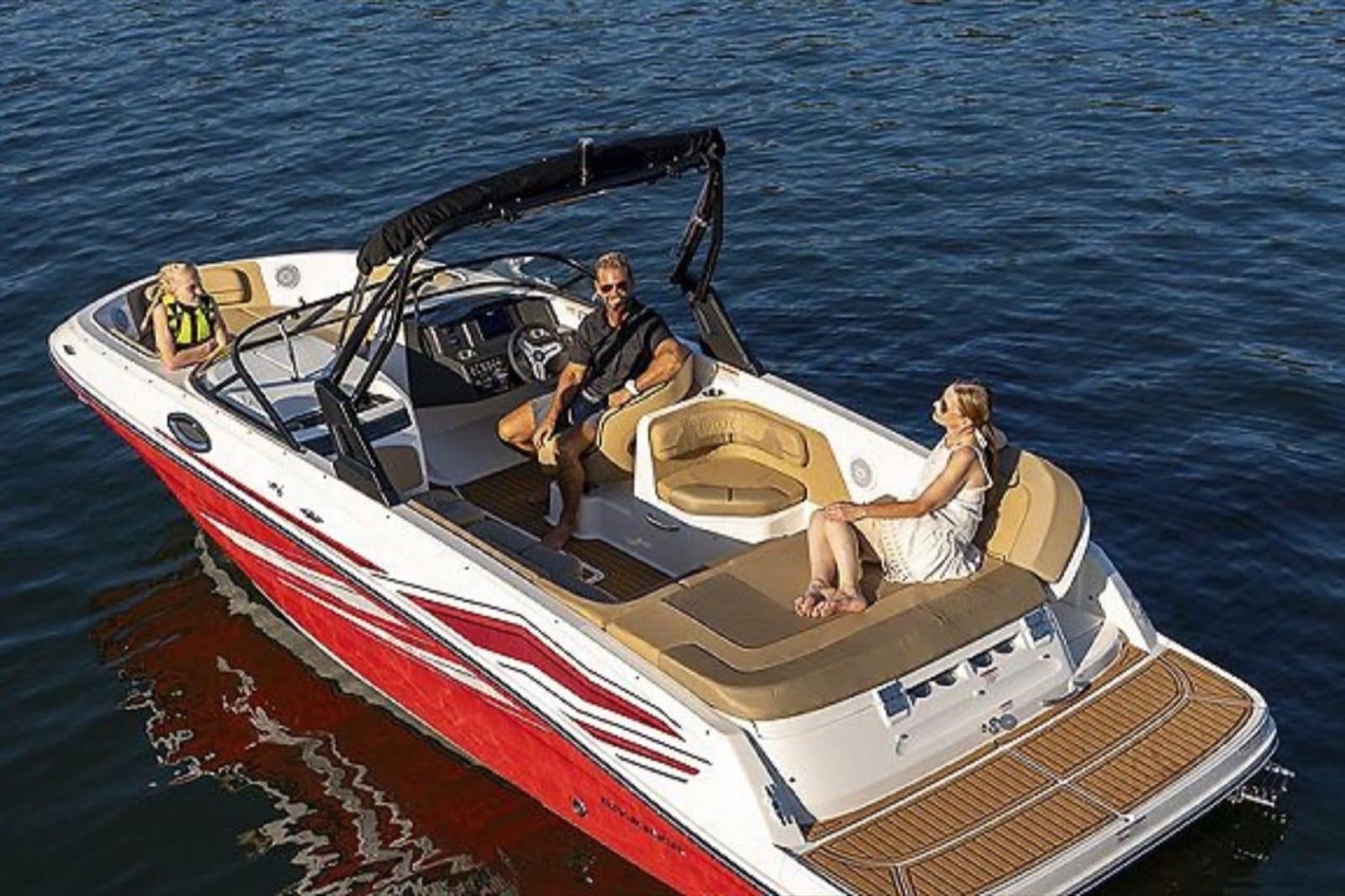
The Chaparral 21 SSi is a 21-foot sterndrive bowrider built in Nashville, Georgia, and the size most lake families end up at after looking at the smaller boats in the range. Chaparral has been building sport boats for more than fifty years and the SSi line covers the mid-tier bowrider segment from 19 to 25 feet. The 21 SSi has been in production in its current form since the 2016 model year, and the 2026 catalog keeps the same hull with refreshed graphics and updated helm electronics.
What is the Chaparral 21 SSi?
The 21 SSi is a 21-foot 1-inch fiberglass sterndrive bowrider on Chaparral's Extended V-Plane hull. Beam is 8 feet 6 inches, dry weight is about 3,650 pounds, and the boat trailers behind a half-ton truck with a proper hitch package. The hull is a modified-V planing layup with the kind of moderate deadrise that works well on inland lakes and protected coastal water.
Power options across the production run have included MerCruiser 4.3L V6 and 4.5L V6 sterndrives, plus Volvo Penta 4.3L and 5.0L V8 options on most model years. The 4.5L MerCruiser at 250 or 270 horsepower is the common build and the engine most used-market buyers default to. The Volvo Penta 5.0L is the upper-trim engine option and the one that gives the boat the strongest pulling power for tubes and wakeboards. Fuel is 41 gallons.
The cockpit lays out with two captain chairs at the helm, a U-shaped seating area aft with a removable filler, a swim platform with a telescoping ladder, and the bow seating forward of a walkthrough. Storage runs under most of the bench cushions plus a deeper in-floor locker. The head compartment in the port console is a popular option and the one most families end up choosing on a dealer build.
I spent a Saturday on a 2022 21 SSi on Lake Geneva in Wisconsin during the late-season cruise window, three adults and a teenager aboard. The boat held a comfortable 30 mile per hour cruise and the Volvo Penta 5.0L pulled the teenager up on a wakeboard without lifting the stern more than the Bimini bows could tolerate. The helm felt a step nicer than the equivalent Sea Ray SPX I had been on the month before, with cleaner stitching on the captain chair and a slightly more thought-out instrument cluster. The build difference between Chaparral and the bigger brands shows up in places like this, on a thirty-minute look around the boat.
Who is it good for?
Inland-lake families running 40 to 80 hours a season. The 21 SSi is sized for full Saturdays on the water, the occasional wakeboard or tube pull, and a Sunday cruise with the family. The 8-foot 6-inch beam keeps the cockpit usable with eight people aboard, which is the kind of load the boat sees on a holiday weekend.
Owners stepping up from a smaller boat who want a finish step. The Chaparral build feels nicer than the same-length Sea Ray SPX or Bayliner VR6, and the dealer network covers most freshwater markets. Buyers who notice the stitching on the captain chair and the layout of the instrument cluster are the right buyers for this boat.
Resale-conscious lake buyers planning a five-to-seven-year hold. Chaparral resale holds nearly as well as Sea Ray and better than most value-tier bowriders. The depreciation curve flattens after year three, and the boat moves through the broker channel reliably in any major freshwater market.
Who is it not good for?
Surf-wake families should look at a different category. The 21 SSi is a sterndrive bowrider and does not throw a surfable wake. A Malibu 22 LSV or an Axis A22 covers that brief at a materially higher price.
Outboard-curious buyers should think hard about the sterndrive maintenance line. Chaparral has been slower to add outboard variants to the SSi range than the segment as a whole, and the bellows service every two to three years adds up over a long ownership cycle.
Buyers tight on entry price should walk past. The 21 SSi sits in the middle of the mid-tier bowrider segment and the Chaparral premium over a Bayliner VR6 or a Stingray 212SC is real. The boat is worth the step up if you plan to keep it, but the entry price is not the value entry.
Pricing
New 2026 21 SSi pricing lands between roughly $72,000 and $89,000 depending on engine choice, dealer, and option package. The most common dealer build includes the Volvo Penta 4.3L or 5.0L sterndrive, the cockpit sound upgrade, a folding tower, the bow filler cushion, and the head compartment, which puts the typical out-the-door price in the middle of that range.
The used market for 2018-to-2023 hulls in clean shape with 100 to 300 hours falls between $34,000 and $58,000. The bottom of that band is a high-hour 4.3L MerCruiser boat in a slow regional market. The top is a low-hour 2023 with the Volvo Penta 5.0L, a tower, and the upgraded helm at a dealer that knows the brand.
Five-year depreciation on a clean 21 SSi sits around 32 to 38 percent off new. That is comparable to a Sea Ray SPX 230 over the same period and is the value the Chaparral badge delivers on the resale side.
What works
- Build finish sits a half-step above Sea Ray and a tier above Bayliner at the same length. The stitching, the gelcoat, and the helm layout all show it.
- 8-foot 6-inch beam gives a wider cockpit than a 20-footer. Three rows of seating actually usable means the front bench is not the only place for guests.
- Resale holds nearly as well as Sea Ray and better than most value-tier bowriders.
- Dealer network covers most freshwater markets and the brand has a strong relationship with both Volvo Penta and MerCruiser.
- Tower option gives a workable tube and entry-level wakeboard pull setup.
- Helm ergonomics are better than the segment average. The driver does not feel cramped after a long day.
- Storage under the seats is deeper than a Stingray or a Bayliner at the same length.
What doesn't
- Sterndrive bellows replacement every two to three years runs $1,400 to $1,800.
- MSRP creep through the 2020s has put the boat into a price band where outboard-rigged alternatives become more attractive.
- No surf wake. The shape of the wake behind a sterndrive bowrider is not surfable.
- Bow seating is sized for two adults. Three adults forward feels tight.
- Standard helm electronics are basic. Most buyers add the Garmin or Raymarine display upgrade at the dealer.
- Vinyl colors fade on south-exposed surfaces. Owners flag this after two to three full seasons in the sun.
Year-by-year notes
The 21 SSi launched in 2016 on the current Extended V-Plane hull. The 2018 model added the option of the MerCruiser 4.5L alongside the 4.3L. The 2020 model refreshed the graphics and made the cockpit sound upgrade more common on dealer builds. The 2021 model went to the upgraded helm electronics package as a popular option. The 2023 model refreshed the upholstery patterns and minor trim. The 2025 model added a wireless device charger and updated cup holders. There is no defect cutover year to screen for on the current production. Pre-2016 21 SSi boats are a different generation on an older hull and should be evaluated separately.
Cost of ownership
Annual recurring costs run typical for the mid-tier sterndrive bowrider segment. MerCruiser or Volvo Penta 100-hour service costs $400 to $700 in parts and $400 to $600 in labor. Drive impeller and gimbal-bearing service adds $400 to $700 per year. Bellows replacement at the two-to-three-year mark adds $1,400 to $1,800. Bottom paint on a freshwater slip-stored boat costs $300 to $500 a year. Insurance on a $48,000 hull is $700 to $1,100 a year in most freshwater markets.
A five-year hold on a 2021 21 SSi bought at $46,000 with 140 hours, used 60 hours a season on Lake Norman with trailer storage and an annual dealer service, lands at roughly $3,800 to $5,400 a year all-in including insurance, fuel, service, and the spread-out capital cost. The maintenance line is similar to a Sea Ray SPX 230 at the same length, and the difference between the two boats over a five-year hold comes down to entry price and the resale price at the end.
Best year and trim to buy
The 2020-to-2023 21 SSi with the Volvo Penta 4.3L or 5.0L sterndrive, the upgraded helm electronics, the cockpit sound upgrade, the folding tower, and the head compartment is the right buy in 2026. Five things to verify pre-purchase. First, the bellows service is current and dated. Second, the impeller and gimbal-bearing work are at the right hour mark. Third, the engine alarm history is clean on a tester pull. Fourth, the upholstery has not cracked at the seat-bottom seam, where wear shows up first on Chaparrals over five years old. Fifth, the trailer rollers and bunks are in good shape. A clean 2022 with 180 hours and the right options should land between $46,000 and $54,000 with a Chaparral-experienced dealer.
Alternatives
The Sea Ray cross-shop at slightly larger length is the SDX 220, which leans more toward party-boat use with a bigger cockpit and a different seating layout. The smaller-footprint alternative is the Four Winns H190, which covers a similar lake day-boat brief at a lower entry price with a tighter cockpit. The value cross-shop is the Bayliner VR6, which sits a tier below Chaparral on finish and dealer footprint at materially less money. For families who really want surfable wakes, the Malibu 22 LSV is a different category of boat at a meaningful price step.