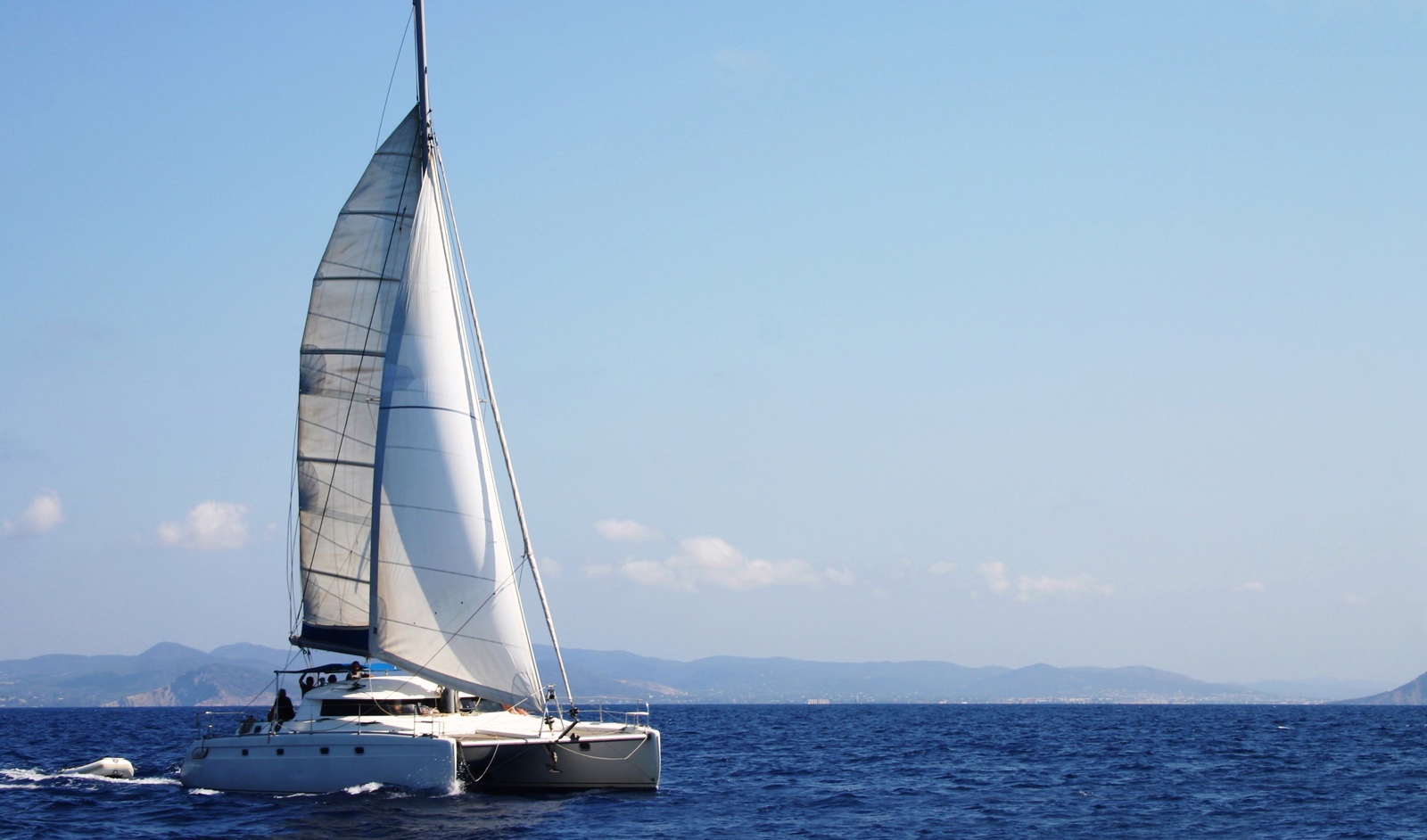
The Fountaine Pajot Lipari 41 is the French-build option in the charter-return catamaran market. Fountaine Pajot's production line in La Rochelle has been building cruising catamarans since 1976, and the Lipari ran from 2010 through 2014 as the four-cabin charter workhorse in the range. It sits in our charter-return catamaran guide because the saloon joinery, the upwind ability, and the price reality of a 2012 or 2013 ex-charter hull line up in a way that buyers cross-shopping a Lagoon 400 or a Leopard 40 keep coming back to.
What is the Fountaine Pajot Lipari 41?
The Lipari is a 39-foot 5-inch fiberglass cruising catamaran, 22 feet wide across the beam, with a 3-foot 9-inch draft and twin Volvo Penta D2-40 diesel engines at 40 horsepower each. The construction is hand-laid fiberglass with closed-cell foam coring through the structural laminates, vinylester resin in the outer skin to slow blistering, and a bonded structural grid that takes the rig loads through the bridgedeck. The mast is a deck-stepped aluminum section with a slightly higher aspect ratio than the equivalent Lagoon spar, and the boom is sized for a single-line reefing setup that charter fleets generally specify.
The four-cabin layout is the one most owners buy. Two double cabins in each hull, each with its own head and shower compartment, plus the saloon and galley up on the bridgedeck. The owner version drops one cabin per hull to give a forepeak office and a much larger head, and it shows up in maybe one in five used listings. The saloon has wraparound forward windows, a U-shaped settee that converts to a single bed if you need it, and a navigation station with a real chart table. I sat at that nav station on a 2013 ex-Sunsail boat in Tortola one February morning, drank coffee while the charter manager walked us through the boat, and noticed the chart table is sized for a folded paper chart and a laptop together, which is rare on production cats at this price.
Two diesels, 250 liters of fuel split between the two hulls, 600 liters of fresh water, a 380-watt solar array on most factory builds, and a 5kW Onan diesel genset on charter-spec boats. Sail wardrobe out of charter is a self-tacking jib, a fully battened main, and on some boats a Code 0 on a furler off the bow. The boat is rigged to be sailed shorthanded, which is what the charter market wants.
Who is it good for?
Bluewater cruising couples who want a four-cabin charter layout for guests two or three weeks a year, and the privacy of an owner suite the rest of the time, are the core buyer. The Lipari sails better upwind than a Lagoon 400 of the same vintage, and on a passage with the wind forward of the beam you notice the difference within an hour. A friend who runs a charter-return brokerage out of Annapolis put it cleanly during a walkthrough: the Lipari is the boat you buy if you actually plan to sail it from the Caribbean back to the US east coast at the end of the season, not just motor it.
Charter-return buyers running the boat as a Caribbean or Mediterranean liveaboard for the first three to five years are the second profile. The charter-return discount on a Fountaine Pajot is a consistent 30 to 32 percent under an equivalent owner-spec hull at the same age, which is the math that gets first-time catamaran owners into the segment. A 2013 ex-Sunsail boat at $325,000 with twin Volvos at 3,800 hours each and standing rigging at year 12 of a 15-year service life is the kind of buy that comes up two or three times a season at the Tortola charter base.
The third profile is owners stepping up from a 35-foot to 37-foot monohull who want catamaran volume without going to a 45-footer. The Lipari is the smallest cruising cat that gives a real four-cabin layout, and the bridgedeck clearance and saloon volume are sized for two couples sharing the boat without anyone tripping over anyone.
Who is it not good for?
Owners far from a Fountaine Pajot service center should think carefully. Dealer coverage in the Caribbean, France, and the Mediterranean is dense, and the brand has a real presence in Annapolis and Fort Lauderdale, but in the Pacific Northwest, the Sea of Cortez, and the Great Lakes you are paying freight on every dealer-supplied part. Lagoon's network is wider in those regions, and for an owner whose plan is to keep the boat near home the Lagoon parts logistics are simpler.
Buyers looking for the largest used-market inventory at the right price walk past too. Fountaine Pajot built fewer Liparis than Lagoon built 400s, and the charter-return supply concentrates in the same two or three bases. Finding a specific year, an owner-version layout, and twin Volvos under 3,500 hours can take six to nine months of patient searching. If you want a cat next season, the Lagoon 400 used market gives you more shots on goal.
Anyone who wants the absolute most volume in a 40-foot cat also belongs elsewhere. The Lipari trades some bridgedeck and saloon volume for the better sail shape, and a buyer who prioritizes interior space over upwind performance will find the Lagoon 400 S2 the more comfortable boat at the dock.
Pricing
The Lipari 41 is discontinued new. Production ran 2010 through 2014, and Fountaine Pajot replaced it with the Lucia 40 in 2016 on a different hull. The 2026 used market for charter-return Liparis spans roughly $265,000 to $395,000 depending on year, engine hours, rigging age, refit history, and whether the boat is sitting in a charter base or a private slip.
A 2010 or 2011 hull with charter-spec systems, original sails, twin Volvos near 5,000 hours, and standing rigging at or near end of life lands in the lower band, $265,000 to $295,000. A 2013 or 2014 boat with one refit cycle behind it, new standing rigging or rigging with five-plus years of service life left, sails replaced inside the last three years, and engines at 3,000 to 4,000 hours sits closer to $355,000 to $395,000. Owner-version hulls run 8 to 12 percent above charter-spec at the same age.
The depreciation curve flattens after year ten on these boats. A Lipari bought in 2026 at $325,000 and held five years is likely to sell in 2031 in roughly the same price band if the systems and rigging stay current, which is the math that makes the charter-return Fountaine Pajot work as a five-year liveaboard.
What works
- Saloon joinery, navigation station, and galley reflect the La Rochelle build culture and feel a step above charter-spec Lagoons of the same year
- Sails meaningfully better upwind than a Lagoon 400, the narrower hulls and slightly higher-aspect rig do real work on passage
- Four-cabin charter layout fits eight legitimately, two couples plus four kids without anyone sleeping on a saloon convertible
- Closed-cell foam coring in the structural laminates reduces moisture intrusion compared with older PVC foam builds
- Charter-return discount of 30 to 32 percent under owner-spec is consistent across the supply
- Twin Volvo Penta D2-40 diesels are a known platform with global parts support, even if the network is thinner in some regions
- 380-watt solar array on most factory builds carries the house bank through a tropical anchorage without the genset running
What doesn't
- Fountaine Pajot dealer coverage is thinner than Lagoon's outside the Caribbean and the Mediterranean
- Bridgedeck clearance is good but not Leopard-good, owners report some wave slap at anchor in choppy bays
- Used inventory is smaller than the Lagoon 400 at the same vintage, finding a specific year and layout takes time
- Charter-spec interiors show wear in the cabins faster than the saloon, plan a refit budget for cushions and headliner
- Original sail wardrobe on most charter-return boats is at end of life, expect to replace the main and jib in the first two years
- Standing rigging service life is 15 years and most boats coming out of charter need it inside the first three years of private ownership
Year-by-year notes
Production ran from 2010 through 2014 with the same hull, the same rig, and the same Volvo Penta D2-40 engine package across the run. The interior trim level lifted slightly between 2012 and 2013, with better headliner material and a revised galley layout that moved the freezer outboard. The 2014 boats carry the most refined of the production interiors, but the hull and the sailing characteristics are unchanged from 2010 forward.
There is no single defect cutover year on the Lipari. The items that come up consistently across what owners report are saloon-window seal failures on boats that lived under tropical sun without a Bimini, the original chartplotter at the nav station being long out of date (most boats have had a Garmin or Raymarine retrofit), and standing rigging reaching end of service life at year 15 from launch. None of these are surprises for a 2010-to-2014 boat, but they should be priced into the buy.
Cost of ownership
A Lipari 41 lived-aboard in the Caribbean or the Mediterranean costs roughly $28,000 to $42,000 a year all-in, including insurance, marina or mooring fees, fuel, engine and genset service, sail and rigging amortization, and an annual haul-out. The Volvo D2-40s want service every 200 hours, parts and dealer labor land around $600 to $900 per engine for a routine service, and the valve clearance check at 600 hours steps the bill up materially. Bottom paint is a 12-to-18-month line in the tropics, $1,800 to $2,800 in materials per haul-out, plus labor.
Standing rigging replacement at year 15 from launch is the line item buyers most often miss. A full re-rig on the Lipari runs $14,000 to $22,000 depending on yard and country. Sails are a five-to-eight-year cycle for the main and jib, and a Code 0 replacement on a furler is its own $4,000 to $7,000 ticket.
A five-year hold on a 2026 used Lipari bought at $325,000, kept in Grenada or the BVI, sailed two to three months a year with charter income offsetting some costs, ends up at roughly $135,000 to $200,000 of net ownership cost over the hold, depending on charter participation. The resale at year five lands inside the same band as the buy if rigging and sails are current.
Best year and trim to buy
A 2012 or 2013 ex-charter Lipari 41 with twin Volvo Penta D2-40 diesels under 4,500 hours, standing rigging within its 15-year window, sails replaced inside the last three years, and a clean charter-decommissioning survey is the right buy in 2026. The owner-version layout commands a premium and is rare on the used market, the four-cabin charter layout is the more common find and the easier price.
Five things to verify pre-purchase. First, the structural grid bonding to the bridgedeck shows no separation or moisture at the inspection ports. Second, the saloon windows show no seal failure or fogging between panes. Third, the Volvo D2-40s have current 600-hour valve clearance documentation and a recent fuel-system service. Fourth, the standing rigging has at least three years of service life left, or you have a re-rig priced into the offer. Fifth, the genset has been run regularly. Gensets that sit unused on charter boats develop fuel system issues that surface on first start under private ownership.
Alternatives
The closest cross-shop on build culture is the Leopard 40, where Robertson and Caine's South African production line lands a step above on hardware grade and bridgedeck clearance at a 5 to 10 percent higher price. The volume alternative is the Lagoon 400 S2, with more saloon volume, less upwind ability, and a wider global service network. For owners thinking about going slightly larger to gain bridgedeck volume and a more modern rig, the Leopard 42 is the step up at materially higher money.