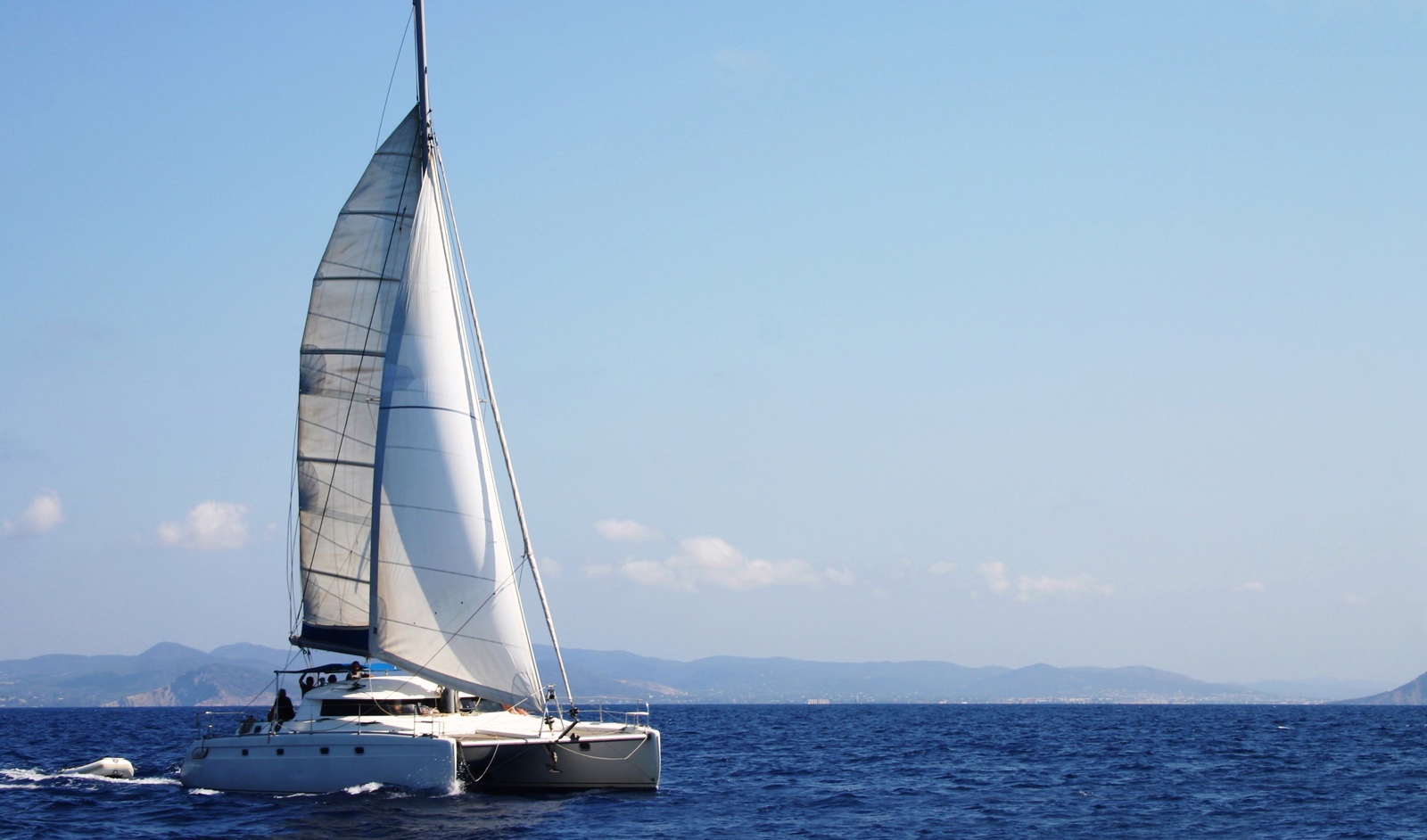
The Lagoon 400 S2 is the catamaran more cruising couples step aboard as their first cat than any other model. Lagoon, owned by CNB inside the Beneteau group, ran the 400 S2 from 2014 to 2018. Around 600 hulls came out of the Bordeaux factory, most of them specced for charter fleets, and the resulting four-cabin used market is the deepest in the cruising-cat segment. The boat sits in the middle of our charter-return buyer's guide because of that depth and because the parts pipeline and worldwide service network make the ownership math add up for couples who have never owned a multihull.
What is the Lagoon 400 S2?
The 400 S2 is a 39-foot 4-inch fiberglass cruising catamaran with a 23-foot 8-inch beam, a 4-foot 1-inch draft, and a displacement of roughly 26,000 pounds. The hulls use PVC foam coring above the waterline with solid laminate below. Twin Yanmar 40 hp four-cylinder diesels live in dedicated engine compartments aft of each hull's transom step. Fuel is 79 gallons per side. Water is 79 gallons. The mast is aluminum, the boom is aluminum, and the standard rigging is wire.
The layout is the part that sells the boat. The bridgedeck saloon sits forward of the cockpit at the same level, with the galley to port and a dinette big enough for eight to port and aft. Four cabins, one in each end of each hull, each with a double berth. Two heads and two stand-up showers, one in each starboard cabin's ensuite on charter-spec boats. The cockpit fits eight more around a folding table. Forward of the mast is a trampoline lounge that nobody uses for sailing and everybody uses for an afternoon nap at anchor.
The sailing is honest. The rig is fractional, the mainsail is full-batten with lazy jacks and a stack pack, and the headsail is a furling genoa. Owners report 5 to 6 knots upwind in 12 to 15 knots true, 7 to 9 knots on a reach, and 8 to 10 knots downwind with the asymmetric spinnaker that came as a factory option. Motoring at cruise on both diesels at 2,200 rpm sits the boat at 7 to 8 knots and burns roughly 1.2 gallons per hour per side. The boat will not point higher than 50 degrees true off the wind, and tacking through 110 degrees is normal. Sport sailors get bored. Cruising couples get exactly what they came for.
Who is it good for?
Cruising couples and families buying their first catamaran are the core. The 400 S2 was designed and priced to be the boat that converts a monohull owner. The hulls are forgiving, the systems are conventional, and the dealer network is the broadest in the segment. We walked through a 2017 ex-Moorings 400 S2 in Tortola one February afternoon, the kind of hot bright day where the saloon hatches are open and the breeze runs through the boat without the air conditioning on. The galley was set up to actually cook, with a deep sink and a real fridge, and the saloon table sat six adults without anyone bumping a knee. That walk-through is what closes most first-cat deals.
Charter-return buyers who want depth of parts and service support are the second profile. Lagoon's worldwide dealer footprint means the parts you eventually need are stocked somewhere within shipping range. Yanmar service is everywhere there is a fishing fleet, which means everywhere. The 400 S2 is the catamaran a mechanic in Panama or Las Palmas or Saint Lucia has worked on before, and that matters more on a long passage than any spec on the brochure.
Liveaboards who value interior volume over upwind angle are the third buyer. Four cabins gives a couple two private guest cabins or a couple plus two kids plus a workspace. Two showers and two heads is the threshold below which liveaboard life gets tight. The 400 S2 sits at that threshold by design.
Who is it not good for?
Sailors who want a sporty boat should walk past the 400 S2. Outremer, HH, and to a lesser extent Lagoon's own Seventy series are the answers to that brief. The 400 S2 is a comfortable cruiser. Pushing it as a performance boat ends in disappointment.
Buyers wanting an owner-spec hull at owner-spec money should also walk past. Around 85 percent of the production run went to charter fleets, and the charter-return market is what defines the used pricing and the boat's reputation. Owner-spec hulls exist but are rare and priced accordingly, and most of what makes the 400 S2 a great value is the charter-return discount.
Buyers in a hurry are the third exclusion. A proper charter-return purchase involves a moisture survey on both hulls, a rig inspection, a sea trial, an engine-hour audit, and usually a refit budget of $20,000 to $60,000 over the first two years. None of that happens fast. Couples who want a turnkey boat next month are happier on an owner-spec used boat or a new build.
Pricing
Lagoon stopped building the 400 S2 in 2018. The new market is the Lagoon 42, which replaced it on the same approximate footprint with a taller bridgedeck, a flybridge helm, and a higher price. Used 400 S2 hulls in 2026 sit between $295,000 and $410,000 for charter-return boats from the 2014 to 2018 production. Owner-spec hulls of the same year run $60,000 to $120,000 more.
The buy window is the 2016 to 2018 charter-return hull, ideally a four-year ex-charter boat coming off a major fleet at the end of its program. That boat lands between $310,000 and $360,000 depending on flag, refit history, and condition. The boat will need a five-figure refit in the first year (sails, running rigging, electronics update, soft-furnishings replacement, often a saildrive seal rebuild). Build that into the purchase math up front.
Depreciation flattens after the charter-return inflection. A 2017 hull bought in 2026 at $340,000 and held for five years with a clean refit history is likely to sell at $260,000 to $300,000 in 2031 dollars, assuming no major hull or rig event. That curve is shallower than monohulls at the same length and reflects how thin the four-cabin cruising-cat used market is in any given year.
What works
- The widest used inventory in the segment. In any given month there are 30 to 60 boats listed worldwide.
- Four-cabin charter layout actually sleeps eight, with two real heads and two stand-up showers.
- Lagoon's parts and dealer pipeline is the broadest in the catamaran category.
- Bridgedeck saloon and cockpit each seat eight. Entertaining capacity at anchor is segment-leading.
- Charter-return discount of 30 to 35 percent versus an owner-spec hull at the same year.
- Twin Yanmar 40 hp diesels are the most widely-serviced small marine diesels in the world.
- Forward trampoline lounge is the social space of the boat at anchor.
What does not
- Sailing is honest, not exciting. Sport-cruising buyers should look at Outremer or HH.
- Charter-spec hardware is mid-tier. Winches, blocks, and deck gear often want upgrading within the first three seasons.
- PVC foam-cored hulls require a careful moisture survey on every used purchase. Charter fleets do not always catch impacts at the dock.
- Bridgedeck clearance is on the lower end of the segment. Steep chop slaps the underside.
- Charter-return rigging is often due for replacement at purchase. Budget $15,000 to $25,000.
- Pointing is 50 degrees true at best. Beating to windward is a motoring exercise on most passages.
Year-by-year notes
The 400 S2 ran from 2014 through 2018 with the platform unchanged. The 2014 to 2015 boats use a slightly different saloon hatch arrangement and a smaller chartplotter standard at the helm. The 2016 model brought the current Raymarine ST70 helm package and tweaks to the galley joinery. The 2017 and 2018 boats are essentially the same. None of the year-to-year changes are large enough to drive the buy decision. Charter-fleet condition matters more than model year on this boat. A clean 2014 hull from a careful program beats a beaten 2018 from a hard one.
The replacement Lagoon 42 launched for 2019 with a different hull, a taller bridgedeck, and a flybridge helm. That is a separate boat and a separate buying decision.
Cost of ownership
Annual costs for a couple using the boat 100 to 150 days a year and chartering it informally to offset slip fees run $35,000 to $55,000 all-in, depending on where the boat is based. Slip in Tortola or Saint Lucia runs $400 to $700 a month for a cat at this beam. Caribbean haul-out twice a year (storm season and routine bottom paint) is $1,800 to $2,800 each time. Yanmar service at 250-hour intervals is $400 to $700 per engine in parts plus dealer labor. Standing rigging replacement at 10 years is $15,000 to $25,000. Sails replaced at 8 to 12 years is $8,000 to $15,000 for the main, $4,000 to $7,000 for the genoa.
Insurance on a $340,000 hull in named-storm territory is $5,000 to $9,000 a year, depending on flag, captain qualification, and storm-plan agreement with the underwriter. A liveaboard couple doing their own maintenance saves roughly 30 percent of the labor lines. A couple paying yards for everything is at the upper end.
Best year and trim to buy
The 2017 charter-return four-cabin 400 S2, freshly off a major-fleet program, with under 5,000 hours per engine, a Raymarine helm package, and a hull that surveys clean on moisture is the buy. Budget $310,000 to $360,000 at purchase plus $30,000 to $50,000 over the first two seasons for sails, rigging, electronics refresh, and soft furnishings. That total puts the boat on the water at $355,000 to $410,000 ready to cruise, which is roughly $90,000 to $130,000 under a comparable owner-spec hull at the same year.
Verify six things before signing. First, a moisture survey on both hulls and the bridgedeck by a surveyor with catamaran experience. Second, engine hours and service records on both Yanmars, with the 250-hour intervals current. Third, saildrive seal age and condition (these wear in charter service). Fourth, standing rigging age and a tuner's opinion. Fifth, the rudder bearing condition on both hulls. Sixth, the soft-furnishings condition and an honest interior smell test, which tells you what the AC and bilge story has been.
Alternatives
The most-compared cross-shop is the Leopard 40, which trades a little interior volume for a stiffer hull and slightly better upwind manners at roughly the same charter-return money. The French alternative is the Fountaine Pajot Lipari 41, which sits a tier above on hardware and a tier under on used inventory. For buyers who want the Lagoon pipeline at lower entry money, the smaller Lagoon 380 covers the same brief in a tighter footprint with three cabins instead of four. Larger-budget buyers should look at the Leopard 42 for a newer boat with the same dealer network.