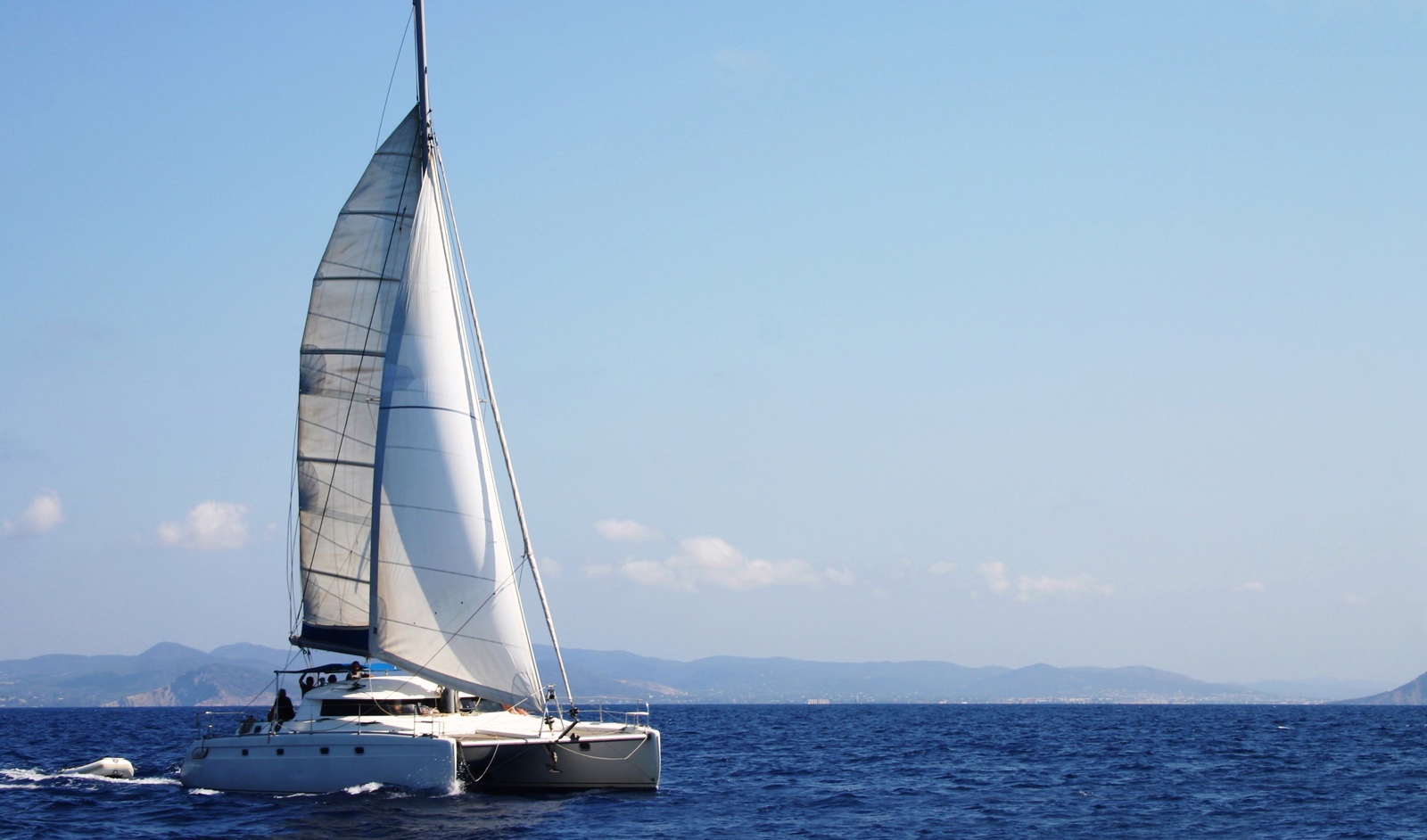
The Lagoon 380 is the catamaran more first-time owners step aboard than any other model in the entry-tier charter-return segment. CNB built the 380 from 1999 to 2018 at the Lagoon yard in Bordeaux, and more than 1,000 hulls left the line over those 19 years. That production run is the reason the boat matters in 2026. It set the template for how a four-cabin charter cat lives, how the layout works for a young family, and how a Lagoon holds its price five and ten years on.
What is the Lagoon 380?
The 380 is a 37-foot 9-inch fiberglass cruising catamaran with a 21-foot 6-inch beam and a 3-foot 9-inch draft. Twin diesels on saildrives, usually 27 to 40 horsepower depending on year. Mast-aft rig with a self-tacking jib on most charter builds, a roller-furling genoa on some owner versions. The standard charter layout is four cabins and two heads (one per hull), with the saloon on the bridgedeck connecting to a cockpit that seats eight around the table.
The build uses balsa coring in the deck on early hulls and PVC foam on later boats. Hand-laid fiberglass with polyester resin. The structural grid is glassed into the hulls and the bulkheads are tabbed in. The saildrive housings, the rudders, and the keels are integrated into the hulls rather than bolted on, which is the catamaran-specific build pattern that makes inspection straightforward.
Two layouts dominate the used market. The four-cabin "Maestro" charter plan is the most common, with each hull holding two double cabins and a head. The three-cabin owner plan replaces one hull with a single owner suite that gets the head, the shower, and a workspace forward. The four-cabin is what you find on a charter-return because charter operators want the bunk count. The three-cabin is what owners convert to (or specify new) when the family lives aboard.
What sets the 380 apart from the boats it competes with in 2026 is the depth of the support behind it. Lagoon dealers carry parts. The rigging, the saildrive seals, the rudder bearings, the through-hull fittings, all of it is sourced through a network that has been moving 380 parts for more than 20 years. That is the practical reason first-time catamaran owners default to a Lagoon. It is the segment where the service question gets the easiest answer.
Who is it good for?
Couples and families of four are the right buyers. The 380 sleeps two adults in the V-berth of one hull, and two kids or guests in the V-berth of the other. The saloon converts to a daybed but the boat is honestly a two-cabin-in-use platform for the people aboard the most. For a family that wants to cruise the Caribbean for a winter or do the Bahamas loop, the 380 is the size where the math works without a captain or a third crew member.
Charter-return buyers are the second profile. A 2014-to-2017 four-cabin 380 coming out of a Caribbean charter fleet sells for 30 to 35 percent below a comparable-spec owner boat of the same year. The boats have been worked hard, the systems have been used and replaced, and the inventory move is constant. We walked aboard a 2015 charter-return at a brokerage in Annapolis last spring, and the soft tells were all there: deck shoes scuffed into the saloon sole, dinghy chocks rebedded twice, a generator that had been swapped at year five. The bones were still solid. The refit budget was the math the buyer had to do, not the build quality.
The third group is buyers who want a catamaran that will be easy to sell five years on. The 380 is one of the more liquid hulls in the segment because the brand and the production run drive consistent demand. The boat holds its price the way nothing else at this length does in the same condition tier.
Who is it not good for?
Larger groups who actually intend to sleep six or eight aboard for a week should walk past the 380 toward the 400 S2 or a Leopard 40. The 380 sleeps eight on the spec sheet but the cabin volume, the head capacity, and the cockpit seating put the comfort ceiling at four. Bridgedeck headroom and the saloon footprint are both smaller than the 400 S2.
Sailors who want to make miles upwind should also look elsewhere. The 380 is built for downwind passage-making and reach-angle cruising. The sailplan is conservative, the hulls are wide-set, and the upwind performance is what owners describe as adequate. If your cruising plan is the trade-wind belt or coastal-hopping in fair-wind months, the 380 fits. If you want to beat from Bermuda to Newport in shoulder-season weather, you want a different boat.
Buyers planning to anchor in serious chop, especially in tropical-storm season, will notice the bridgedeck clearance. The 380 was designed with a lower clearance than the 400 S2, and wave-slap noise at the foot of the V-berth is a real thing in 2-foot chop at anchor. On a hot night in the Sea of Cortez I lay awake listening to the slap-and-pause pattern for three hours before I finally moved to the cockpit. It was the only honest complaint I had about that particular boat.
Pricing
The Lagoon 380 has been out of production since 2018, so the new-market line is dead. Used-market pricing in 2026 spans roughly $140,000 at the bottom (early 2000s hulls with deferred service and tired systems) to $325,000 at the top (well-maintained 2017-2018 owner boats with current standing rigging, recent saildrive work, and updated electronics). The charter-return sweet spot in 2026 sits at $185,000 to $295,000 for 2008-to-2018 four-cabin hulls in fair-to-good condition.
The math charter buyers run is roughly $200,000 for the boat, $25,000 to $60,000 in a first-year refit covering batteries, electronics, dinghy outboard, sails as needed, and a saildrive seal service, and the boat goes back in the water at owner spec for the price of a smaller comparable-condition monohull. That is the structural reason the 380 keeps moving year over year.
What works
- The four-cabin layout that the charter fleet built around is also the layout a young family of four can grow into for a multi-year cruise
- Twin diesels on saildrives are straightforward to service and the parts path is established
- Lagoon's dealer and parts network is the deepest in the catamaran segment, which makes warranty work and out-of-warranty service the easiest in class
- Resale price is one of the more stable in the segment because production volume supports active demand
- Cockpit-to-saloon flow is the right size for entertaining six adults at anchor without anyone hovering at the edge of the conversation
- The 3-foot 9-inch draft opens shallow anchorages that a comparable monohull cannot reach
What does not
- Sleeping eight is a spec-sheet number. The 380 is honestly a four-person cruising boat
- Bridgedeck clearance is lower than the 400 S2 and successor Lagoons. Wave-slap noise at anchor is part of the ownership experience in any chop
- Upwind sailing performance is modest. The boat reaches and runs comfortably and points poorly
- PVC foam coring on hulls and balsa coring on older decks make moisture-intrusion checks at pre-purchase non-negotiable
- Charter-return boats often need a $25,000 to $60,000 first-year refit budget on top of the purchase price
- The saloon table seats six comfortably and eight tightly. If you actually have eight aboard, dinner gets split between the saloon and the cockpit
Year-by-year notes
The 380 launched in 1999 with the original hull form and a slightly different deckhouse than later versions. The 2003 update softened the bridgedeck profile and changed the saloon glazing pattern. The 2007 update was the substantive interior refresh, with new joinery in the galley, an updated nav station, and a revised saloon table.
The 2010-to-2013 boats are the ones owners point to as the easiest to live aboard, because the cumulative interior refinements from the previous decade had all landed and the systems were still common to current parts. From 2014 onward the boat got the S2 update to electronics and a more contemporary helm layout, though the hull and rig remained the same. The 2017 and 2018 final-production hulls carried the most modern systems package and tend to command the top end of used-market pricing.
There is no defect cutover year on the 380 to screen against. The known wear points (saildrive seals, rudder bearings, standing rigging, headliner sag in tropical service) show up on hulls of every vintage and are part of the maintenance pattern rather than a year-specific issue.
Cost of ownership
Annual costs are higher than a comparable monohull because the boat has two of most things. Two engines, two saildrives, two rudders, two heads, two berths' worth of bedding. Marina and slip costs scale with beam, and at 21 feet 6 inches the 380 needs a catamaran slip or two adjacent monohull slips, which adds 50 to 100 percent over a 38-foot monohull. Coastal coverage on insurance for a $200,000 hull runs $2,200 to $3,800 a year, more in storm-prone markets.
Saildrive seal service every five to seven years is $1,500 to $2,500 per side. Standing rigging replacement is a once-a-decade $8,000 to $14,000 line. Diesel service intervals follow the manufacturer's 250-hour schedule. Bottom paint on a catamaran is roughly twice the surface area of a comparable monohull, so figure $1,800 to $3,200 in materials annually for an in-water boat.
A five-year hold on a 2015 charter-return 380 bought at $205,000 with the typical refit budget at year one, used 200 hours a season cruising the Caribbean, lands at roughly $28,000 to $42,000 a year all-in including insurance, fuel, slip, service, and amortized capital cost. The amortized cost is lower than it looks because the resale price at year five sits within 10 to 15 percent of what you paid on a clean, well-kept hull.
Best year and trim to buy
A 2014-to-2017 four-cabin Lagoon 380 with under 4,000 engine hours per side, a recent rig survey, and clean moisture readings on the hull and bridgedeck is the right buy in 2026. The 2010-onward interior refinements make day-to-day living easier, the systems are still serviceable through the current Lagoon parts network, and the depreciation curve at this age is essentially flat.
Verify six things pre-purchase. First, the saildrive seals are within service interval, with documentation in the file. Second, moisture readings on the bridgedeck and hull coring are clean, especially around through-hull fittings and any deck-hardware penetrations. Third, the standing rigging has been replaced or independently surveyed in the last decade. Fourth, the batteries, the watermaker if fitted, and the generator are documented to working state. Fifth, the rudder bearings are not showing the play that 380s develop after long charter service. Sixth, on a charter-return boat, the dinghy and outboard are either fresh enough to use or budgeted to replace.
Alternatives
The natural step up is the Lagoon 400 S2, which adds bridgedeck clearance, saloon volume, and headroom for the larger-family use case the 380 stretches to cover. The performance-bias cross-shop is the Leopard 40, a stiffer South African build that points better upwind and feels more like a passage-maker. The French alternative is the Fountaine-Pajot Lipari 41 at slightly more length, with a more finished saloon and a thinner US service network.