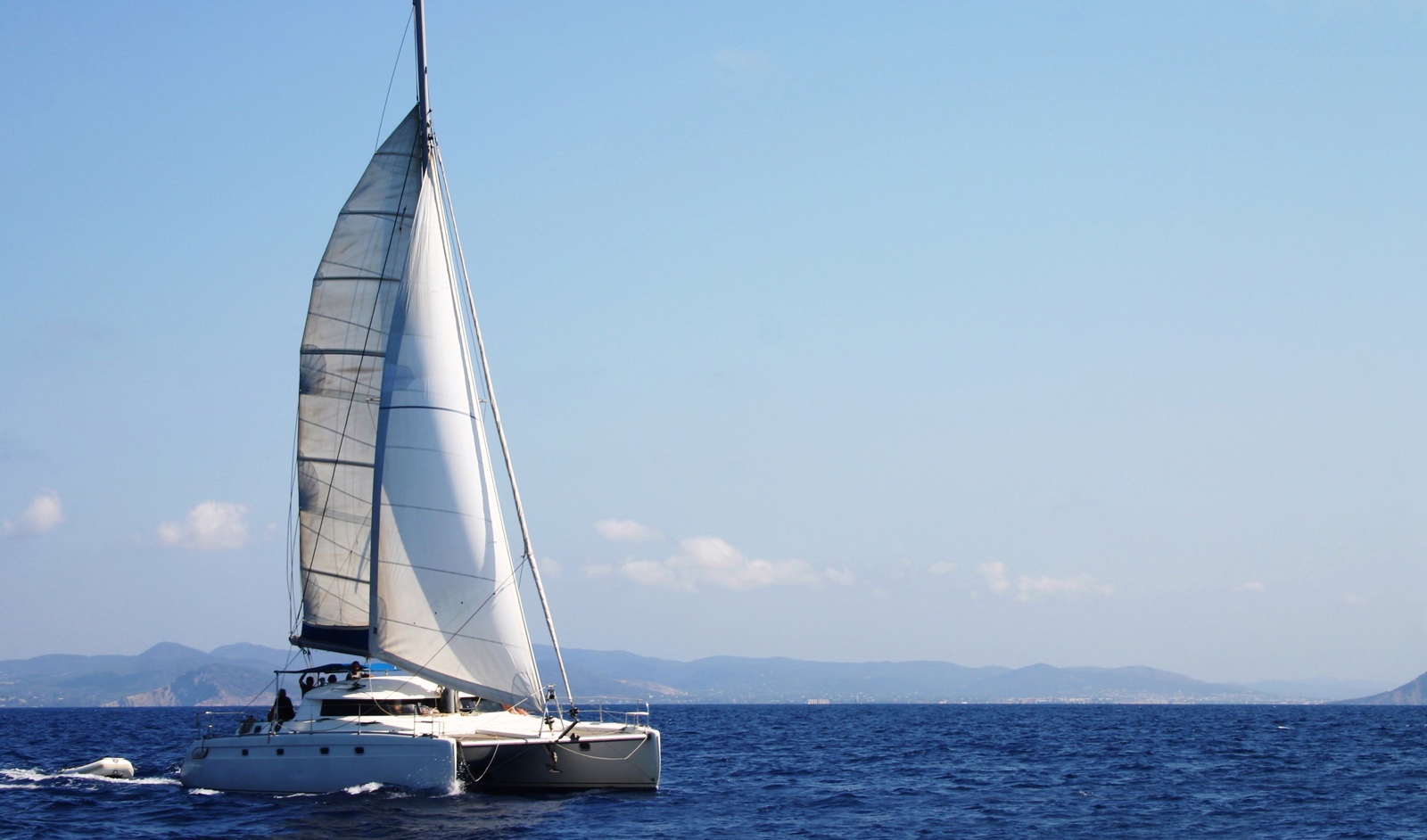
The Leopard 42 is the modern pick among charter-return catamarans. Robertson and Caine has been building Leopards out of Cape Town since the late 1990s, and the partnership with The Moorings and Sunsail charter fleets is what keeps a steady supply of late-model catamarans coming back to the used market every year. The 42 ran from 2019 through 2022. It replaced the long-running Leopard 40 and brought a meaningfully updated systems package along with a redesigned deck layout that turned out to be the model's biggest selling point.
What is the Leopard 42?
The 42 is a 42-foot fiberglass cruising catamaran with a beam of 23 feet 7 inches. Draft is 4 feet 5 inches, which keeps the boat out of trouble in most Caribbean anchorages and most ICW work. Displacement is around 27,000 pounds. Auxiliary power is twin Yanmar 4JH57 diesels, 57 horsepower each, driving fixed three-blade propellers. The build is hand-laid fiberglass with vinylester resin on the outer skin, a sandwich-cored deck and superstructure, and bonded bulkheads. The construction is honest production catamaran work. Not Outremer level, not Lagoon either. Robertson and Caine builds the boat to be repaired by a charter operator in a far-flung yard, and that priority shows in the details.
The forward cockpit is the feature that changed how owners use the boat. Access from the saloon through a sliding door, with seating for four, integrated cup holders, and clear sightlines to the bow. On a typical Lagoon or Fountaine Pajot, the foredeck is a place you go to anchor or sunbathe. On the Leopard 42, it's a second cockpit you actually use. We watched a charter group at a base in St Martin spend an entire morning at anchor in the forward cockpit while the aft cockpit stayed empty in the heat. The forward cockpit catches the trade wind. The aft cockpit doesn't.
The four-cabin layout is what most boats came with from the charter fleets. Two double cabins in each hull, each with its own head and shower. The two forward heads share a shower compartment on most builds. The saloon is up on the main deck with a U-shaped galley to starboard, a dinette to port, and the inside helm forward. Headroom is 6 feet 5 throughout. The cockpit aft fits eight under the hard top, with a wet bar and grill on most charter builds. The owner three-cabin version moves one of the starboard cabins into a master with private head and a bigger forepeak, but those hulls are rare on the used market.
Systems on a charter-spec 42 are robust. 12-volt and 230-volt or 110-volt, depending on the build's destination market. A 9-kW generator on most boats. Reverse-cycle air conditioning. Watermaker on later builds. The 2021-onward hulls increasingly came with lithium-iron-phosphate house batteries, which is the spec to chase on a used purchase because the weight savings and the capacity bump are real.
Who is it good for?
Charter-return buyers wanting a recent-spec systems package are the core profile. The 2019-2022 Leopard 42 offers the lithium option, the updated rig, and the forward cockpit at a price that's roughly 45 percent above a comparable charter-return Leopard 40. For the buyer who plans to cruise the boat for five to ten years, the systems jump alone justifies the premium.
Families stepping up from a monohull are the second profile. The four-cabin layout gives you privacy that a monohull at the same length can't touch. Two adults forward, two more aft, kids in the second cabin. We surveyed an ex-Sunsail Leopard 42 in Tortola one winter morning, twin Yanmars at about 3,200 hours each, lithium house battery in the build spec. The boat had the systems list a charter operator orders by default. AC, watermaker, generator, davits, dinghy. For the family that wants a turnkey Caribbean cruiser, that's the boat.
Liveaboard couples or families planning Caribbean or Mediterranean cruising are the third profile. The Leopard 42 is the right size for two adults to handle solo and big enough for kids or guests aboard for weeks at a time. The galley-up layout means cooking happens in the saloon rather than in a hot hull, which matters in the tropics. Watermaker, generator, big house bank, and a dinghy on davits add up to a boat you can run independently of marinas for weeks.
Who is it not good for?
Buyers looking for a private-owner three-cabin layout for under $500,000 should pass. The 42 was a charter boat first. The three-cabin owner version exists but is rare on the used market, and the boats that show up command a premium that often pushes them past the budget for this segment. A more reasonable plan is a four-cabin charter-return that gets converted to an owner-layout over the first year or two of ownership.
Performance-cat sailors should also walk past. The 42 is a comfortable cruising catamaran, not a performance design. Outremer, HH, and Catana hulls sail meaningfully faster on the same wind. The Leopard 42 will hit eight to nine knots on a beam reach in the trade winds and motor at six knots. It won't break ten boat speed in a hurry. If passage speed matters, the boat is wrong.
Anyone tight on the survey budget should reconsider too. Charter-return catamarans have lived hard lives. Crews come and go every week, drives get put in gear at the wrong RPM, dinghies get dropped on davits, anchors get dragged. A thorough survey on a Leopard 42 costs $3,500 to $5,000 for hull and rig, and another $1,500 to $2,500 for engines and systems. That money saves you from a $25,000 surprise on month three of ownership.
Pricing
The Leopard 42 was discontinued at the end of 2022. New-boat pricing applied between roughly $560,000 base and $720,000 fully optioned during the production run. The used market in 2026 spans about $445,000 at the bottom (high-hour 2019 charter-return hulls with deferred work) up to $695,000 at the top (an owner-version 2022 hull with full optioning, low hours, and a clean private-use history).
The sweet spot is the $485,000 to $615,000 band on charter-return four-cabin hulls from 2020-2022. That gets you a boat with current rigging, an engine service file with documented Yanmar work, lithium house batteries on the better-spec'd hulls, and a hull that's been through one big charter-base inspection cycle already.
The five-year depreciation curve on a Leopard 42 looks better than most things at this length. Roughly 18 to 22 percent off the new MSRP at year five on a clean charter-return is normal. That's why the segment exists. The boats hold value because they're produced in volume to a known spec and the brokerage network knows how to move them.
What works
- Forward cockpit accessed from the saloon. The feature owners didn't know they wanted
- Lithium-iron-phosphate house battery option on later charter builds. Real weight savings and capacity gain over AGM
- Square-top mainsail option gives meaningful performance gains over the standard rig
- Build culture is the same Robertson and Caine standard that the Leopard 40 established. Robust production catamaran work
- Resale 18 to 22 percent off new at five years on clean hulls. Segment-leading
- Four-cabin layout fits a charter group of eight to ten with two heads and a galley up
What doesn't
- Premium of roughly 45 percent over Leopard 40 charter-return. The budget gap is real
- Forward cockpit reduces saloon volume slightly compared to the Leopard 40
- Lithium upgrade is build-spec dependent. Not every hull has it. Verify on each
- Charter-return hulls have been worked hard. Rigging, sails, and dinghy davits are usually past life
- Twin 57 hp Yanmars are right-sized rather than generous. Big head seas eat range
- Three-cabin owner versions are rare. Most used-market hulls are four-cabin charter builds
Year-by-year notes
The 42 launched for the 2019 model year as the replacement for the Leopard 40. The 2019 and 2020 hulls shipped with AGM house batteries as standard. The lithium-iron-phosphate option appeared more often on 2021 builds and became common by 2022. The square-top mainsail was an option throughout the run and started showing up more frequently on private-owner orders late in production. Charter-fleet boats from The Moorings and Sunsail dominate the used market, and within those fleets, the standard systems package was consistent year to year. The 2022 hulls were the last off the production line before Robertson and Caine retired the model.
Cost of ownership
Annual costs on a Leopard 42 split into the usual cruising-catamaran lines, scaled up to 42 feet of waterline and twin diesels.
Routine maintenance runs $7,000 to $12,000 a year if you're cruising the boat 100 to 200 hours and doing your own work. Yanmar service intervals on twin 57s mean about $1,500 per engine annually in parts and another $1,000 to $1,500 in labor if you bring a tech in. Generator service is another $700 to $1,200. Bottom paint every 18 to 24 months in the Caribbean is $3,000 to $5,000.
Marina costs in the Caribbean range from $1,500 a month at modest bases up to $4,500 a month at premium marinas in season. Most cruising Leopard 42 owners spend more time on the hook than at a slip, which is part of the boat's appeal. Insurance is $7,000 to $14,000 a year for cruising coverage in the hurricane belt. Storm-season haul-out and hurricane storage adds $3,500 to $7,000 if you keep the boat in the Caribbean.
A five-year hold on a 2021 ex-Moorings Leopard 42 bought at $545,000 with 1,800 hours, lithium upgrade, current rigging, and a documented service file, used 350 hours a year cruising the Eastern Caribbean, lands around $52,000 to $78,000 a year all-in including amortized capital cost. The boat is expensive to run. It's still cheaper than a 50-footer.
Best year and trim to buy
A 2020-2022 charter-return Leopard 42 with the lithium house battery upgrade, the square-top mainsail if you can find it, a documented Yanmar service file, and rigging that's been replaced or inspected within the last two years is the right buy in 2026. Four-cabin layout is fine for owner use. The two forward cabins make a comfortable owner suite once you swap mattresses and add storage.
Five things to verify pre-purchase. First, the standing rigging. Charter-fleet rigs are due for replacement at around the 10,000-hour or seven-year mark, and most charter-return 42s are at or past that benchmark. Second, the dinghy davit hardware. Davits take constant abuse and stainless welds crack. Third, the bridge-deck underside gelcoat. Charter boats slam in head seas and the bridge deck shows it. Fourth, the engines. Compression, hours, and recent service. Fifth, the through-hulls. Charter-fleet maintenance on through-hulls is variable. A surveyor's hammer test on every fitting is non-negotiable.
Alternatives
The previous-generation cross-shop is the Leopard 40. Same build culture, no forward cockpit, no lithium option, simpler rig. The Leopard 40 typically sells for 30 to 45 percent less money than the 42 at similar age and condition. If the systems list on the 42 doesn't matter to you, the 40 is the value play.
The step-up at similar production years is the Leopard 44. More volume, more storage, a longer waterline that helps on long passages, and a noticeably bigger galley. The 44 is the right answer for owners who plan transatlantics or extended Pacific cruising.
The French cross-shop is the Fountaine Pajot Lipari 41. Different build culture, lighter feel, and an owner-version layout more common on the used market. The Fountaine sails a little better. The Leopard has the better forward-cockpit layout and the lithium option.